

I have spent much of my life interested in action.
How do people build capability? Why do some individuals and organizations convert intention into outcomes while others remain stuck? What allows a person to keep moving when certainty, resources, or support are missing?
These questions led me toward systems, leadership, organizational culture, mental models, and frameworks such as MSDx and DLMx. They also led me toward a different question, one that cannot be answered by improving execution alone.
What happens when our ability to act becomes the source of our captivity?
The competence trap
Competence creates its own trap.
The more problems we can solve, the more problems find their way to us. The more an organization depends on us, the more important we may appear. But importance and independence are not the same.
A person can build successful systems and still remain trapped at their center.
The captivity is not only operational. It is internal.
An outcome begins to determine our peace. A role becomes our identity. Wealth becomes proof of worth. Responsibility becomes an inability to let go. Even purpose can become another attachment through which the self demands significance.
I do not think the answer is withdrawal from ambition, work, wealth, or consequence. Nor do I think detachment means indifference.
The harder possibility is to remain fully engaged without becoming psychologically owned by what we build.
Action and its fruit
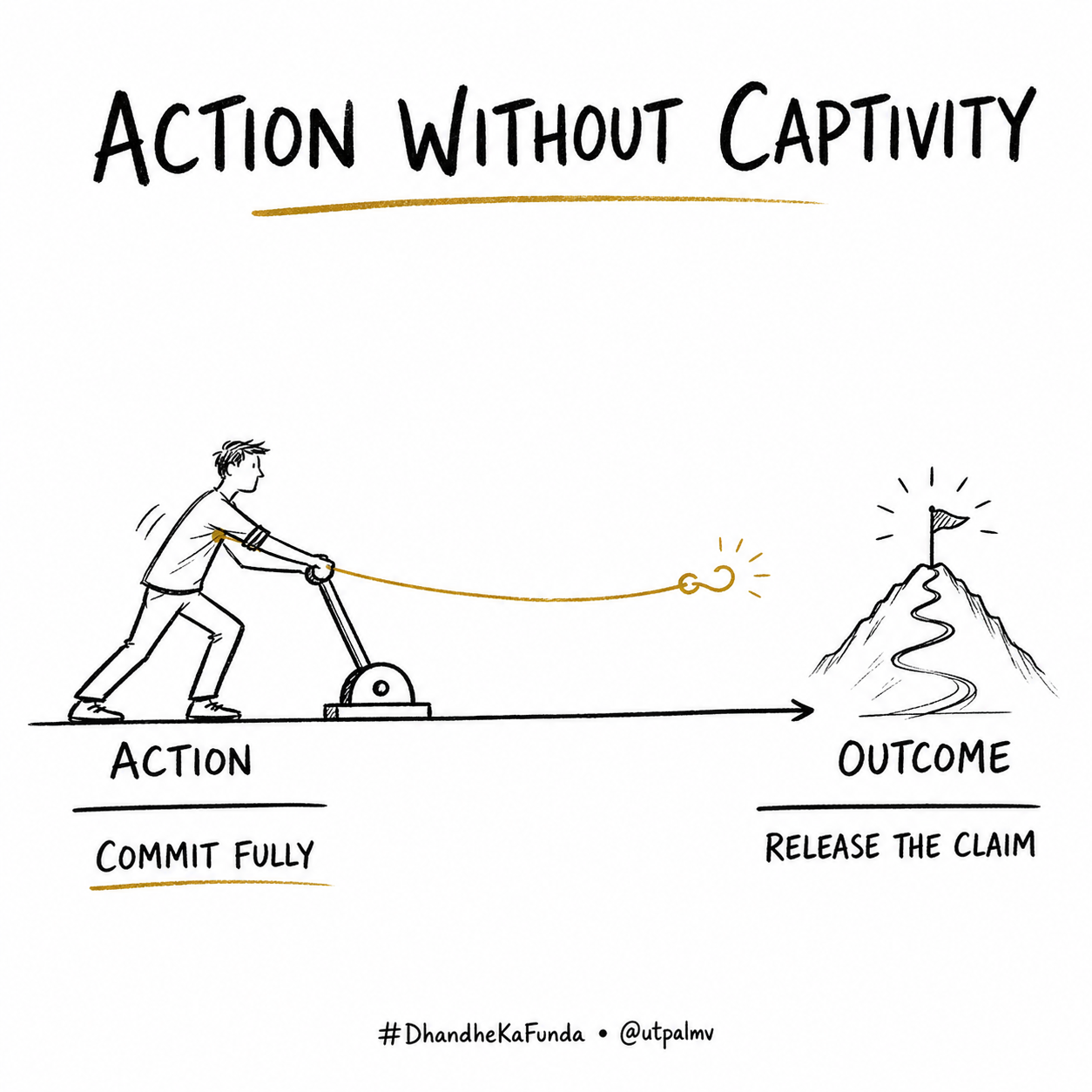
I find an important provocation in Bhagavad Gita 2.47 and 2.48: act, do not make the fruit of action the basis of your action, and do not use nonattachment as a reason for inaction.
I am not treating these verses as a management formula. The Gita is not a business book, and its traditions of interpretation cannot be compressed into a productivity lesson.
But the tension is useful.
Can I act with full commitment while remaining inwardly independent of the outcome?
This is different from pretending the outcome does not matter. Consequences matter. Commitments matter. Other people may bear the cost of our decisions. Responsibility cannot end where control ends.
The distinction I am trying to understand is between caring about an outcome and requiring that outcome to sustain my identity.
Three kinds of freedom
I currently see at least three kinds of freedom.
The first is freedom to act. It comes from capability, resources, judgment, and the ability to convert intention into movement.
The second is freedom from unnecessary dependence. It comes from designing systems that do not require our constant presence, intervention, or approval.
The third is freedom from identification. It is the ability to participate in work without allowing a role, organization, success, or failure to become the complete definition of the self.
These freedoms do not automatically arrive together.
Someone may possess inner calm but lack the capability to affect material conditions. Another person may possess extraordinary agency while remaining dependent on recognition and control. An organization may operate without its founder while continuing to reproduce the founder's fears.
The useful question is not which freedom matters most. It is how they interact.
Freedom to act without freedom from dependence can make a person indispensable and exhausted.
Freedom from dependence without responsibility can become distance disguised as architecture.
Freedom from identification without committed action can become avoidance dressed as wisdom.
Captivity can look like success
Captivity is not always visible as failure.
It may look like being indispensable. Every consequential decision returns to one person. The organization calls this leadership, but the pattern may reveal weak capability, concentrated authority, or a leader who cannot tolerate decisions made differently.
It may look like commitment. A person continues to carry work long after its purpose has weakened because stopping would threaten the identity built around it.
It may look like ambition. The next outcome is expected to provide the peace that the previous outcome could not provide.
It may also look like detachment. A person adopts the language of acceptance to avoid conflict, accountability, grief, or difficult action.
These are not diagnoses. They are propositions to test against experience.
A practical test
When work begins to feel inseparable from the self, I can ask:
- What am I actually responsible for?
- Which part of the outcome can I influence, and which part am I pretending to control?
- What keeps returning to me because the system lacks capability or authority elsewhere?
- What keeps returning to me because I do not trust another person to decide differently?
- If this role, company, or project ended, what part of my identity would feel threatened?
- Am I using commitment to justify attachment?
- Am I using detachment to avoid responsibility?
These questions do not produce liberation. They create a little distance between the work and the person doing it.
That distance may be enough to see the system more clearly.
It may also be enough to act without becoming captive to the action.
Source note
The references to the Bhagavad Gita are a bounded personal reading of verses 2.47 and 2.48, informed by the text and multiple commentarial traditions presented by IIT Kanpur's Gita Supersite. They are not offered as a definitive translation or interpretation.
Use this workExplore with AI
Explore this journal
Take this work into your preferred AI system. Choose a ready-made prompt or add your own context. Nothing you enter here is sent or saved by utpalmv.com.
Use the work as a thinking lens without adding personal context.
Optional. Add details when you want the exploration grounded in your situation. Your context remains in this page and is included only in the prompt you copy.