
What should healthcare remember?
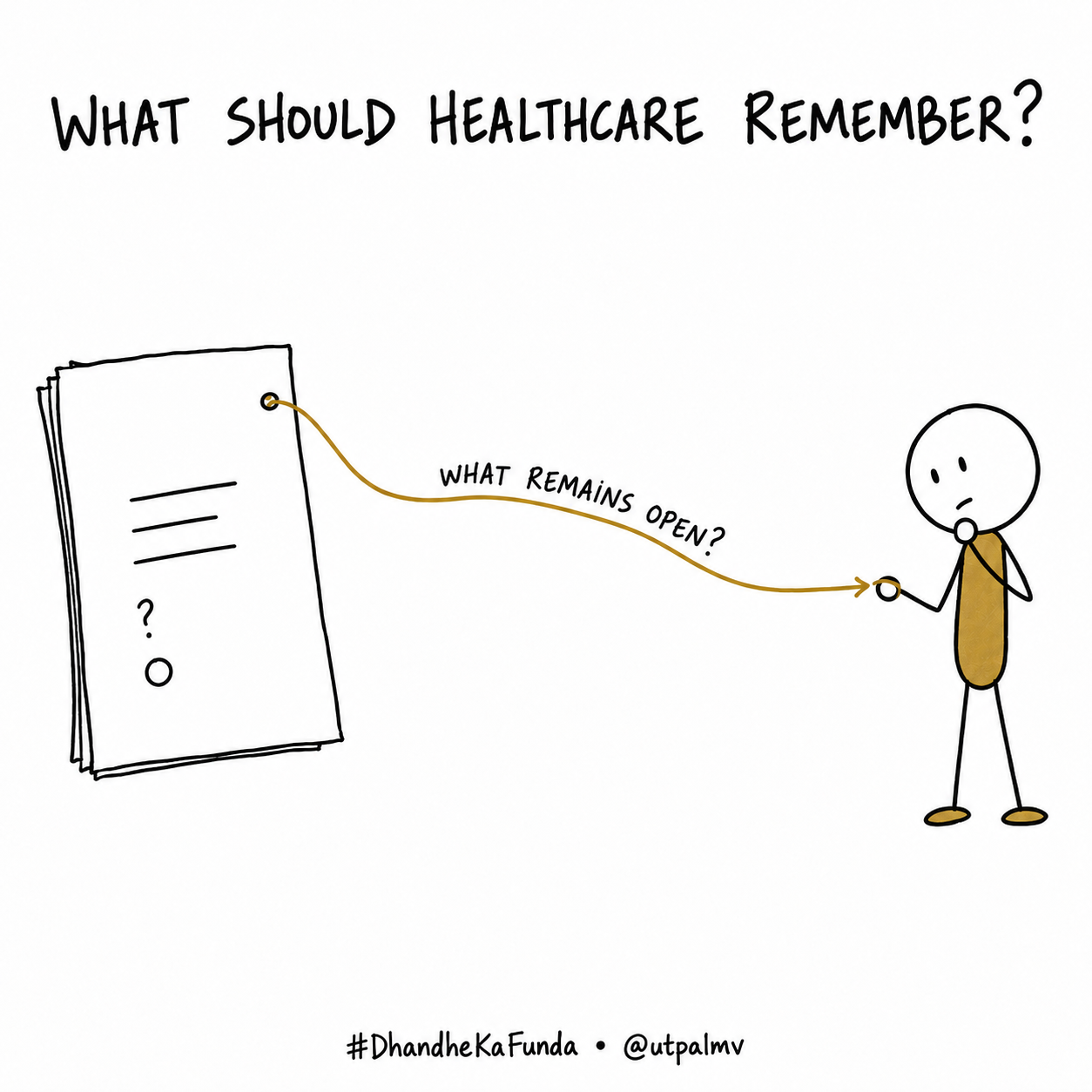
A systems architect asks what care must carry forward: decisions, uncertainty, sources, and follow-up. A working hypothesis about memory, AI, and human judgment.
Latest writing
Every published work, in publication order.
A systems architect asks what care must carry forward: decisions, uncertainty, sources, and follow-up. A working hypothesis about memory, AI, and human judgment.
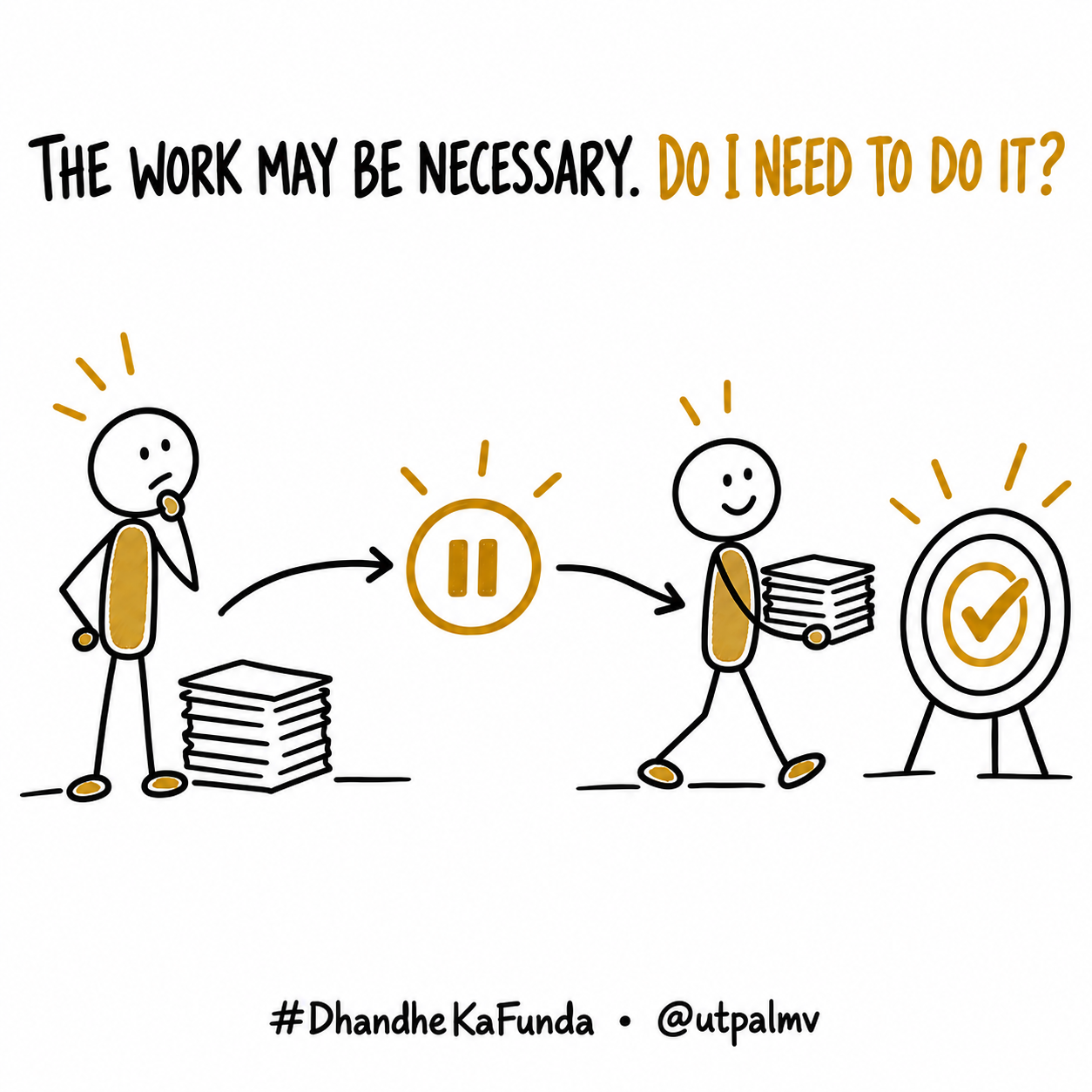
I used to look at a task and think I could do it better than the other leaders around me. Sometimes I may have been right.
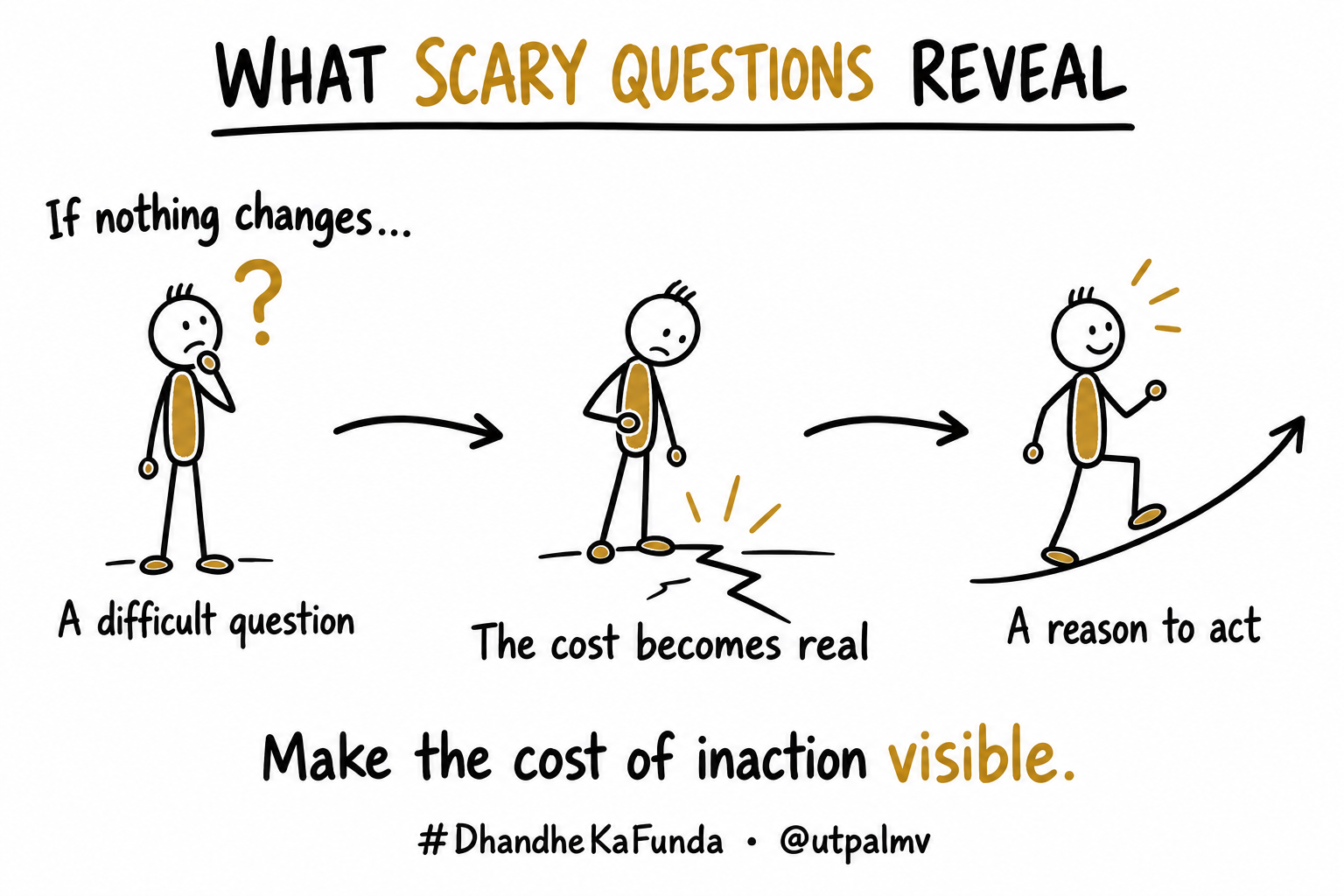
Scary questions create fear. The useful part is what that fear reveals.
A good scary question makes you feel a gap in your gut. Something you have been ignoring, underestimating, or postponing suddenly becomes visible.
You may have understood the problem for months. Now you can feel what leaving it unresolved might cost.
"If nothing changes, where does this leave us a year from now?"
The question is simple. An honest answer can be uncomfortable.
That realization can create urgency. And urgency can lead to action.
This is why the right question can help a seller. It gives the buyer a chance to confront a real consequence of not acting. When the offer addresses that consequence, a sale can become a natural next step.
The distinction matters. A seller who exaggerates the danger manufactures fear. A useful question makes an existing consequence easier to see. The buyer still has to decide whether the proposed solution is worth pursuing.
And this goes beyond selling products or services. We sell ideas, change, strategies, and possibilities too. A team can understand a strategy and still keep postponing the decision it requires.
A question that makes the consequence of the status quo emotionally real can move someone from "I understand" to "I need to do something."
Scary questions don't literally sell. They make the cost of inaction difficult to ignore. A sale may follow.
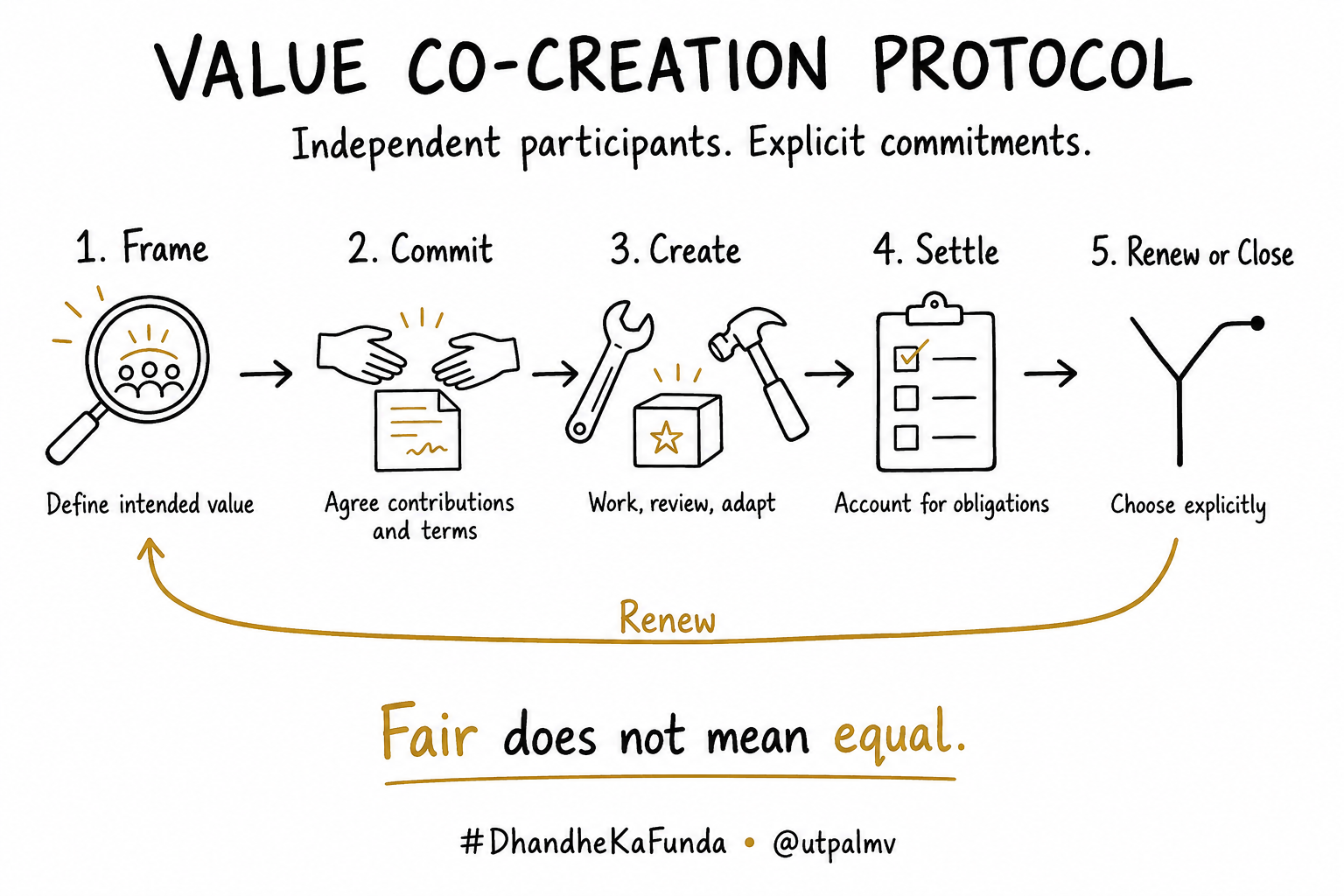
The Value Co-Creation Protocol helps independent participants agree contributions, benefits, and commitments through five stages, from framing to closure.
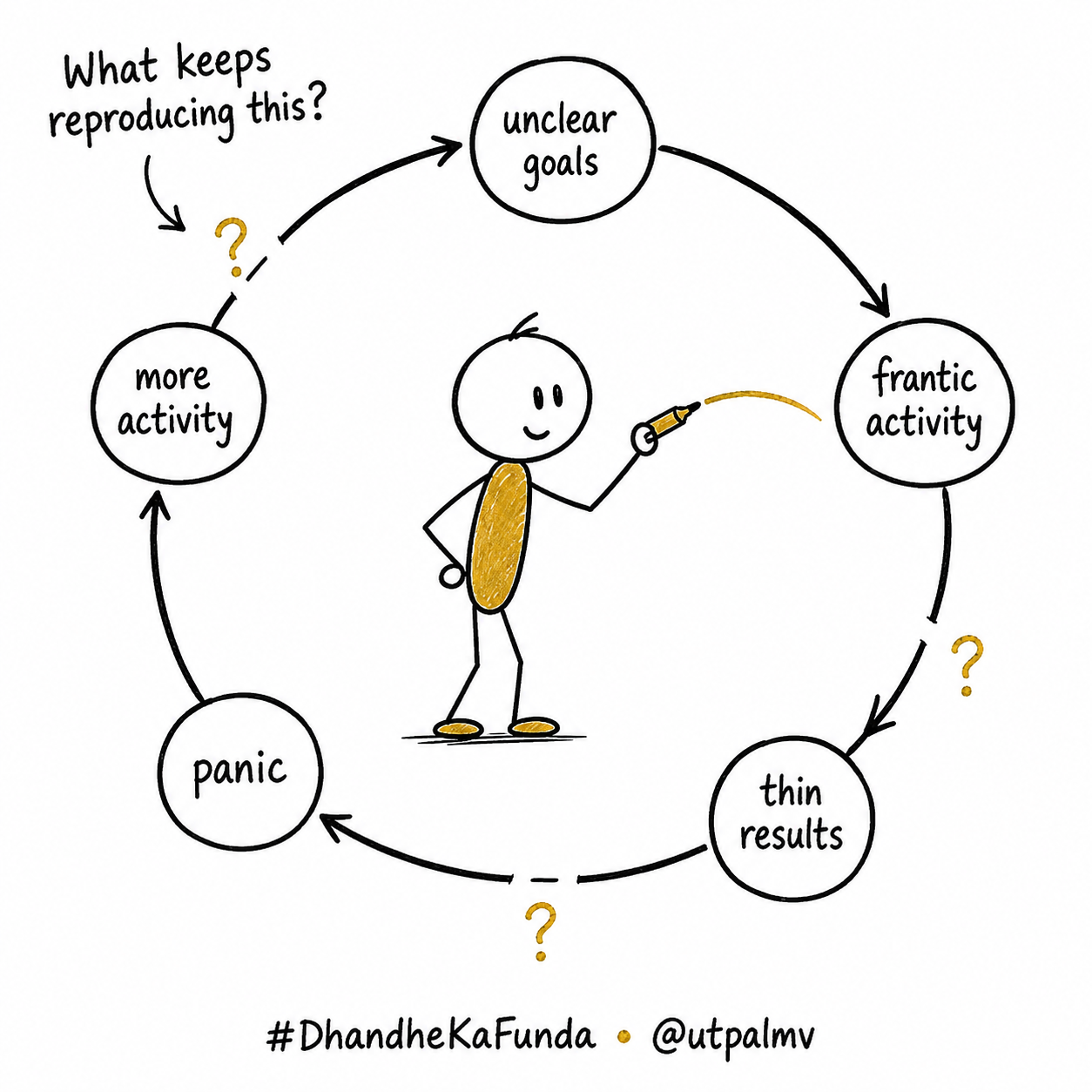
A loop you have not named is a loop you are standing inside.
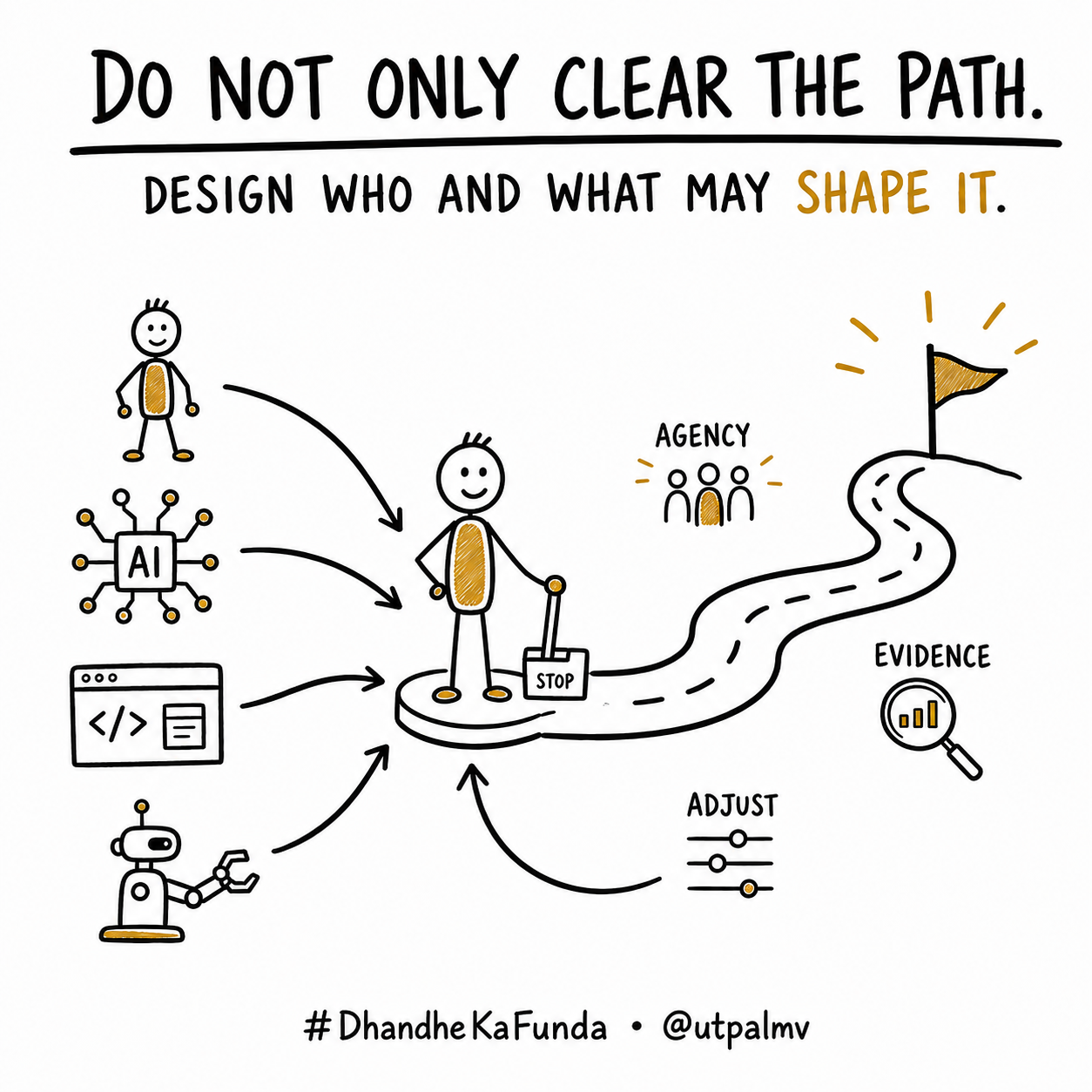
Path-goal theory for AI-native teams: when agents can build, human leadership shifts from tasking work to clearing the path.
AI is lowering the cost of execution. It is not lowering the cost of choosing well. That changes what founders must become good at.
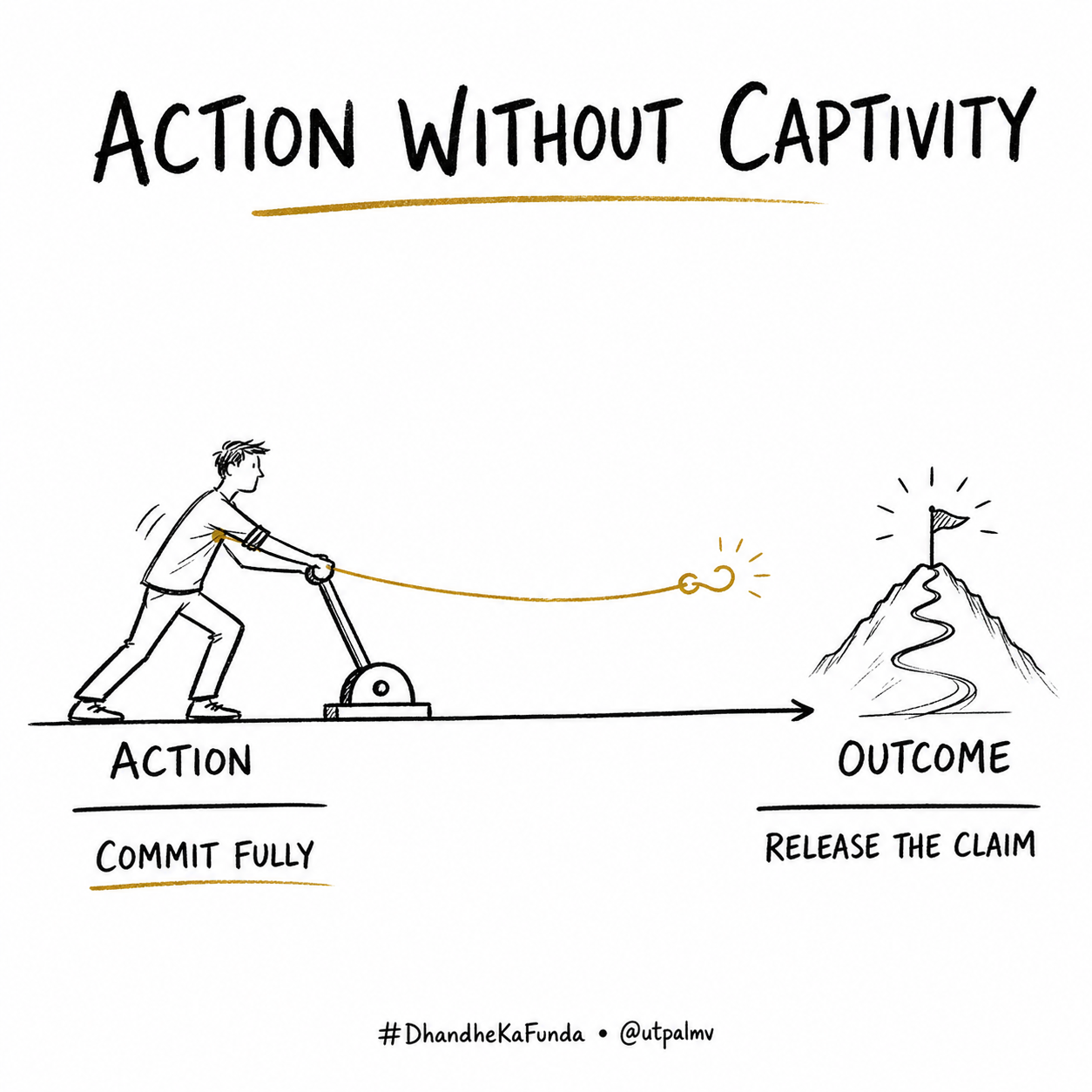
I have spent much of my life interested in action. How do people build capability?
Historical anchor: April 2012. Written as a present-day reconstruction on August 29, 2026. SCRUM tweet began years before it became a published book.
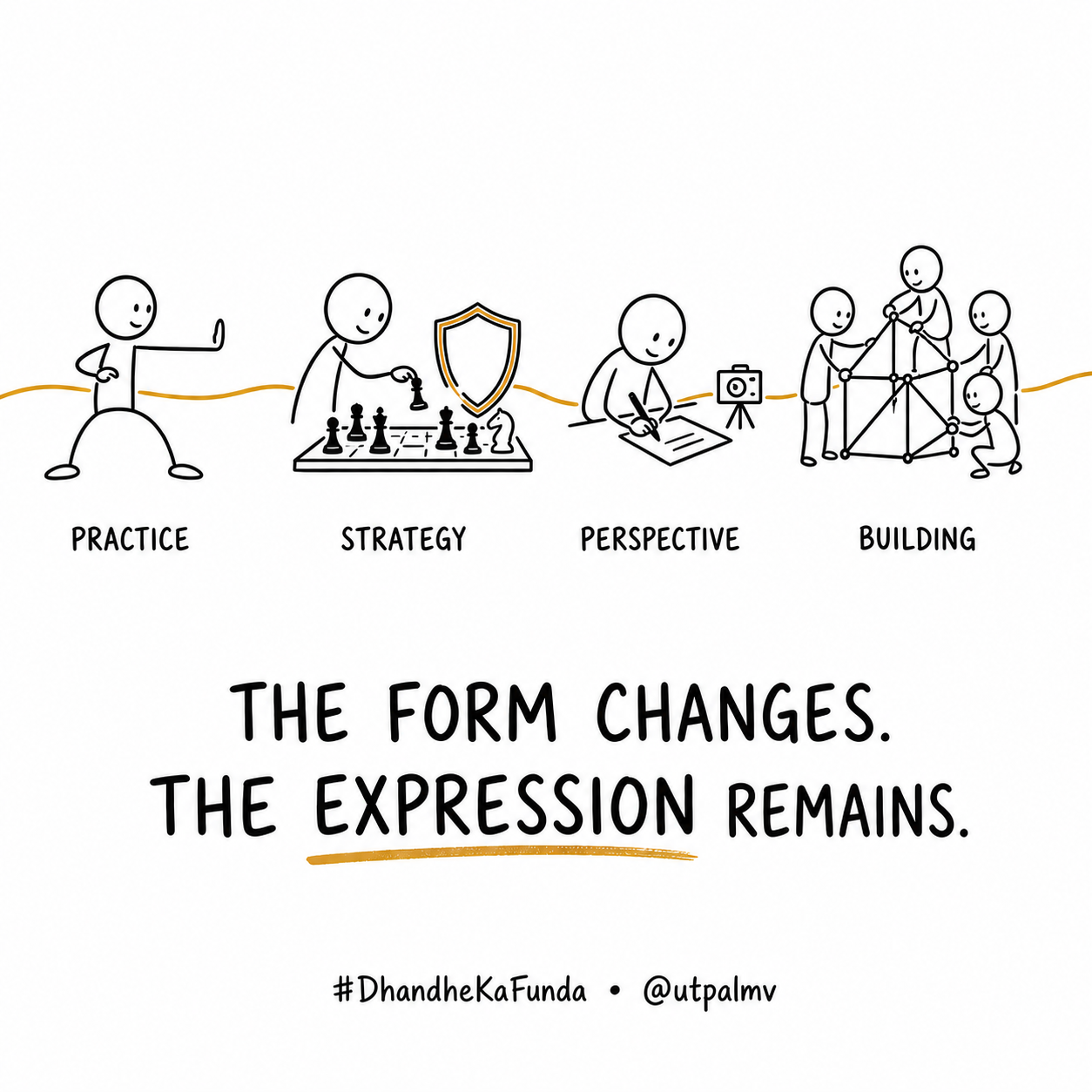
I was writing long before I had a website. As a teenager, I wrote poetry in Gujarati, Hindi, and English.
By many worldly measures, I have done reasonably well.
I can afford a more luxurious life than the one I live.
Yet I choose to remain relatively frugal.
I mostly fly economy. I stay in decent four-star hotels. My personal needs are few.
Not because I cannot consume more.
Because I do not need to.
There is a distinction here that matters to me.
Experiencing something and surrendering to it are two different things.
Much of everyday life reaches us through our senses. We see, hear, smell, taste, and touch. Pleasure is real. So is discomfort. I see no virtue in pretending otherwise.
The question is not whether I should experience these things.
The question is whether they begin to govern me.
My eyes detect light, color, shape, beauty, and ugliness.
I naturally look for what is good while remaining aware that what I see is a perspective. Another perspective always exists.
I hear sounds, words, and opinions.
I choose to listen to what helps me learn, grow, or understand. For much of the rest, I have learned the usefulness of selective deafness.
Here, I play smart.
I prefer things with little or no smell. Less sensory drama to manage.
Sweet. Salty. Sour. Bitter. Savory.
The tongue can experience all of them. But I still have considerable freedom over what I put on it.
Heat. Cold. Pressure. Texture. Comfort. Discomfort.
I cannot control everything my skin encounters. But I can choose much of what I expose myself to.
This distinction extends beyond the five senses.
We cannot always choose what reaches us.
But we can choose much of what we expose ourselves to. We can choose what receives our attention. And, most importantly, we can choose the meaning we give to what we experience.
Luxury, then, is not having unlimited access to pleasurable experiences.
Perhaps the greater luxury is needing fewer of them.
Freedom may not be the ability to experience everything.
It may be the ability to experience something without becoming its slave.
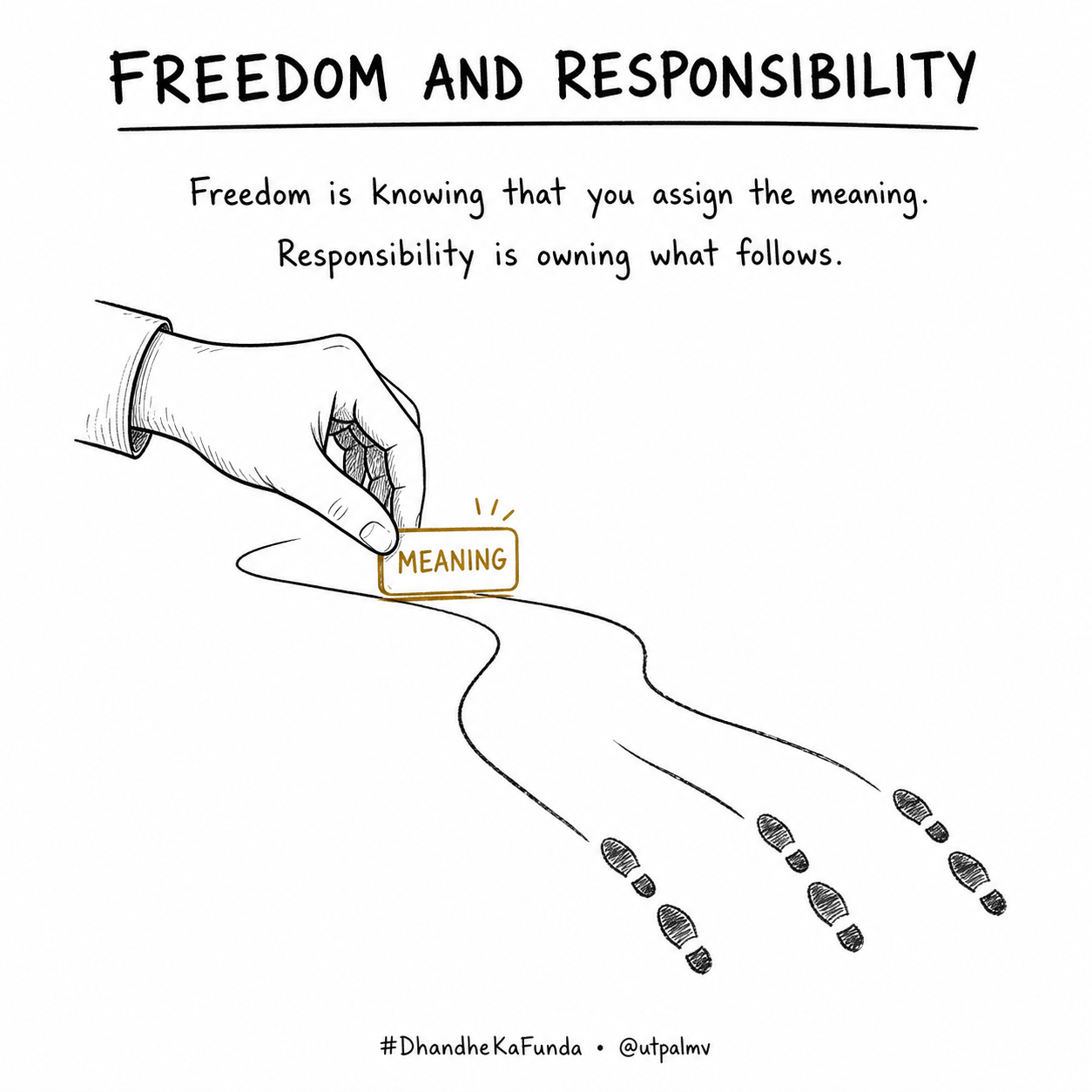
What is the most intelligent meaning to give to a life? Perhaps the question contains its own trap. “Intelligent” is already a meaning we have assigned.
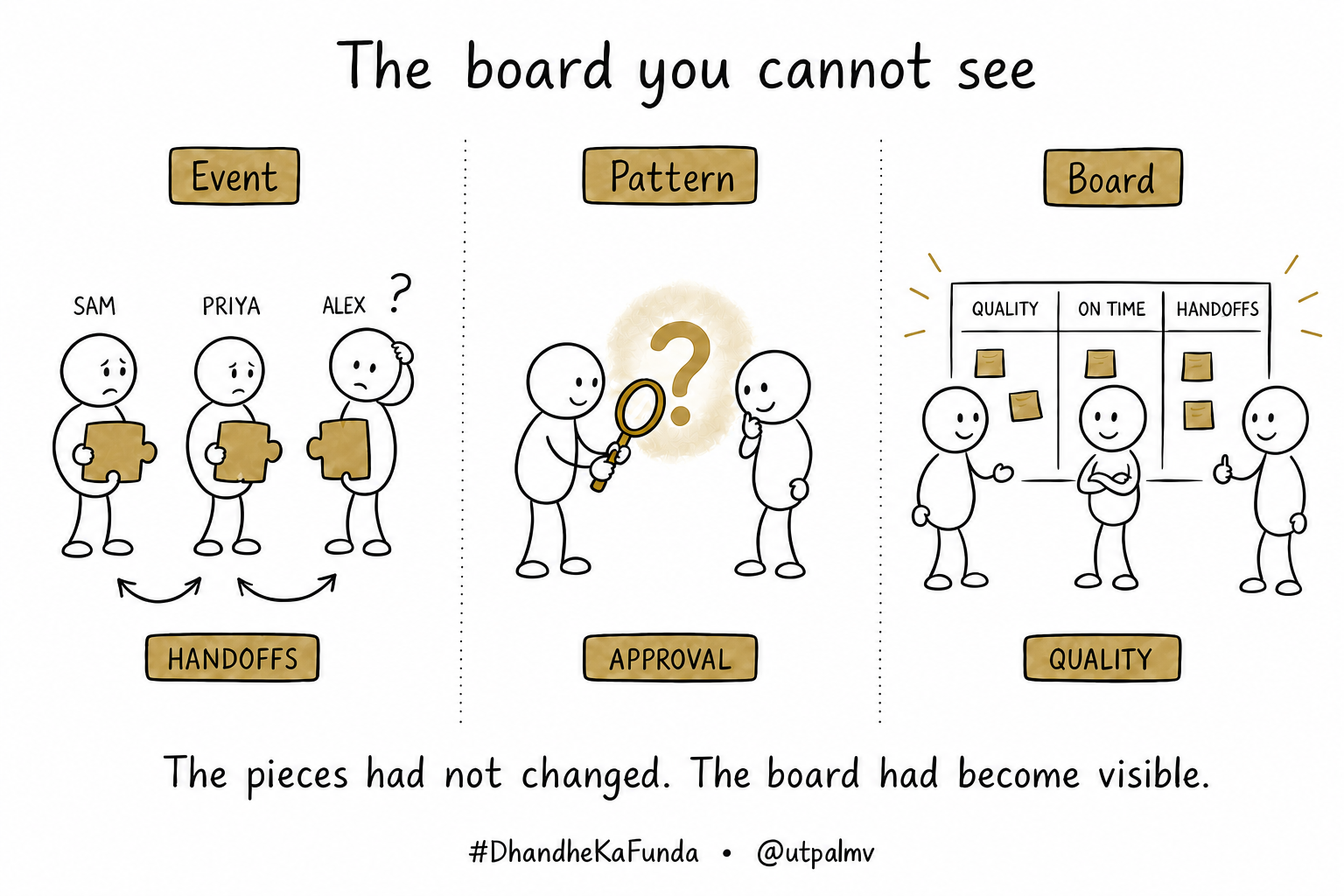
Imagine this. At 11:47 p.m., the office was dark except for one meeting room.
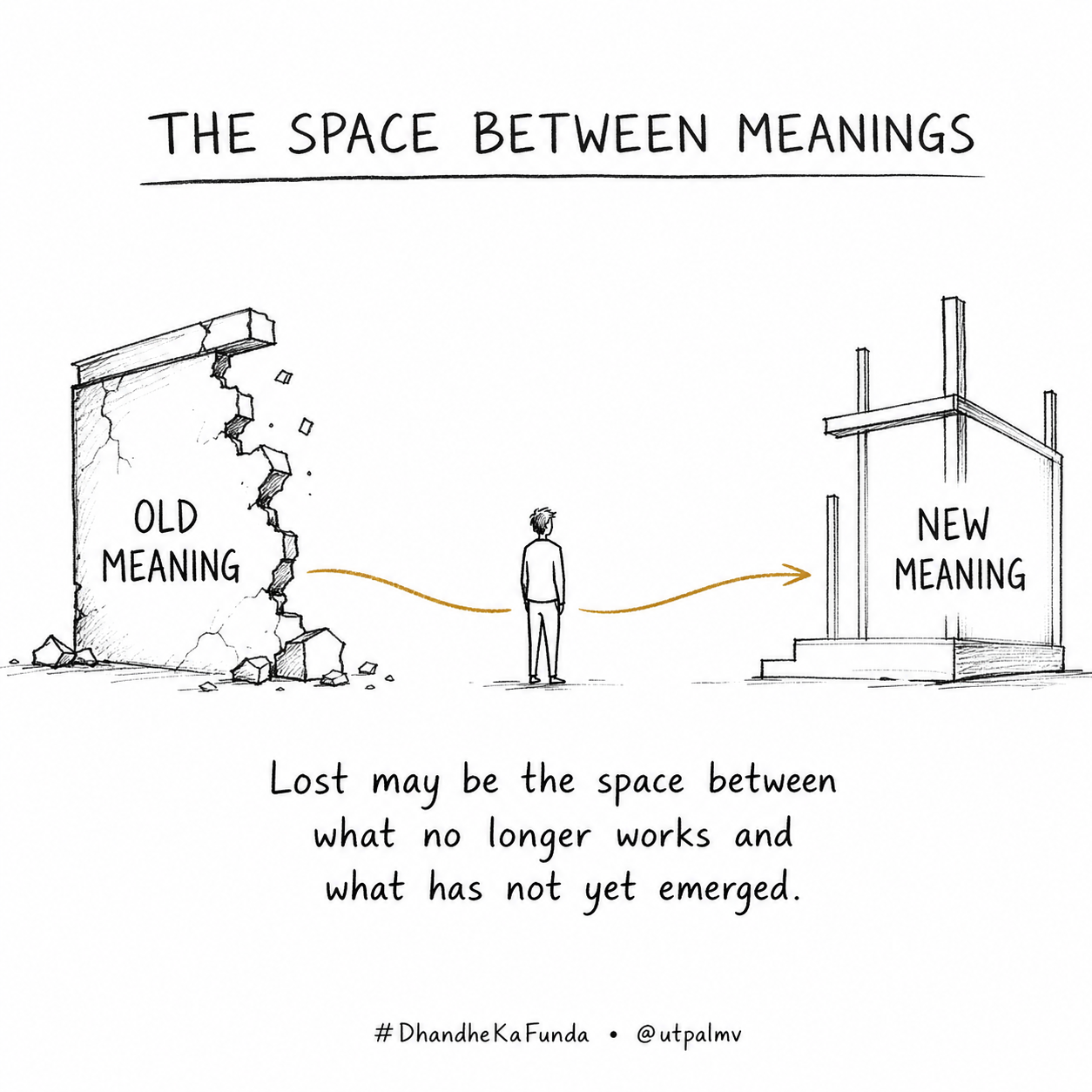
Late last night, someone close to me said he felt completely lost. Not lost as in being unable to find the way back.
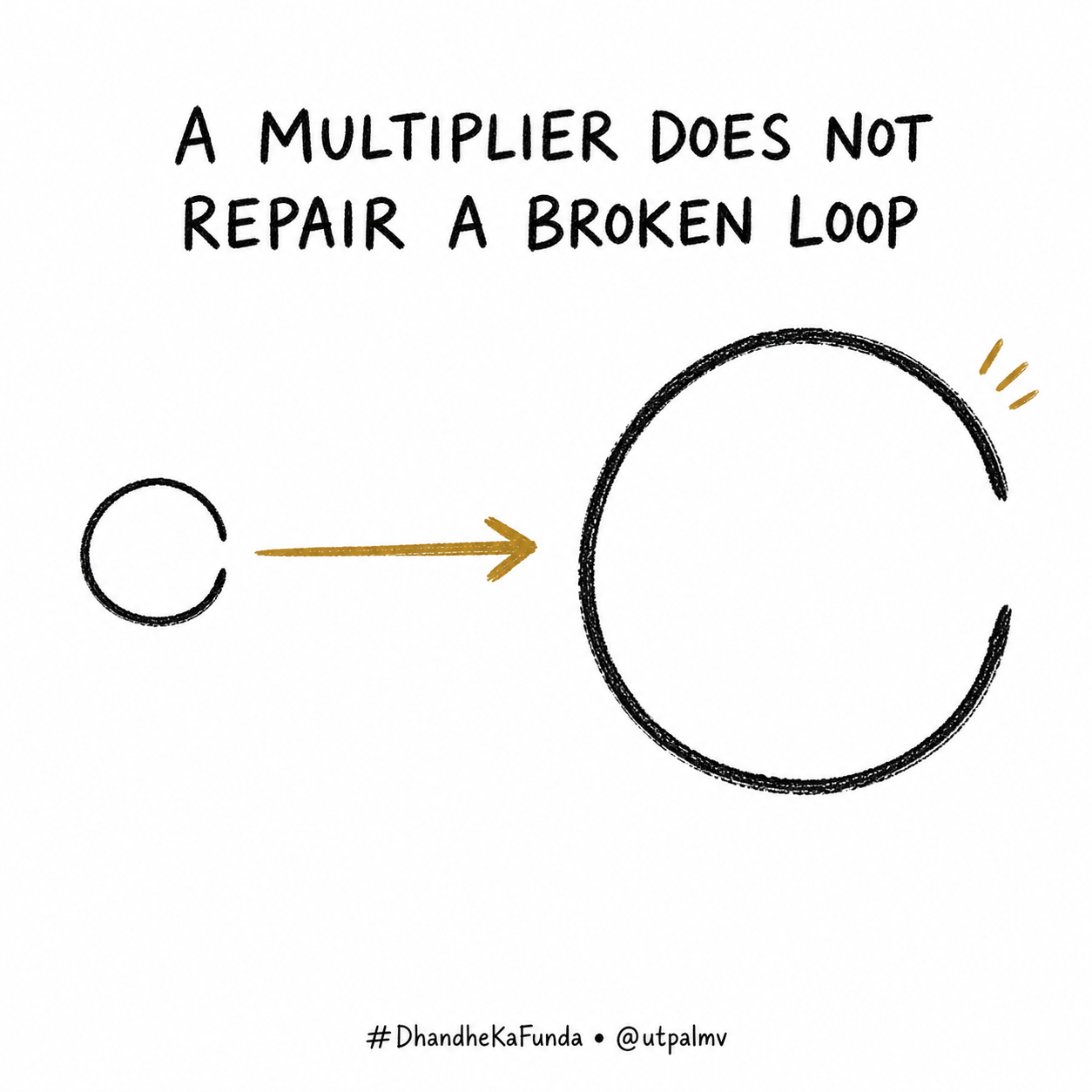
Speed is attractive because it is easy to see. A task takes 2 hours instead of 2 days. A report appears in seconds.
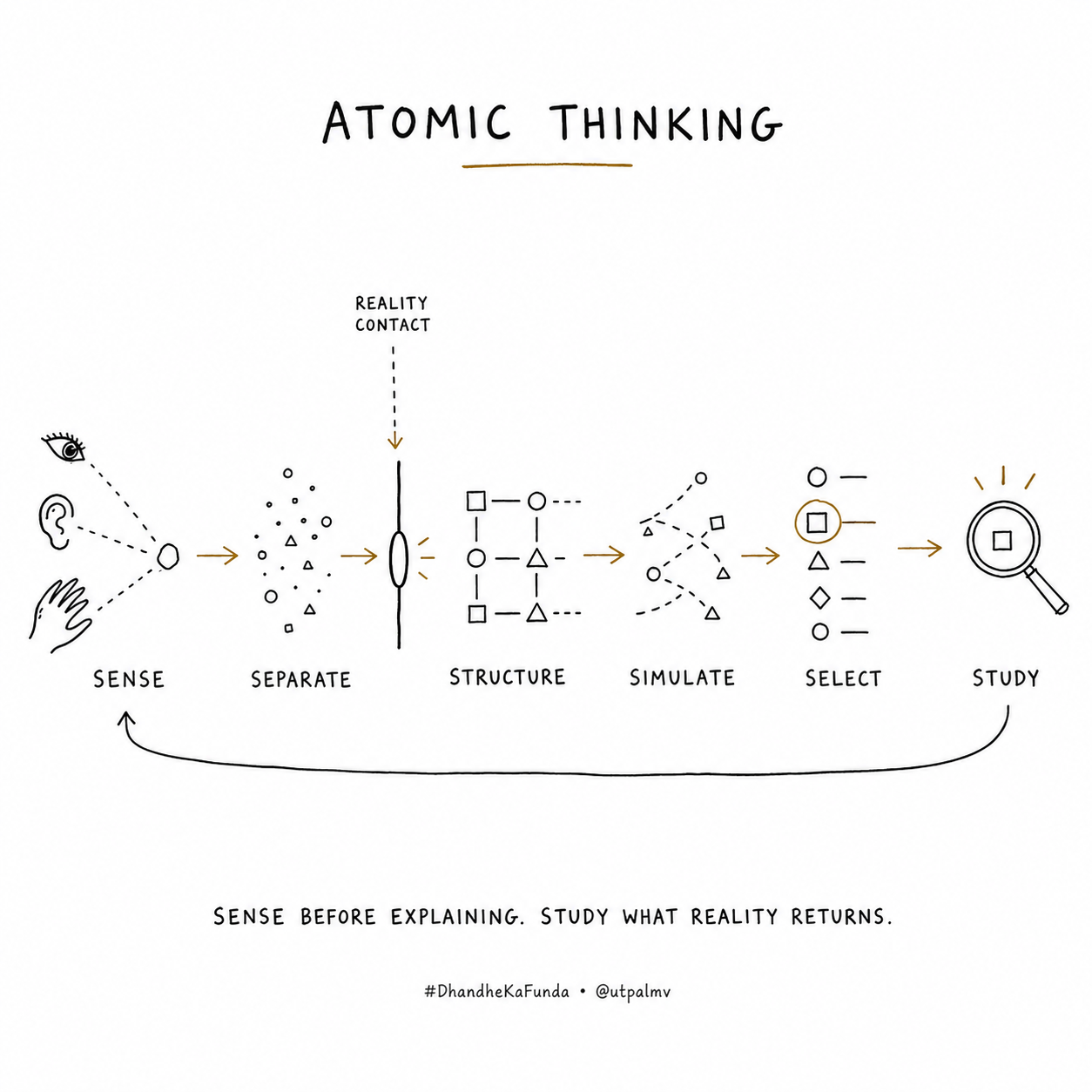
The Atomic Thinking Protocol makes consequential judgment visible, testable, and correctable: a reality-contact practice for high-stakes decisions.
In April 2013, an email from a friend led me back to his website.
He had built it in 2005. It had been a beautiful design. Eight years later, it was still the same.
By then, the site no longer worked well for the people visiting it. It was not responsive. It did not adapt to tablets or phones. Some of its text was embedded in images. What had once looked considered now made the experience harder.
I called him.
He resisted the idea of changing it. He had invested several months in the design, and he was proud of what he had made. Both things were true. The work had required care, and the result had once been good.
Neither truth made the website useful in 2013.
That is the difficult part of replacing something we built ourselves. We remember the effort. The user meets only the result.
A design can deserve respect and still need to be replaced. The question is not how much work went into it. The question is whether it still helps the people it was made for.
The website was only an example. The same attachment can settle around a process, a product, a role, or a decision. What once served us becomes familiar. Familiarity begins to look like value.
But usefulness can move while the thing itself remains unchanged.
If the people we serve have moved on and our design has not, preserving the design is not loyalty to the work. It is loyalty to effort already spent.
This historical Journal note is adapted from Scrap that beautiful design, first published on April 18, 2013. The original source date and any future Almanac publication date remain separate.
August 22 was Kavita's birthday.
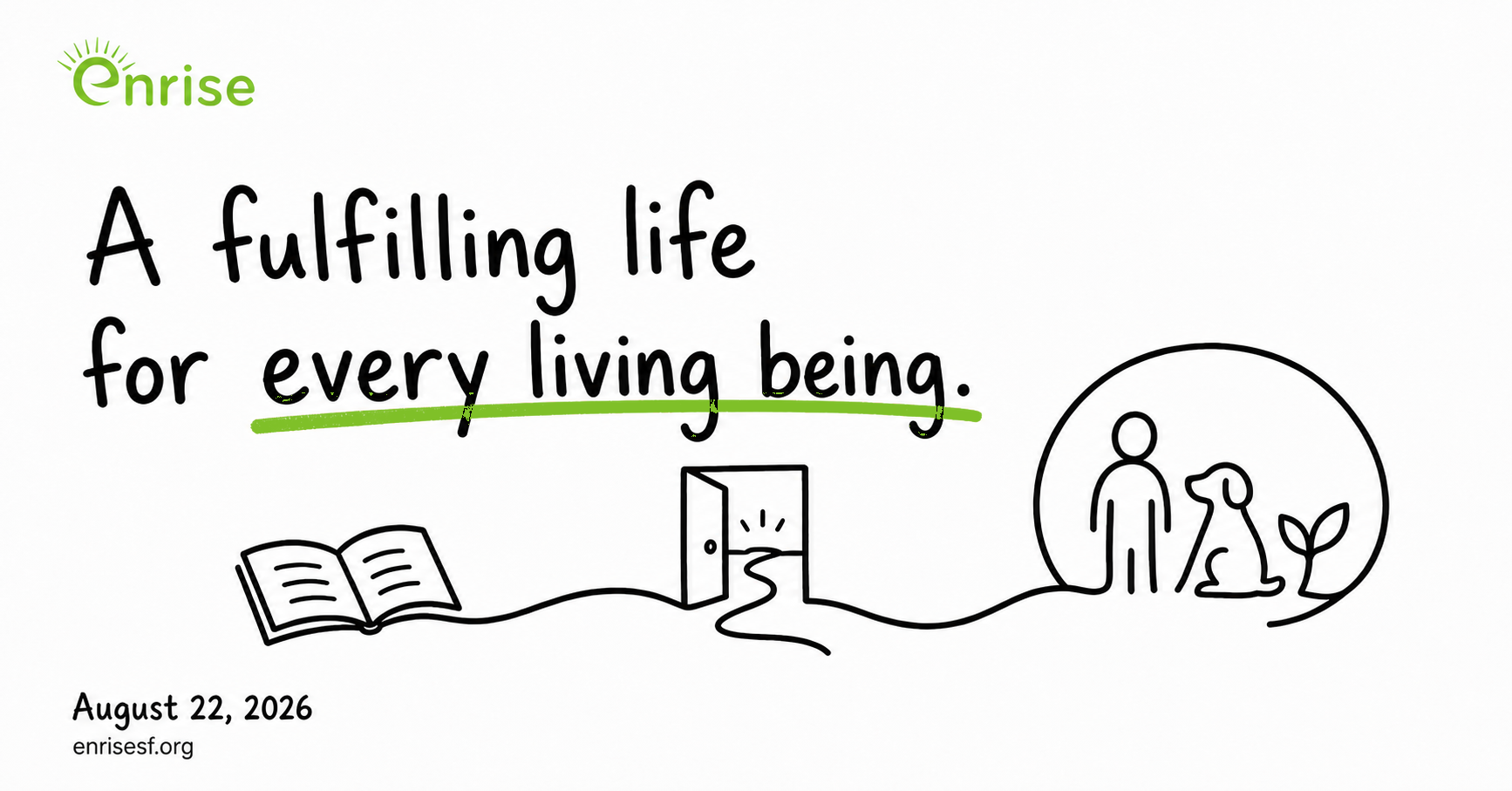
Kavita and I founded Enrise Social Foundation in 2021. Its work spans education, entrepreneurship, women's empowerment, and animal welfare.
On her birthday this year, we completed Enrise's new website. It gives the organization a clearer public home for its purpose, vision, work, and people.
We also spent part of the day at the Blind People's Association in Ahmedabad. Through a local charitable trust already working with families in the city, we contributed 50 grocery kits.
The website and the visit were two parts of the same day: making the institution clearer, and doing the work it exists to do.
Enrise's vision is a fulfilling life for every living being. August 22 was one small expression of that vision.
A meaningful way to spend Kavita's birthday.
In May 2013, I returned to Diu after six years.
Three friends came from Rajkot. I traveled from Ahmedabad. We spent the weekend near the sea, watching the sunrise, sitting on the sand at night, and giving ourselves time that ordinary weeks rarely make available.
Diu was familiar to me. Between 2003 and 2007, when I worked with domestic clients, I visited it about 30 times.
This visit felt different.
My camera was part of the reason.
Over the previous year, fewer trips, other priorities, and new challenges had moved photography away from the center of my attention. Simply using the camera again felt like an event.
I imagined the camera saying something to me:
You realize the importance of someone when they are no longer as accessible as they once were. Otherwise, they become routine.
On the way home, one thought stayed with me.
The camera was the same. I was the same person. Yet the experience was different.
We often meet a situation through the feeling that arrives first. The other possibility is harder: notice the feeling we want to bring, then see whether it changes how we meet what is already there.
That was not a lesson I had mastered.
It was something I wanted to become better at.
This is a lightly edited historical note from The choice of feeling, first published on May 5, 2013. The source date and the Almanac publication date remain separate. This Almanac edition was published on August 22, 2026.
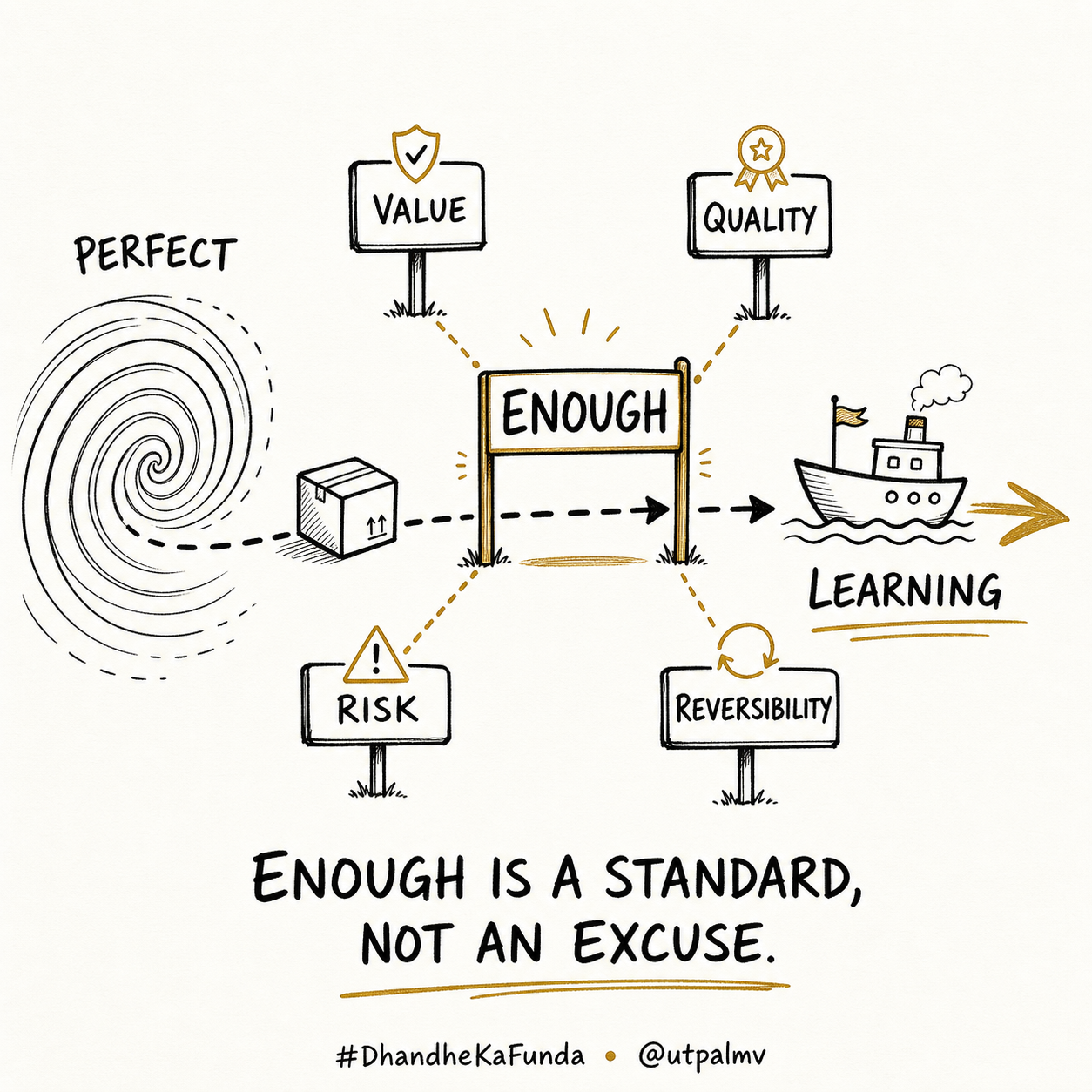
The 2012 note It is not perfect. It can still be improved. That is the wrong question. The better question is: when can I ship it?
In 2010, I was asked to deliver a project I did not believe in. That created a conflict I could not solve with a project plan.
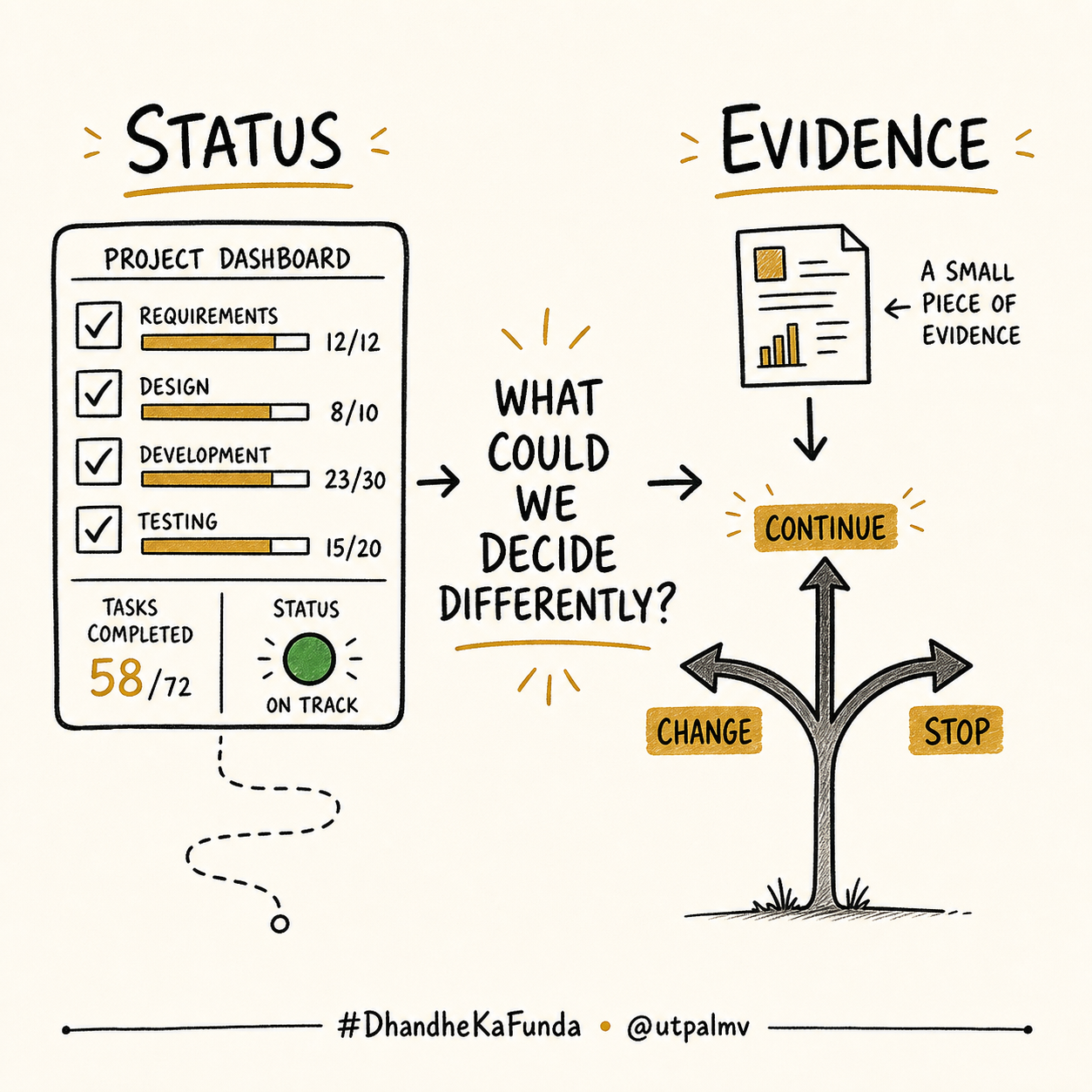
A status tells you what happened. Evidence helps you decide what should happen next.
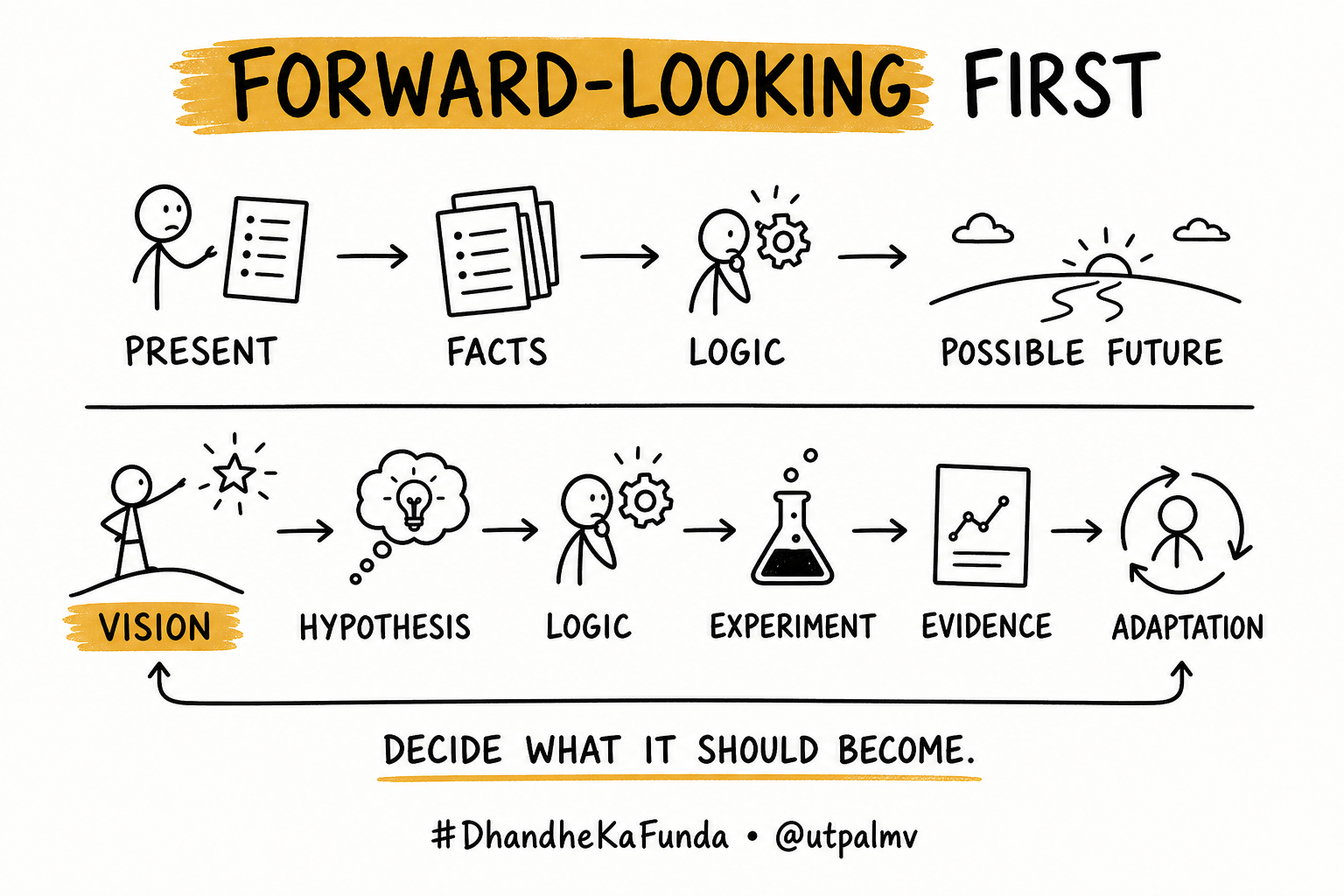
Logic is essential. But logic has a limitation. It is exceptionally good at reasoning from what already exists.
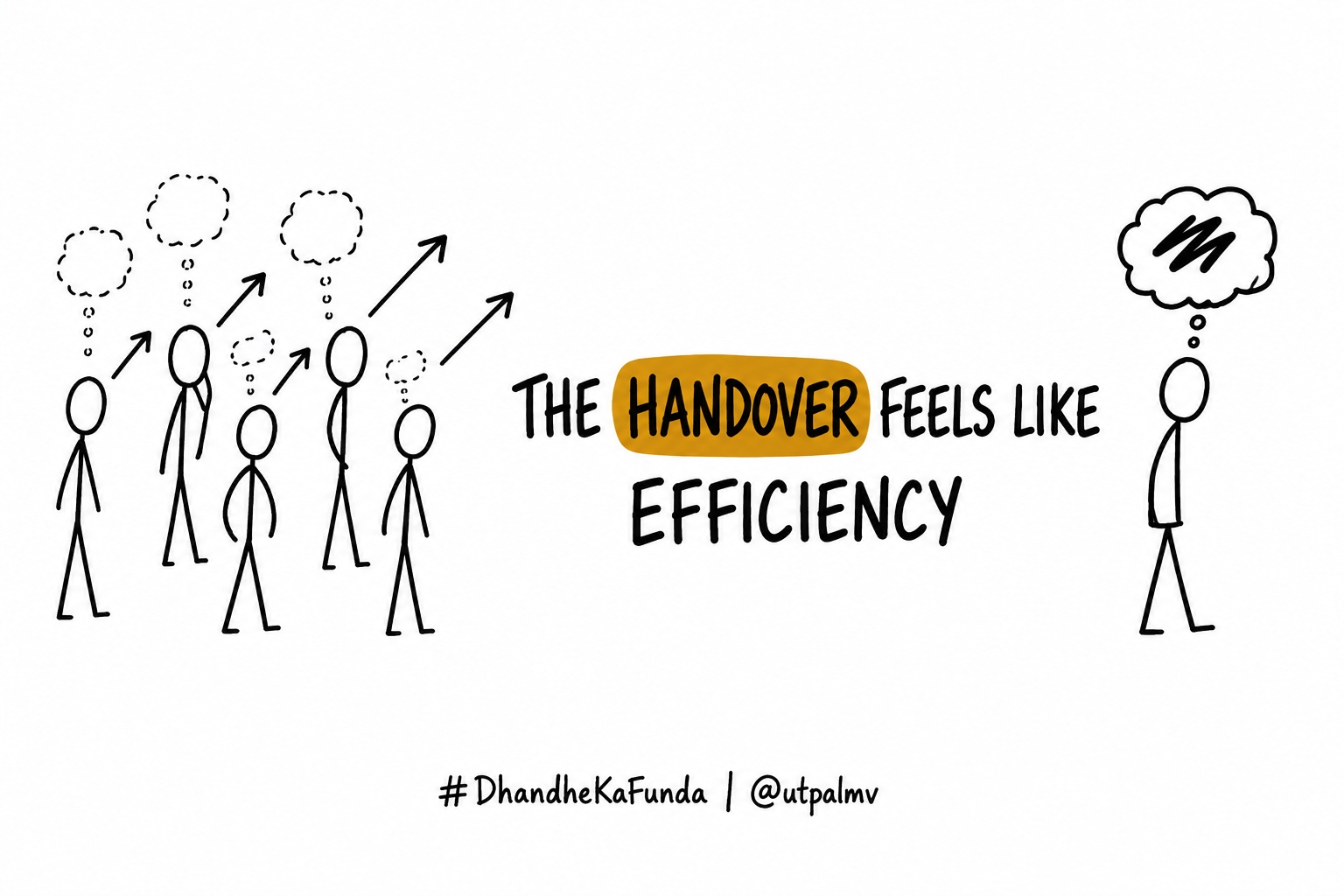
The bystander effect names something narrow.
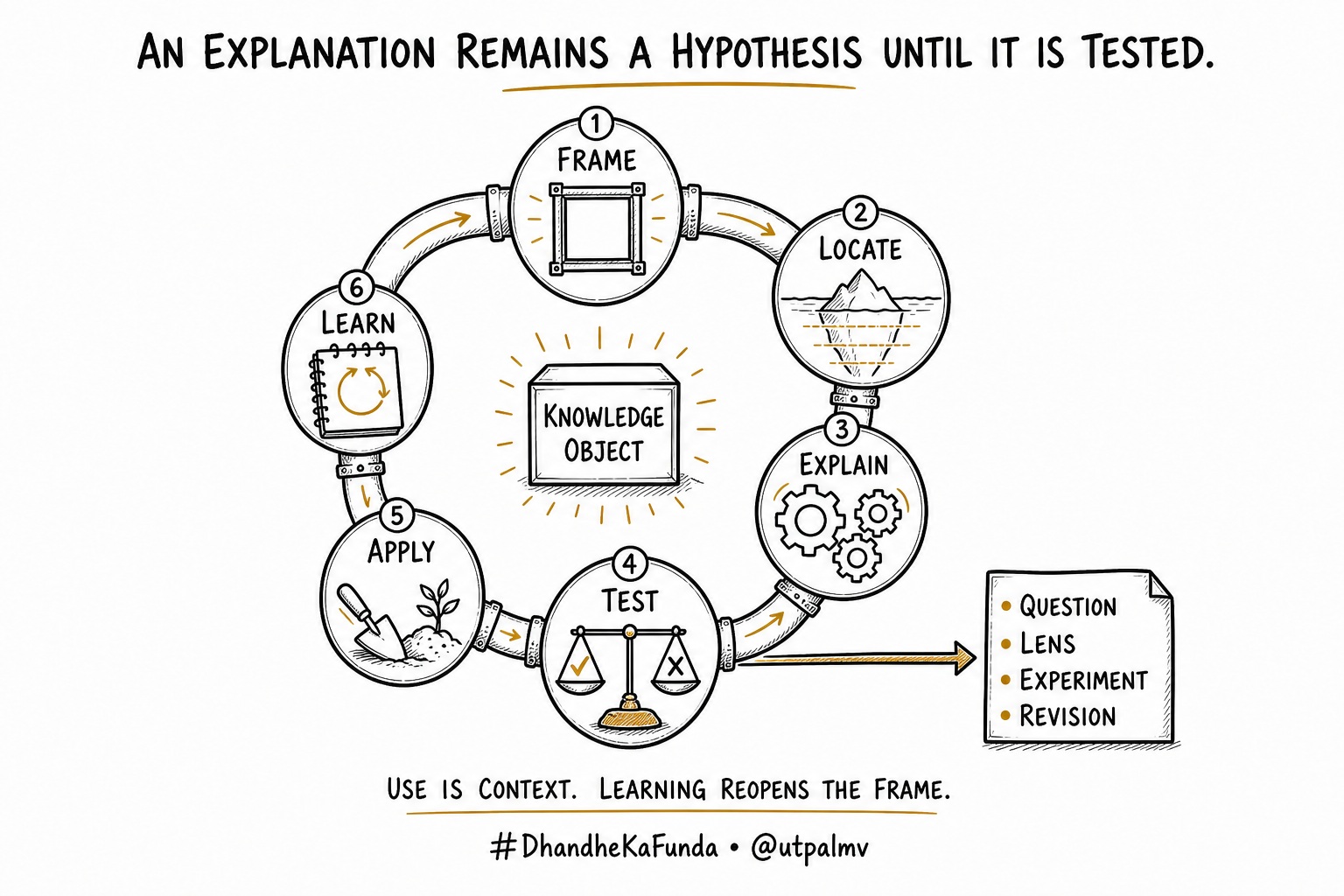
The KNOLt Framework uses six movements to examine a knowledge object, its evidence, limits, and context before it becomes advice, principle, or operating rule.
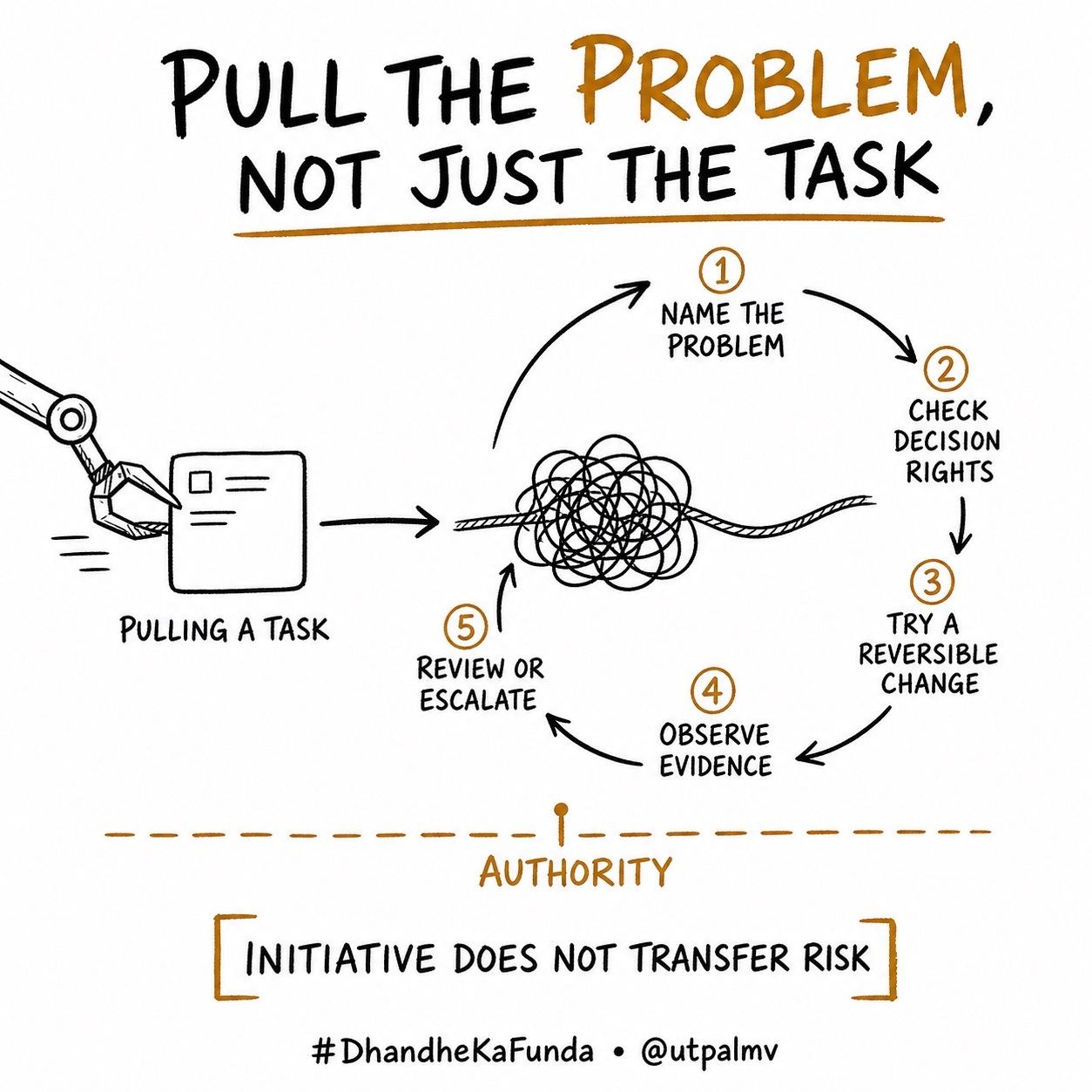
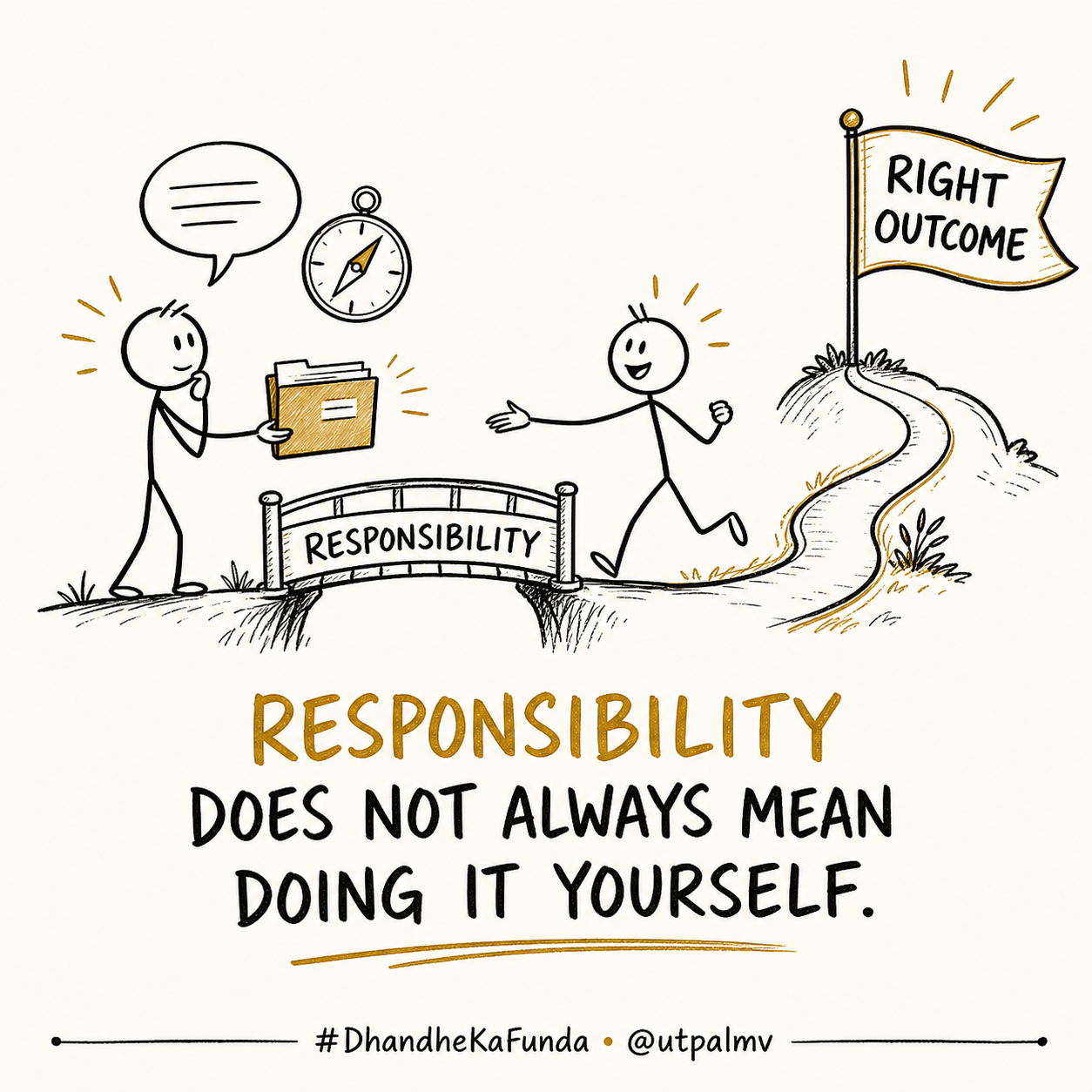
Pull changed my relationship with Scrum because it moved responsibility closer to the person doing the work.
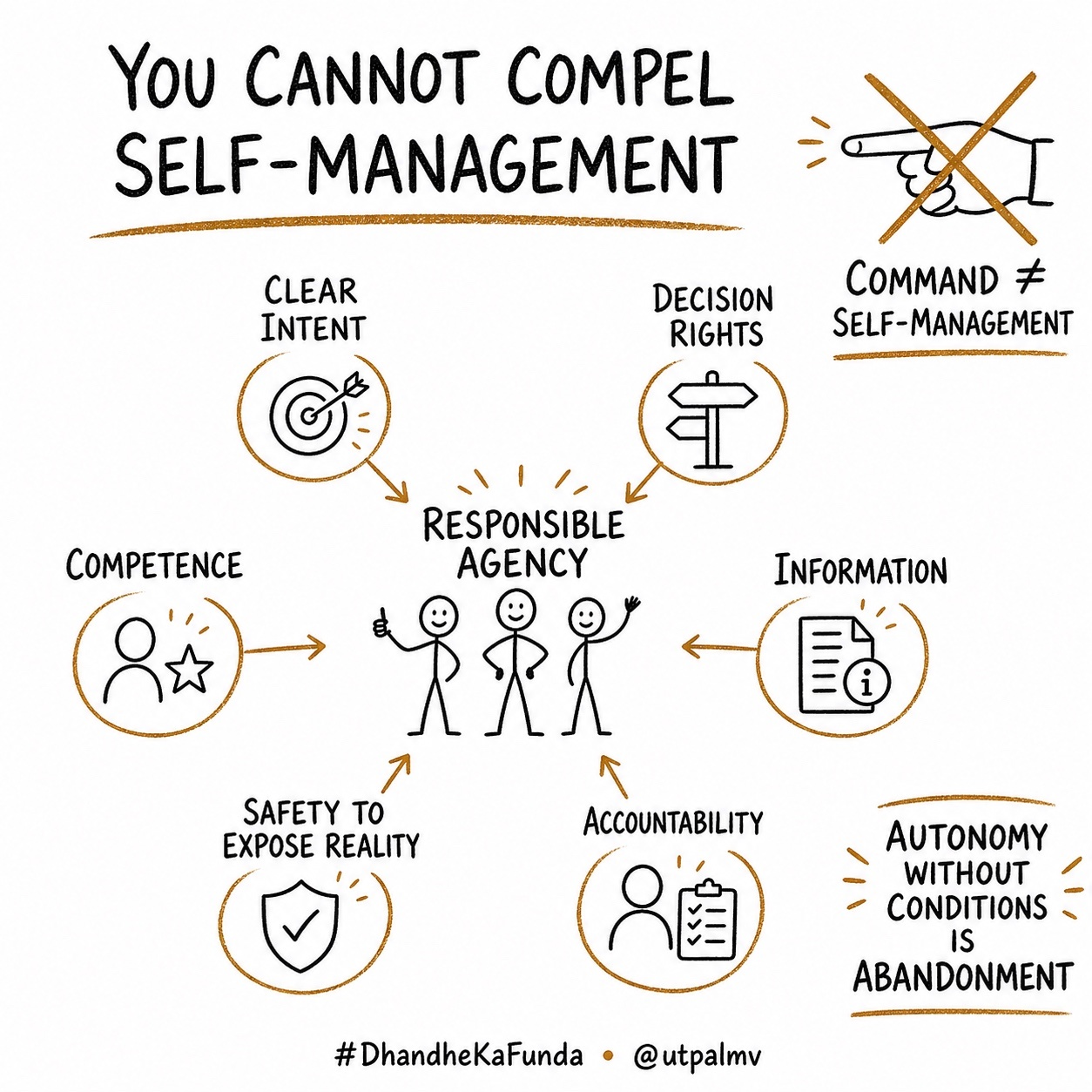
An organization cannot command people to self-manage and continue making every consequential decision for them.
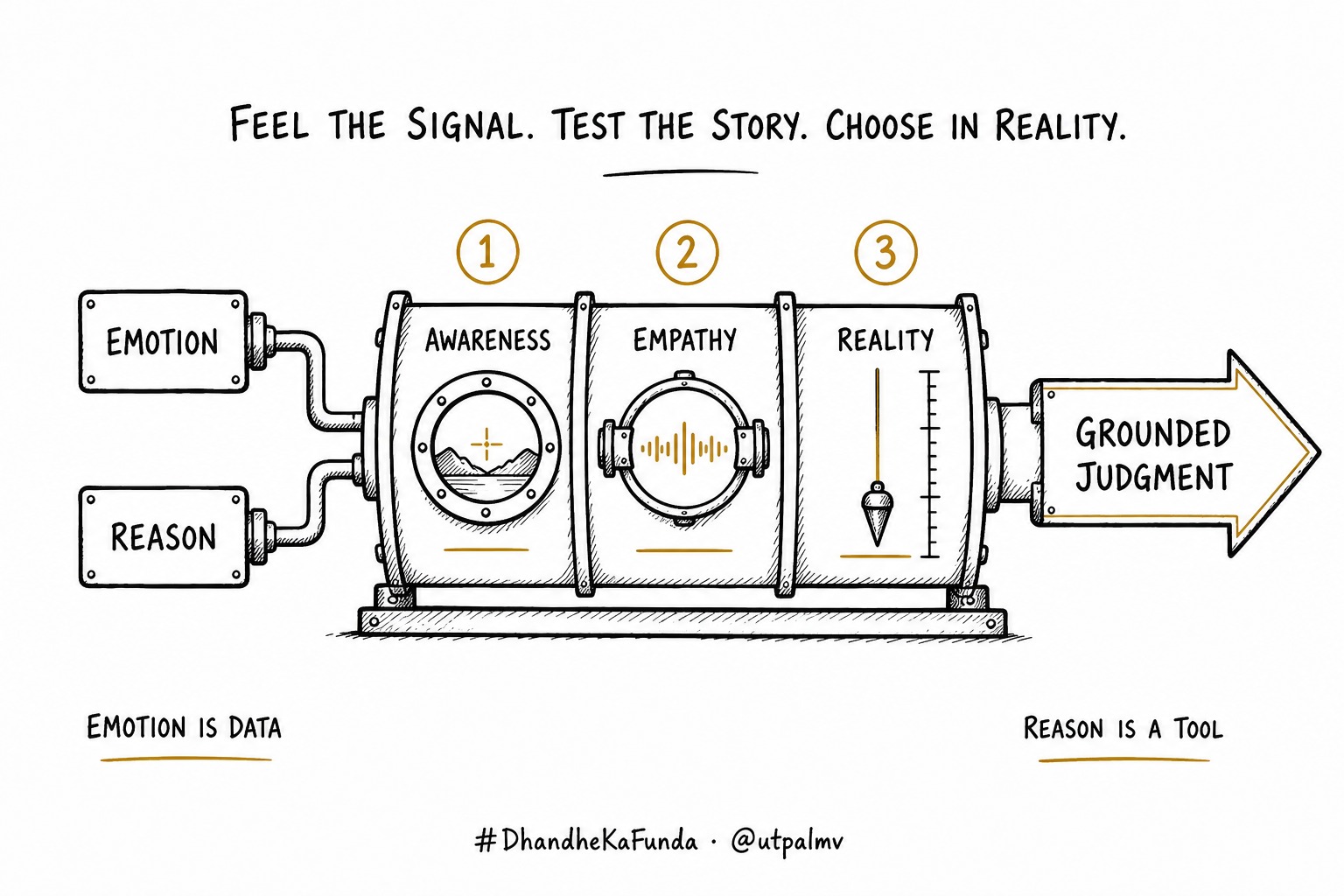
Feel the signal. Test the story. Choose in reality. From the Architect, 13 August 2026.
Clarity about priorities does not make the next decision easy. It makes the exposure visible.
That is where motion becomes attractive.
A decision carries two costs: effort and exposure. Motion can spend the same effort while avoiding the exposure.
The calendar remains full. Meetings happen. Documents move. People work hard. By the end of the day, the tiredness is real.
So is the activity.
What may still be missing is a choice someone is willing to own.
This does not require lazy people or weak teams. It only requires a system in which making a choice carries a visible personal cost, while continuing the activity carries a quieter cost spread across the organization.
Given that structure, motion can be the safer option.
A status update can describe the work without deciding what changes. An alignment session can reveal disagreement without resolving it. A framework review can test the logic without committing anyone to the consequence.
All 3 may be useful. None should be mistaken for the decision itself.
The standard is sharper:
A decision is a place where you can be publicly wrong. Any activity that cannot make you wrong is not a decision.
Use that standard carefully.
Research can reduce uncertainty. Discussion can expose a constraint. Review can prevent an avoidable error. Work often has to move before a responsible choice is available.
The test is not whether the activity should exist. The test is whether it is being reported as progress after it has stopped producing information for a decision.
Priority without decision becomes a list.
Distributed authority without exposure becomes permission nobody uses.
Both can look active from a distance.
The harder move is to name the decision, name who owns it, and name what that person is willing to be wrong about.
Everything else may still be useful.
Just stop reporting it as progress.
#DhandheKaFunda: If it cannot make you wrong, it is not a decision.
We shipped something structural this week. A change to how people enter the organization. Eleven people came in under it on day one.
Someone on my team sent me a long note last week. Real gaps. Product issues, process issues, friction with a colleague.
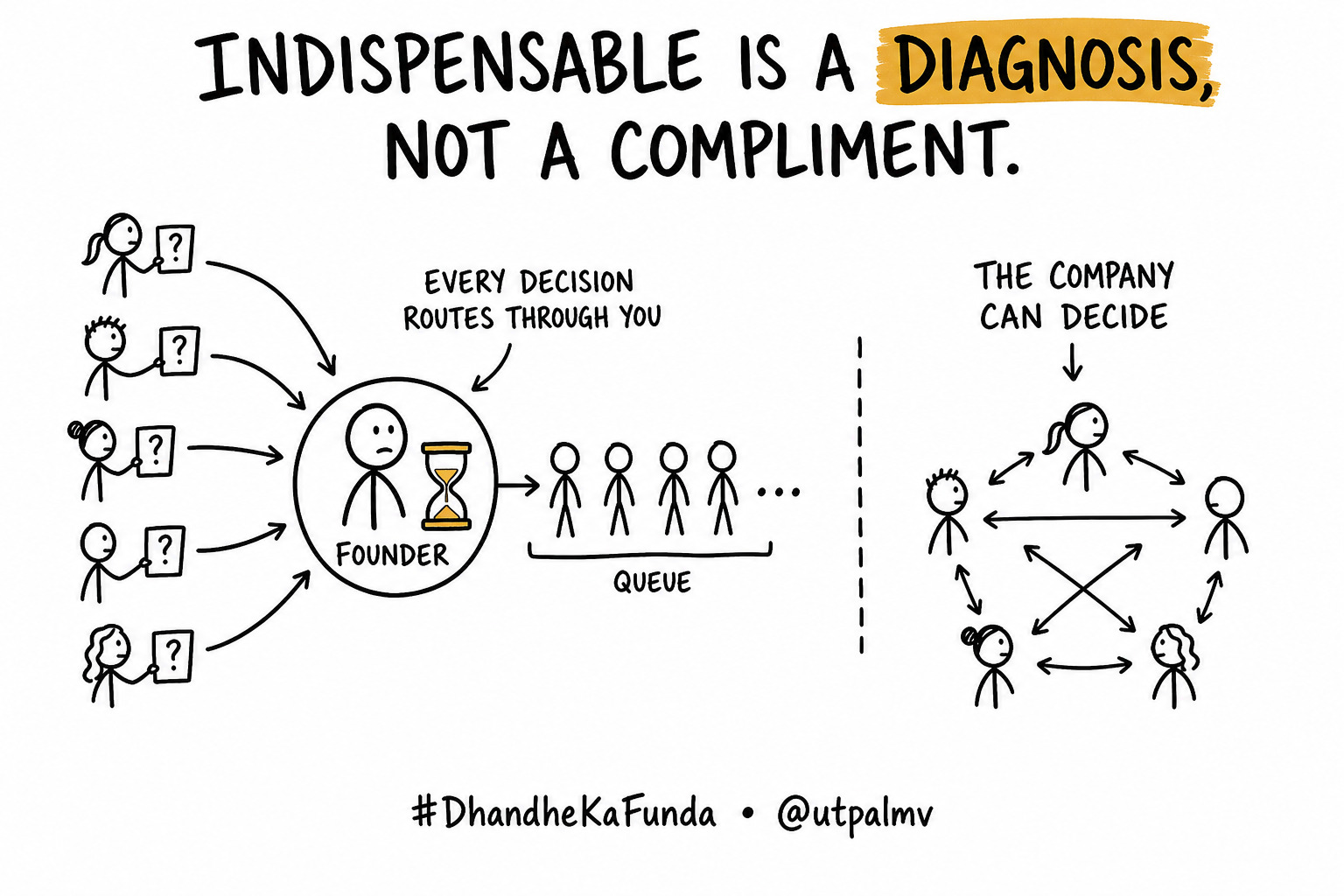
I have held a version of this as a rule for some time. If an operator cannot leave for ninety days, they may have built a demanding job for themselves.
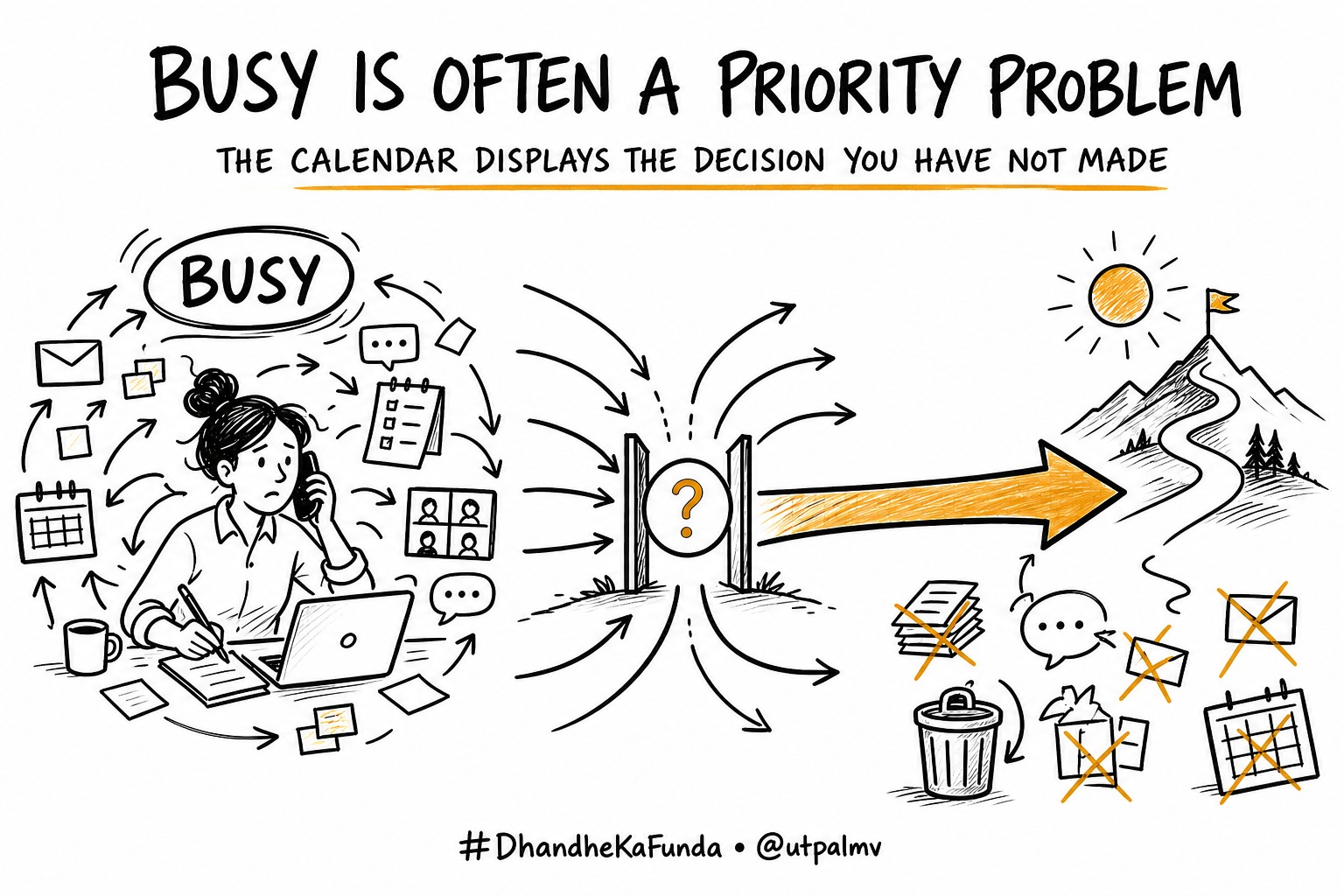
"Busy" might be the most socially acceptable answer we have invented. How are things? Busy. Why didn't this move? Too much going on. Why haven't you started?
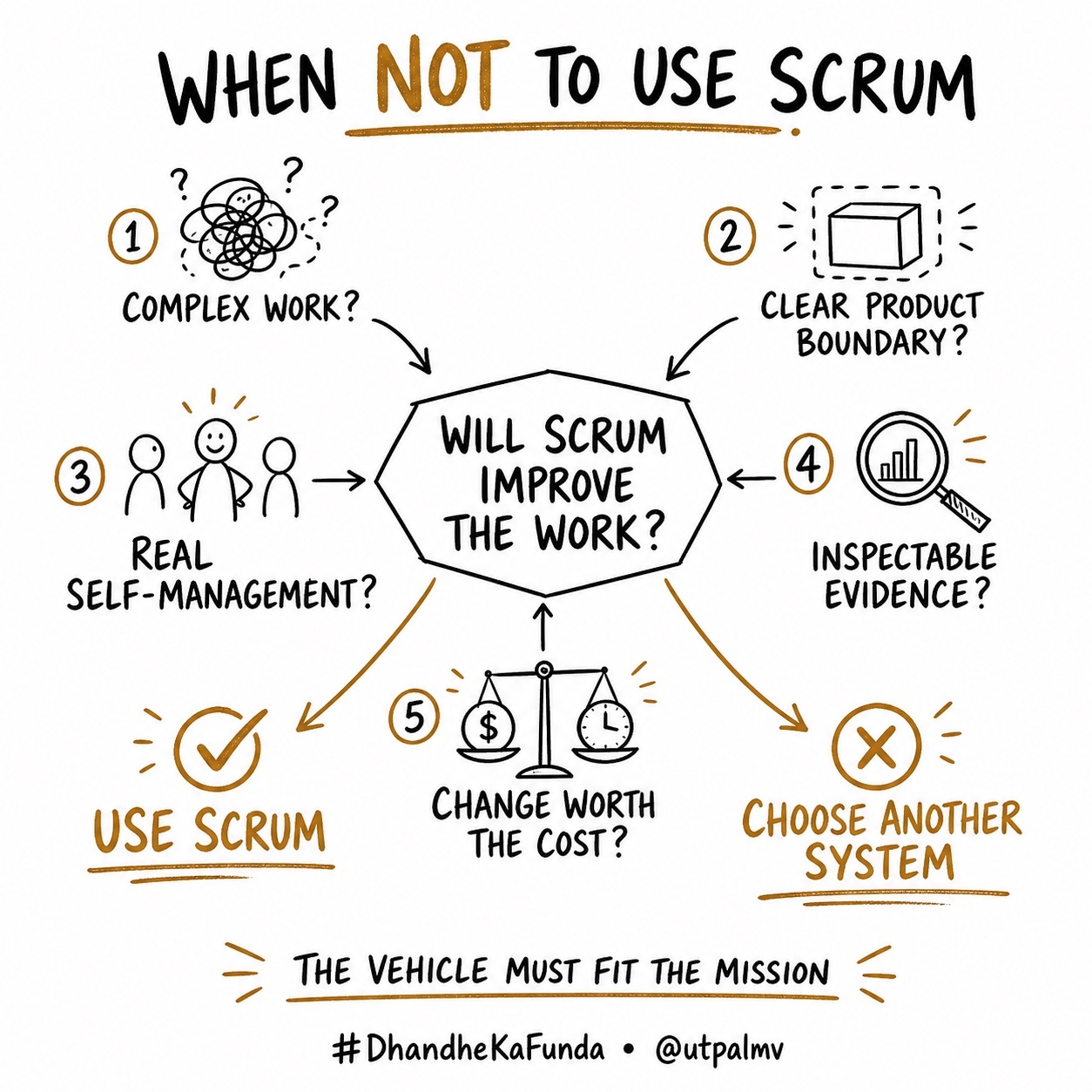
Scrum is useful when the work is uncertain and a capable team can turn short cycles into evidence.
From the Patanjali Yoga Sutras, Sutra 2.03 avidyā-asmitā-rāga-dveṣa-abhiniveśāḥ kleśāḥ Five distortions. But not five independent problems.
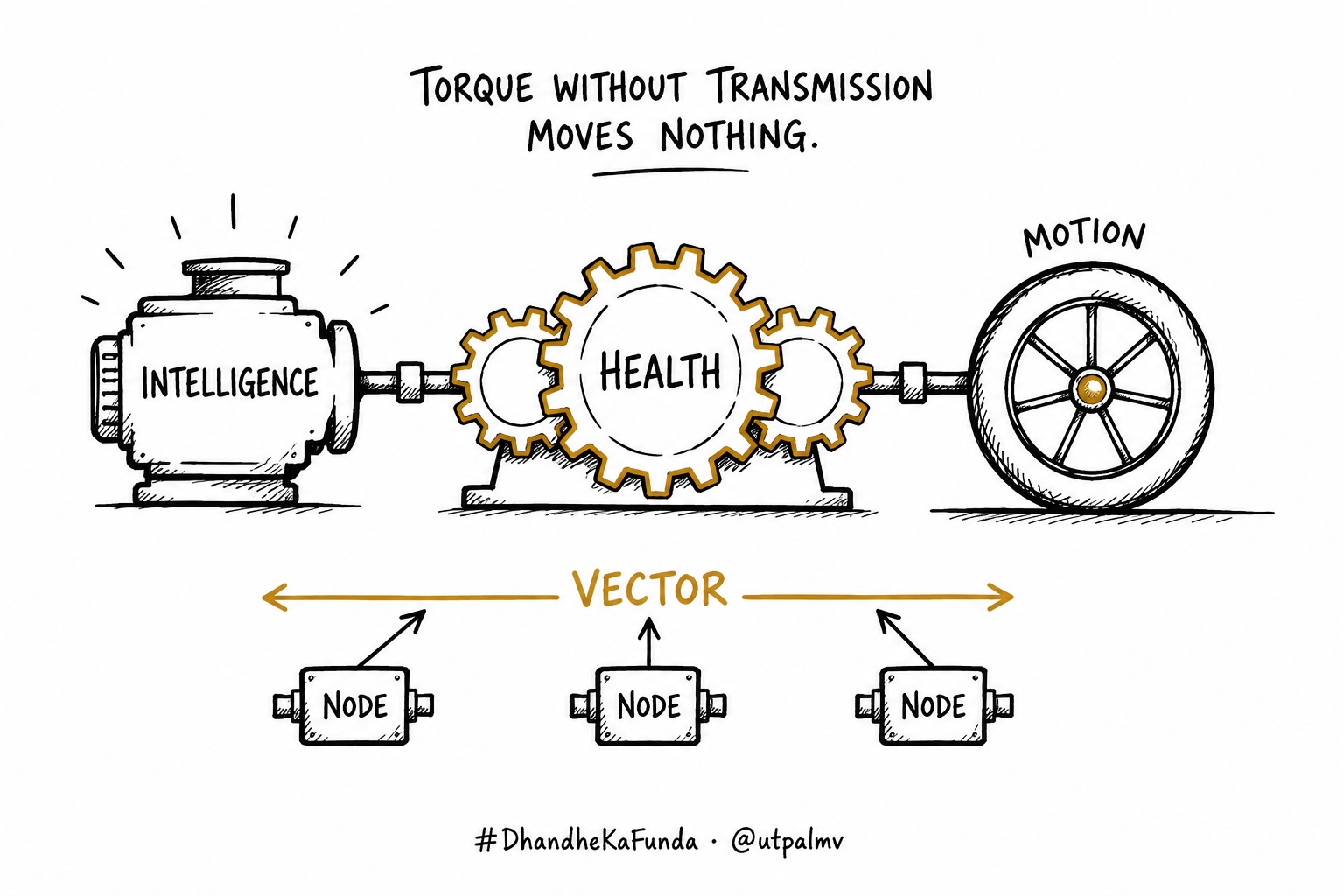
Health is not the opposite of smart. It is the transmission. From the Architect, 09 August 2026.
My Scrum blog then said, "Scrum exposes problems. It does not solve them." I still think this is one of the most useful things I wrote about the framework.
From the Architect, 8 August 2026 The alarm is faster than the assessment. Not two problems. One sequence, running in the wrong order.
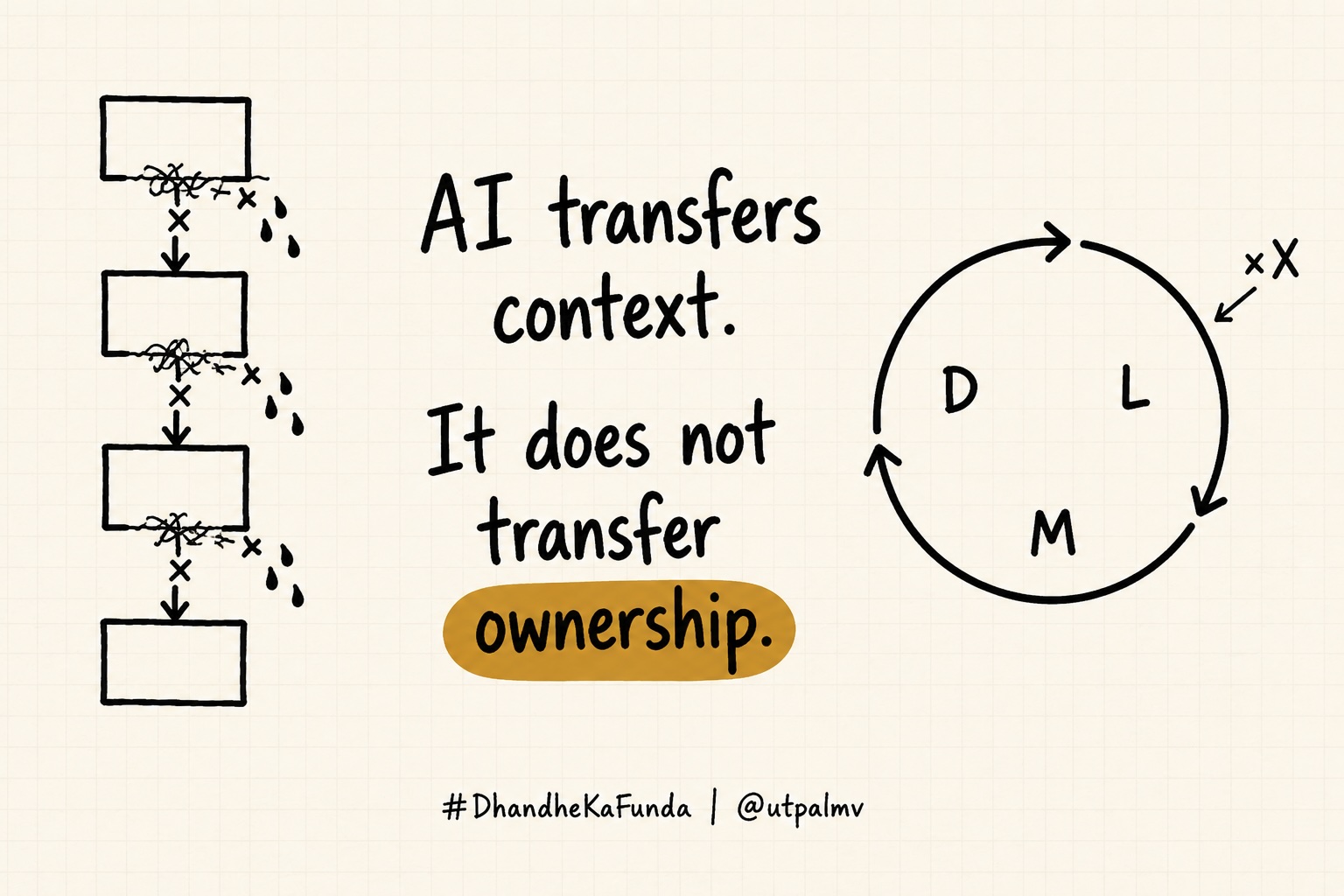
The DLMx Protocol examines how work moves from intent to outcome through doing capacity, leadership clarity, management discipline, and multipliers.
A backlog can make a team look certain long before the team has earned certainty. The list is long. The items are estimated. Priorities are numbered.
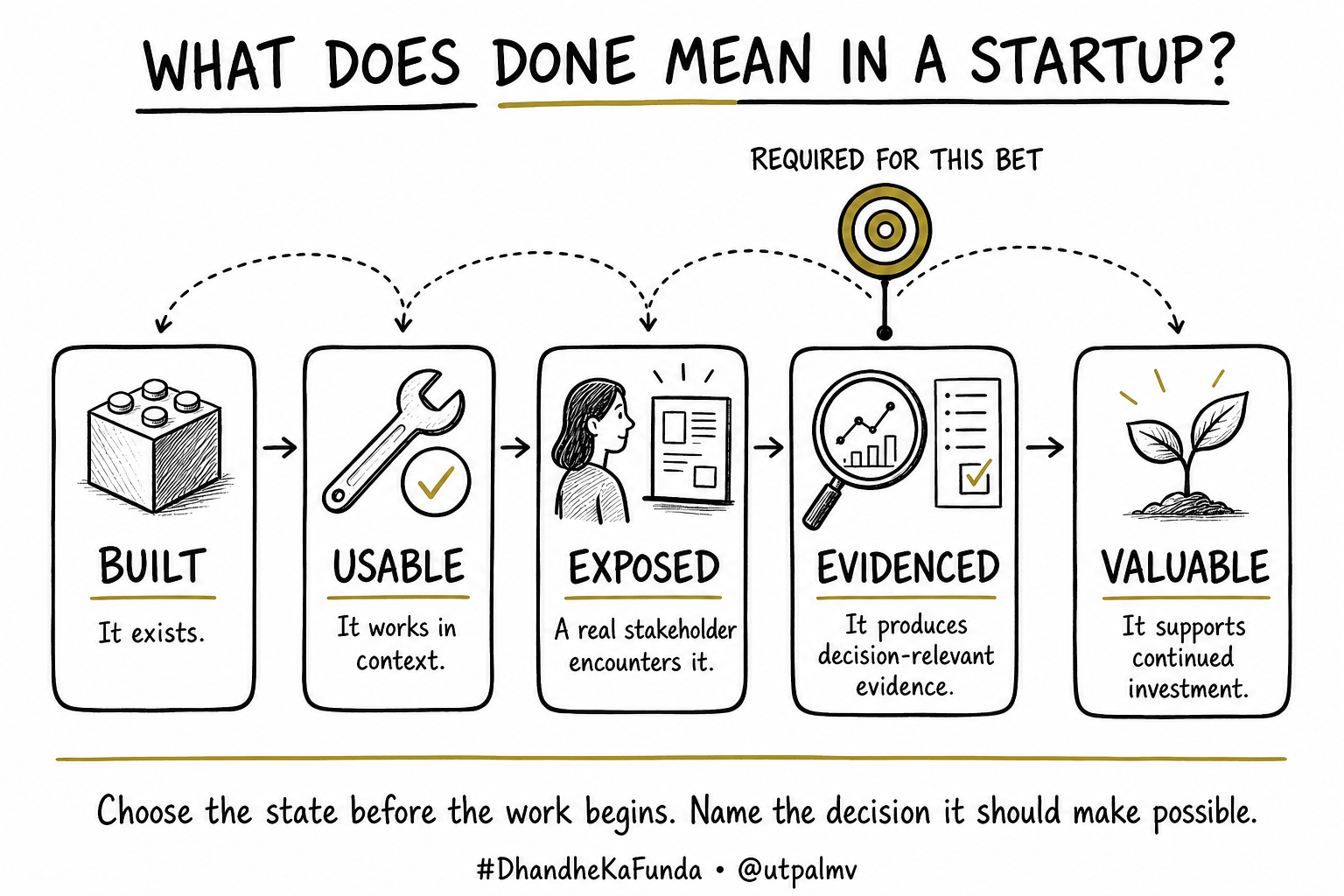
Four people can look at the same work and declare it done for four different reasons. The developer says it works. Operations says it has been released.
I no longer see Scrum as the answer to how work should be done.
Scrum was once an important part of my public identity. I read it, practiced it, blogged about it, and eventually wrote a book about it.
From the Patanjali Yoga Sutras, Sutra 1.12
abhyāsa-vairāgyābhyāṃ tan-nirodhaḥ
Two levers, not one. Show up again and again, and stop being dyed by the result.
I knew about the first one. Consistency, reps, keep going. Everyone knows about the first one. The second lever I have been skipping for years is marked as dual in Sanskrit, which is a separate grammatical number from the plural. The grammar holds the two together as a pair. I have been trying to make half a mechanism stabilize me.
And vairāgya is not what I assumed. I am using uncolored as a working metaphor, not as a definitive translation. The version where you pretend not to care may still leave you governed by the result, only from the other direction. The text treats rāga and dveṣa, attachment and aversion, separately in sutras 2.7 and 2.8. What seems to be asked here is harder: keep caring completely, and stop being moved by the result.
This takes me back a decade. Somewhere in May 2016. Personal front. Work front. Dual fronts. I wanted to care. I wanted to create. I wanted to get consumed by what I was causing and creating. Not getting consumed made me less happy.
Which is the joke. Being consumed is how I understand sārūpya here. Sutra 1.4 describes taking the shape of whatever is moving in you. I was chasing the dye and calling it devotion. I did not know what care was. Care can stay complete, total, mad, and still not be moved by its own output.
This week, effort stays exactly where it is. Nothing changes on the input side. I only track one thing: how much I move when I check the result. Zero to five, once a day. Care stays high, coupling comes down.
Not caring less. Being dyed less.
From the Patanjali Yoga Sutras, Sutra 1.02
yogaś citta-vṛtti-nirodhaḥ
Yoga is when the turning settles enough for me to see again.
In this sutra, Patanjali does not describe a posture or promise calm. I read it as a change in vantage point. Sutra 1.4 describes the default, the thing that happens when I am not paying attention: I take on the shape of whatever is moving in me. Not that I feel the anger. I become the anger, and it walks around wearing my name.
I noticed this on Tuesday. A team member pushed on a timeline, and within a second I was already defending, already building the case. There was no one there deciding to defend. The defending was the whole of me. I only found the door twenty minutes later, and by then I had already said things I would have edited.
So this week, one thing. Before responding to anything that arrives with heat, name it. "This is urgency." "This is being flattered." "This is not wanting to look slow." Out loud if I am alone, on paper if I am not.
Whatever I can name, I am not currently made of.
A rehearsal can reveal a missing step before that omission matters. Imagine preparing to lead a difficult project review: the opening sounds clear in your head, but speaking it aloud reveals that you have not decided what answer you need from the room.
That is a useful result from rehearsal. It does not require claiming that the nervous system has been pre-compiled.
Walk through the action far enough to encounter its dependencies. What information must be available? Where could someone reasonably disagree? What will you do if the expected response does not arrive?
A perfect imagined performance can conceal the very uncertainty that makes the real situation difficult. Include one plausible interruption and practice choosing a response, rather than memorizing an uninterrupted script.
For one ordinary presentation or handoff, write down two gaps the rehearsal exposed. Afterward, note which gaps mattered and which unexpected condition required adaptation.
Judge the rehearsal by what it helped you notice and prepare. Feeling fluent is not evidence that the plan is sound.
For technical or safety-critical procedures, follow the relevant training and approval requirements. An informal mental run-through does not replace supervised practice or demonstrate competence.
This is a proposed preparation exercise. It makes no general claim about anxiety reduction or performance gains. Its value is the specific omission or dependency you discover early enough to address.
This work develops the concern in “Pre-Compiled Execution,” published on 2026-07-16.
I have observed that indifference can feel like hostility when we are already prepared for an attack.
A customer does not respond. A room remains quiet after an idea is presented. A person passes without acknowledgment. In the absence of an explanation, the mind supplies one: they rejected me, they oppose the work, or they are deliberately withholding respect.
Sometimes that interpretation is correct. People can be dismissive, political, or openly hostile. But silence alone does not establish motive. Customers, markets, and unfamiliar people are usually occupied with their own concerns. They may not understand the offer, may not need it now, or may simply have more urgent demands on their attention. Their indifference can be disappointing without being personal.
The distinction matters because a defensive response changes what happens next. We may overexplain, retaliate, withdraw too early, or redesign useful work around a judgment that was never made. The defense can create the conflict it expected.
Before building that defense, check what actually happened. Separate observation from interpretation. “They did not reply after two messages” is an observation. “They want me to fail” is a claim about intent. The first may justify a follow-up or a decision to stop. The second requires evidence.
Where possible, run a small check. Ask a direct question. Look for behavior across time rather than one moment. Compare the response with how the person treats others. In a market, examine whether the problem is relevance, clarity, timing, trust, or distribution before concluding that the audience is hostile.
This is not an instruction to ignore patterns or tolerate disrespect. Repeated conduct can make intent less important because the effect is already clear. It is an instruction not to convert ambiguity into an enemy before the evidence supports one.
Indifference may tell us that the work has not earned attention. It may tell us nothing at all. Either way, we can respond more intelligently when we do not begin by inventing a war.
On July 12, 2026, I revisited Ikigai as an alignment check rather than a search for one permanent purpose.
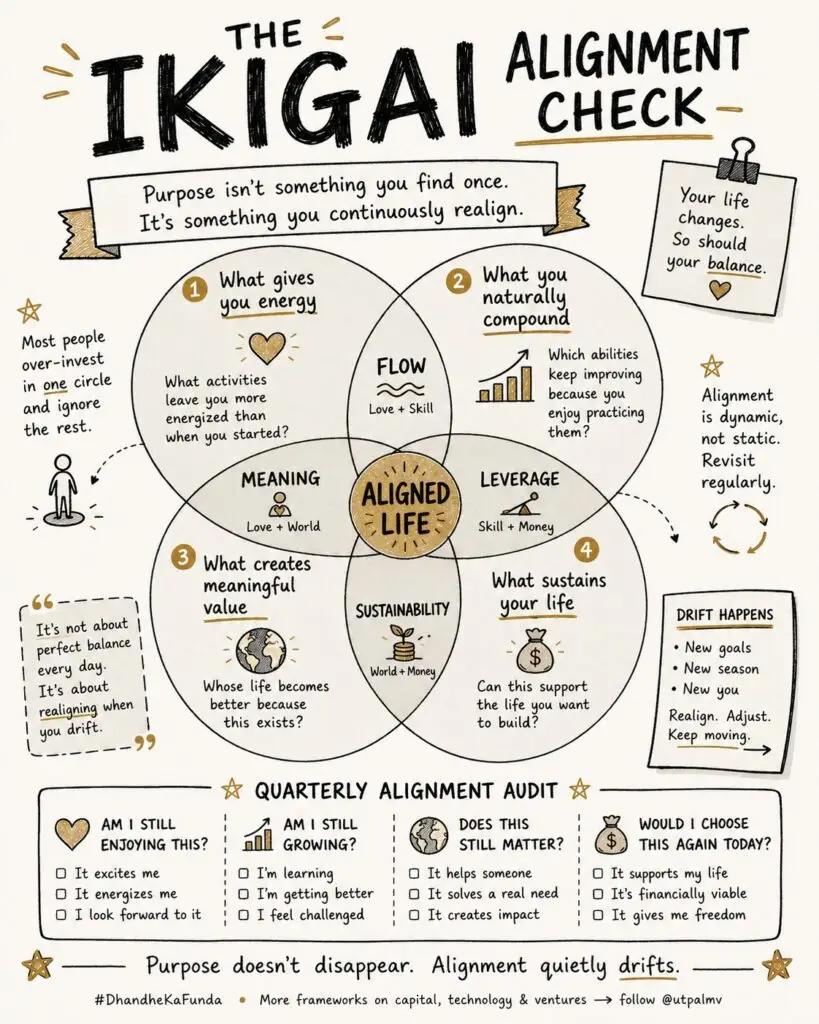
The familiar diagram brings together what you love, what you are good at, what others need, and what can sustain you financially. I find the questions more useful in the present tense:
None of these signals is infallible. Energy changes, skill can grow without enjoyment, meaningful work may not be measurable, and financially viable work is not merely a purpose that pays rent.
The circles also move as life changes. I revisit them periodically to notice drift, not to demand perfect balance or let one question dissolve every prior commitment.
The framework does not deliver an aligned life. It helps me ask where adjustment may be due.
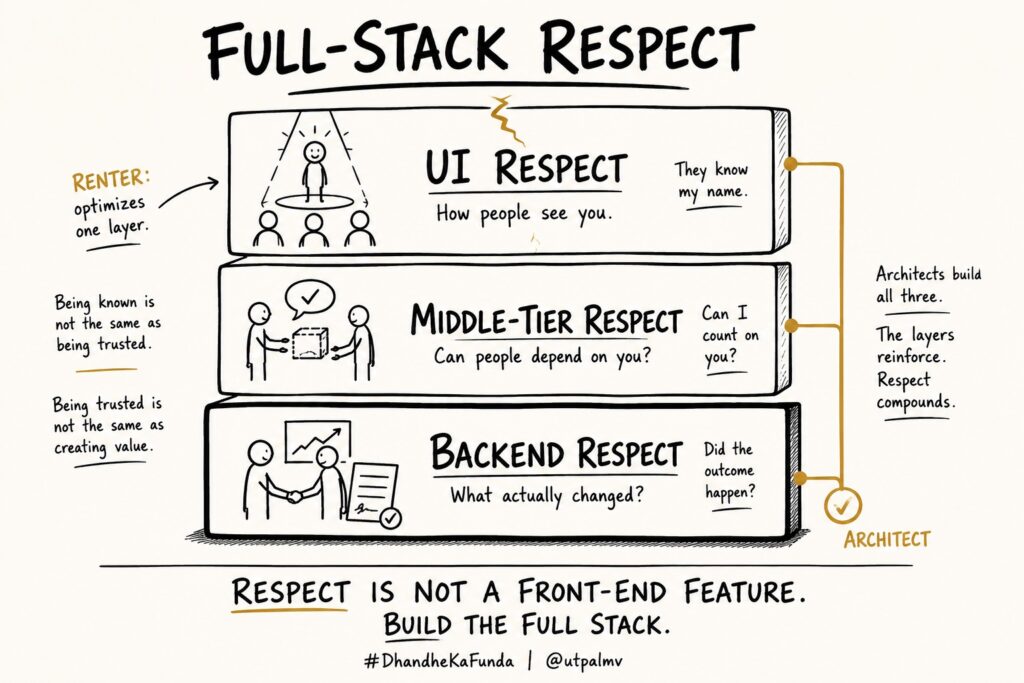
From the Architect, July 10, 2026 Respect has a UI. Most people stop there. The handshake. The stage time. The photograph with the right person in the frame.
A version was published as a LinkedIn article on May 8, 2021. The export does not establish that LinkedIn was the first-publication venue. Adapted for the Almanac on August 9, 2026.
The difference between a CTO and a project manager is not best understood through titles. It is a difference in what each role owns.
A CTO owns the organization's technological capability and the consequences of its technology choices. That includes research, architecture, capability building, technical judgment, and the connection between technology decisions and business value.
A project manager owns delivery within a defined project. The role aligns people and work around scope, timing, dependencies, communication, and obstacles that prevent the project from moving.
The boundary changes with context. A product organization, a technology services company, and a non-technology business do not need identical versions of either role. In smaller organizations, one person may carry parts of both.
The distinction still matters. Delivery ownership asks whether a specific commitment is moving as intended. Capability ownership asks whether the organization is developing and governing the technological capacity required for many commitments over time.
Confusion begins when coordination is mistaken for technological ownership, or when technical authority is treated as a substitute for delivery discipline.
The useful design question is not which title is more senior. It is whether capability decisions and delivery commitments each have a clear owner.
A version was published on LinkedIn on July 20, 2026. The export does not establish the timezone or first-publication venue. Adapted for the Almanac on August 9, 2026.
Most founders do not begin with a funding problem. They begin with a clarity problem.
Capital does not repair an idea that has not survived contact with the world. Before approaching investors, a founder should be able to show what has been built, what has been learned, and why this problem deserves to exist as a company.
The question becomes sharper for hardware and other physical-world businesses: what would the world lose if this were never built? If the honest answer is nothing, a stronger deck will not rescue the idea.
The source of capital matters too. Venture funds and individual angels do not operate on the same clock. Taking money means taking on its time horizon, return expectations, and eventual pressure for an outcome.
AI can be useful before the first investor conversation. A founder can use several models to challenge assumptions, expose missing evidence, and test whether the argument survives basic scrutiny. That does not validate the business. It makes weak reasoning visible earlier.
The useful distinction is between the romance of appearing to be a founder and the work of understanding a problem deeply enough to build evidence around it.
Investors may hear the idea first. What they are evaluating is whether the founder understands how the world around that idea works.
A version was published on LinkedIn on July 29, 2026. The export does not establish the timezone or first-publication venue. Adapted for the Almanac on August 9, 2026.
Organizations can make reasonable decisions and still move too late.
Think about driving on ice. The brakes work. The steering works. What changes the outcome is the interval between seeing the skid and responding to it.
I have started noticing the same pattern inside organizations. Projects drift as small delays stack on top of one another.
A delayed approval. A handoff waiting in an inbox. A question held for next week's meeting.
No single delay looks serious. Together, they change the behavior of the system. Deadlines slip. People work around one another. Customers feel the slowdown before it becomes visible on a dashboard.
Then the search for someone to blame begins.
Sometimes a person did make a mistake. Sometimes the more useful diagnosis is that the system is carrying too much latency.
That changes the question from "Who failed?" to "Where did the delay enter?"
The highest-return improvement may be small: remove one approval, make one decision earlier, or shorten one feedback loop.
Delays rarely appear on an org chart. They live between teams, between meetings, and inside the promise to get back to someone later. That makes them easy to ignore and expensive to accumulate.
A version was published on LinkedIn on July 24, 2026. The export does not establish the timezone or first-publication venue. Adapted for the Almanac on August 9, 2026.
You raised the round. It felt right.
Eighteen months later, growth pressure arrived before the product was ready. A pivot required investor alignment. The timeline was no longer entirely yours.
The decision was not necessarily wrong. The trade-off was never made visible.
A trade-off seen is a decision made. A trade-off unseen is a surprise waiting.
Count barrels, not bodies A version was published on LinkedIn on April 13, 2026. An earlier Journal origin is claimed in the source but remains unverified.
A version was published as a LinkedIn article on December 13, 2019. The export does not establish that LinkedIn was the first-publication venue. Adapted for the Almanac on August 9, 2026.
It is easy to fall in love with the state of being a startup founder.
Contests, community events, product building, and public visibility may all have a place. But they can also become comfortable substitutes for the harder question: does the original hypothesis support a viable business?
That question should govern the startup phase.
The founder's work is not to preserve the romance of the role or the product. It is to understand which actions, conditions, and causes produce the outcome the business needs, then test those assumptions against reality.
Past knowledge and earlier success can help. They can also become something to defend. The difficult discipline is to keep pursuing the truth when it challenges the identity we have built around the company.
A startup moves forward by seeking, testing, and experiencing the business truth. The title matters less than whether the hypothesis survives.
A completely full calendar looks like commitment. Sometimes, it is. Sometimes, it is the opposite.
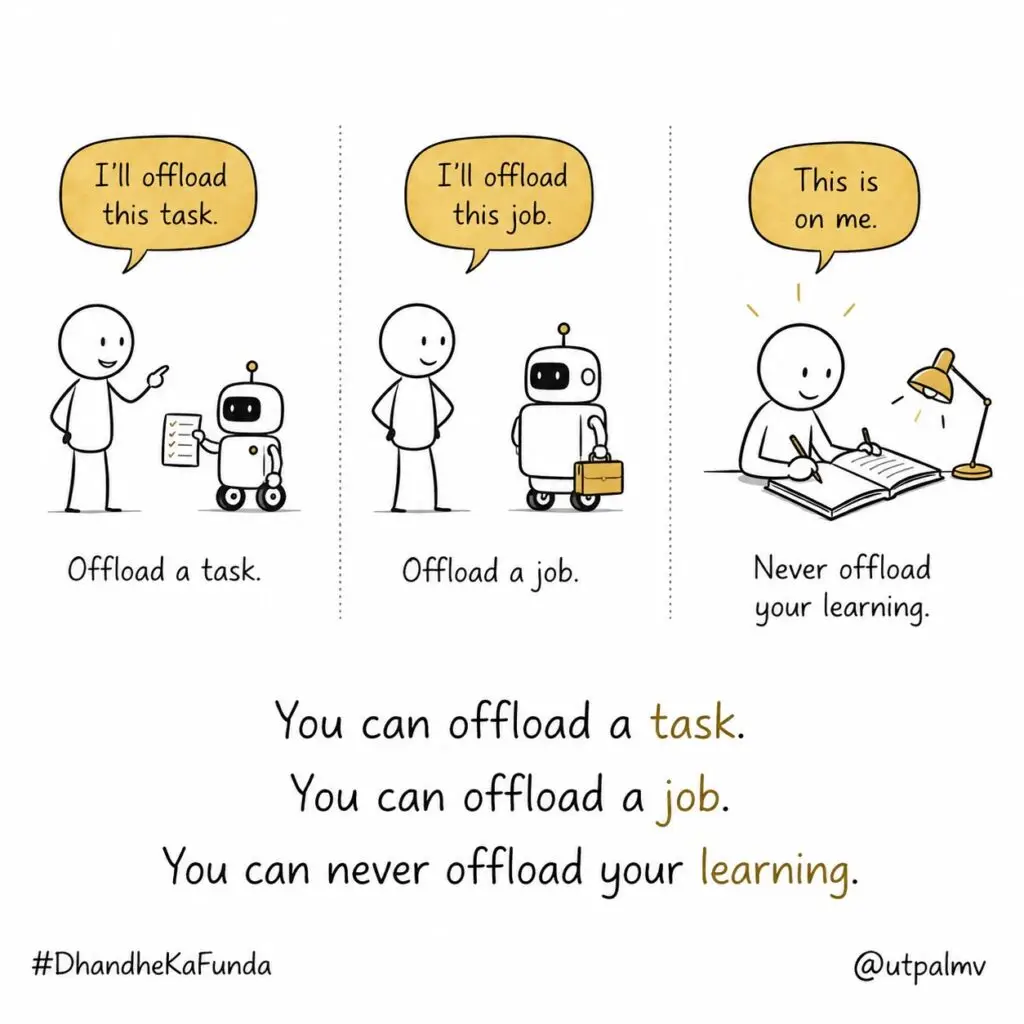
From the Architect - June 27, 2026. A note on what survives when models eat everything they see.
From the Architect. 21 June 2026. Written at the edge of a decision I made before the evidence was in.
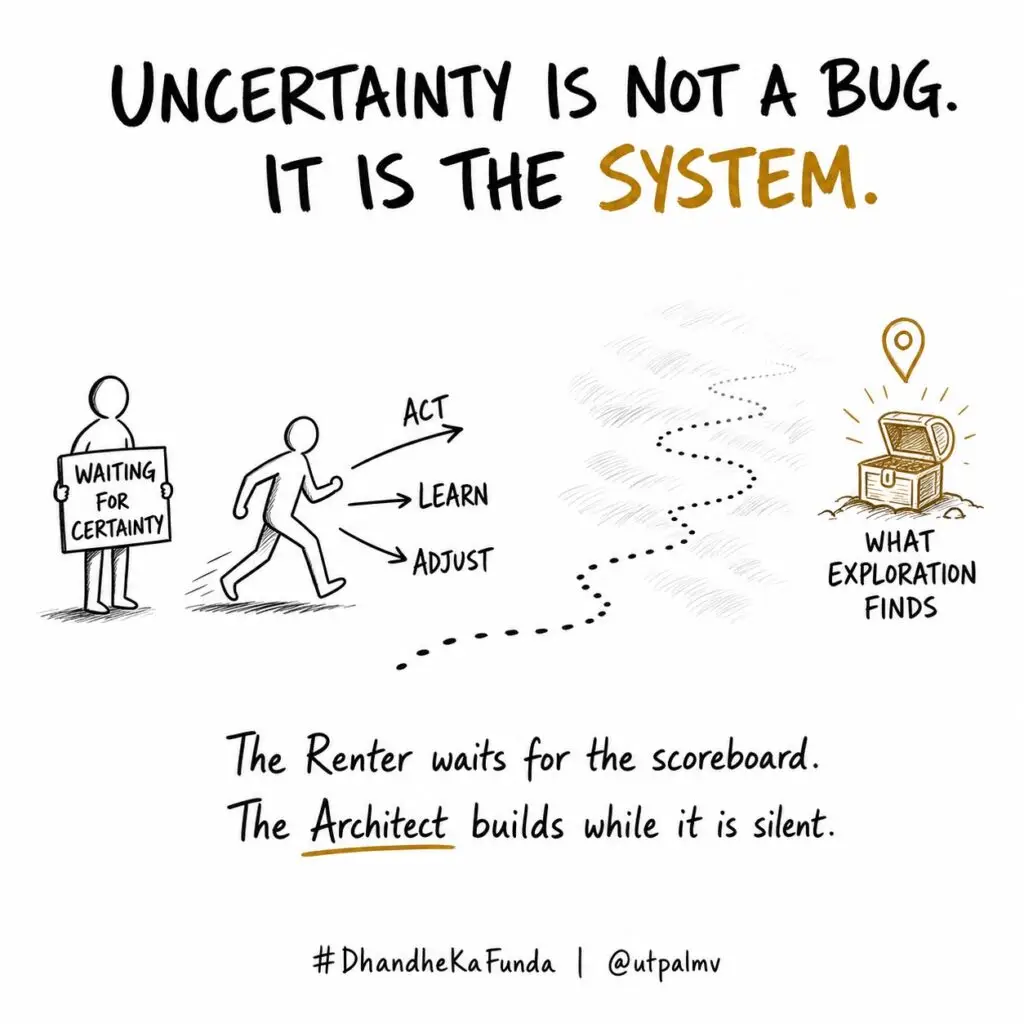
Most people overestimate talent. And underestimate uncertainty.
I have seen it repeat across founders, allocators, operators, and builders. The gap between the ones who compound and the ones who flatten out is almost never raw intelligence. It is 'conduct under fog.'
One node needs certainty before it will fire. Another fires, reads the result, adjusts, and fires again. The second node wins. Not on information. On duration. It stayed in the game longer.
Every meaningful business I have built started with incomplete information. Every investment I have made carried uncertainty. Every major decision looked obvious only in hindsight.
The future does not arrive pre-loaded with evidence. You move before certainty shows up, or you do not move at all.
[Architect's Note: Watch the quitting carefully. People rarely quit because they are incapable. They quit because uncertainty becomes psychologically expensive. They trade possibility for predictability. Potential for comfort. And the trade always looks reasonable at the moment. That is what makes it dangerous.]
The rewards people chase sit on the far side of the uncertainty they spend their energy trying to avoid. They are running from the toll booth that guards the thing they want.
From an MSDx lens, this reframes cleanly. Uncertainty is not a defect in the system. It is the system. The future cannot be predicted. It can only be explored. Exploration time, not certainty, is what surfaces the opportunities everyone else walks past.
The Renter waits for the scoreboard to speak. The Architect keeps building while it stays silent.
The goal is not to eliminate uncertainty. That door does not exist. The goal is to become the kind of node that can move through it, keep learning when the answer is incomplete, and keep showing up when the scoreboard says nothing.
#DhandheKaFunda: Certainty is paid out to the people who acted before it arrived.
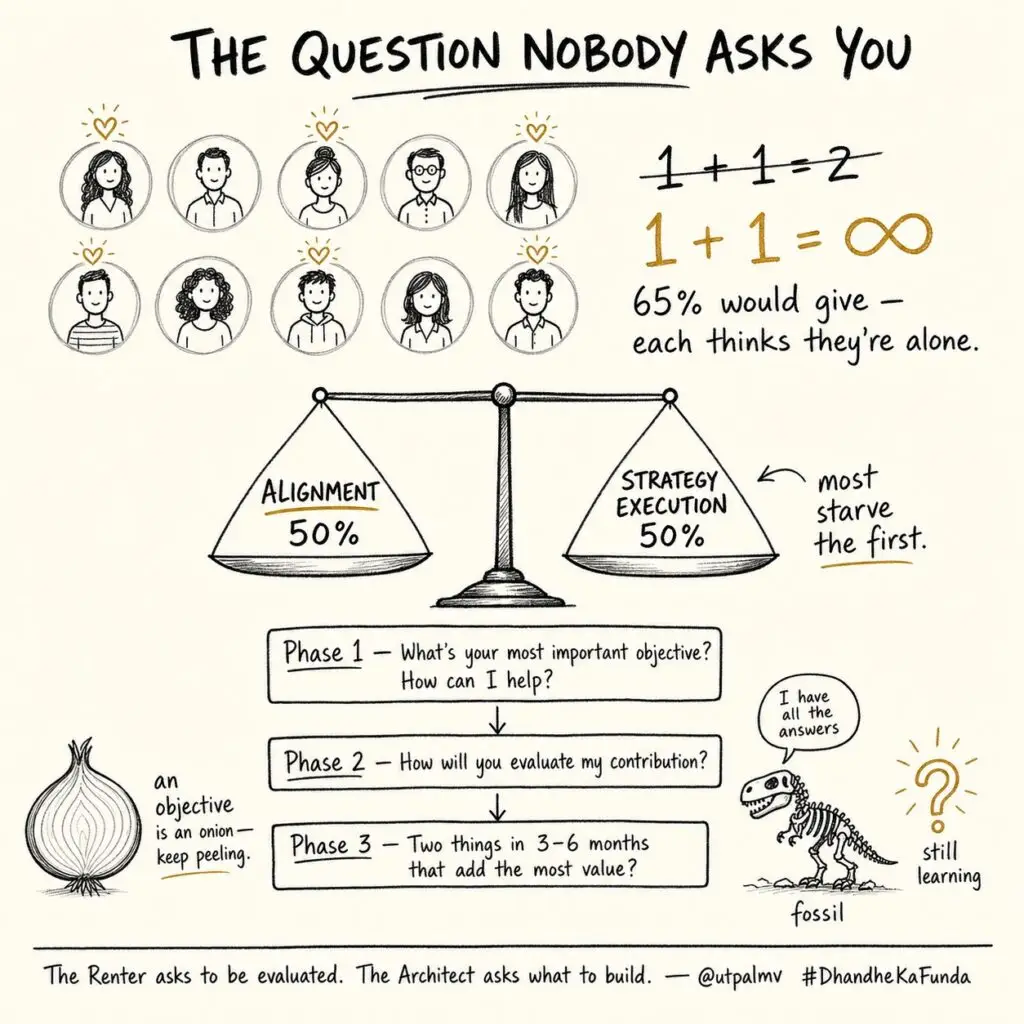
Ask a person what they most want, and watch the pause. Not evasion. Something closer to vertigo. The question lands in a place that has never been visited.
Equanimity is staying centered when everything else is not.
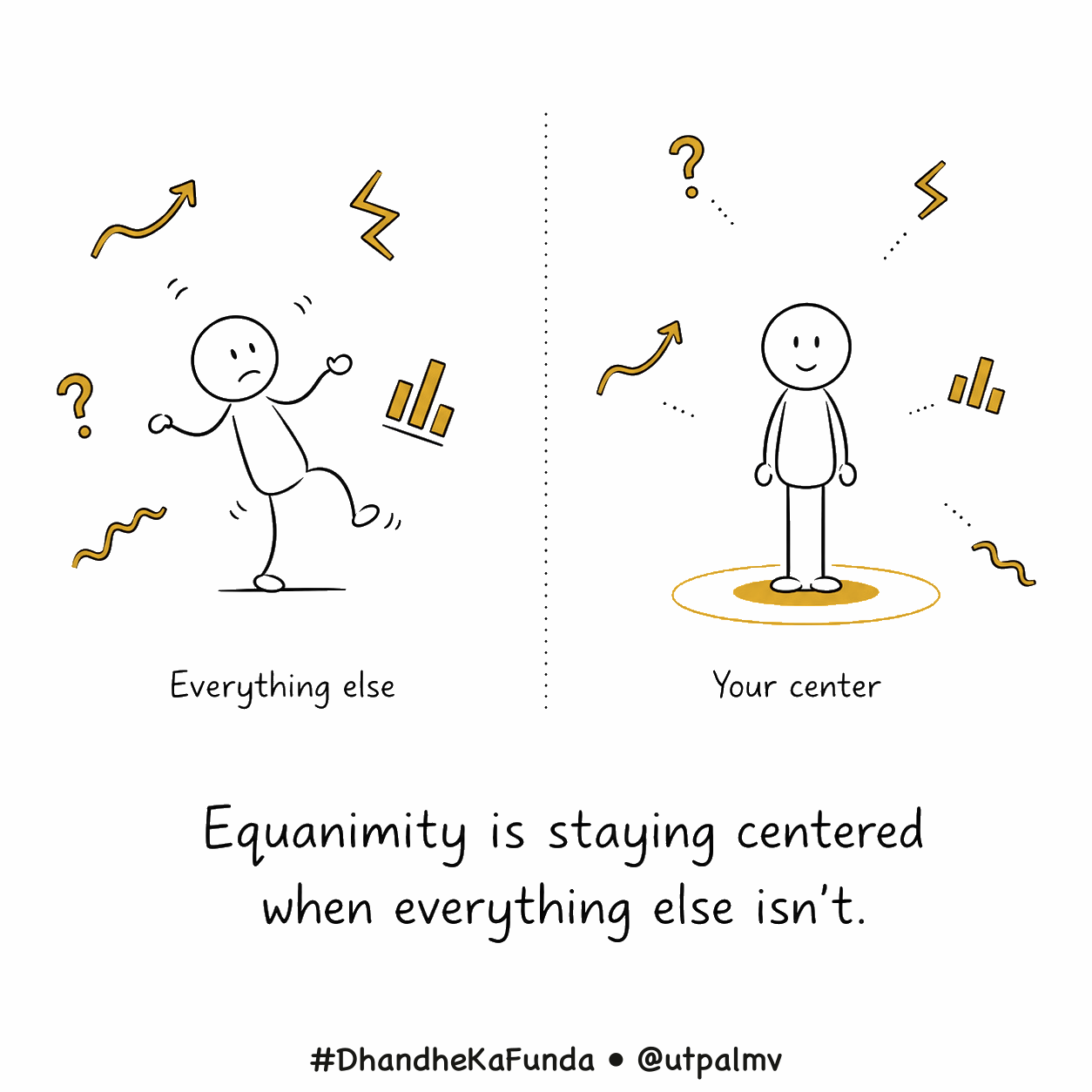
This sounds simple until the surrounding volatility is personal.
A missed commitment, difficult conversation, market change, financial surprise, or failure inside a team can alter the emotional temperature of an entire day. The first reaction arrives quickly. It may carry fear, anger, urgency, or the desire to regain control.
Equanimity does not mean the reaction never arrives. It means the reaction does not receive automatic authority.
I think of centeredness as creating a small interval between what happened and what I do next. In that interval, I can ask:
The interval may be a few breaths, a walk, a written page, or a night before making a decision. Its length matters less than its purpose. It prevents the pressure entering one person from being passed, unchanged, into everyone around them.
Centeredness also has limits. Calm is not always wisdom. Delay can become avoidance. Some situations require an immediate boundary, apology, escalation, or exit. Equanimity should improve contact with reality, not provide a dignified way to hide from it.
Nor is the aim emotional insulation. If nothing can affect us, we may have achieved distance rather than steadiness. The work is to remain affected without becoming governed by every fluctuation.
That is why equanimity is a practice rather than a permanent state. Some days the interval is available. On others, we recognize the reaction only after it has already escaped.
The world does not need to become quiet before we can respond with care. We need enough internal room to decide which signal deserves action.
Naval Ravikant’s writing and conversations often connect specific knowledge, accountability, leverage, and judgment.
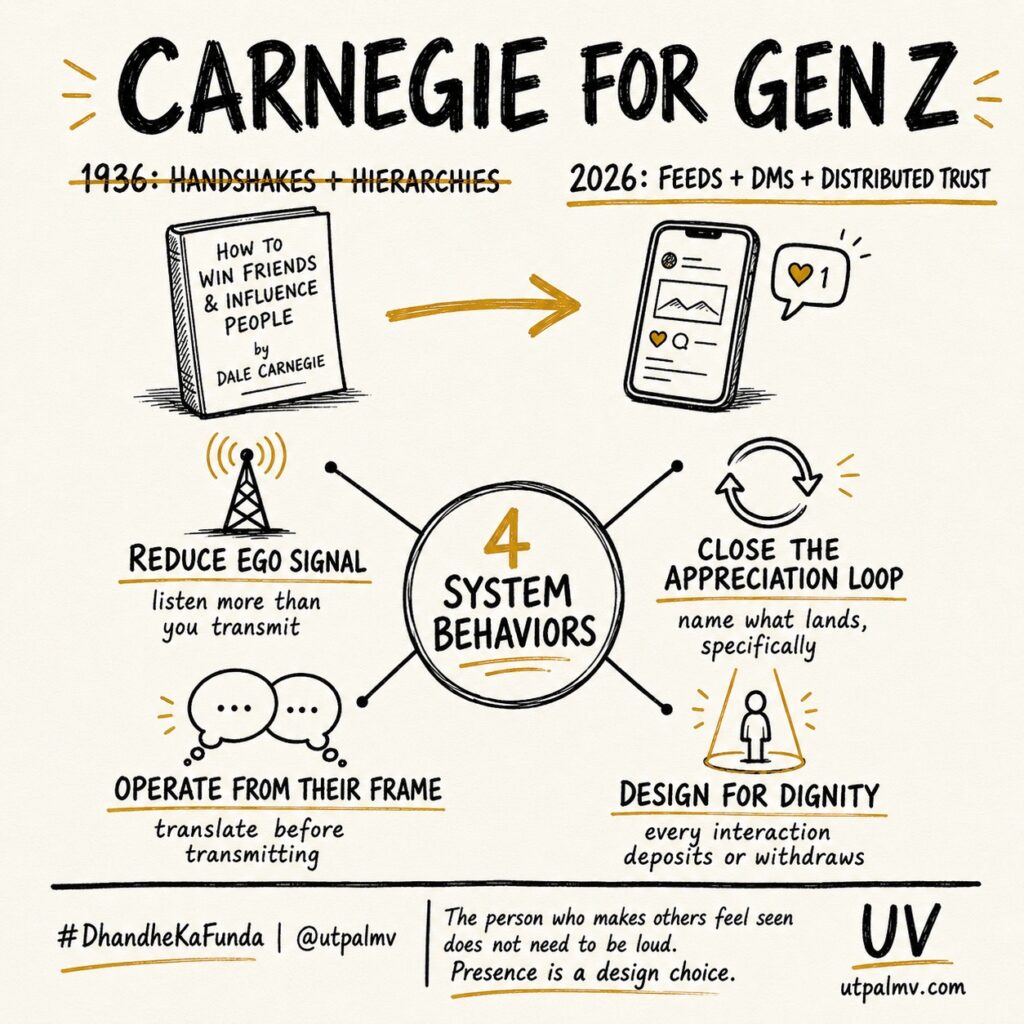
[Note from the Architect: 01st June 2026] Dale Carnegie wrote How to Win Friends & Influence People in 1936.
On May 29, 2026, I was examining how the language of “resources” shapes management.
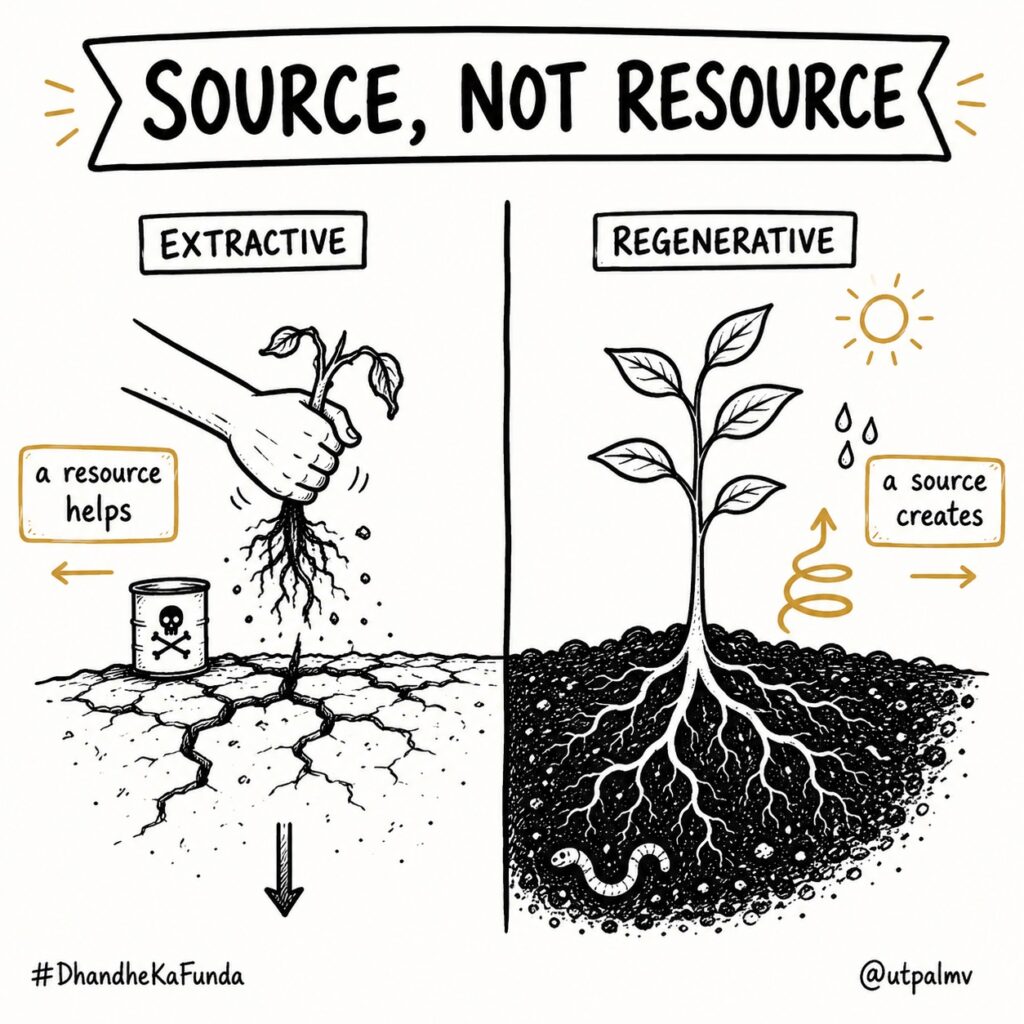
Calling people resources can make capacity visible while making personhood, judgment, and agency easier to overlook. The opposite is not to assume that everyone becomes an owner or creator when management stops suppressing them.
The farming metaphor also needs limits. Extractive and regenerative agriculture are specific practices with environmental evidence that cannot be transferred directly to people. Employees are not soil, and organizational outcomes are not harvests.
Still, the contrast suggests useful questions:
“Higher self” is personal language, not an organizational state that can be engineered. Morning reflection, evening review, empathy, purpose, and AI-assisted thinking may help in some settings. None guarantees better prompts, outcomes, creativity, or resilience.
The durable point is simpler: people are participants in creation, not supplies to be depleted.
One of the quietest joys in life is being with someone who actually enjoys you.
Not tolerates. Not includes. Enjoys.
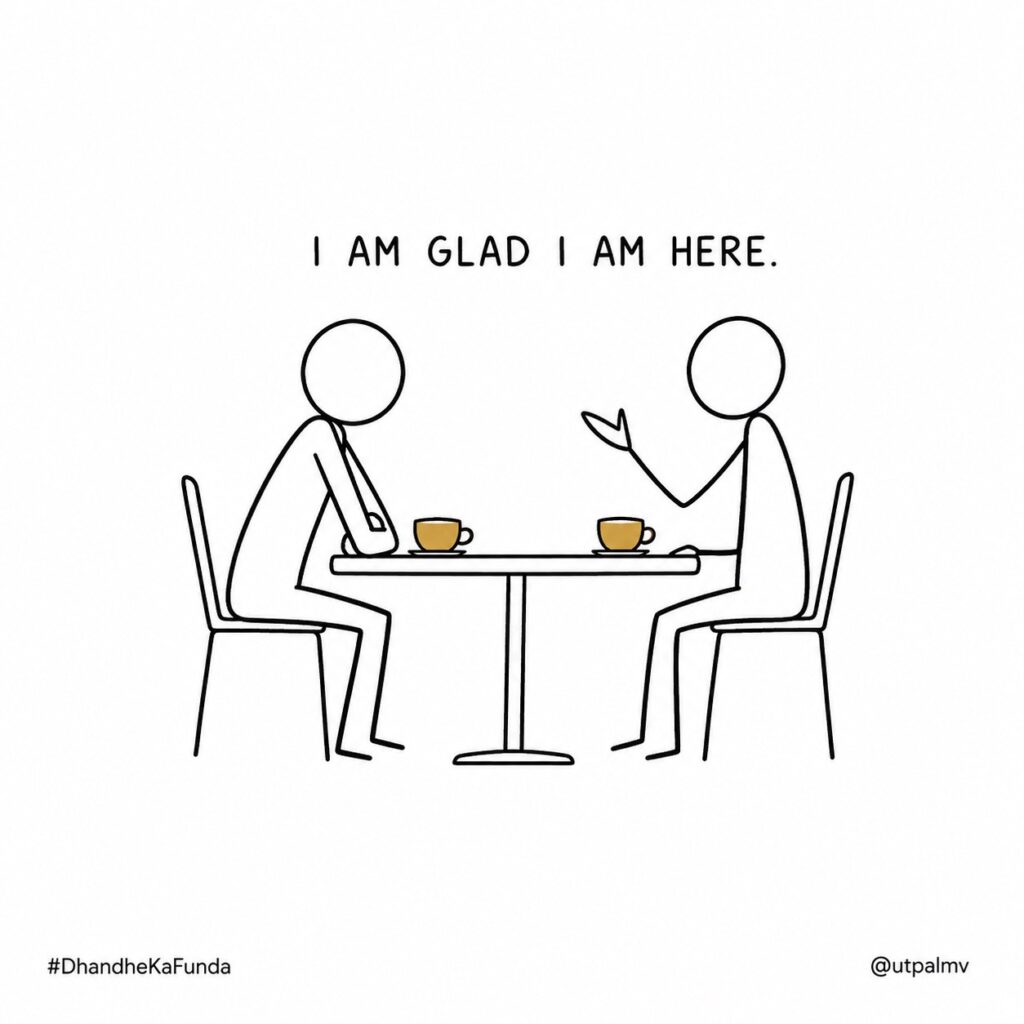
They are not with you out of habit or obligation.
They genuinely want to hear what you think. They notice the small things about you and remember them not because they are trying to impress you but because you matter to them.
The way you laugh. The things that bother you. The little opinions you have about nothing important.
Conversation with them does not feel like a performance.
You do not rehearse before speaking. You do not check yourself mid-sentence.
You just talk, and they listen, and then they talk, and you listen, and the whole thing feels effortless in a way that most things in life are not.
Their interest is not forced. You can feel the difference.
Forced interest has a texture to it. It comes with delays, with half-attention, with a faint sense that you are taking up space.
Natural interest is different. It leans in. It asks follow-up questions. It makes you feel like what you said was worth saying.
You never leave those conversations wondering if they actually wanted to be there. That question does not come up.
That is rarer than people admit. Most connection carries some degree of effort, some social friction, some quiet performance on both sides.
But when someone genuinely enjoys your presence, something drops. The guard, the edit, the low-level anxiety of not being enough.
And that kind of feeling does not hit loud. It settles in slowly.
You realize it somewhere in the middle of a perfectly ordinary conversation, when nothing special is happening and everything is fine and you think, quietly, I am glad I am here.
That is the one.
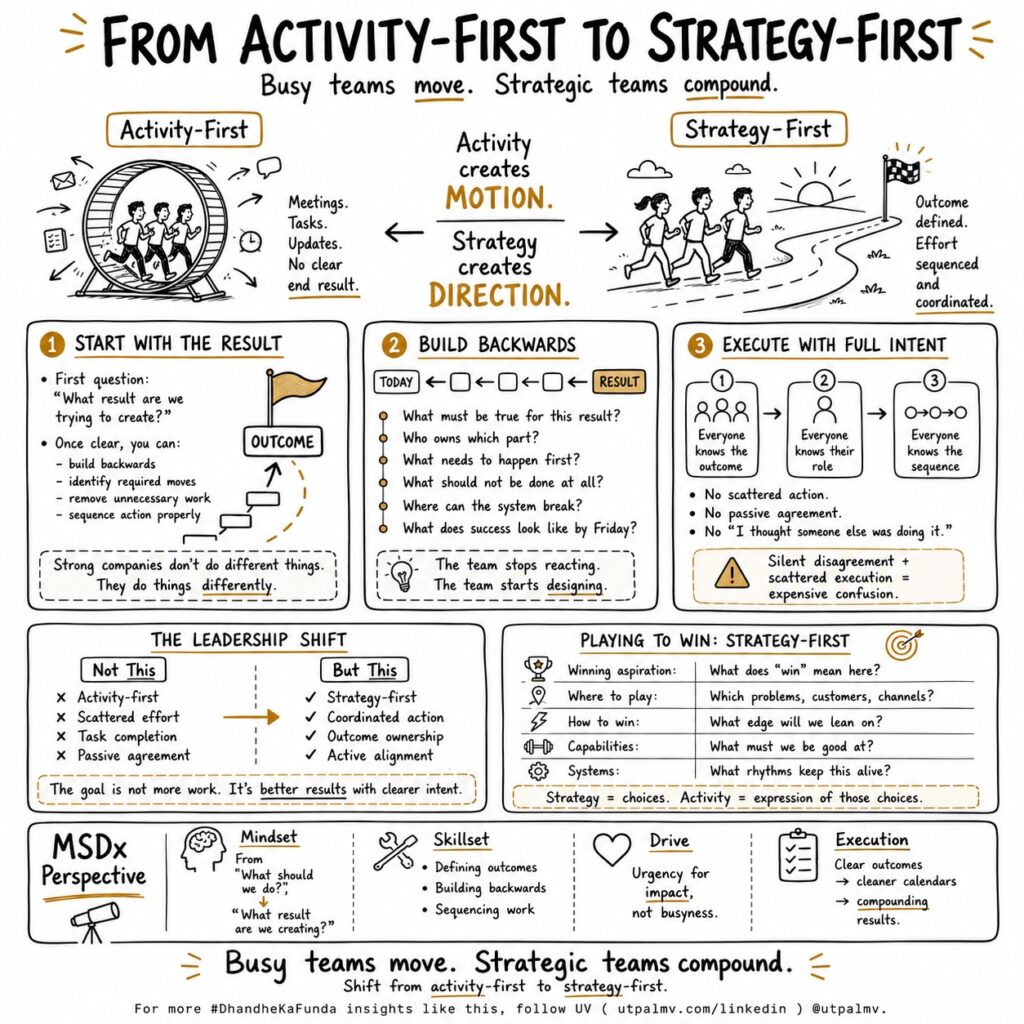
I observe one clear pattern. Most work is activity-first. People start doing before they define what winning looks like. Meetings happen. Tasks move.
On April 29, 2026, I was thinking about founders who described an AI strategy while remaining personally distant from the tools and decisions involved.
Delegation is necessary in a company. Abdication is different. A founder does not need to be the strongest technical practitioner, but a consequential shift cannot be governed responsibly through summaries alone.
The useful distinction is between an open loop and a closed one. In an open loop, work is completed and the evidence disappears into meetings, messages, or individual memory. In a closed loop, execution produces records that can inform the next decision.
That can mean capturing decisions, preserving useful artifacts, examining customer feedback, and making important knowledge retrievable. It does not mean feeding every conversation into an automated system. Privacy, consent, security, and context determine what should be retained and who may query it.
Personal use helps a founder understand where a tool is capable, where it fails, and what still requires human judgment. It does not make personal leadership the only valid model. Teams need domain expertise, authority to challenge the founder, and room to decide how the technology affects their work.
Token usage is also not a substitute for capital allocation. A higher API bill may indicate productive automation or simple waste. Headcount is not coordination overhead by definition, and one builder with agents does not universally replace a team. The comparison must include quality, risk, maintenance, and the labour displaced or newly required.
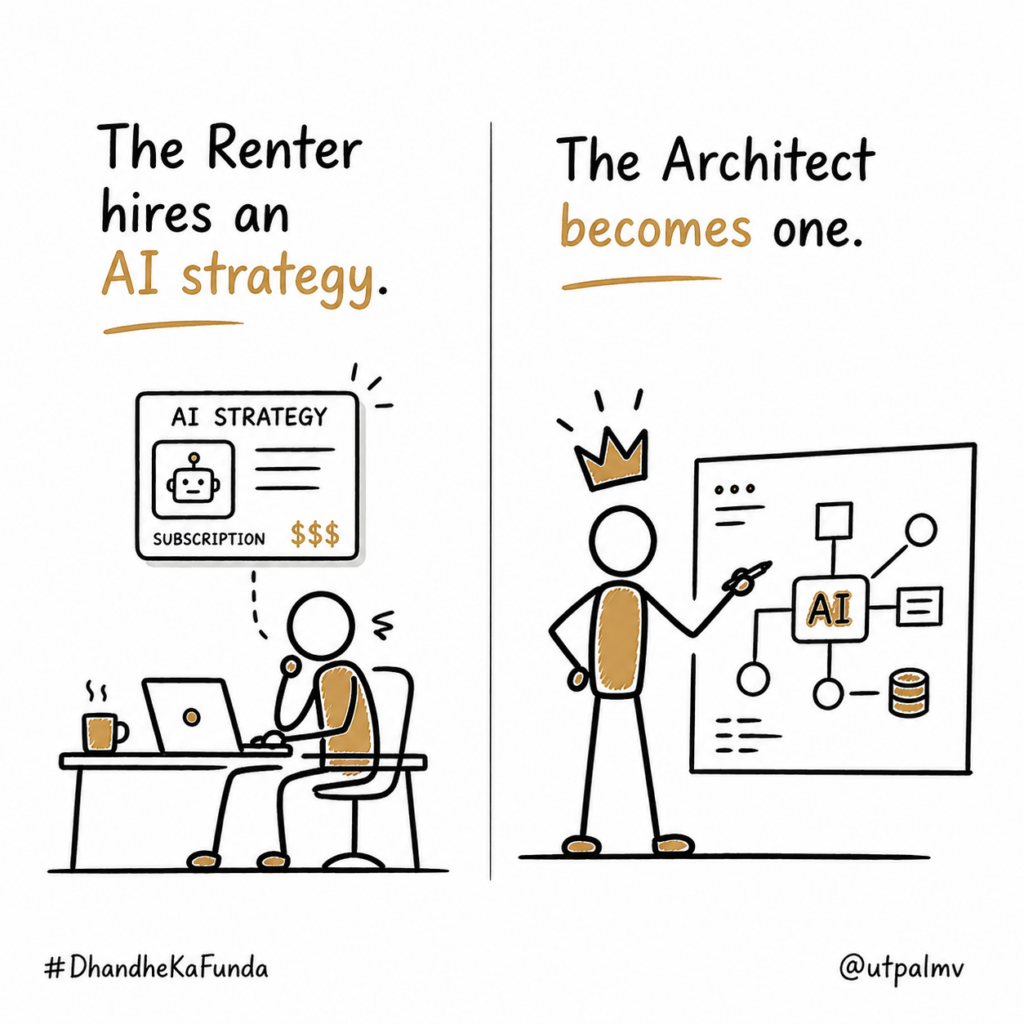
The durable point is practical fluency. Leaders should understand enough of the systems they govern to question claims, recognise trade-offs, and build feedback into the work. They can delegate implementation without delegating responsibility for the consequences.
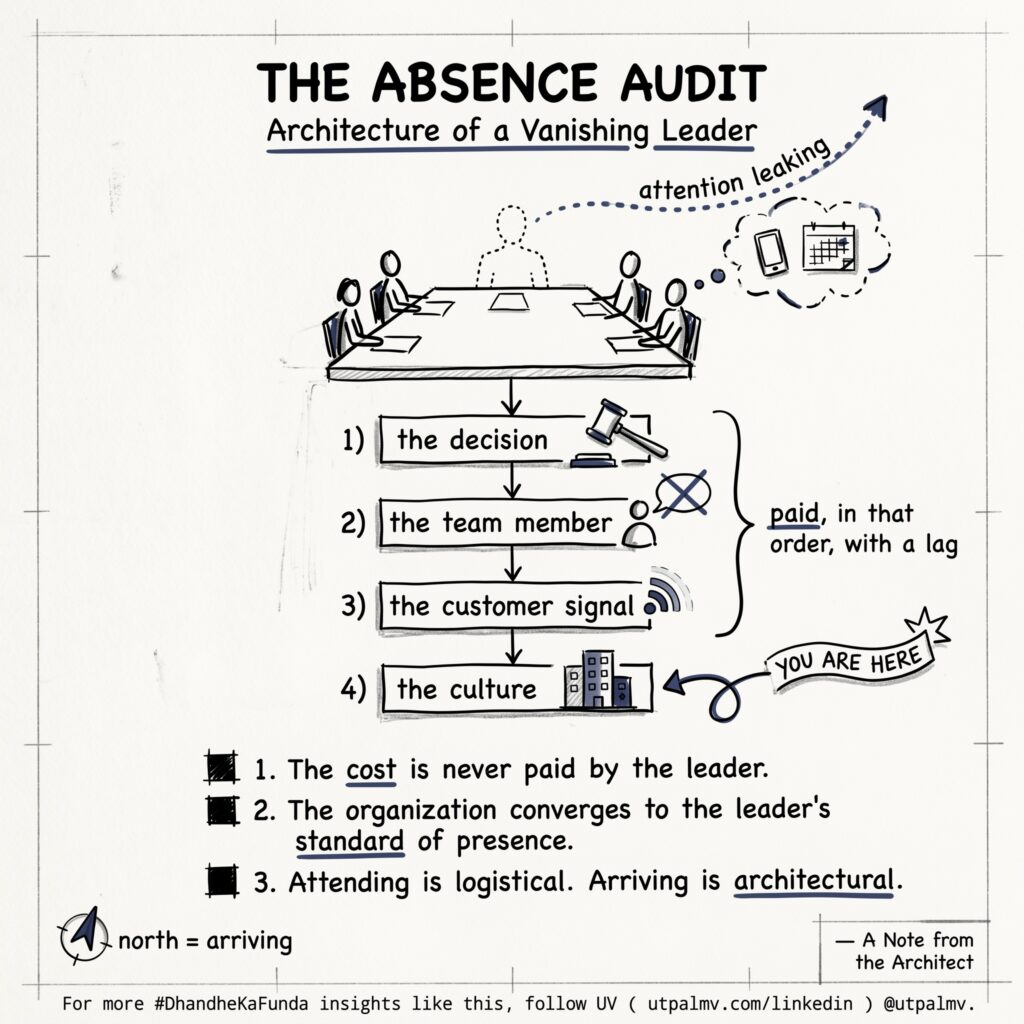
[A Note from the Architect] On April 23, 2026, I am auditing a specific failure of leadership presence. The failure is quiet, structural, and expensive.
Two people can describe the same disagreement accurately and still misunderstand what is at stake for each other. One is discussing a delayed reply. The other is defending the space needed to finish a difficult day.
Entering another person's weather means checking what the event means to them before deciding that your interpretation explains it.
Ask what they understood, what mattered to them, and what they feared would happen next. Then offer your interpretation back in language they can correct.
“It sounds as though the silence felt like being left alone with the decision. Have I understood that?” is an invitation to clarify. “You always need reassurance” closes the explanation before the other person can contribute.
This is an illustrative conversation, not a claim about how any particular person feels.
Understanding someone does not require agreeing with their demand. You can recognize why a reply mattered and still explain why immediate availability was not possible.
Try this in an ordinary disagreement where both people are willing to talk. Before proposing a solution, each person states the other's concern and lets them correct it. Notice whether the proposed solution changes after that correction.
The practice has failed if it becomes an exercise in guessing hidden motives or securing compliance. It also cannot make an unsafe interaction safe merely through better wording. Participation and boundaries still matter.
The aim is a more accurate conversation, not a promise that empathy will resolve the conflict.
This work develops the concern in “Inside Their Weather,” published on 2026-04-16.
On April 13, 2026, I was examining a distinction associated here with Keith Rabois and Khosla Ventures: people who can carry an ambiguous objective to an outcome, and people who execute well within clearer direction.
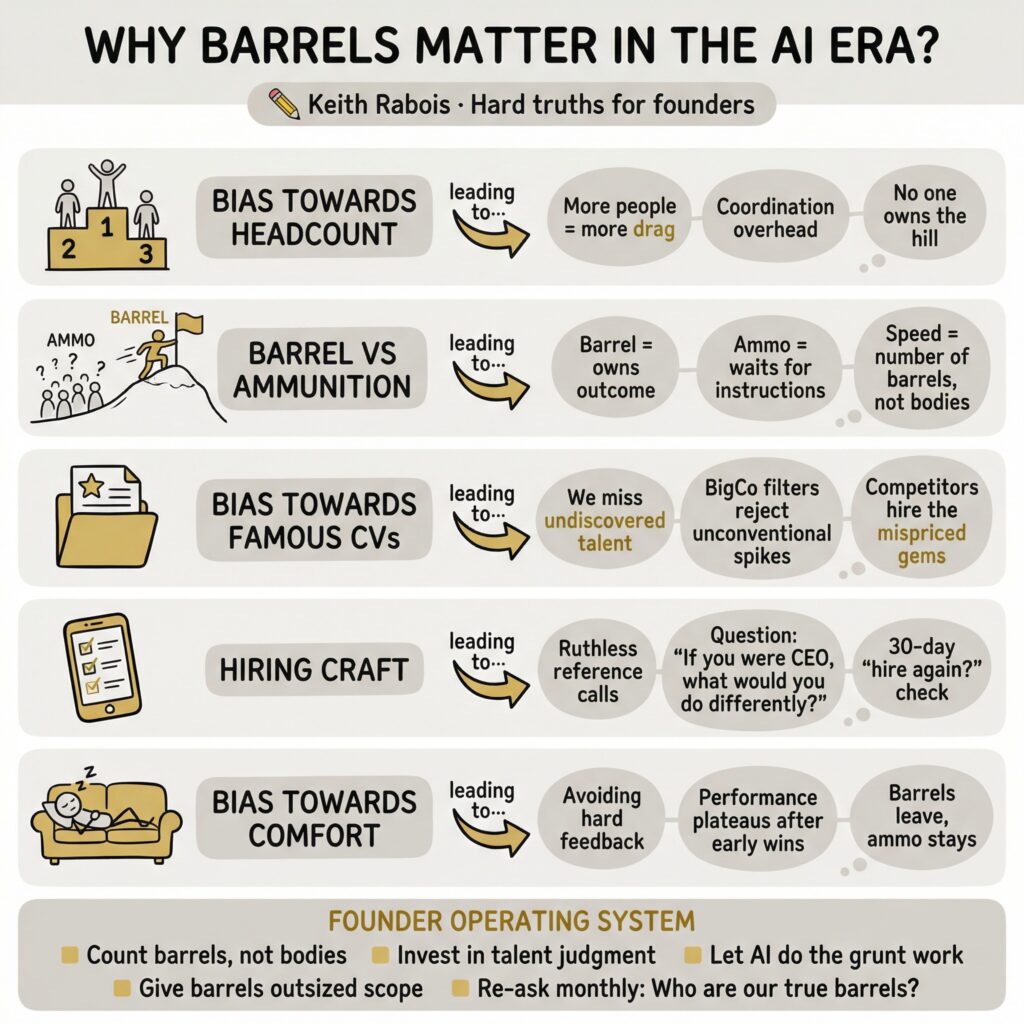
The “barrel” and “ammunition” language is memorable but dehumanizing. People move between levels of ownership according to experience, authority, support, role, and context.
Hiring and development can still examine:
AI may reduce some procedural work, but document-heavy tasks do not automatically belong to AI, and judgment remains subject to verification. No scaling law connects the number of outcome owners to quarterly output.
The source’s EightQor and UAE transition language does not provide a concrete event needed to understand the model, so it is not carried forward.
On April 12, 2026, I was reviewing ten elements that can strengthen a strategy.
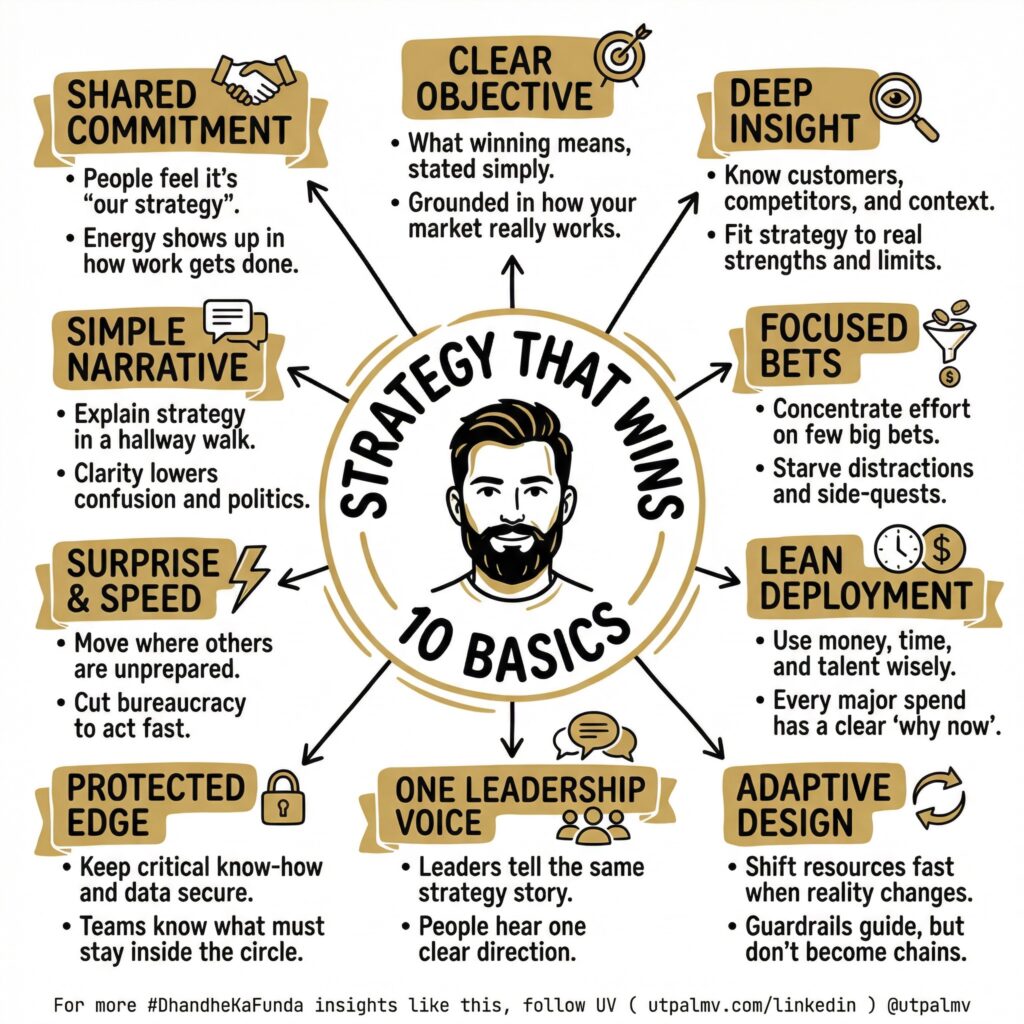
They include a clear objective, market insight, a simple narrative, focused bets, careful deployment, appropriate speed, shared commitment, leadership alignment, protection of sensitive advantage, and adaptation when evidence changes.
These are considerations, not laws or a clinical protocol for victory. A strategy may need more than 30 seconds to explain. Surprise and speed can create risk. Leadership disagreement can be productive when it remains visible and governed.
The useful test is whether people understand the choices, constraints, responsibilities, and evidence well enough to act and revise.
On April 11, 2026, I was trying to connect several frameworks I had been developing. The useful structure was not an operating system for existence. It was a three-layer review of thought, relationships, and execution.
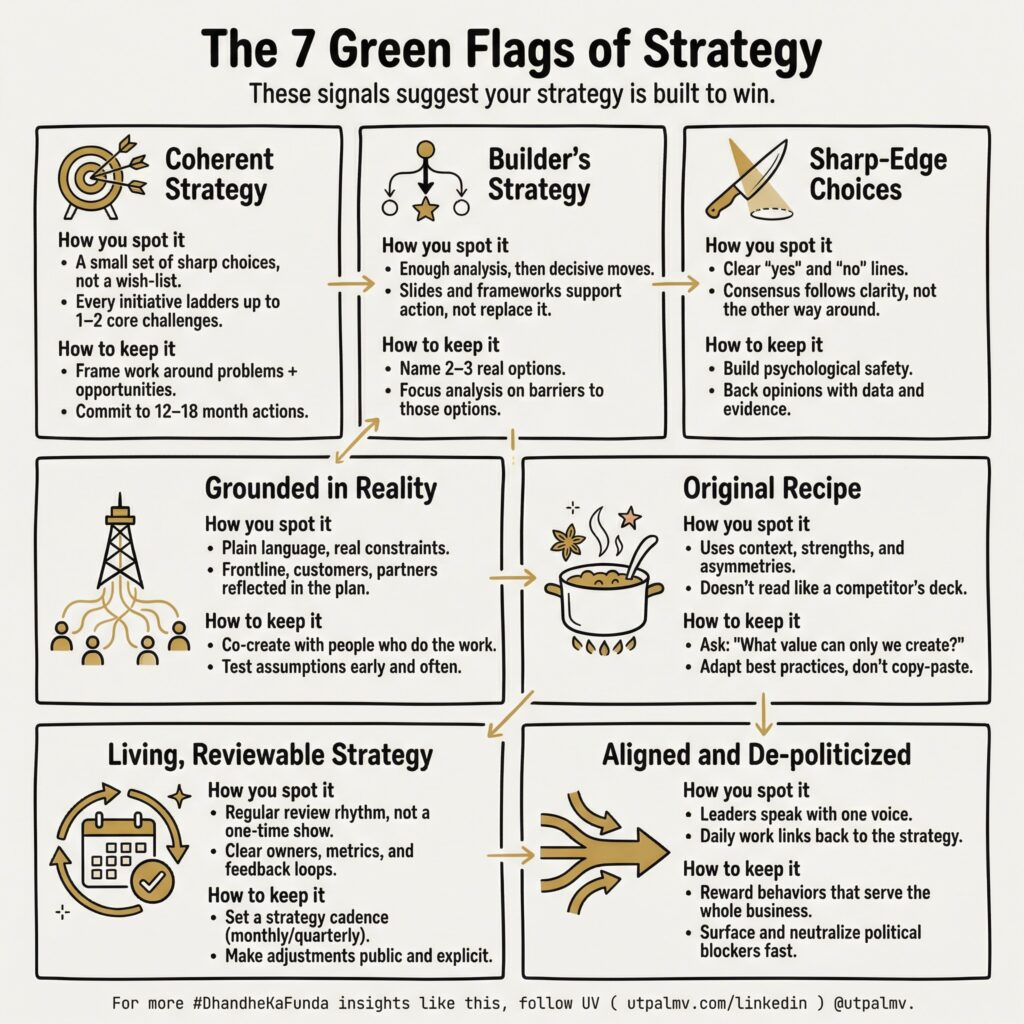
Examine the mental model behind a decision. Use critical-thinking prompts, notice familiar thinking traps, and distinguish confidence from evidence.
Consider character, empathy, listening, reliability, and the effect of behaviour on other people. Leadership does not belong only to a formal position.
Connect direction with execution. Clarify decision and delivery roles, test the strategy against evidence, and revise the tools when they no longer serve the work.
The layers interact, but no framework guarantees leverage or prevents collapse. Start with the layer where the evidence shows the most consequential weakness.
Strategy is not finished when the deck is approved. It remains a loop between intention, evidence, action, and revision.
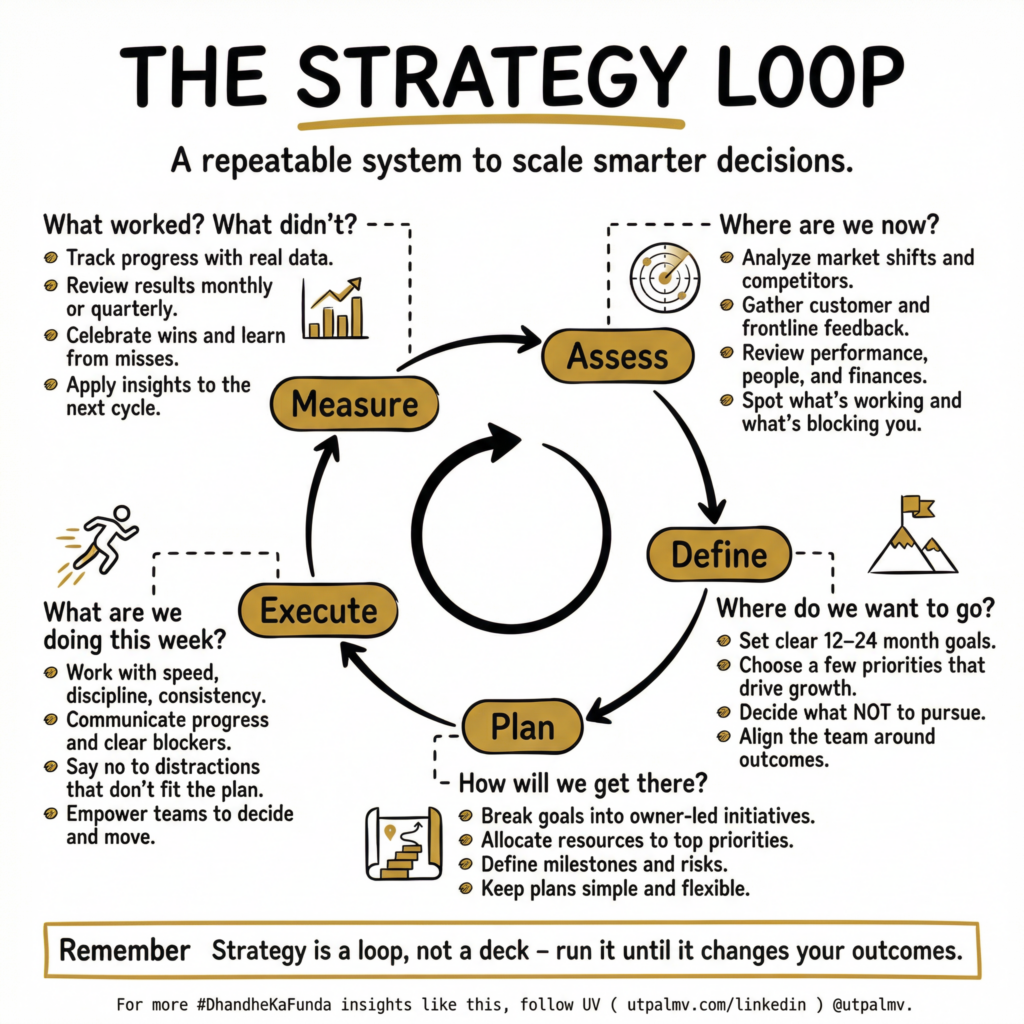
Faster cycles are not automatically better. Run the loop at the speed required to learn without making the evidence meaningless.
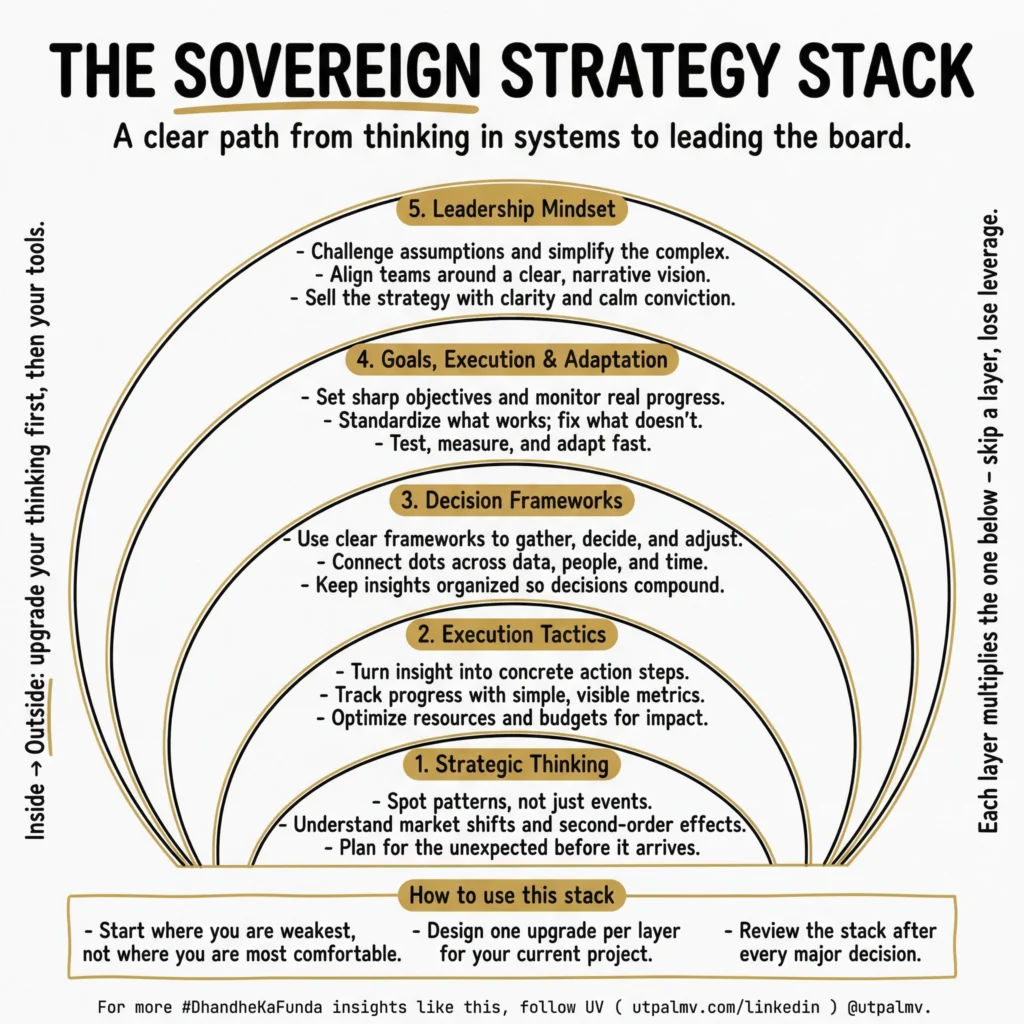
Tools can improve execution, but they cannot decide which problem deserves attention.
On March 23, 2026, I was reflecting on behaviours that can contribute to respect.
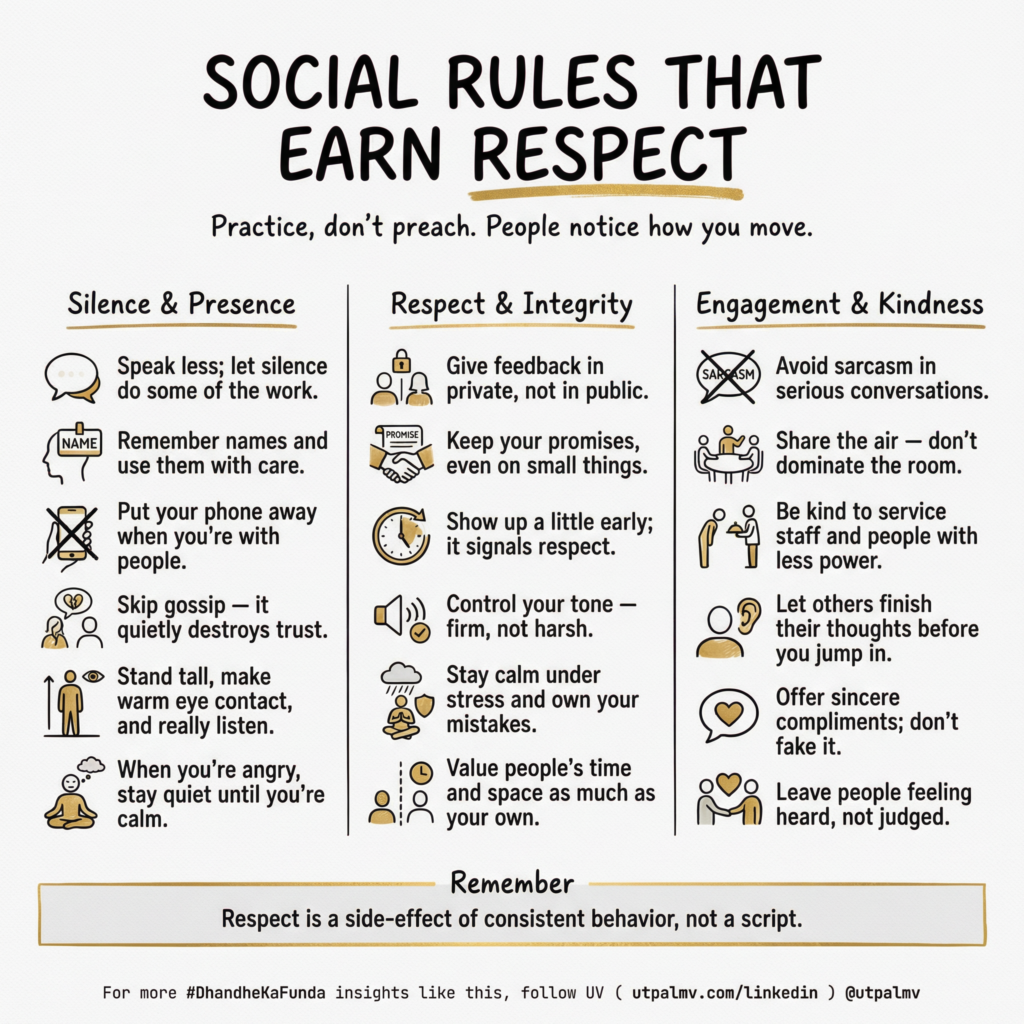
Respect is neither a script nor a guaranteed output. It is shaped by behaviour, role, history, culture, power, and the judgment of other people.
Several practices remain useful:
Consistent conduct can earn trust. It does not entitle anyone to respect.
Logic still needs a bridge.
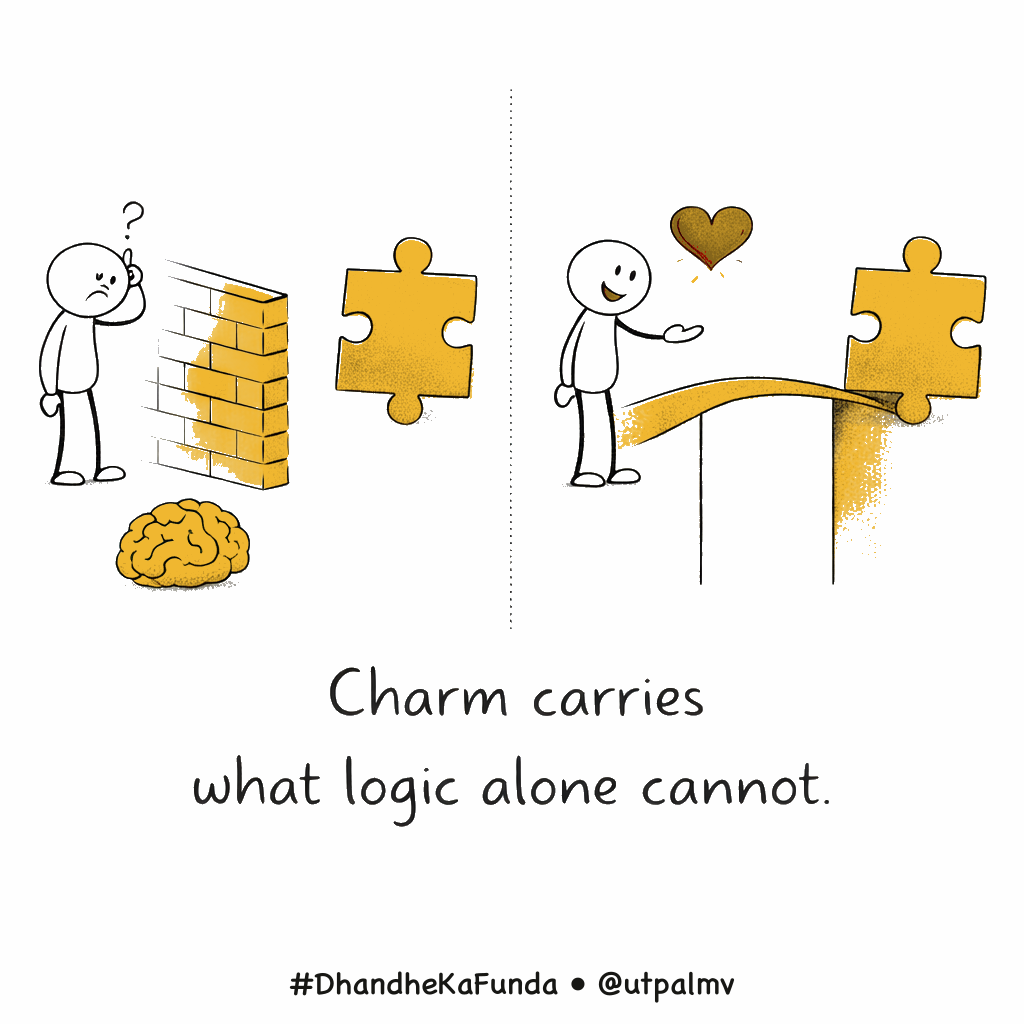
A sound idea can fail to travel when it is delivered without warmth, timing, or regard for the person receiving it. This does not make the idea less sound. It means that communication is not a simple transfer of correct sentences from one mind to another.
People listen through context. They notice whether we understand what is at stake for them, whether the moment is suitable, and whether our certainty leaves room for their knowledge. Even a precise argument can provoke resistance when it arrives as a verdict. A less polished person may be heard because the conversation feels human and the listener can find a way into it.
I use charm here carefully. I do not mean performance, manipulation, or the ability to make weak thinking attractive. Charm without substance can win attention and still leave everyone with a poor decision. Nor should warmth become an excuse to avoid disagreement. Some truths remain uncomfortable after the best possible delivery.
The bridge is simpler: respect the person enough to make the reasoning reachable. Ask before assuming. Use an example that belongs to the listener's world. Notice whether the conversation needs evidence, a question, or time. Say the difficult part plainly, but do not make harshness a proof of honesty.
This matters particularly when expertise creates distance. The person who knows a subject well can forget how many intermediate steps have become automatic. What feels obvious to the speaker may still be inaccessible to everyone else. Rebuilding those steps is not dilution. It is part of the work.
Charm cannot rescue weak thinking. It can help good thinking become understandable. Logic establishes whether an idea deserves to travel. The relational bridge determines whether it has a fair chance of arriving.
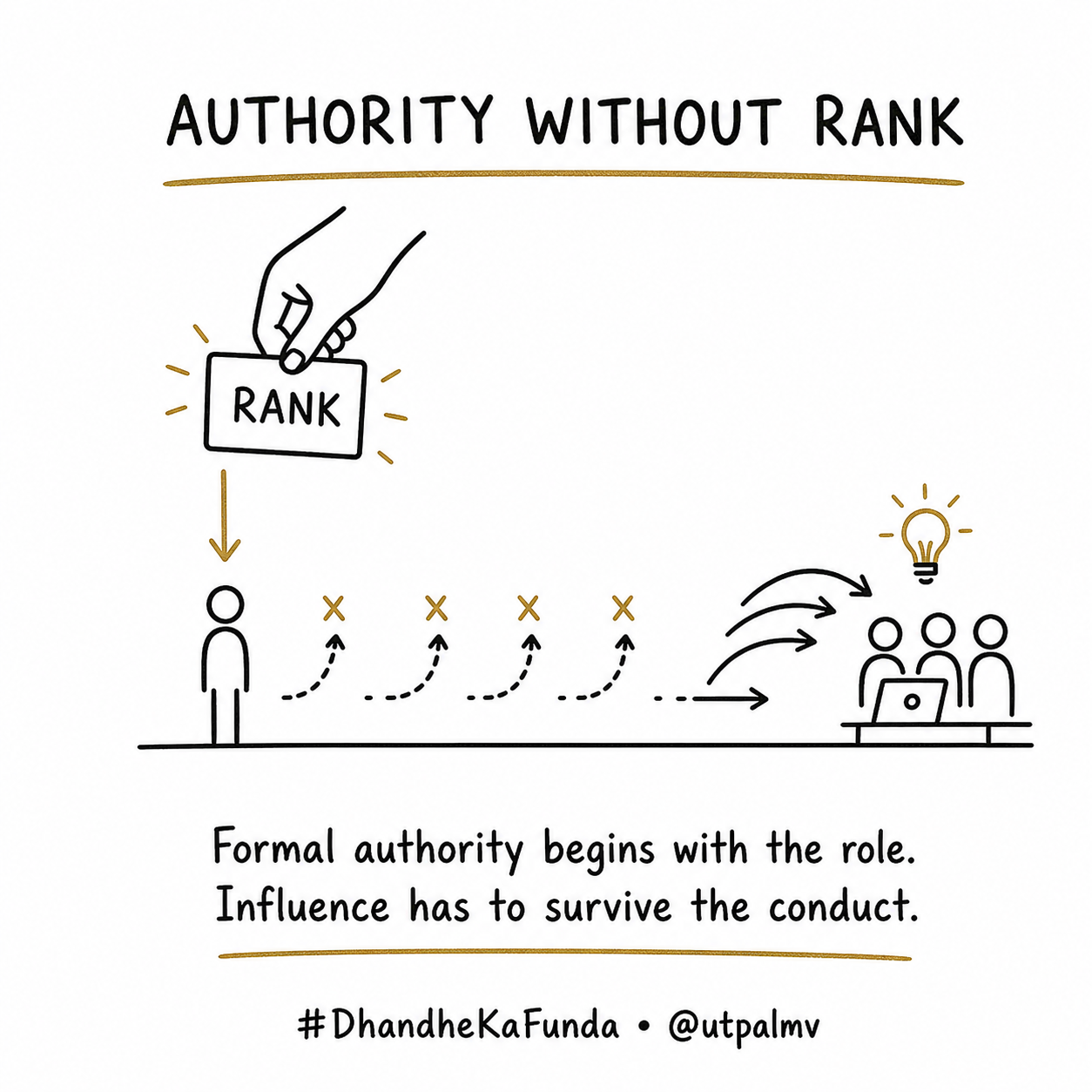
In 2023, I brought a CXO into my team to lead a significant business function.
His title gave him full formal authority. The second line of leaders still did not respect him much. They spoke about him behind his back. When a critical business situation appeared, they looked toward other leaders rather than the person formally responsible for the function.
His intentions were genuine. That was never the problem.
He was also capable. When he took up a piece of work, he often handled it skillfully and in the right way. But he spent too much time cribbing about why something did not make sense. He was highly risk-averse and showed less agency than the role required. Pressing work was sometimes avoided or bypassed before it was eventually handled.
The gap was not competence alone. It was whether the team believed he would stay with a difficult situation when the path was unclear.
A title can settle reporting lines. It can give someone the right to approve, allocate, or direct. It cannot make people trust that person's judgment when the situation falls outside the prepared process. That trust comes from repeated conduct.
In this case, the conduct gradually unearned the influence that the rank was supposed to support. People complied when the title could enforce attention. They looked elsewhere when they needed someone to help them make sense of uncertainty.
When he moved on, the team was happy about it. That is uncomfortable to write because he was not malicious, lazy, or without skill. He was simply a poor fit for what that role demanded in that situation.
We did not replace him with another person carrying the same title. We restructured the business function differently.
The experience changed how I think about authority without rank. The function did not merely need someone who could exercise power from the top of an organization chart. It needed authority that would remain useful across situations, especially when there was no title available to enforce attention.
Formal authority begins with the role. Influence has to survive the conduct.
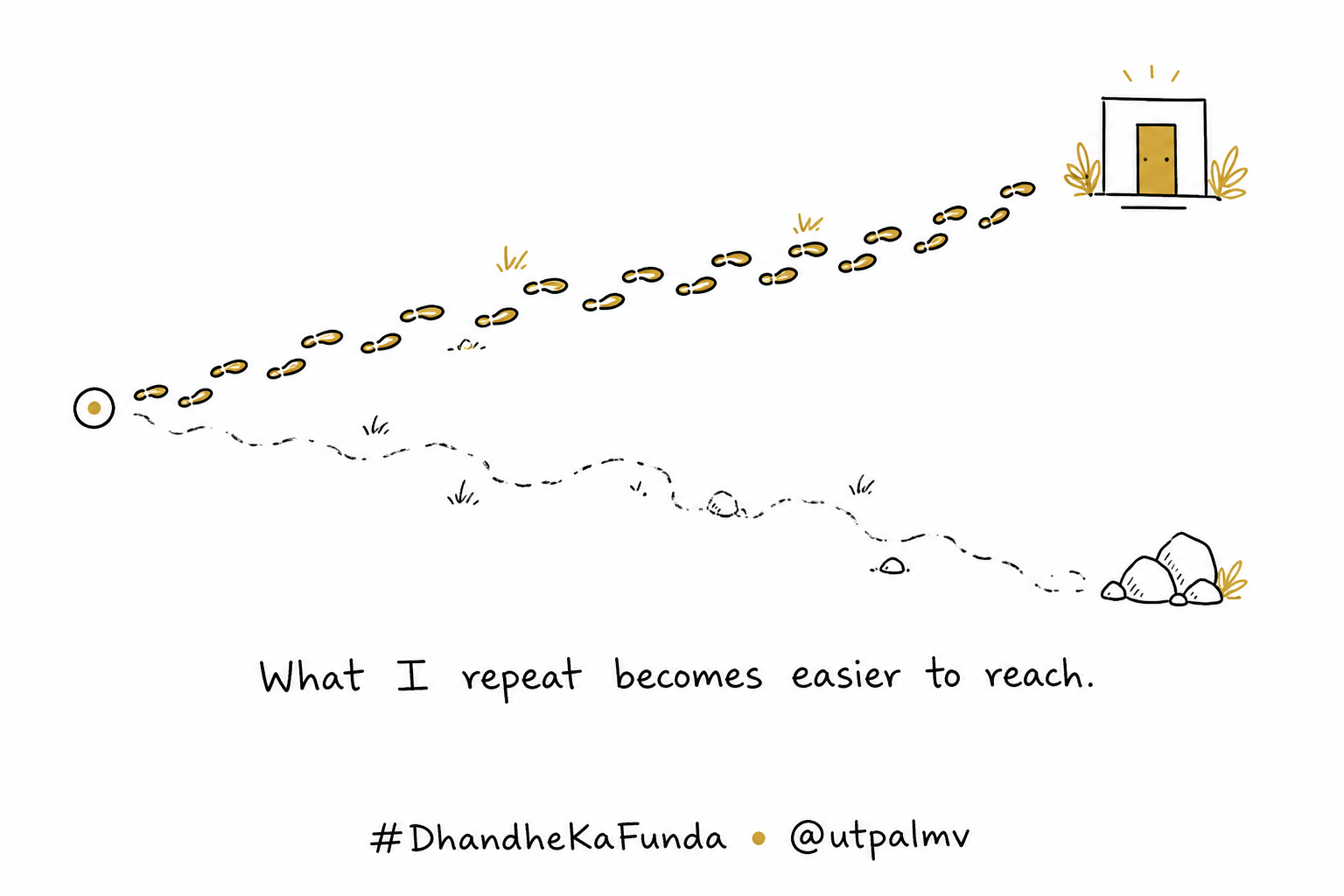
I have noticed that repetition does more than improve a skill. It also makes a response easier to reach.
If I repeatedly meet uncertainty with distraction, distraction becomes available quickly. If I repeatedly return to a difficult piece of work, beginning becomes less dramatic. The same seems true of attention, physical practice, and the way I respond under pressure.
I do not think this means a person can simply choose away every limitation. Biology, health, circumstance, and past experience matter. Calling fragility a choice, as the earlier version of this note did, was too absolute. It turned a useful observation into blame.
The useful part is smaller.
I can influence what I practice. I can make one behavior easier to begin by reducing the number of decisions around it. I can notice when I am rehearsing the very response I say I want to change. I can increase difficulty gradually instead of confusing intensity with progress.
Recovery matters too. Sleep and rest are not the opposite of practice. They are part of whether practice can continue. When I ignore that, I may still produce effort, but I am less certain that I am building anything durable.
This is not a five-step protocol for rewiring a brain. It is a reminder to look at repetition honestly.
What am I making easier through use? What am I strengthening because it is familiar? Which environmental cue keeps pulling me toward the same response? What is one small repetition I can make more available instead?
Those questions keep the work at a scale I can observe and use. I cannot control every condition under which I act, but I can pay attention to what I repeatedly practice inside those conditions.
I have sometimes confused empathy with taking another person’s distress into myself.
The impulse looks caring. If someone is anxious, disappointed, or overwhelmed, I try to feel the situation from inside their experience. That can help me notice what a detached reading would miss. It can also leave me less able to listen, because my attention shifts from what they are living to what their emotion is doing to me.
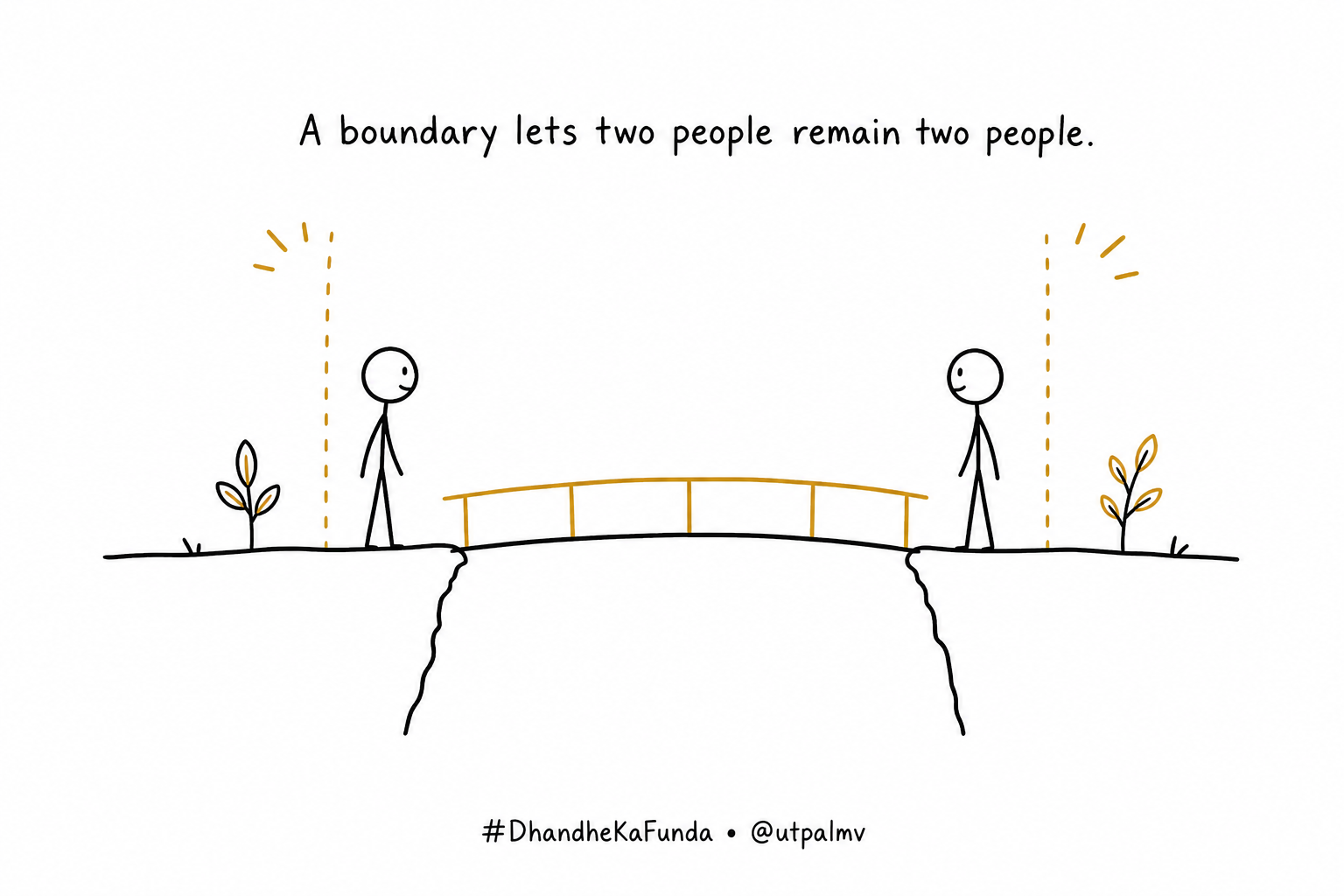
The distinction I am learning is between contact and absorption.
Contact means staying close enough to understand something of the other person’s context, words, and constraints. Absorption means treating my version of their feeling as if it were theirs, then carrying it as my responsibility. The first can support care. The second can produce confusion, resentment, or a rescue they did not ask for.
A boundary does not make empathy cold. It lets two people remain two people.
In practice, that may mean asking rather than assuming: What happened? What matters most right now? Do you want listening, help thinking, or a concrete action? It may mean acknowledging an emotion without claiming to know its depth. It may also mean being honest about what I can offer and what I cannot.
This is not only a leadership matter. Rank does not give one person the role of stable anchor and everyone else the role of emotional weather. A colleague, friend, founder, or team member may need support and may also have resources, choices, and knowledge that I do not see.
There are moments when I will still be affected. Boundaries are not impermeability, and composure is not proof of wisdom. If the situation overwhelms my capacity, I may need help or distance before I can be useful.
The aim is not to avoid feeling. It is to remain present without converting another person’s experience into my identity or project. Empathy becomes more honest when it includes both connection and separation.
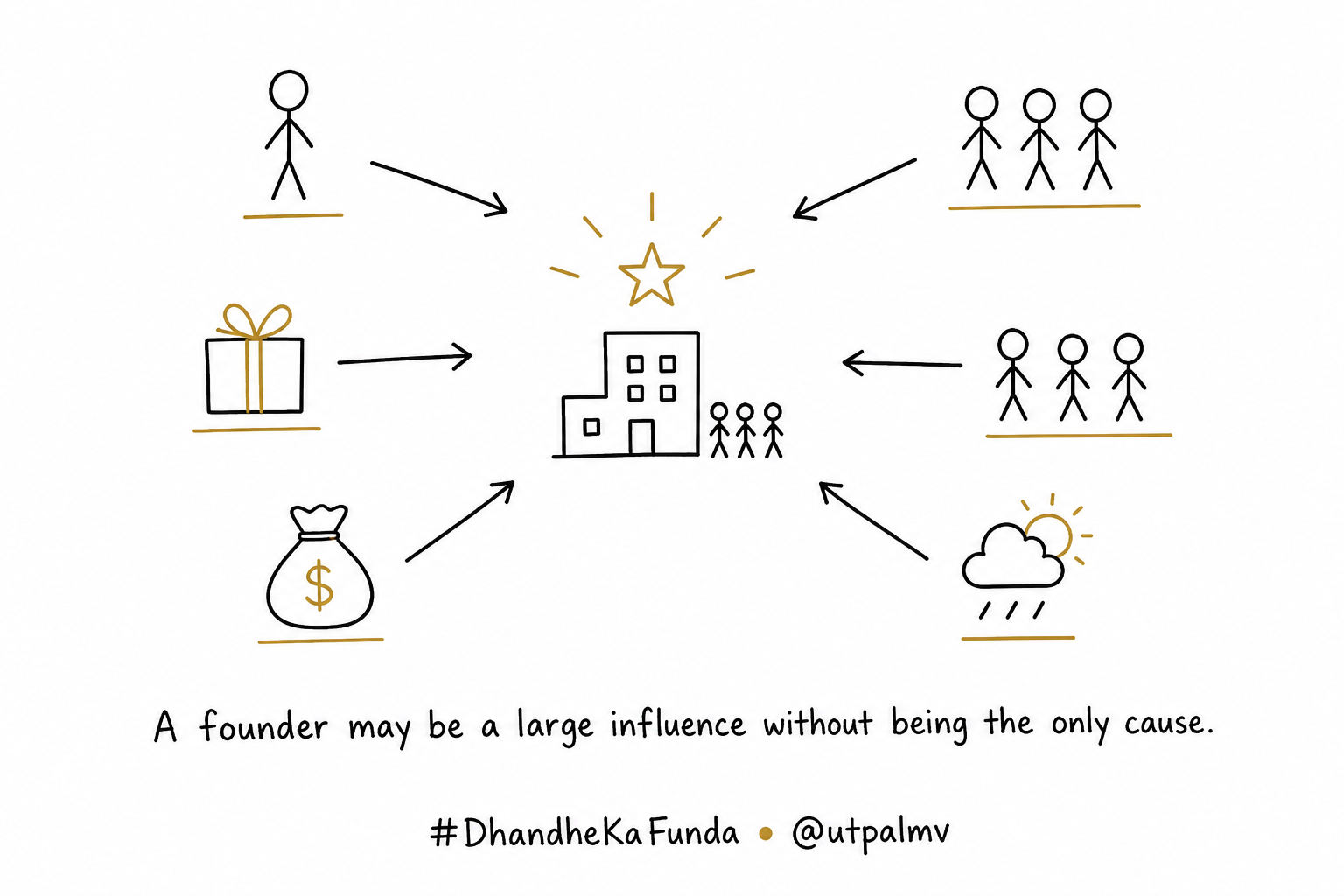
On March 14, 2026, I wrote that a founder cannot hire their way out of their own flaws. I was trying to name a real pattern: behavior at the top can travel through an organization.
What a founder rewards, tolerates, avoids, and repeats affects decisions elsewhere. If I punish bad news, I should not be surprised when information arrives late. If every important choice waits for me, hiring more people will not create autonomy. If I speak about focus while changing direction every week, the contradiction becomes part of the working environment.
The metaphor of a founder as source code goes too far, though. A company is not a faithful execution of one person’s character. It is shaped by colleagues, customers, investors, incentives, law, history, luck, and material conditions. Employees interpret, resist, repair, and create. Sometimes they protect the organization from the founder.
That distinction matters because self-examination can become vanity in another form. If I assume every result mirrors me, I remain at the center even while appearing to take responsibility.
The more useful audit is specific. Which decisions require my approval? What behavior am I rewarding through attention, money, or access? Where does the team have authority in name but not in practice? What evidence connects my conduct to the outcome I am concerned about? What part belongs to another cause?
Character matters, especially when power makes one person’s habits expensive for others. Integrity is visible when it costs something, but cost alone does not prove integrity. Confidence may steady a difficult moment, but certainty can also suppress necessary doubt. Purpose can orient decisions, but it cannot replace clear roles, safe disagreement, and competent execution.
I remain one influence on the company, sometimes a large one. My responsibility is to understand that influence without mistaking it for total authorship. The organization becomes healthier when its ability to notice and correct problems does not depend on the founder first correcting himself.
On March 11, 2026, I was examining how practice and evidence affect confidence.
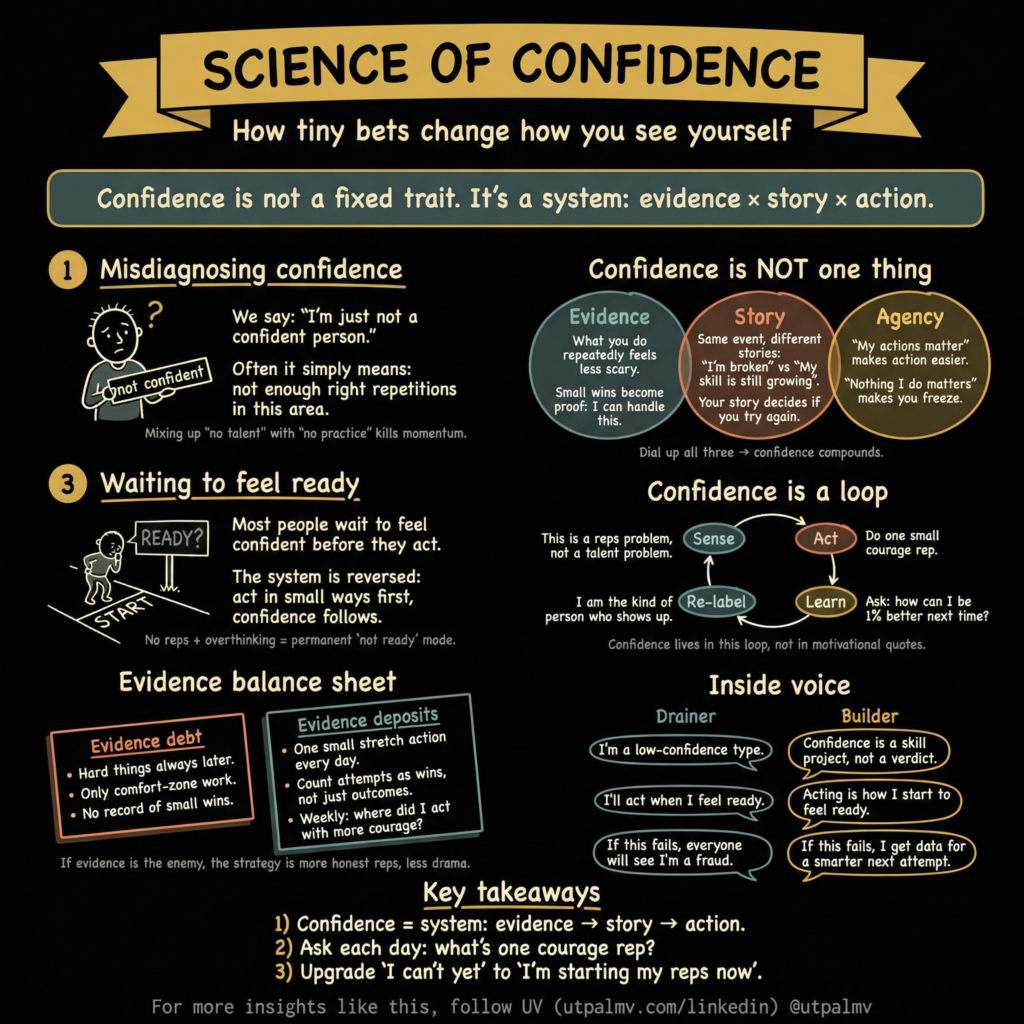
Confidence is not a calculated product of evidence, story, and action. It is also shaped by context, past experience, health, power, support, and the consequence of being wrong.
Practice can still help:
Action does not always produce confidence, and survival is not proof that a risk was wise. The loop is a way to learn, not engineer certainty.
Systems thinking begins by resisting the urge to solve the problem too quickly.
On March 10, 2026, I was thinking about how preparation and relationships affect what we later call luck.
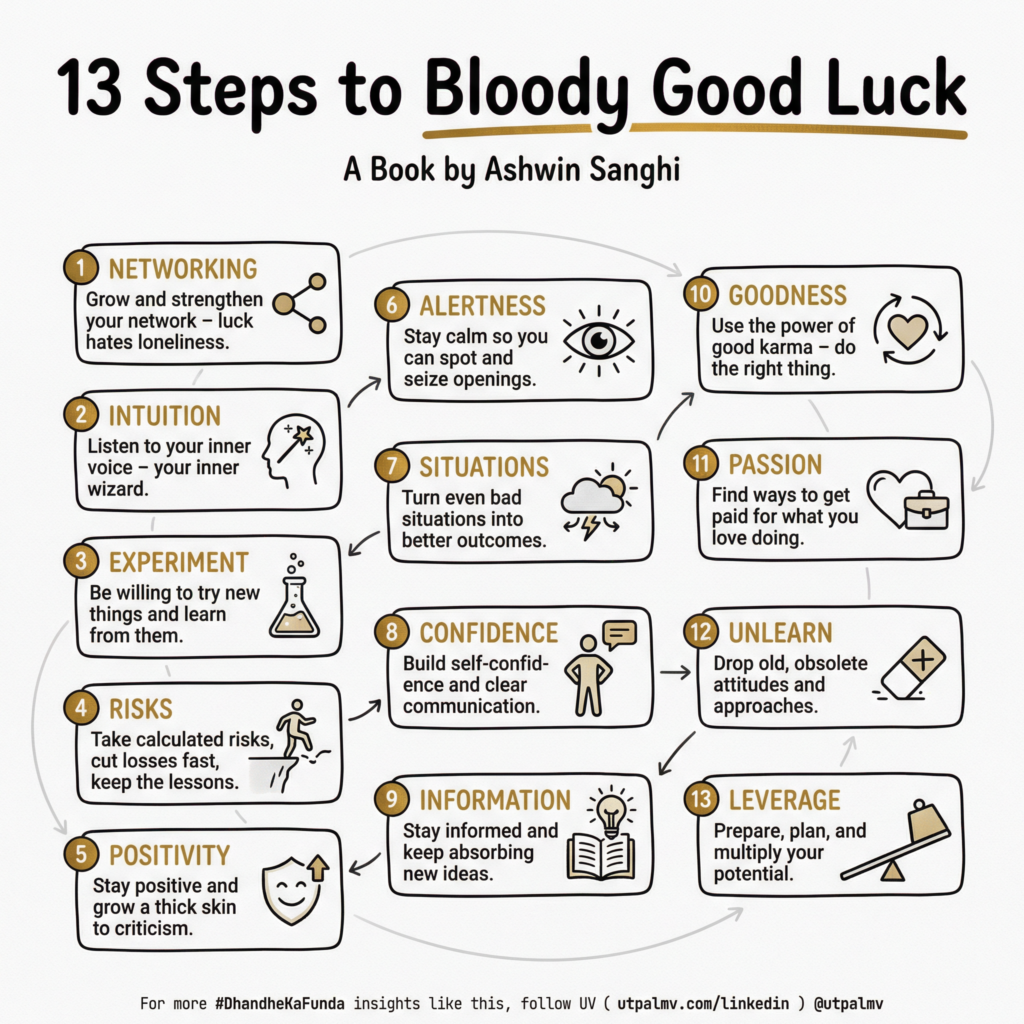
Luck is not an algorithm, and no system can engineer serendipity. Some practices can still increase exposure or readiness:
Preparation can help someone use an opportunity. It does not explain every fortunate outcome or make misfortune a positioning failure.
Relationships are often sustained through small acts.
The important moments are not always large favors or long conversations. A short thank-you can tell someone that their contribution was noticed. An introduction can connect two people who should know each other. A useful article sent without ceremony can continue a conversation that might otherwise disappear. None of these actions is remarkable. That may be why they matter.
We sometimes postpone contact until we have a substantial reason to make it. Months pass while we wait for the perfect message, the finished project, or an occasion that justifies reaching out. The relationship then has to carry the weight of our silence. A small, honest message would have been enough to keep the thread alive.
This should not become a system for extracting future value from people. Relationship advice often borrows the language of investment, returns, and networks. That language can make generosity sound like a delayed transaction: do something useful now so that the person owes you later. People usually sense when attention contains an invoice.
Gratitude is worth expressing because the contribution was real. Help is worth offering when it is genuinely useful and proportionate. The return may be immediate, delayed, indirect, or nonexistent. If the act becomes disappointing only because nothing came back, it may not have been generosity in the first place.
There are also boundaries. Keeping a relationship alive does not require constant availability or artificial familiarity. Some relationships are seasonal. Some end. Some need distance. A small act should respect the actual relationship rather than perform a closeness that is not there.
The practical standard is modest: notice what another person contributed, and acknowledge it while the memory is still alive. Share something when it truly belongs in the conversation. Make an introduction when both sides may benefit. These acts do not guarantee enduring relationships. They do make neglect less likely to be the reason a good one disappeared.
In March 2026, I was revisiting ideas from Ray Dalio’s Principles about reflection, learning, and systems.
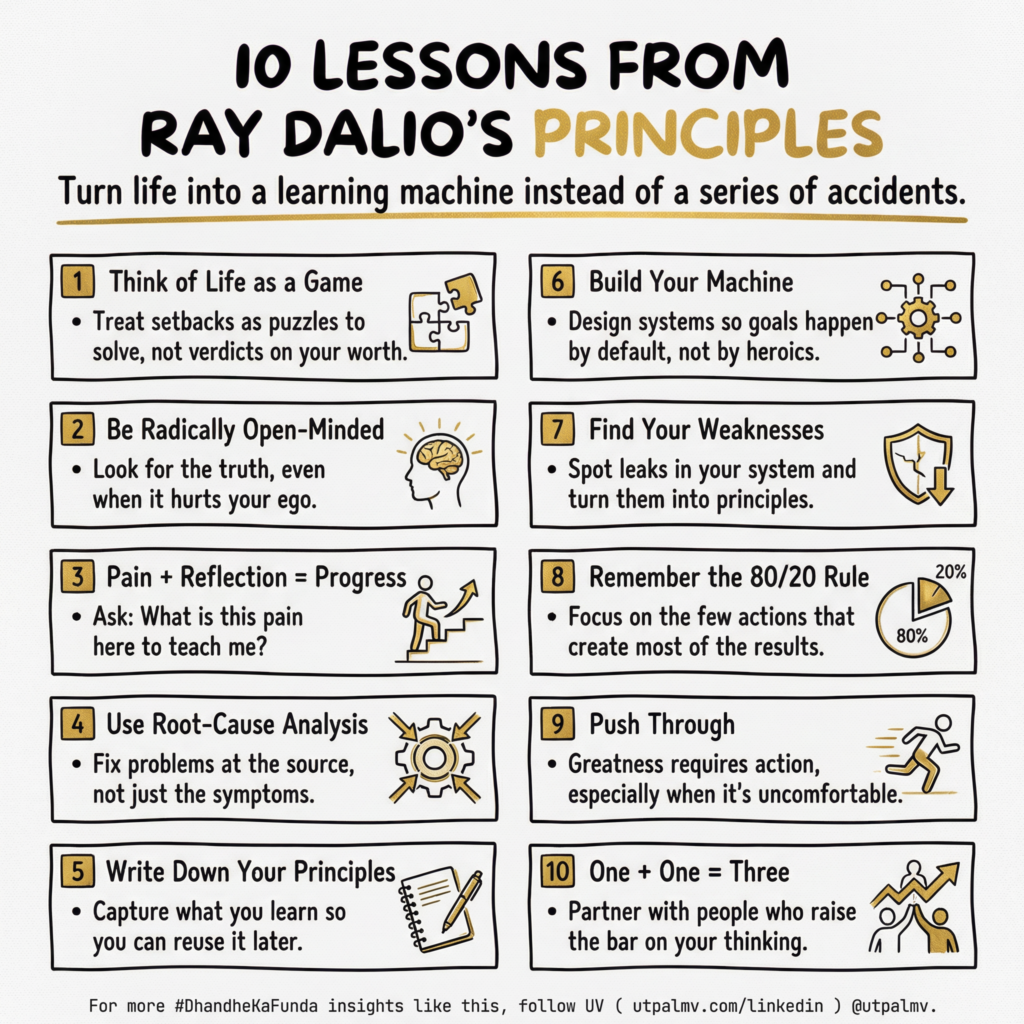
Several ideas remain useful: examine setbacks without turning them into identity, invite contrary evidence, look beyond symptoms, record principles, design repeatable processes, understand weaknesses, focus effort, and act on learning.
The formulas are metaphors. Pain plus reflection does not guarantee progress. The Pareto pattern is not universal. Collaboration does not make 1 plus 1 equal 3, and a system does not make success its default output.
A principle should remain revisable. The goal is not to become unnecessary, but to prevent the work from depending on avoidable heroics or hidden knowledge.
In March 2026, I noted that all-or-nothing thinking was a recurring trap for me. The broader list came from common descriptions of cognitive distortions.
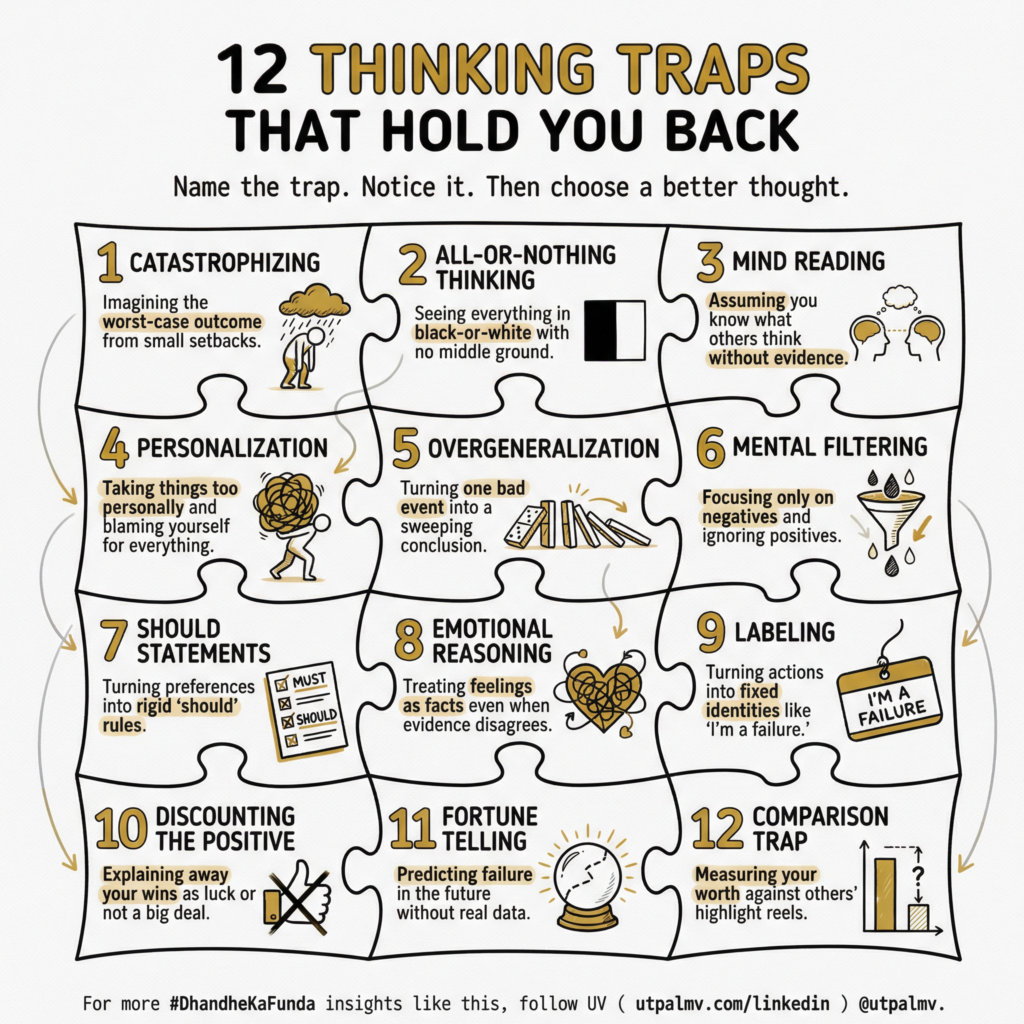
The list includes catastrophizing, all-or-nothing thinking, mind reading, personalization, overgeneralization, mental filtering, rigid “should” statements, emotional reasoning, labeling, discounting positives, fortune telling, and unhelpful comparison.
Naming a pattern may create distance from it. It does not seal a leak, override emotion, or prevent harm. Context matters, and persistent distress may deserve qualified support rather than self-debugging language.
For me, the practical sequence is modest: notice the thought, test it against available evidence, consider another interpretation, and choose the next proportionate action.
In 1997, I moved away from the CA and CS path I had been following. That experience made me more attentive to assumptions presented as obvious.
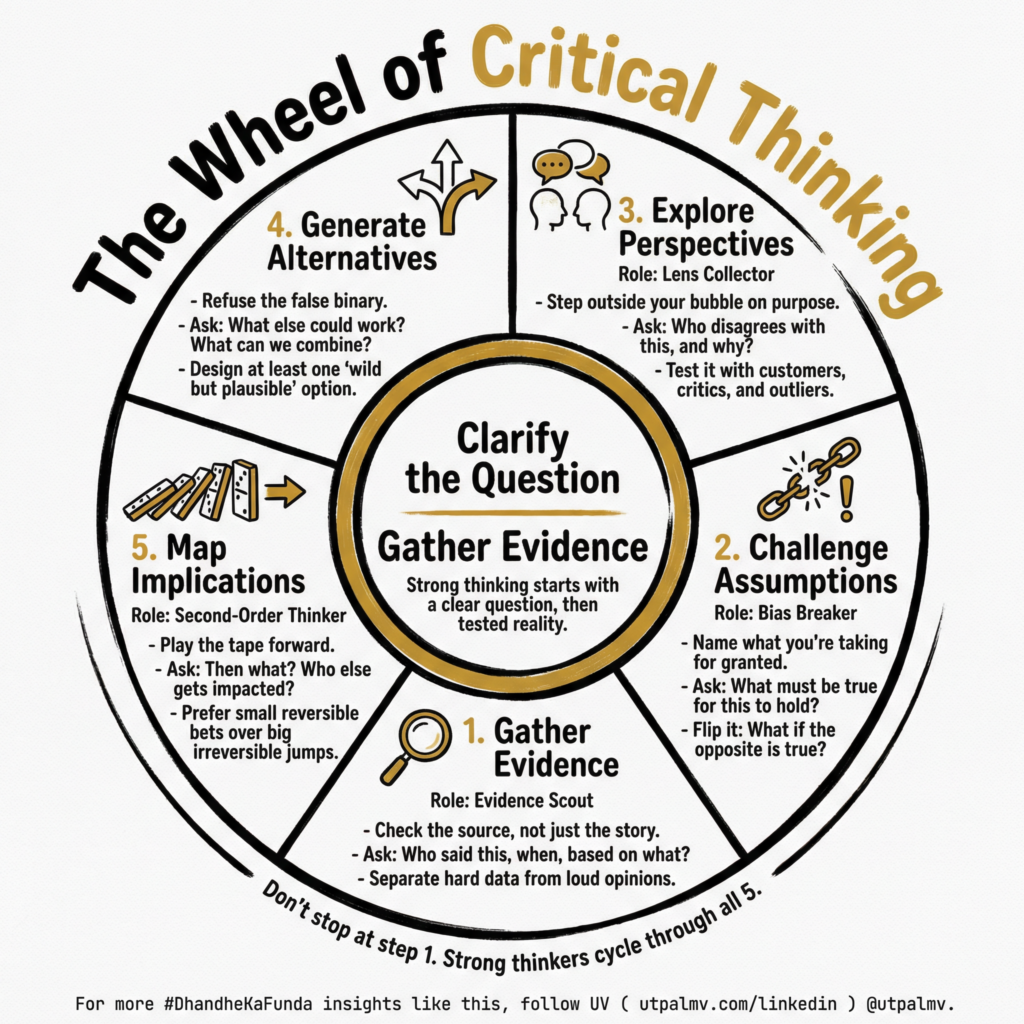
The wheel offers five prompts:
This is not mandatory syntax, and completing the cycle does not prove that a conclusion is correct. Some decisions need speed, expertise, or established procedure. The wheel is a way to slow down selected judgments, not a claim that other thinking is merely search.
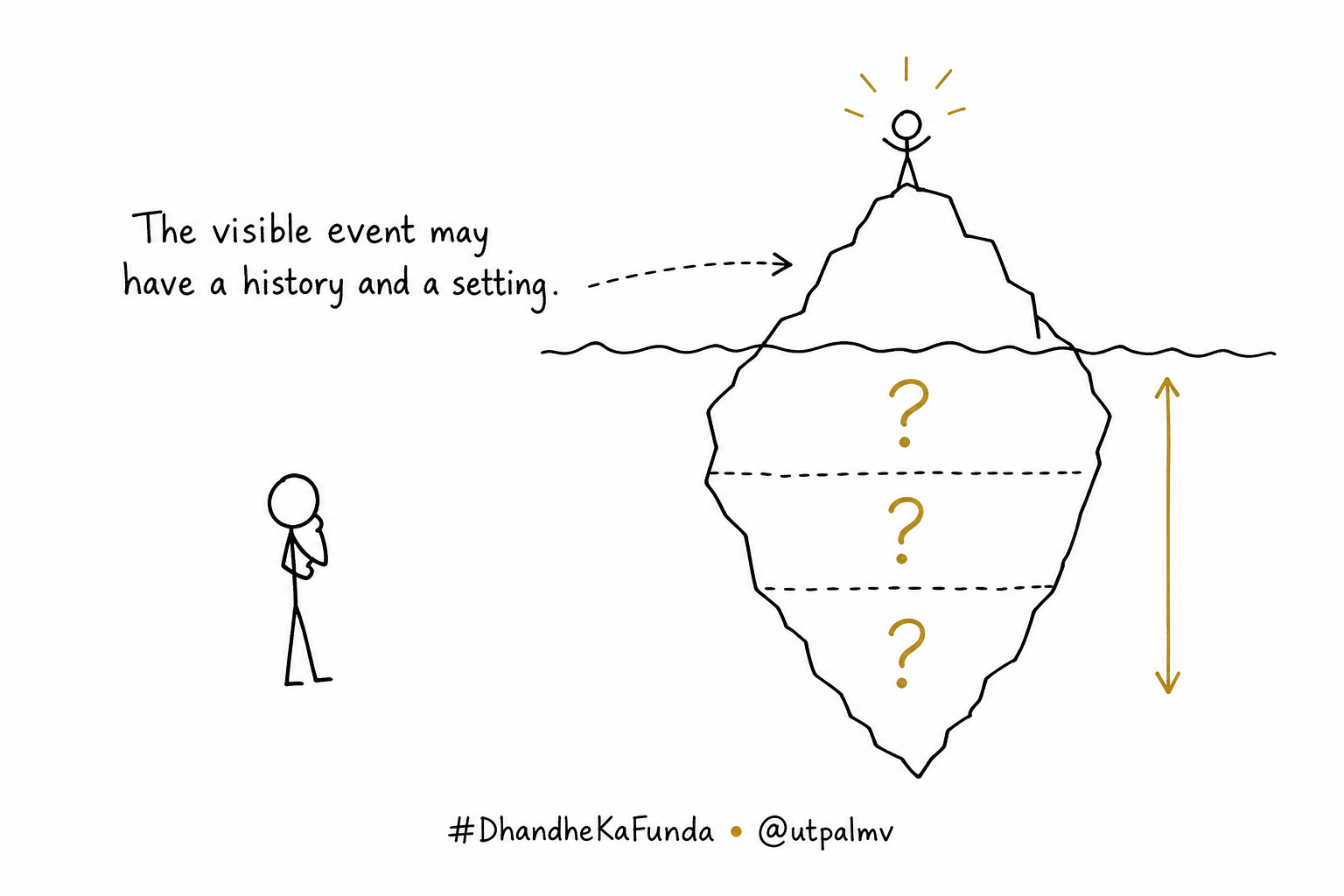
The iceberg model is useful because it interrupts the first explanation.
An event appears above the water: a missed deadline, failed launch, recurring complaint, or conflict. The visible event asks for attention, and sometimes immediate response is exactly what is needed. The model then invites a second set of questions. Has this happened before? What arrangements make it more likely? What assumptions keep those arrangements in place?
I use four levels as prompts.
At the event level, I ask what happened and what needs protection or repair now.
At the pattern level, I look for recurrence, variation, and exceptions. One event may be noise; several may reveal a tendency. The data can also show that a compelling story is not actually a pattern.
At the structure level, I examine roles, incentives, information flows, resources, rules, and power. These conditions can shape repeated behavior without determining it completely.
At the mental-model level, I ask which beliefs or assumptions make the structure seem natural. I treat the answers carefully. It is easy to invent a hidden belief that explains everything and cannot be tested.
Deeper is not automatically better. A broken server may need repair before a cultural inquiry. A harmful rule may be easier to change than the beliefs behind it. Mental models can shift while incentives keep producing the same result. Different levels often require work at the same time.
The iceberg is therefore not a ranking of intelligence or leverage. It does not promise that one percent of effort at depth will create one hundred percent change. It is a reminder that the visible event may have a history and a setting.
I want the model to widen inquiry, not delay action. Respond to the fire when the fire is real. Then, when there is room, ask what keeps supplying fuel and what evidence would show that the explanation is wrong.
Strategy is the art of subtraction.
It is the ruthless engineering of focus through the elimination of the "Good" to make space for the "Exceptional."
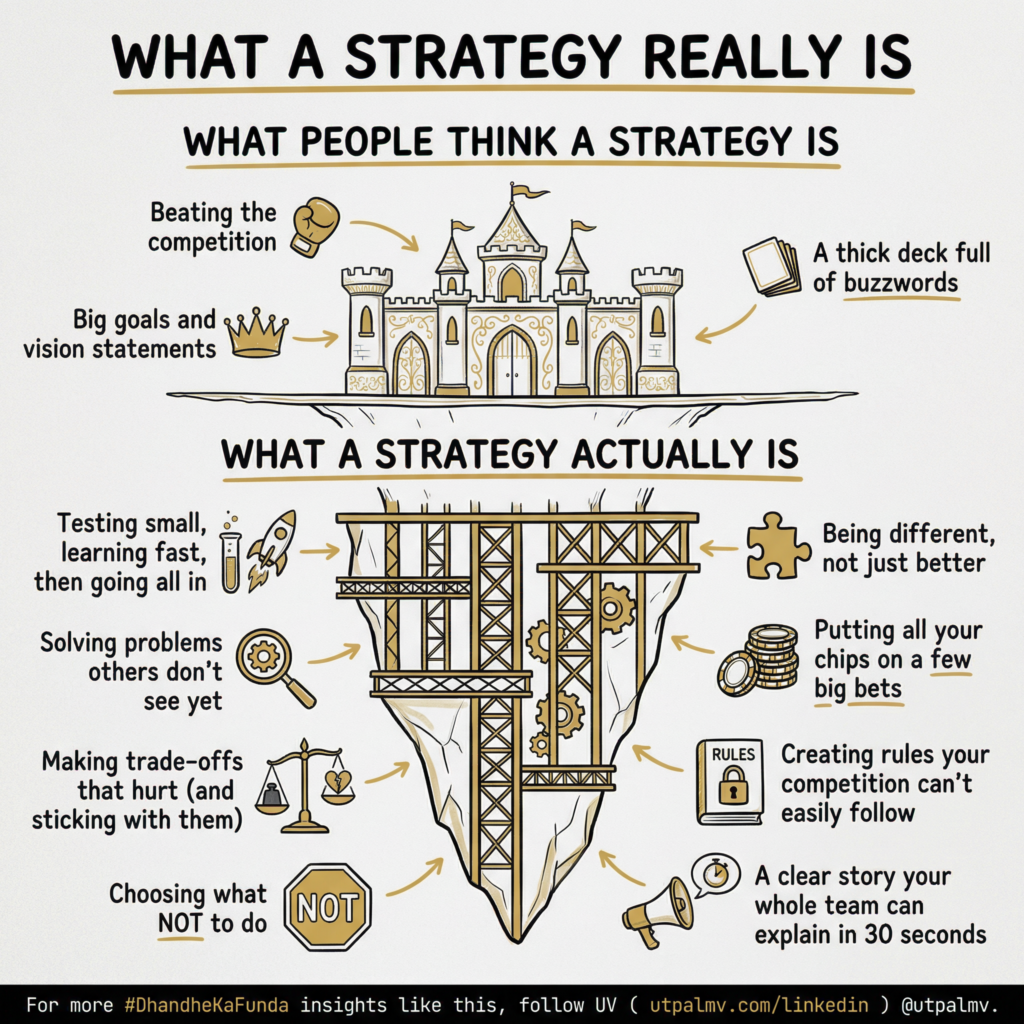
The Vision Trap: Big goals that look good on paper but provide no mechanical guidance.
The Competition Obsession: "Beating" someone else is a renter’s game. It keeps you tethered to their frequency.
The Buzzword Deck: A 50-page document designed to signal intelligence rather than enforce execution.
The Law of Exclusion: Choosing what NOT to do is the only way to protect systemic energy.
Painful Trade-offs: If a choice doesn't have a cost, it wasn't a choice. Real strategy hurts because it requires the death of alternative possibilities.
Asymmetric Bets: Placing concentrated chips on the few variables that actually move the needle.
Defensive Rules: Creating a set of operational principles that your competition literally cannot follow without breaking their own machine.
If your team cannot explain the strategy in 30 seconds without a deck, you haven't architected a strategy; you’ve just hosted a meeting.
Stop polishing the castle. Start hardening the scaffolding.
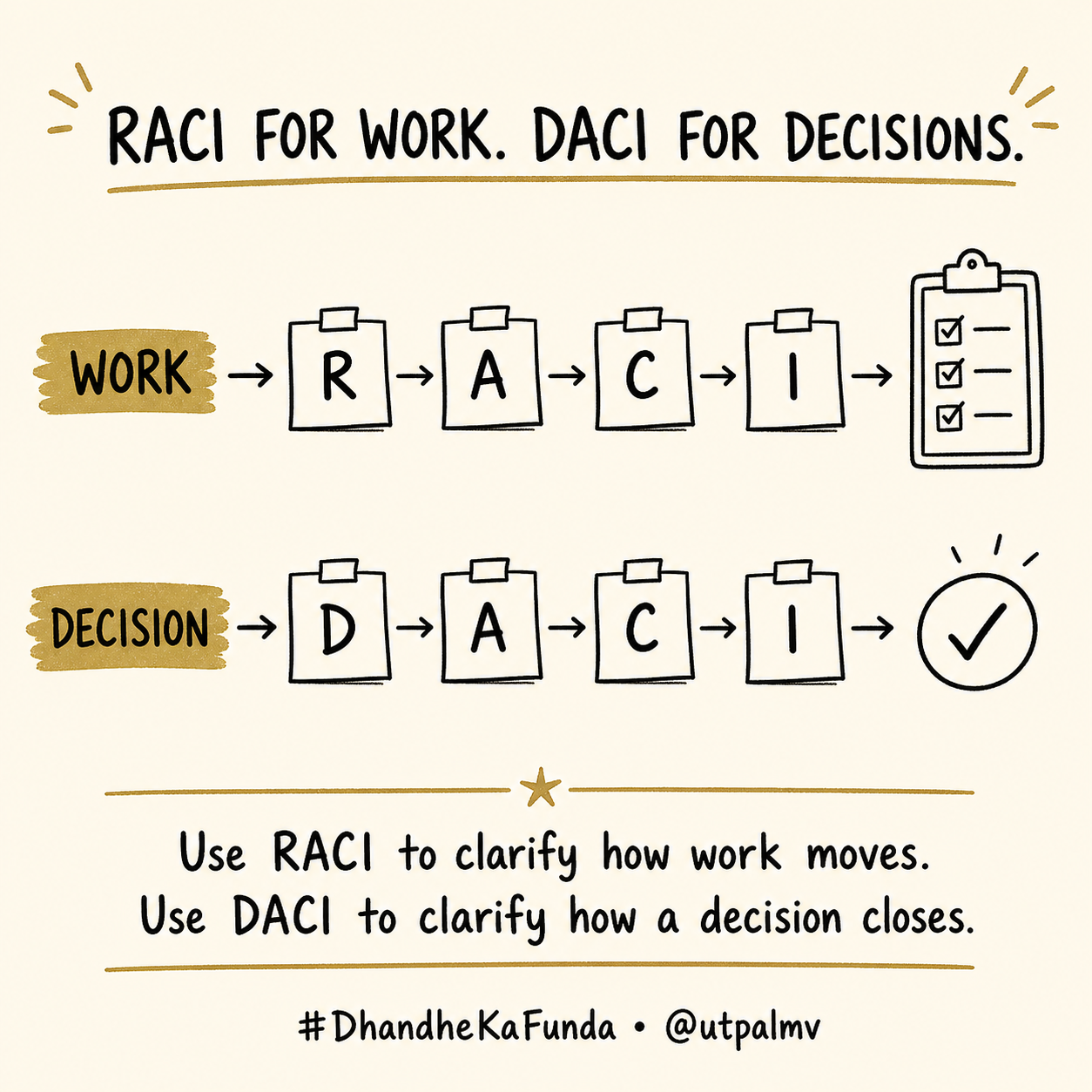
RACI and DACI solve related problems, but they are not interchangeable. RACI is useful when a group needs clarity about how work will be carried out.
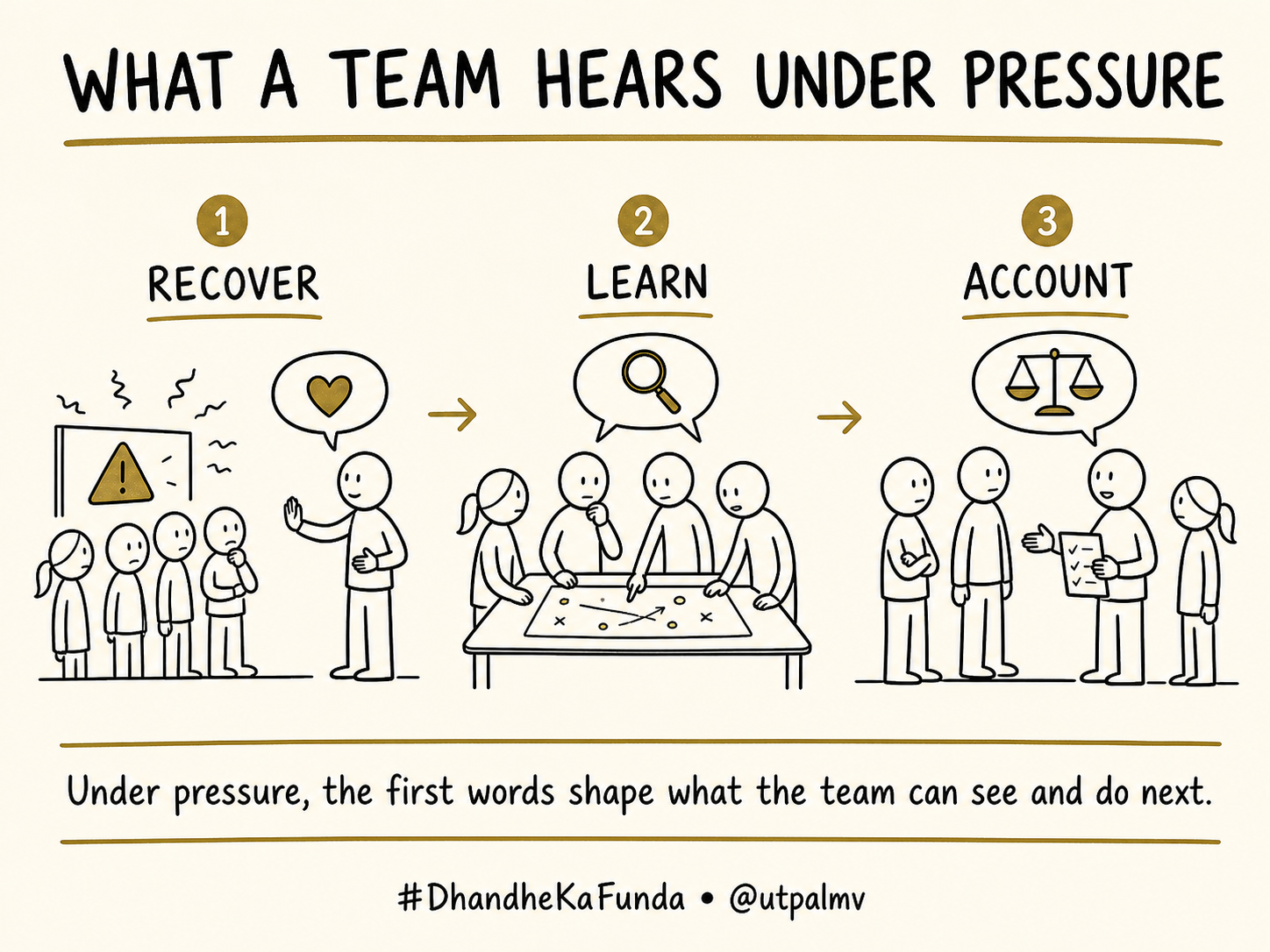
A team listens differently when something has gone wrong.
The server has failed, a client has left, or a deadline has been missed. People are already trying to understand the damage. In that moment, a leader's first words can widen the problem or make the next action easier to see.
“Who did this?” may be a necessary question later, particularly when responsibility has been avoided or trust has been broken. Asked first, it often turns attention toward self-protection. People begin assembling explanations before they have stabilized the situation.
“What do we need to do next?” creates a different sequence. It does not erase accountability. It separates immediate recovery from the later examination of causes, decisions, and ownership.
The same distinction appears in other familiar responses. “Figure it out” may communicate confidence, but it can also abandon someone who lacks information or authority. “What support do you need?” does not promise rescue. It reveals whether the constraint is capability, access, time, or a decision that only somebody else can make.
“This should never have happened” expresses frustration without yet producing learning. A more useful question is, “What would reduce the chance or impact of this happening again?” Some failures cannot be eliminated. They can still be detected earlier, contained better, or recovered from faster.
Calm language alone is not leadership. A composed sentence followed by avoidance, secrecy, or delayed decisions will not create trust. Nor should warmth become a way to evade a difficult performance conversation. The language matters because it sets the conditions for the work that must follow.
Under pressure, the team is listening for more than tone. People want to know whether the problem can be named, whether help is available, whether responsibility will be handled fairly, and whether the person leading them can stay close to reality.
The aim is not to sound calm. It is to help the team see and do the next necessary thing without making fear another problem they must manage.
Stop using "Strategy" and "Systems" as synonyms.
It is a lethal category error that collapses the architecture of your life and your business.
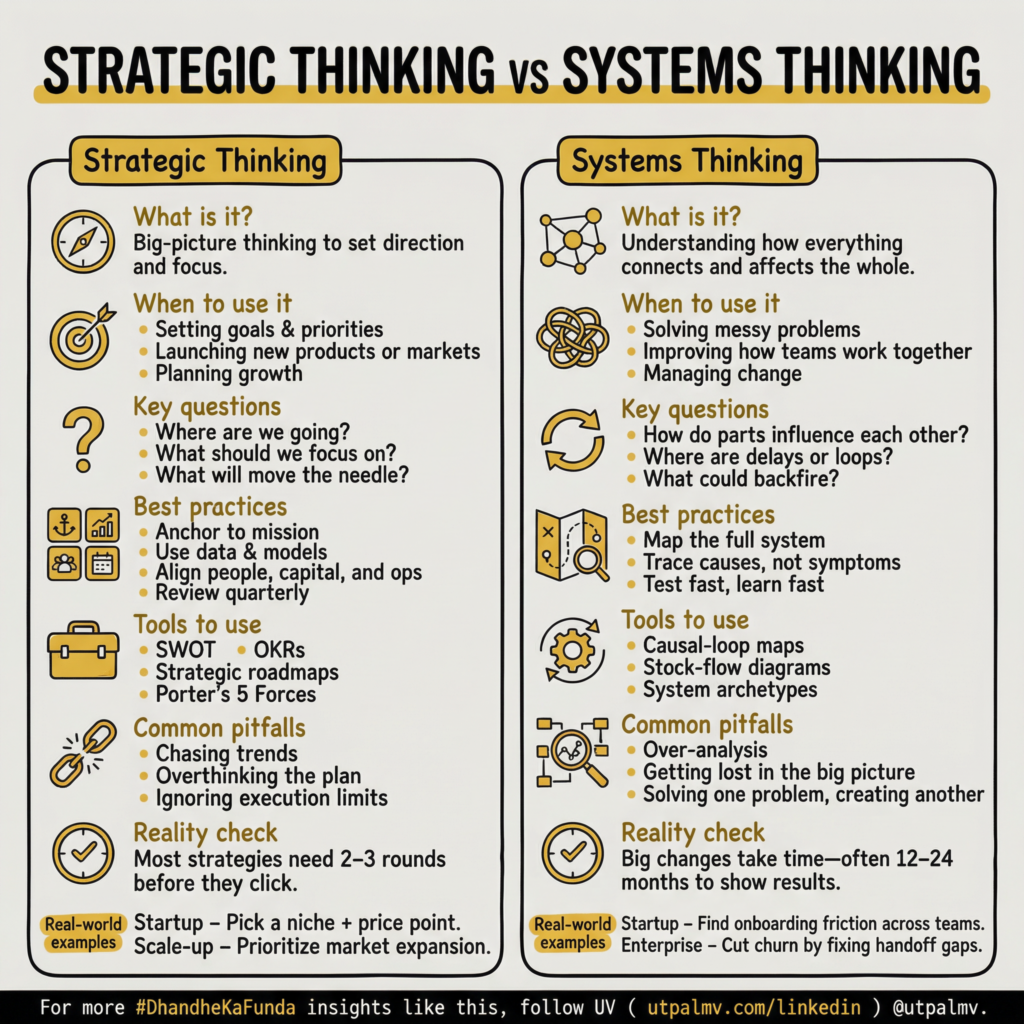
Definition: The selection of a destination and the magnitude of effort required to reach it.
Core Question: Where are we going?
The Architect’s Warning: A strategy that ignores the underlying system is merely a fantasy. If you set a vector that the structure cannot support, you aren't a strategist; you are a saboteur.
Definition: The web of connections and feedback loops that govern how energy flows through the entity.
Core Question: How does the structure sustain itself?
The Architect’s Warning: A system without a strategy is a treadmill: infinite motion with zero displacement.
Applying Strategy to a System Problem: You demand more output (Strategy) from a broken process (System). Result: Burnout.
Applying Systems to a Strategy Problem: You optimize the process (System) but for the wrong destination (Strategy). Result: Efficient Obscurity.
Strategy picks the path. Systems ensure the vehicle doesn't disintegrate under the pressure of the journey.
Most entities have a precise compass and a fractured foundation.
Before you announce your next move, audit your load-bearing walls.
A schedule can stay full long after the reason for parts of it has weakened. The work continues because stopping to examine it feels like falling behind.
A useful pause creates a decision about what should continue, change, or end.
Imagine a weekly meeting established during a difficult launch. Months later, the launch is over, but the meeting remains. Attendance alone cannot tell you whether it still serves a purpose.
Ask which decisions it makes possible, what participants prepare, and what would be lost if the format changed. Consult people who depend on it before assuming that your own low value means nobody benefits.
For a low-consequence recurring activity, propose a limited experiment: shorten it, change its output, or skip one occurrence with the affected people's agreement. Name what you will watch for and when you will decide whether to restore it.
Observe both the time released and any coordination that quietly disappears. A cancellation that causes several private catch-up conversations may merely move the cost.
The companion piece on planning concerns getting an untested idea into contact with reality. This piece concerns interrupting established activity long enough to assess whether it still belongs.
A pause earns its place when it changes the understanding or the work. Otherwise, reviewing the schedule becomes another recurring item inside it.
This work develops the concern in “The Latency Trap,” published on 2026-02-26.
A team can agree on a plan and still leave the meeting with nothing it can attempt. The goal is clear enough to discuss but too large to act on.
An execution threshold is the point at which the next action has enough definition, permission, and capacity behind it to begin. That is a proposed planning lens, not an explanation of anxiety or courage.
Ask three separate questions. Can someone name the next action? Are they authorized to take it? Do they have the time, tools, and help it requires?
These gaps need different responses. More encouragement will not supply access to a system. A smaller task will not resolve conflicting instructions from two owners.
Imagine a team preparing to test a new intake process. “Improve intake” is an intention. Trying a draft form with one consenting colleague, using fictional data, is an action with a visible result and limited consequences.
For one stalled item, record the action, owner, permission, expected observation, and stopping condition. Attempt it once. Then identify what prevented useful progress or what the result changed.
If making these conditions explicit does not reduce the stall, inspect the commitment itself. The work may be unwanted, poorly timed, or dependent on a decision nobody has made.
The purpose is to make a meaningful attempt possible. It is not to turn every hesitation into a demand for more output.
This work develops the concern in “Execution Thresholds,” published on 2026-02-26.
We do not choose our initial conditions. I see this in the world around me, including the different forms of poverty and privilege into which people are born. We enter life with circumstances already in motion: family, geography, health, education, money, social expectations, and accidents of timing. Any account of personal agency that ignores these differences turns privilege into virtue and constraint into personal failure.
But circumstance is not the whole account either. Repeated choices can change part of what follows. A skill practiced for years becomes available when an opportunity appears. A relationship maintained without immediate benefit may later provide trust, knowledge, or access. Money saved in small amounts can create room for a different decision. Attention given to health can preserve the ability to keep working. None of these actions guarantees an outcome, but each may alter the set of outcomes that remains possible.
This is why iteration matters more than the dramatic language of reinvention. Most lives do not change through a single declaration. They change through choices whose individual effects are almost invisible: one more attempt, one avoided expense, one difficult conversation, one hour of learning, one decision not to repeat an old pattern. Over time, some of those choices begin to reinforce one another.
Compounding can also work in the other direction. A neglected problem becomes harder to address. A small compromise becomes a normal practice. A relationship left unattended becomes distant. Repetition does not make every choice consequential, but it can make a direction harder to reverse.
Agency begins with seeing both facts clearly: circumstance matters, and our choices still matter within it. The useful question is not whether we control everything. We do not. It is whether there is one repeated choice, within the room we actually have, that can improve the next set of conditions.
A test is useful when a result can change the decision. Producing an error and calling it learning is not enough.
Before the attempt, state what you expect to happen and what a different result would cause you to reconsider. That gives the result somewhere to go.
Consider a proposed change to a support form. You expect clearer instructions to reduce incomplete submissions. Try it in a limited setting, observe whether people still miss the same field, and inspect their explanation before changing the wording again.
The useful sequence is expectation, bounded attempt, observation, interpretation, correction. This is a practical synthesis. It does not establish that iteration always outperforms planning.
Errors also have social conditions. Amy Edmondson's 1999 study of 51 manufacturing teams found an association between team psychological safety and learning behavior. That finding supports taking the conditions for speaking up seriously; it does not validate this particular loop or every use of it. Research source.
Run one small trial and record the decision it changed. If repeated trials produce activity but no useful discrimination between explanations, redesign the test. You may be observing the wrong thing.
Do not experiment casually where an error can harm someone who did not agree to bear the risk. In those settings, simulation, expert review, and stronger controls may need to precede any real attempt.
This work develops the concern in “Iterative Error-Correction,” published on 2026-02-26.
Growth often begins with a small test beyond what has become familiar.
We tend to describe a boundary as if it were a permanent fact: I am not good at this, this market is not for us, that conversation will go badly, or this is as far as the body can go. Sometimes the boundary is real. Sometimes it is an old conclusion that has not been examined since the conditions changed.
A useful test does not require a dramatic leap. Try one conversation, method, market, exercise, or responsibility that reaches slightly beyond the current pattern. The aim is to gather information about what the boundary actually is. Can the skill improve with practice? Does the other person respond differently when the question is clearer? Is the limitation technical, emotional, financial, or simply unfamiliar?
Small scale matters because it makes honesty easier. A large public commitment can turn the experiment into a defense of identity. Once we announce a transformation, we may continue to protect the announcement even when the evidence says to stop. A bounded test allows curiosity to remain more important than appearance.
The boundary also deserves respect. “Leave your comfort zone” is poor advice when it ignores safety, health, obligations, or the cost of failure. Not every fear is irrational, and not every constraint should be conquered. The test should be proportionate, reversible where possible, and clear about what it places at risk.
Before starting, decide what you want to learn. Afterward, record what happened without forcing a heroic interpretation. A difficult attempt may show that more preparation is needed. An easy one may show that the boundary had already moved. A failed test may reveal a constraint worth accepting rather than fighting.
Growth is not proved by discomfort. It is proved, if at all, by a changed capacity or a more accurate understanding. One honest test can provide either. That is more useful than declaring yourself transformed.
Repeatedly fixing the same avoidable problem can look like commitment.
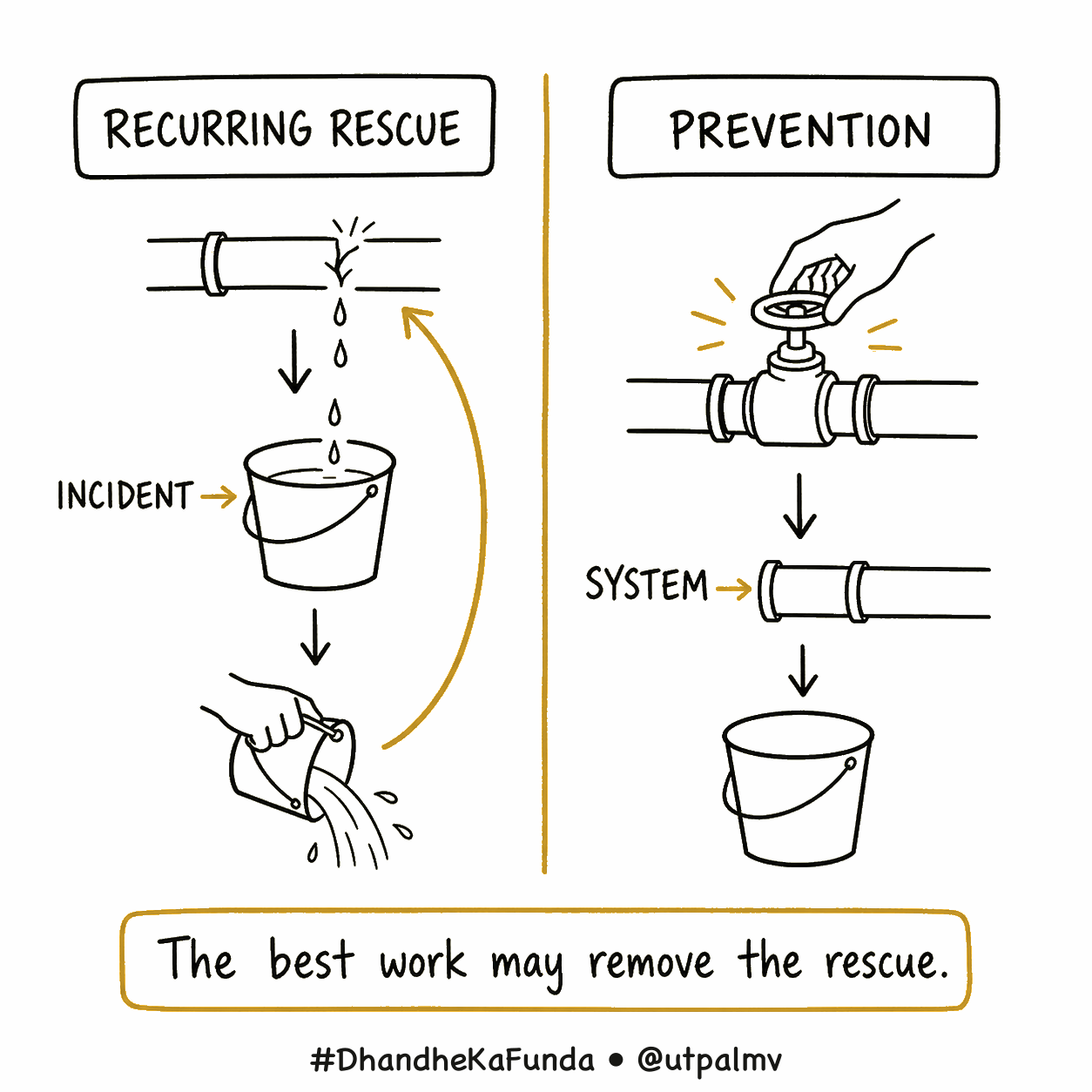
Someone notices the failure, stays late, restores the service, calms the client, and gets thanked for saving the day. The effort may be real. Sometimes the intervention is genuinely necessary.
The trouble begins when the same rescue becomes part of how the organization expects work to happen.
Recurring emergencies create a distorted picture of contribution. Visible recovery receives attention. Quiet prevention does not. The person who repeatedly fixes the failure can appear more valuable than the person who removed its cause.
That incentive is expensive. It rewards responsiveness while allowing the underlying weakness to remain.
The better questions come after the immediate problem is contained:
The answer will not always be another process. It may be a simpler handoff, a clearer decision right, a test closer to the source, better documentation, or the removal of a dependency nobody had questioned.
Prevention also needs proportion. Not every unlikely problem deserves an elaborate control. A system burdened with safeguards can become harder to operate than the risk justifies. The aim is not to eliminate every surprise. It is to stop paying repeatedly for failures we already understand.
This changes what leaders should recognize. If praise goes only to the rescuer, people learn that prevention is invisible work with little reward. Recognition should also reach the person who reduced the need for rescue, even when the result is harder to dramatize.
This kind of work is easy to miss because its evidence is an absence. The incident does not recur. The client does not need calming. Nobody stays late.
When prevention works, there may be no heroic story to tell. That is often the point.
A recurring complaint can identify an unresolved problem. It can also become a familiar activity that changes nothing. The distinction is what the criticism enables someone to understand or do.
Ask which decision it should change, which standard it protects, and what evidence would support or weaken it. A useful criticism need not arrive with a complete solution. The person who sees a defect may not have the authority or expertise to repair it.
Imagine someone repeatedly reporting that a handoff loses important context. “Be more constructive” is not a repair. Examine a recent handoff, locate the missing information, and decide who can change the process.
A practical record can contain the observation, consequence, evidence, and next responsible owner. If nobody owns the response, the repeated complaint may be evidence of failed follow-through rather than excessive negativity.
For a low-stakes recurring issue, use that record once and review what happens. Did the criticism become a decision, a repair, or a reasoned decision to accept the problem?
If the only outcome is less visible criticism, do not count that as improvement. Silence can conceal an unresolved defect.
This proposal replaces the earlier suggestion to bury criticism under workload. Useful work includes noticing what is wrong and ensuring that the observation reaches someone who can act.
This work develops the concern in “Parasitic Auditing,” published on 2026-02-26.
Imagine revising a useful piece of work because the simpler version does not look impressive enough to share. Before long, the audience's imagined reaction has become part of the design brief.
An audience can improve the work by revealing what is unclear or missing. The cost begins when anticipation of approval replaces your judgment about what the work needs.
One kind helps you assess the result: a reader cannot follow the example, an operator finds a failure, or a colleague identifies an unsupported claim. Another mainly tells you how the work affects your standing.
Both can influence a real decision. The distinction matters because praise for the presentation does not establish the usefulness of the substance.
Choose a recent change made before sharing something. Write the change, the reaction you anticipated, and the evidence that the change served the work. If the evidence is absent, compare the version with and without it using a reader who can explain the difference.
Watch for improved understanding, not merely preference for the more polished version. If the extra treatment genuinely helps the reader, keep it.
This proposal does not require private work or indifference to reputation. Work often needs to be seen, questioned, and trusted.
The practical test is whether you can explain a consequential choice in terms of the work's purpose after the applause is removed from the explanation.
This work develops the concern in “The Visibility Tax,” published on 2026-02-26.
You can understand a plan in detail and still know little about how it will behave outside the planning room. At some point, a bounded encounter with the work becomes more informative than another description of it.
The important speed is the time between an assumption and useful feedback, including the time needed to interpret that feedback.
Suppose you are considering a new service. Writing a sample deliverable and asking a prospective user to explain how they would use it may answer a more useful question than polishing a launch announcement.
The example is hypothetical. The practice is to select an action because of the uncertainty it can resolve, not because it creates visible motion.
Record what the attempt can teach, what it cannot teach, and what you will do if the result contradicts the plan. Interest in a sample, for example, does not establish willingness to pay or sustained use.
An AI agent can prepare many variants quickly. That increases the need to choose which comparison matters. It does not make deployment, customer contact, or spending automatically appropriate.
Try one reversible experiment and count the decisions it changes. If the experiment leaves the important uncertainty untouched, faster repetition is unlikely to help.
Moving to learn requires restraint as well as initiative. Keep enough room to stop, inspect the result, and choose a different path.
This work develops the concern in “Jurisdictional Velocity,” published on 2026-02-26.
Thinking can improve an action. It can also postpone one.
The difference is not the amount of time spent thinking. Some decisions deserve slow work because the consequences are large, the evidence is incomplete, or the action will be difficult to reverse. A considered delay can be responsible. The problem begins when analysis continues after the next useful test is already known.
At that point, thinking often changes character. We refine the model without changing the decision. We ask for another opinion that is unlikely to add new evidence. We enlarge the plan because a larger plan feels more serious. The activity remains intellectually respectable, which makes the avoidance hard to see.
Reality offers information that a model cannot. A customer may respond differently from the interview script. A prototype may expose a constraint that no workshop identified. A week of practice may reveal whether a new routine is sustainable. A difficult conversation may show that the assumed disagreement was not the real one.
This does not justify careless experimentation. The useful move is bounded. Define what you are trying to learn. Limit the time, money, people, or reputation placed at risk. Decide what evidence would support continuing, changing, or stopping. Then take the smallest action capable of producing information that matters.
A test is not useful merely because something happened. If the question is vague and the result cannot affect a choice, action becomes theater in the same way that endless analysis does. Good testing connects a real uncertainty to a decision.
There is also no virtue in speed for its own sake. When harm could be serious or irreversible, more thought may be exactly what reality requires. But when the risk is contained and the next learning step is visible, further simulation can become a shelter from being wrong.
Thinking should prepare contact with reality, not replace it. When the model has reached its limit, make a bounded move and allow the world to answer back.
Attention is a form of rehearsal.
When I repeatedly replay an antagonist, I give that person more room in my thinking than the situation deserves. The conversation has ended, but I keep reconstructing it. I improve the reply I should have made, predict the next offense, and collect evidence for a case nobody has asked me to present. In doing so, I rehearse their behavior instead of returning to my own work.
Not every repetition is useless. Some situations require action. A pattern may need to be documented. A boundary may need to be stated. A mistake may need repair. Reflection is valuable when it produces a clearer account of what happened and a responsible next step.
The loop becomes costly when it no longer changes either understanding or action. The same material returns with greater emotional force but no new information. Attention then stops serving the problem and begins preserving it. The other person may not be present, yet the conflict continues to occupy time, sleep, and judgment.
Telling ourselves simply to stop thinking rarely works. A more practical response is to complete the unfinished part. Write down the facts. Decide whether a conversation, apology, boundary, or record is required. Set a time for that action. If nothing further is needed, say so plainly. The mind may still return to the event, but it no longer needs to keep it active as an unresolved instruction.
Withdrawing attention is not forgiveness, agreement, or denial. It does not make harmful conduct acceptable. It is a decision about where the event is allowed to live after the necessary response has been made.
The question I find useful is not, “How do I defeat this person in my head?” It is, “What does this situation still require from me?” Do that part. Then stop rehearsing a role in someone else's drama and return attention to the life that is actually yours.
Changing your availability can disappoint someone who has relied on it. That reaction does not prove that your boundary is wrong, or that the other person has been exploiting you.
The useful question is what you owe, what you can continue to give, and how the change will be handled.
A promise creates a different responsibility from an expectation that grew without discussion. Both may matter, but they need different conversations.
Imagine a colleague who regularly asks for an evening review. If you agreed to cover a release this week, ending the arrangement tonight has consequences you need to address. If the arrangement developed by habit, you can explain a different review window and discuss urgent exceptions.
For one recurring demand, write down the explicit agreement, the assumed availability, and the change you propose. Name the notice, handoff, or alternative you can reasonably offer.
After the change, observe whether the demand moves to a workable time or simply becomes someone else's unacknowledged burden. Reclaimed hours alone are an incomplete measure.
This is a proposal for ordinary commitments, not a rule that every relationship deserves continued access. The original concern about protecting capacity remains. The claim that disappointment proves another person's parasitism does not.
A boundary becomes clearer when it describes what you will do and how you will honor what remains.
This work develops the concern in “Resource Reclamation,” published on 2026-02-26.
Some work depends too much on the continued visibility of the person who built it.
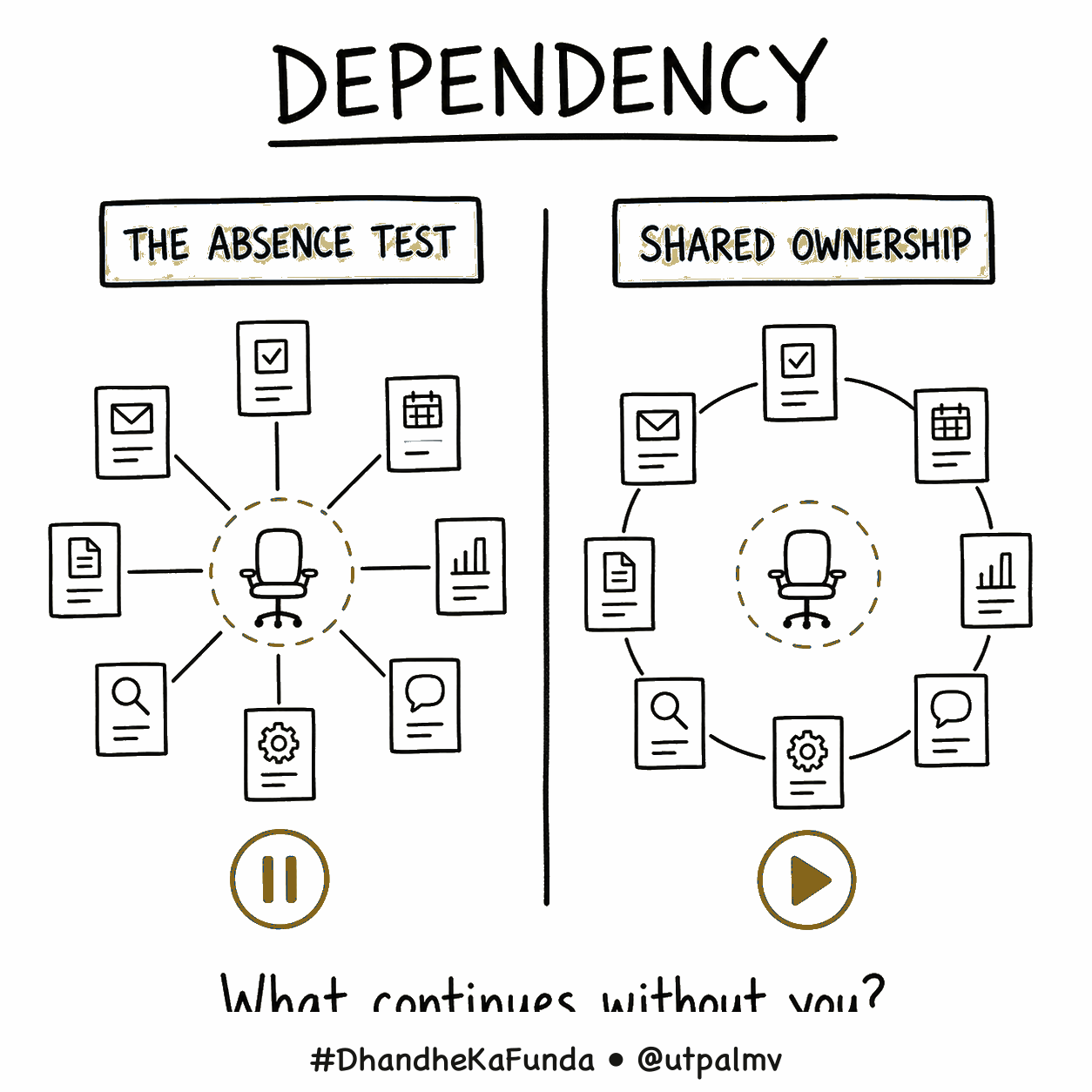
The dependency may be operational. Decisions stop when the founder is absent. Relationships exist only through one person. Quality depends on their direct inspection.
It may also be narrative. The work receives attention because its creator is constantly explaining, promoting, defending, and representing it. When that visibility stops, interest disappears with it.
Neither condition is automatically wrong. Early work often needs a visible advocate. A founder may be the clearest expression of an idea before the organization has developed its own language, evidence, and trusted relationships. Hiding too early can look like independence while leaving the work without a responsible voice.
The problem is permanent dependency.
A useful test is to step away in degrees.
Can someone else make the ordinary decisions? Can the work be understood without a personal explanation? Do customers, readers, or partners still receive value when the creator is not present? Can quality survive without inspection at every point?
This is not a demand for invisibility. Some people choose a public role because teaching, writing, selling, or convening is part of the work itself. The question is whether visibility is being chosen or continuously required to prevent collapse.
Privacy becomes different under those conditions. It is no longer a dramatic disappearance or a rejection of the audience. It becomes the ability to decide when to be visible because the work does not need constant performance to prove that it exists.
There is also a personal test. If attention disappears, does the work still feel worth doing? A project built mainly around recognition may struggle when recognition becomes quiet.
The aim is not to become unnecessary to everything we build. It is to remove the dependencies that exist only because we never designed for anyone, or anything, to continue without us.
The same work can demand different amounts of effort in different environments. In one team, a commitment is enough to begin. In another, every step requires repeated confirmation of who can decide.
Before concluding that you need more discipline, examine the conditions in which that discipline is being spent.
Some friction belongs to the task: the problem is difficult. Some belongs to coordination: authority, expectations, or handoffs are unclear. Some expresses a real disagreement about how the work should be done.
A move may change the second and third without making the first disappear. It also creates transition costs, new dependencies, and obligations to people you leave behind.
For one recurring task, note where work waits, what needs to be checked again, and which disagreement repeatedly returns. Compare that with evidence from the proposed alternative, rather than its reputation or your hope for it.
Try repairing one local condition first when it is within your authority. Clarify a handoff, document a decision right, or agree on an acceptance standard. Observe whether the recurring friction changes.
If the repair works, departure may not be necessary. If the environment repeatedly prevents an agreed repair, that is different evidence.
This lens applies to choosing teams and working arrangements. It is not sufficient advice for migration, legal jurisdiction, or other consequential moves. A better fit is a possibility to investigate, not a place where effort and disagreement disappear.
This work develops the concern in “Jurisdictional Alignment,” published on 2026-02-26.
“I don't want it” can express a clear preference. It can also end a difficult conversation with yourself before you have examined the opportunity.
The useful move is to distinguish not wanting the outcome from not wanting the uncertainty that comes with pursuing it.
Ask whether the outcome matters to you, whether the commitment is affordable, and what you do not yet know. These are different reasons to decline. None needs to be disguised as another.
Imagine being invited to teach a small workshop. You may dislike teaching, lack the time, or be unsure whether the material helps anyone. Only the third reason is directly addressed by a limited trial.
If uncertainty is the obstacle, choose a small attempt with a clear cost, stopping point, and learning question. Decide those limits before enthusiasm or embarrassment makes them harder to enforce.
Afterward, record what became clearer. A pleasant trial does not oblige you to continue. An awkward trial may reveal a repairable problem rather than an unsuitable direction.
This is a reflection aid, not financial advice or a presumption that risk-taking is superior. Some opportunities do not deserve your resources even if they might succeed.
The better decision is one whose reason you can state honestly, including a deliberate no.
This work develops the concern in “The ROI Deficit,” published on 2026-02-26.
When a commitment is repeatedly missed, asking for more effort may be premature. The expectation, available capacity, and design of the work all deserve examination.
A gap is an observation. Its cause still needs to be established.
First make the expected result specific. Then inspect what was actually delivered, under which conditions, and with which interruptions or dependencies. A vague expectation can move after the result arrives and make learning impossible.
Imagine a team expected to finish six items while also responding to unpredictable support work. Count the support demand before concluding that its planned delivery rate represents unused ability.
For the next bounded period, adjust one plausible cause: clarify the acceptance standard, protect capacity, resolve a dependency, or reduce the commitment. Record what you expect the change to affect.
Compare quality and consequences alongside completion. More closed items can conceal rework or make another team's load worse.
If the change does not help, revisit the explanation. Do not reinterpret every result as proof that the person should try harder.
This is a proposed work-review method. It does not diagnose anxiety or infer a person's potential from an output measure. The useful outcome is a more accurate commitment or a better working condition, supported by what you observed.
This work develops the concern in “The Performance Gap Alert,” published on 2026-02-26.
A process fails repeatedly, and the most decisive response appears to be removing a role, habit, or relationship. Before making the cut, establish what is failing and why removal would address it.
An ending can be necessary. It should not acquire the appearance of precision merely because it is irreversible.
First, the evidence may be weak. The gap between intended and actual results has never been measured consistently.
Second, the process may be unstable. Priorities and decisions change before the work has a chance to improve.
Third, the arrangement may no longer fit, while changing it carries a real transition cost.
These explanations can coexist. They do not lead automatically to the same remedy.
Imagine a handoff that repeatedly misses a deadline. Before eliminating it, clarify the required input and test one change in timing or ownership. Observe both the missed deadlines and the burden placed on the receiving person.
If a local repair cannot address the constraint, document why. Then compare redesign, a boundary, an ending, and conscious acceptance of the cost.
The past may carry commitments, knowledge, and responsibilities that remain after an arrangement ends. A transition plan should name them.
This is a decision aid, not a case for postponing every difficult ending. Its test is whether the selected response addresses the demonstrated failure without hiding its costs.
This work develops the concern in “Structural Amputation,” published on 2026-02-26.
An opportunity can matter because of what it makes possible later. Learning a skill may open work you could not previously attempt. A new commitment may create access while also making departure harder.
The immediate return captures only part of the choice.
For a significant opportunity, ask what it enables, what it requires, and what it makes harder to leave. Keep these questions together. An open door can lead to an arrangement that consumes the capacity needed for other doors.
Imagine taking responsibility for a new project because it offers useful experience. The benefit depends partly on whether there is time to learn, support to ask questions, and permission to make appropriate decisions. The title alone does not establish the opportunity.
Write two plausible paths: accept and decline. For each, name one capability you might gain, one commitment you would carry, and one option you would preserve or lose.
Identify the uncertainty that could reverse your preference. Seek evidence about that point before widening the comparison further.
More options do not necessarily make a better life. Some possibilities matter because you can let them go and concentrate on what you have chosen.
This lens earns its use if it reveals a consequence that the immediate payoff concealed. It should not turn every decision into an effort to maximize future possibility.
This work develops the concern in “The Geometry of Potential,” published on 2026-02-25.
Curiosity does not guarantee wealth, relevance, or good judgment.
It does something more modest and more useful: it helps us update a view of the world that would otherwise become stale. Markets move, tools change, and people reveal information that an old model cannot contain. A conclusion that was sensible five years ago may now describe a landscape that no longer exists.
The danger is not having a model. We need models to decide. The danger is forgetting that the model was built from limited evidence at a particular time. Once it becomes part of our identity, contradictory information can feel like a personal attack. We then defend the map even while the ground keeps changing.
Curiosity interrupts that defense. It asks what has changed, which assumption no longer holds, and what the person closest to the problem can see that we cannot. It also asks whether an apparent change is merely noise. Updating every belief in response to every new signal produces confusion, not learning.
This is why curiosity needs discipline. Seek evidence that could genuinely alter a decision. Return to primary sources when a summary seems too convenient. Spend time with people whose incentives and experiences differ from your own. Keep a record of what you believed and why, so that revision does not become a story in which you were always right.
There is no shame in retaining an old conclusion when new evidence is weak. There is also no integrity in preserving it because changing your mind would be awkward. The purpose of a map is to help us move through the territory, not to protect the reputation of the cartographer.
Curiosity can become consumption without consequence: another book, feed, conversation, or tool that never changes a choice. Its practical value appears when something is updated: a question, a plan, an assumption, or a boundary.
Yesterday's map may still be useful. Keep it only as long as it continues to match the ground.
Luck is not fully controllable. Exposure is more adjustable.
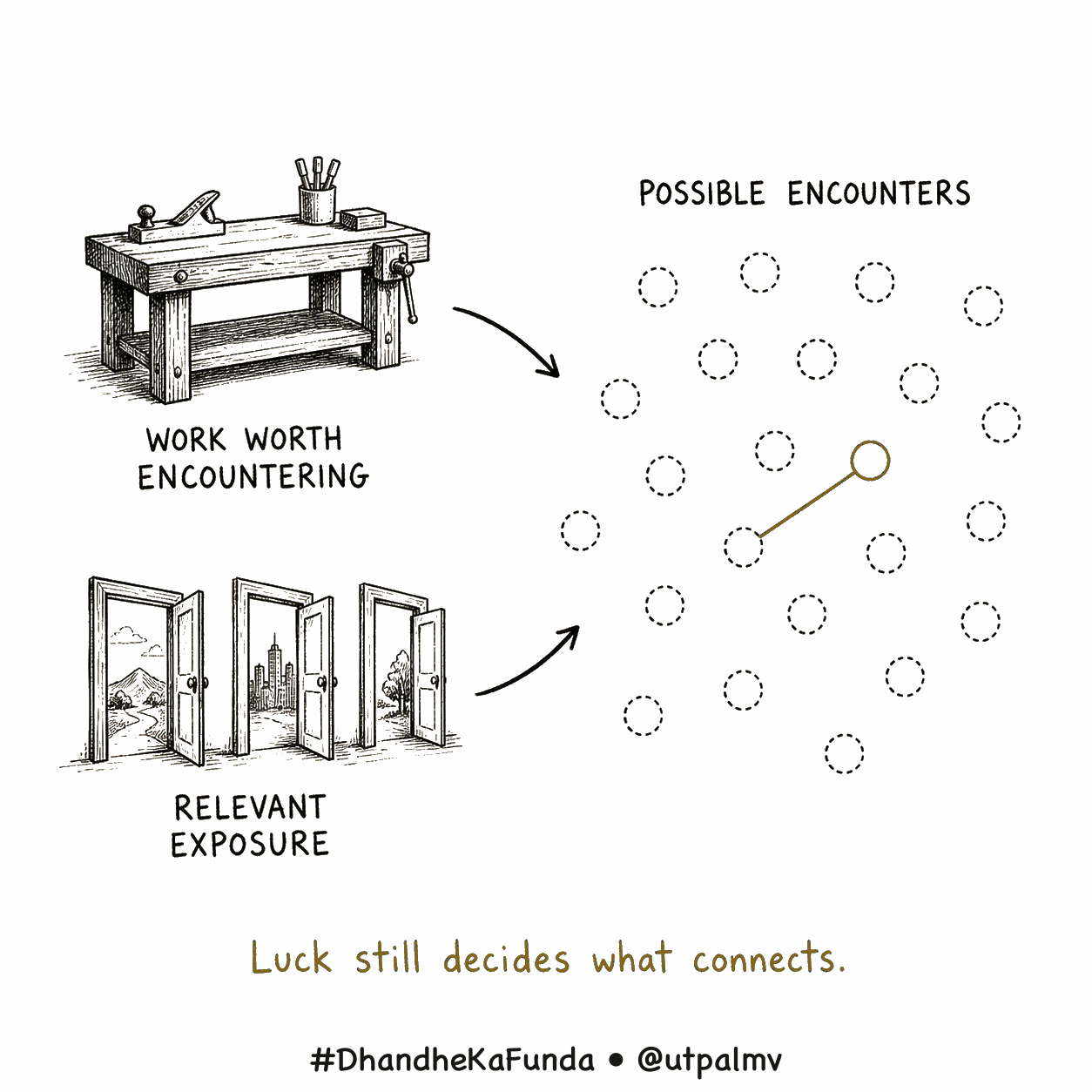
Many useful encounters look accidental in retrospect: a person sees a piece of work, a conversation reveals a shared problem, or an introduction arrives when both sides are ready. The outcome may be fortunate, but the conditions were not always random. Someone made the work visible, entered the conversation, or stayed close enough to a field for the encounter to become possible.
This is not a promise that visibility produces opportunity. Public work can be ignored. Events can consume time without creating a single meaningful relationship. A large network can remain shallow. The point is narrower: if nobody can see what we are working on, and we rarely meet people engaged with adjacent problems, the number of possible useful encounters becomes very small.
Increasing exposure does not require constant broadcasting. It may mean publishing one honest piece of work, asking a thoughtful question in a small group, helping someone without treating the exchange as a transaction, or returning regularly to a community where trust can accumulate. Consistency matters because people often need more than one encounter before they understand what we care about and whether we are reliable.
The quality of the surface matters more than its size. Being visible to everyone is less useful than being legible to a few people who share the problem. The same is true of rooms. A relevant conversation with five attentive people may create more possibility than an audience of thousands with no reason to respond.
There is also a limit. Exposure can become performance, and participation can become avoidance of the work itself. If every hour is spent expanding the network, there may be nothing substantial for the network to discover.
So keep both sides alive: do work worth encountering, and create a few honest ways for the right people to encounter it. This does not manufacture luck. It gives luck more places to arrive.
An hour can end without any clear sense of where it went. That does not make the hour wasted. Rest, enjoyment, and connection do not need to justify themselves as output.
The concern is a repeated use of attention that you would not choose if you noticed it clearly.
For a recurring activity, ask whether it restores, informs, connects, helps you make something, or simply continues because it is easy to continue. These purposes can overlap.
Imagine opening a feed to find a specific update and remaining there long after finding it. The useful distinction is between the chosen visit and the unexamined continuation.
For a few days, note one activity that regularly runs beyond its purpose. Before beginning, write what you came for and what would indicate that you are finished.
Compare the result with your usual pattern. Did you regain room for something you valued? Did you cut short a worthwhile conversation or a needed rest? Both observations matter.
This is a proposed reflection practice, not a scientific measure of attention or a treatment for difficulty concentrating. An elaborate tracking system can itself become another demand.
Use the smallest record that helps you choose. The goal is greater say over the next hour, not a life in which every minute must produce a measurable return.
This work develops the concern in “The Attention Audit,” published on 2026-02-22.
The body is part of the work.
This is easy to forget when work is described mainly through thought, judgment, ambition, and output. The language makes the person sound separate from the physical conditions through which all of those things happen.
They are not separate.
Sleep, movement, food, illness, pain, medication, stress, and recovery can affect how a day is experienced. They can influence attention, patience, energy, and the ability to stay with a difficult problem. The effect is not identical for every person, and good health does not guarantee good judgment. But neglect has a cost, even when the bill arrives slowly.
I have often treated maintenance as something to fit around the real work. Physical fitness is one of the practices through which I have tested a different relationship with that maintenance. The old hierarchy eventually defeats itself. Work expands into the space reserved for recovery, and then reduced capacity makes the same work take longer.
The answer is not to turn physical discipline into another contest. Health advice can easily become moral judgment, especially when it ignores disability, illness, caregiving, access, age, or the different limits people carry. A person is not more worthy because they wake earlier, train harder, or display more energy.
The narrower point is stewardship.
What conditions help this particular body support the work being asked of it? What is being borrowed from tomorrow to complete today? Which pattern is sustainable, and which one survives only because the consequences have not arrived yet?
For me, physical fitness is one part of maintenance. More broadly, maintenance may also mean sleep, medical care, rehabilitation, stillness, boundaries, or admitting that the current load is too high. The correct practice depends on the person and the condition.
Serious work does not happen outside the body. Caring for the body is not proof of seriousness, but ignoring it eventually changes what the work can ask from us.
I currently wake at 5:30 a.m. The early morning offers a quiet window before messages and obligations begin competing for attention.
That is useful if the rhythm suits you. The advantage is not moral and it does not belong only to morning. What matters is protecting a period in which demanding thought can happen without interruption.
Making the bed does not make the day successful.
It can still be a useful first act of order. One completed physical task reduces a little visual noise and makes the next action easier.
That is enough. It does not need to become a philosophy of discipline.
Discipline does not need a uniform.
Its useful form is often private: keeping a promise, preparing before pressure arrives, and acting from principle when nobody is watching. Public recognition may follow, but recognition is not what makes the commitment real.
I think about this in relationships. Two people can remain deeply committed to each other as life partners without getting married. A ceremony can carry meaning, and a legal structure can create important rights and responsibilities. Neither one manufactures the daily commitment. That commitment appears in how two people care for each other, make difficult decisions, repair damage, and continue to choose the relationship when there is no audience.
The same distinction appears elsewhere. A flag can express genuine patriotism, but displaying one does not establish service or integrity. An organizational title can represent responsibility, but it does not prove that the responsibility is being carried. A stated value can guide conduct, but repeating it publicly is not the same as practicing it under pressure.
This is not an argument against symbols, ceremonies, institutions, or public declarations. They can make commitments visible, shared, and durable. They can remind us of what we have promised. The mistake is treating the symbol as sufficient evidence that the underlying discipline exists.
Private discipline is harder to display because it is made of ordinary repetitions. It is the call returned, the boundary respected, the preparation completed, the truth told without advantage, and the promise kept after the emotional moment has passed.
That quieter evidence accumulates slowly, but it usually tells us more than the declaration made at the beginning.
Public expression and private conduct do not have to oppose each other. The strongest symbols are supported by behavior that would continue without them.
Discipline does not need to hide. It simply needs to be real before it is displayed.
Pressure can reveal that something must end. It can also narrow what we can see.
In the middle of a conflict, a failed project, or a relationship that has become exhausting, departure can feel like the only honest response. Sometimes that feeling is accurate. Sometimes it is the nervous system asking for immediate relief from a situation that still needs a considered decision.
The distinction matters because an exit can be both necessary and badly executed. We may leave the right situation at the wrong moment, without protecting people, obligations, information, or options that still matter. We may also stay too long because we keep treating a structural problem as a temporary storm.
When possible, stabilize the immediate situation before making an irreversible exit. Reduce the temperature. Write down what actually happened. Separate a recurring pattern from one difficult event. Identify which obligations survive the decision. Ask what becomes harder to repair once the exit is announced. A short pause is useful when it creates a clearer view, not when it merely postpones what we already know.
Reversibility is a practical guide. If a small step can create distance without closing every door, take that step first. If the decision will affect employees, partners, customers, family, or finances, give the consequences the attention they deserve. The aim is not to make departure painless. It is to avoid adding preventable damage to an already difficult choice.
There is an important boundary to this advice. Sometimes leaving immediately is the responsible decision. Safety comes first. Abuse, credible threats, coercion, or an acute health risk do not require a performance of calm deliberation before action.
For everything else, try not to decide only from the storm. Let the emotion report what it knows. Then make the decision from the clearest view still available.
Prediction tries to tell us what will happen. Rehearsal asks how we might respond.
The distinction is useful before a consequential meeting, negotiation, launch, or decision. We can spend hours trying to forecast the exact sequence of events, even when the important variables depend on other people. That effort creates an impression of control, but it often produces a brittle plan. The first unexpected response can make the entire forecast irrelevant.
Rehearsal has a different purpose. It identifies the difficult parts and gives us a few responses worth practicing. What is the strongest objection? Which fact would change the decision? What happens if the preferred option disappears? Where might emotion outrun judgment? Which actions are reversible, and which ones require a deliberate pause?
This is not about scripting every sentence. A memorized performance can prevent us from listening to what is actually happening. Useful rehearsal prepares principles, boundaries, questions, and options. It makes the structure familiar while leaving the conversation open.
The same approach applies to failure. Instead of predicting that a project will succeed or collapse, examine a few plausible ways it could go wrong. Decide which signals would matter, who needs to know, and what can be contained early. The preparation may never be used. Its value is that a foreseeable problem does not have to become an improvised crisis.
There is a stopping point. Rehearsal can become another form of postponement when every imagined scenario creates three more. Once the major risks, decision thresholds, and first responses are clear, further simulation may add detail without adding readiness.
The exercise will not remove surprise. It should not. Reality will contribute people, timing, and information that no model contained. Rehearse enough to reduce avoidable hesitation, then enter the real situation prepared to notice what is different.
People begin reading us before we speak.
I have noticed this as a pattern across corporate settings, social structures, and friendships. It does not come from one decisive event. It appears repeatedly in the small judgments people make before a conversation has had time to establish anything more reliable.
Clothing, care, posture, timing, and presence shape that first reading. They do not prove competence, character, intelligence, or kindness. A polished person can be careless. A casually presented person can be exceptionally capable. Still, people use the signals available to them, especially when they have little other information.
This creates an uncomfortable tension. We may reject superficial judgment and still live among people who practice it. Pretending that presentation has no effect does not make the effect disappear. It only makes us less deliberate about the signals we are already sending.
The response is not to build a costume for every room. That creates a different kind of instability because the person presenting and the person acting begin to separate. Nor should presentation become a performance of status, superiority, or belonging. The aim is not to make other people feel smaller.
Personal standards can instead be a form of self-respect. They can show that we understood the setting, cared enough to prepare, and arrived with attention rather than accident. In a meeting, that may mean being ready and present more than being formally dressed. In a friendship, it may mean giving the other person our attention. In a social setting, it may mean respecting a shared expectation without surrendering individuality.
First impressions remain incomplete and sometimes wrong. They should be revised as evidence arrives. But before evidence has arrived, appearance and presence often carry more of the message than we would like.
People begin reading us before we speak. We do not control the entire reading, but we can decide whether the opening signal is careless, performative, or aligned with how we intend to show up.
An organization chart can show who reports to whom while leaving the real path of a decision unclear. Work may wait for an informal reviewer, depend on a spreadsheet nobody owns, or rely on one person's willingness to intervene.
Before changing the system, map one actual journey through it.
Choose a recent, ordinary piece of work. Identify who proposed it, supplied information, decided, acted, checked the result, and could stop it. Mark the points where responsibility was assumed rather than explicit.
Keep the map descriptive first. A gap is not automatically an invitation to exploit an informal route. It may reveal missing authority or a safeguard that needs repair.
With AI agents, include tools and delegated permissions in the map. A system that can recommend and one that can execute do not occupy the same position.
NIST's AI Risk Management Framework organizes risk work through Govern, Map, Measure, and Manage. It supplies governance context; the single-workflow exercise here is a proposed practice, not a NIST compliance assessment. Framework source.
Ask the people involved to correct the map. Resolve one ambiguity, then observe the next comparable workflow. Did the clarification reduce delay, conflicting action, or an unowned decision?
If the map looks clearer but behavior is unchanged, inspect whether people have the information and authority needed to use it. A diagram alone does not change a system.
This work develops the concern in “Topological Awareness,” published on 2026-02-13.
Not every action deserves more deliberation.
Many ordinary tasks have a recognizable next step: send the clarification, schedule the repair, make the small correction, run the safe test, or close the loop with the person who is waiting. Yet the step remains open while we reconsider timing, wording, and every possible reaction. The delay can become longer than the work.
The useful distinction is not between fast people and slow people. It is between reversible and consequential action. When a step is clear, within your authority, and inexpensive to correct, taking it usually produces more information than continued thought. If the result is imperfect, adjust it.
Consequential choices deserve a different tempo. A commitment that affects another person's livelihood, exposes private information, spends substantial money, closes an important option, or creates a public promise should not borrow the same rule. In those cases, delay may protect what cannot easily be repaired.
This means “act now” is not a general philosophy. Speed can be avoidance too. It can help us escape the discomfort of consultation, evidence, or responsibility. The person who moves instantly may appear decisive while transferring the cost of correction to everyone else.
The practical habit is to classify the action before debating it. What is the downside? Who else is affected? Can the step be reversed? Do I have the authority to take it? What new information would waiting reasonably add? If the risk is contained and no meaningful evidence is expected, shorten the gap.
Sometimes the gap exists because the action carries an emotional cost rather than an operational one. A simple message may feel difficult because it admits uncertainty or invites rejection. More analysis will not remove that exposure. Recognizing it helps us stop pretending that the remaining problem is intellectual.
The aim is not constant speed. It is an appropriate relationship between consequence and delay: move when correction is cheap, and slow down when other people or irreversible stakes deserve more care.
A new opportunity can feel compulsory when too many existing commitments depend on saying yes. Autonomy has a practical side: the room to decline, renegotiate, or wait without immediately breaking something important.
That room is built partly through the commitments you take on and the alternatives you preserve.
Ryan and Deci's account of self-determination theory treats autonomy alongside competence and relatedness. It offers a useful counterweight to equating freedom with the absence of other people. The practical review proposed here is not a validated application of their theory. Research source.
Consider a team that depends on one specialist for every approval. The specialist's full control does not necessarily create freedom for anyone. Shared capability and clear limits may provide more room to choose.
Choose a commitment that repeatedly removes your ability to decide. Ask what makes it difficult to refuse, what responsibility is legitimate, and what preparation could create another option.
Try a modest change: transfer knowledge, clarify response times, or negotiate a narrower obligation. Observe whether choice increases without leaving a responsibility unattended.
This will not remove structural constraints outside your control. Nor should every obligation be treated as an intrusion. The aim is enough room for deliberate judgment within a life that still includes other people.
This work develops the concern in “Structural Immunity,” published on 2026-02-11.
A visible sign of success can create its own maintenance work. The title needs defending, the update needs polishing, and the public promise becomes harder to reconsider.
Reputation can be useful. The question is what you are spending to preserve a particular impression and what that spending displaces.
Evidence that helps someone judge your work has a practical purpose. A clear account of results, limits, and responsibility can support a decision. An appearance becomes costly when preserving it takes priority over making those facts clear.
Imagine a project update that stays green because changing it would be embarrassing. The appearance now interferes with the information others need to respond.
Choose one recurring act of presentation. Record the time it takes, the audience it serves, and the decision it helps them make. Ask what could be removed without making that decision worse.
Try a simpler version once. Watch for lost clarity or trust as well as saved effort. If the simpler version obscures necessary evidence, the removed work was doing more than decorating the result.
Visibility may be part of a real role, and presentation can help good work be understood. The aim is not to withdraw from every audience. It is to ensure that the work required to look successful does not prevent an honest account of the work itself.
This work develops the concern in “The Overhead of Status,” published on 2026-02-10.
A day that differs from the plan is not automatically a bad day. An urgent need may deserve the attention it received. The concern is a repeated difference between the work you say matters and the work your decisions actually advance.
Precision begins with noticing that difference accurately.
Choose one priority and identify the concrete work that would advance it. At the end of a short period, compare that intention with where the effort went. Include interruptions you consciously accepted; do not classify them as waste merely because they were unplanned.
Imagine protecting time to write a proposal but using each session to improve the filing system around it. Organization may be necessary. Repeatedly avoiding the argument itself is a different pattern.
For the next session, name one output and remove one obstacle that prevented it. Then observe whether the adjustment helped or exposed a different constraint.
If the intended priority repeatedly loses to legitimate demands, reconsider the priority or the capacity available for it. A more detailed plan cannot create time that is already committed elsewhere.
Minute-by-minute records can look exact while missing the value of the work. Use enough detail to make a decision and no more.
This practice is useful if it changes allocation in a way you can defend. It does not make productivity the measure of every day.
This work develops the concern in “The Precision Hedge,” published on 2026-02-09.
Decision-making cannot be taught.
It is an internal architecture that must be self-built.
To improve the Master Builder's intuitive, unconscious performance, one must first dismantle the existing patterns: the "Renter" habits formed over years of external prescription.
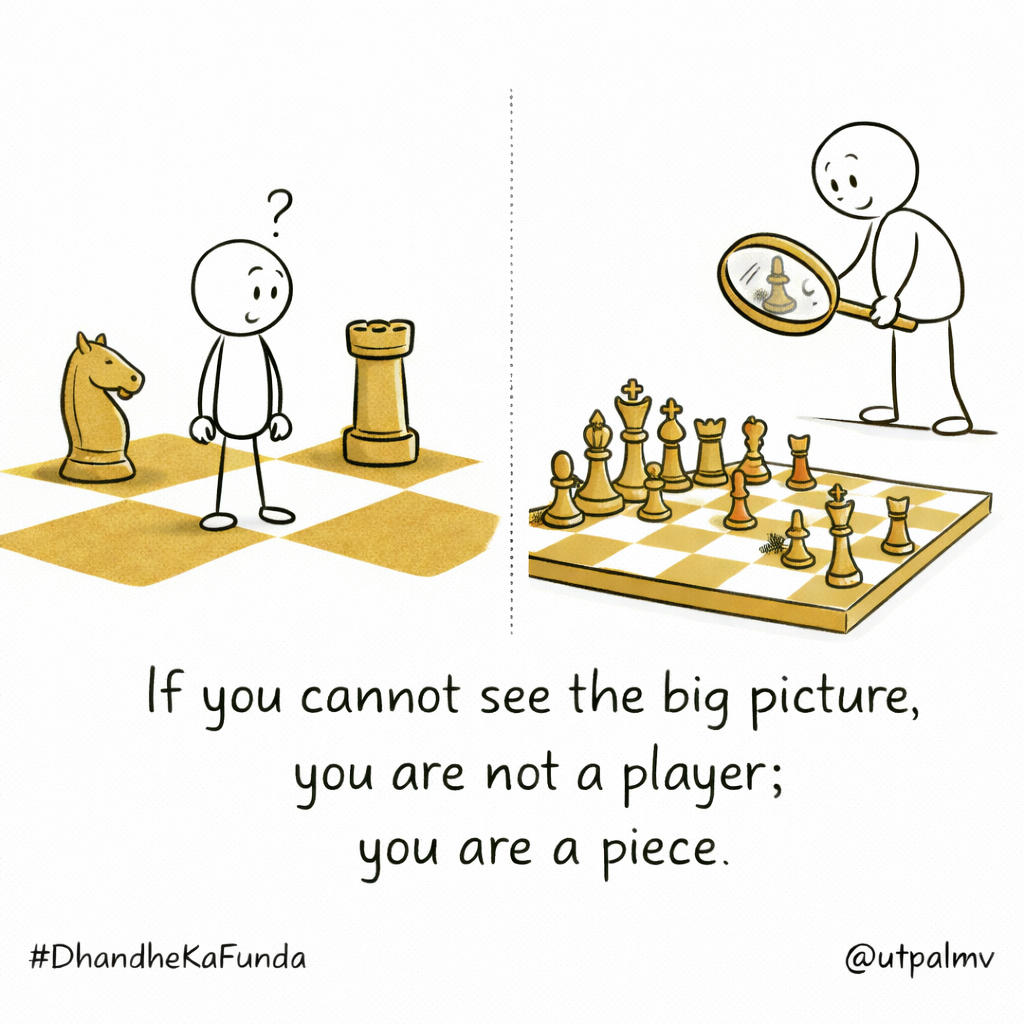
Effective decisions are not events; they are the result of three systemic layers:
Preparation: The board's jurisdictional alignment before the move is not even considered.
Calculation: The cold, monospaced logic of potential lines and consequences.
Strategy: Improving the square so that the final choice becomes an inevitability rather than a gamble.
Every decisive moment is a one-way bridge.
We do not avoid these turning points; we architect them.
The Master Builder consciously pursues the "fork in the road" because the resulting crisis is the only furnace hot enough to harden one's gifts.
Confidence is not a feeling; it is a calculation that has been internalized.
By developing a personal Blueprint, you move from seeking the "right" result to maintaining Decisional Integrity.
Whether the outcome is a capture or an exchange, the system emerges stronger.
#DhandheKaFunda: "The Law is if you cannot see the big picture, you are not a player; you are a piece."
A decision can consume a week without becoming any better defined. You gather another opinion, open another comparison, and return to the same uncertainty.
The useful question is what would make the decision ready. Clarity needs an exit condition.
Separate what you need to know from what would merely be interesting to know. If you are choosing a tool, the decisive questions might concern one required workflow, the cost of leaving, and who will maintain it. Another feature comparison may add little.
Before researching, write the choice, the missing evidence, and the condition under which you will decide. This is a proposed working practice, not a claim that every difficult choice can be reduced to a checklist.
Choose a decision you have revisited at least twice. Name the single uncertainty most likely to change your answer. Seek evidence about that uncertainty, then record whether your preferred option changed.
If the answer did not change, ask whether further inquiry could reasonably change it. If it could, specify how. If it could not, another research session may simply postpone responsibility for choosing.
Irreversible consequences, competing obligations, and missing expertise can justify delay. The test is whether the delay has a purpose and an observation plan.
Judge this practice by the quality of the eventual decision and avoidable rework, not just how quickly you stop thinking. A faster mistake is not clarity.
This work develops the concern in “Default Clarity,” published on 2026-02-08.
A team can improve its execution while continuing to serve an assumption that no longer holds. The schedule looks healthy because nobody has asked whether the work still solves the problem it was created for.
An assumption audit begins with one consequential belief, not a general invitation to doubt everything.
Write the belief in a form that could be contradicted. “Users need this report before making the weekly decision” is more useful than “Reporting is important.” Name the evidence currently supporting it and what would cause you to change it.
Then inspect actual use. A report may be opened without influencing a decision. A missing response may reflect poor access rather than lack of need. Keep competing explanations visible.
Select a recurring deliverable. Ask its intended recipient to describe the last decision it informed. Compare that account with the purpose you had assumed.
If the evidence is weak, do not immediately remove the deliverable. Test a smaller or different version where consequences allow, and check who else depends on it.
Record the decision changed by the review, including a reasoned decision to continue. If every audit ends with the same answer regardless of evidence, the exercise is ceremonial.
The aim is a model that can be corrected while correction is still manageable. Constant novelty is no better evidence of judgment than unquestioned routine.
This work develops the concern in “The Assumption Audit,” published on 2026-02-07.
A proposal can become increasingly polished while its central assumption remains untouched. Everyone understands the presentation. Nobody has seen whether the intended user can do anything useful with the result.
The delay that matters is the distance between the plan and an encounter that could correct it.
Some preparation is essential. It can prevent harm, resolve dependencies, and make a test interpretable. Other preparation mainly improves how the idea appears before it is challenged.
Suppose you are designing a workshop. Another slide revision may be less informative than asking one willing participant to attempt the central exercise. The trial can expose an unclear instruction without requiring a full launch.
Choose a stalled plan and identify its central uncertainty. Design the smallest responsible encounter that could reveal something about it. Name who participates, what they will do, and what result would change the plan.
Afterward, compare the new information with what your last round of planning produced. If neither addresses the central uncertainty, reconsider the question.
This lens concerns a planning pattern. It does not explain anxiety, establish a person's courage, or imply that productivity creates peace.
Keep necessary safeguards. The test is useful when it brings better evidence into the decision, not simply when it gets something shipped sooner.
This work develops the concern in “The Latency Trap,” published on 2026-02-06.
Talent is not enough by itself. It always appears through conditions.
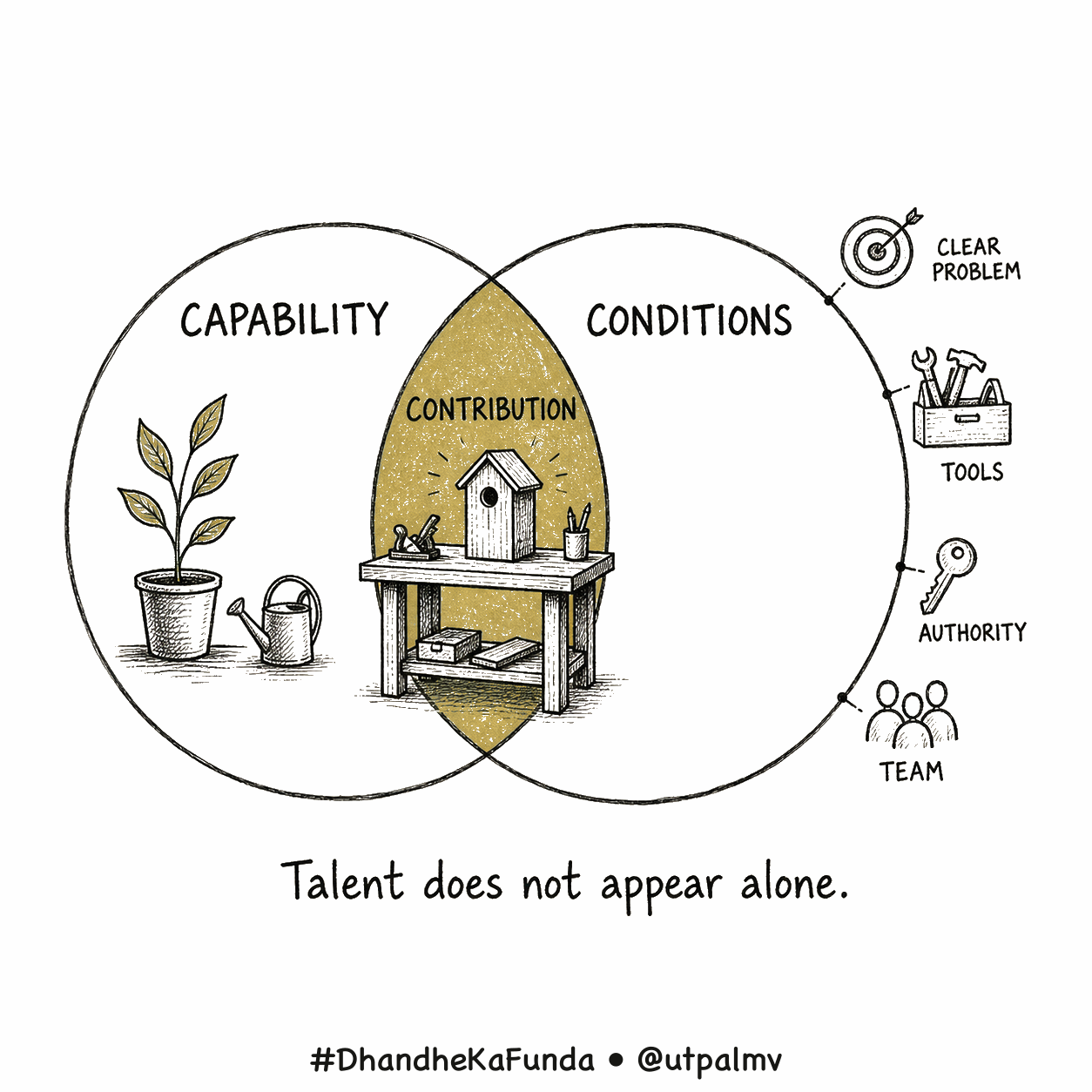
We often describe performance as if ability were a fixed quantity carried from one job to another. Someone succeeds, so we call the person talented. Someone struggles, so we question the talent. This account is convenient because it places the explanation inside the individual. It also ignores how much work depends on the problem, tools, standards, authority, incentives, and people surrounding that individual.
A capable person can look average in a role that rewards the wrong strengths. A careful thinker may fail in an environment that treats every pause as weakness. A decisive operator may become ineffective when authority is unclear. Someone who thrives with a difficult customer problem may be wasted on work whose only measure is internal compliance. None of this means that every mismatch excuses poor performance. It means that performance is evidence about an interaction, not only about a person.
Good conditions are not the same as comfortable conditions. Demanding work, direct feedback, and high standards can reveal talent. The important question is whether those pressures help the person contribute or merely create noise. A role should stretch capacity without making success depend on guessing hidden rules.
This changes the manager's responsibility. Hiring is not finished when a capable person arrives. The organization must make the problem clear, provide enough authority to act, establish useful constraints, and notice where the surrounding system blocks contribution. It must also be willing to name a genuine mismatch rather than indefinitely redesigning the role around one person.
For the individual, the same lens can replace a global judgment with a better diagnosis. Instead of asking, “Am I talented or not?” ask which conditions allow the talent to become useful, which skills are actually missing, and which parts of the environment cannot be changed.
Talent matters. So does the place where it is asked to perform. Management includes understanding both.
Some work is won through persistence rather than intensity.
Intensity is easy to recognize. It produces long days, urgent decisions, visible effort, and stories about commitment. Persistence is quieter. It returns after the first excitement has gone and continues when progress is difficult to display.
This matters because many valuable things compound slowly. Trust develops through repeated behavior. Skill improves through practice that looks ordinary from one day to the next. A body of work becomes useful after enough pieces begin supporting one another. A business often needs several cycles of learning before its assumptions become clear.
Stopping too early interrupts that accumulation.
But persistence is not automatically wise. The same language can defend a project that no longer deserves time, a strategy contradicted by evidence, or a commitment maintained mainly because abandoning it would hurt the ego.
The distinction is not persistence versus quitting. It is whether continued effort is still producing information, capability, relationships, or movement.
I would ask:
Without those questions, endurance can become delayed acceptance. With them, persistence becomes an active choice rather than passive attachment.
Timing matters too. A sound idea can meet the wrong market, team, or moment. Continuing exactly as before is not always courage. Sometimes the persistent move is to preserve the underlying question while changing the form in which it is pursued.
Endurance does not guarantee success. It changes the odds only when it remains in contact with reality.
The useful form of persistence is therefore not stubbornness. It is sustained commitment with the freedom to revise how the commitment is expressed.
Some decisions are calculations. Others remain bets.
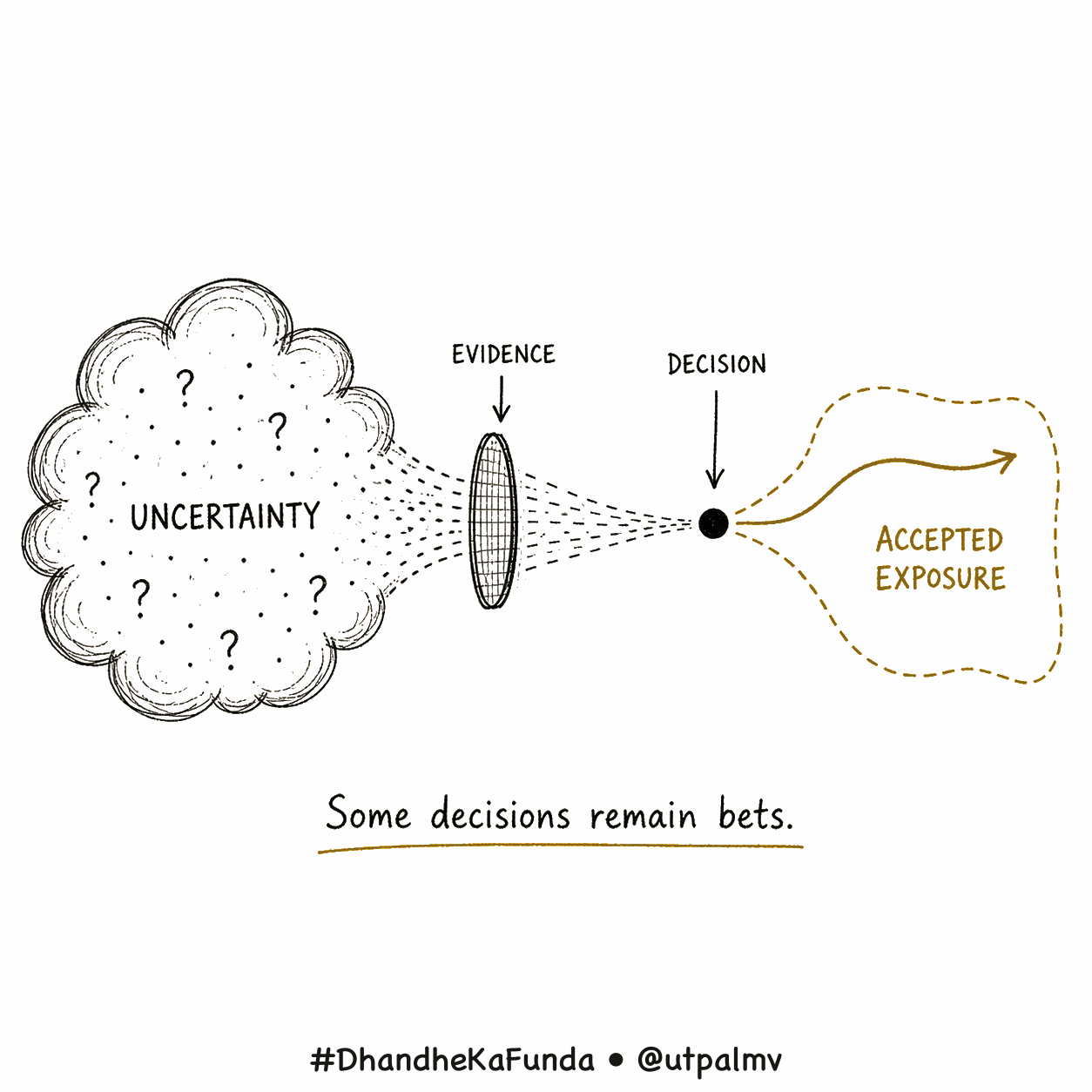
The distinction can disappear when a spreadsheet gives an uncertain future a precise number. Revenue forecasts, probabilities, weighted scores, and scenarios are useful ways to organize what we know. They do not automatically turn uncertainty into fact. A model can clarify a bet without ceasing to be one.
When the relevant evidence is available, use it. Check the assumptions, compare alternatives, and let the numbers correct preference. But also notice what the evidence cannot establish: how a market will respond, whether a partnership will hold, whether a person will grow into a role, or whether timing will make an otherwise sound move fail.
In those cases, decisional integrity begins with naming the uncertainty. Which assumptions are supported? Which are estimates? What are we choosing to believe because experience points that way? What would make the decision unacceptable even if the upside remains attractive?
Instinct belongs in this account, but it should not be disguised as data. Pattern recognition developed through experience can identify something before we can fully explain it. It can also carry bias, fear, pride, or attachment. Treat instinct as a signal worth examining, not as evidence that ends the examination.
The final question is often about exposure. How much money, time, trust, or reputation are we willing to place behind this incomplete view? Can the decision be staged? Is there a smaller commitment that preserves the learning while limiting the loss? If not, are we willing to carry the consequence without rewriting the story afterward?
A sound process does not guarantee a sound outcome. A good bet can fail, and a careless one can succeed. Integrity lies in remembering what was known at the time, what remained uncertain, and why the risk was accepted.
Calculation helps us see the bet more clearly. It should not be used to pretend that no bet remains.
An outburst may communicate that something matters. It rarely resolves the thing that caused it.
Anger can be information. It can reveal that a boundary was crossed, a promise was broken, or a pattern has become intolerable. A calm voice is not automatically a wiser voice, and composure should not be used to protect the person who created the problem.
But the force of a reaction is not the same as the quality of a response. Volume may make the problem impossible to ignore while leaving its causes untouched. It may also introduce a second problem: people begin managing the outburst instead of addressing the original failure.
Once the emotion has been acknowledged, the operational questions remain. What happened? Is this an isolated event or a recurring pattern? Who had the information and authority to act? What can still be repaired? What changes before the next occurrence, and who owns that change?
These questions are not a demand for sterile language. A response can be direct, emotional, and still precise. The important shift is from expressing the seriousness of the problem to creating the conditions for resolution. If nobody can state the next step after the room becomes quiet, the reaction has not yet become a response.
There are situations in which protest, public pressure, or refusal is itself part of the remedy. Outrage can move an ignored issue into view. Even then, attention is not completion. Someone must still translate the signal into an investigation, decision, repair, boundary, or sustained change.
Discipline here is not emotional suppression. It is not asking the harmed person to become more comfortable for everyone else. It is refusing to let the performance of concern substitute for the work that concern requires.
Let the emotion tell the truth about importance. Then ask it to make room for evidence, ownership, and action. Resolution begins when the energy of the reaction is connected to a change that can be observed.

I first wrote this reflection in 2013 and revised it substantially in 2018.
Funding and valuation can matter. They can buy time, capability, distribution, and room to experiment.
They are still not the work.
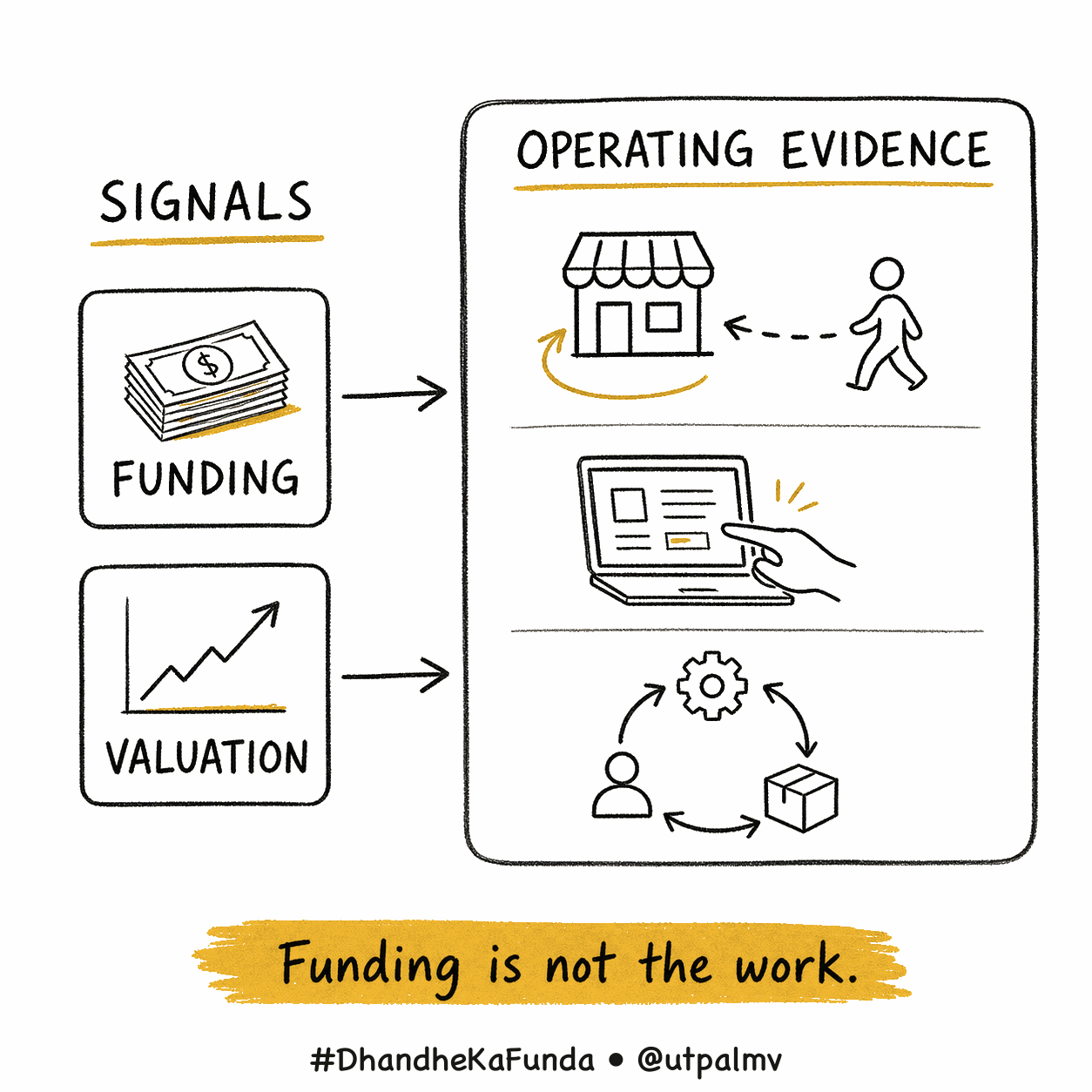
The distinction becomes difficult because financing events are unusually visible. A round has a number, a valuation, investors, photographs, and an announcement. It gives the company and the founder a moment that other people can easily recognize as progress.
The operating work is less theatrical.
Does the company understand a problem worth solving? Are customers choosing the product, using it, and returning? Can the team learn from failure without hiding it? Is the business becoming more capable, or merely better funded?
Capital can strengthen all of those things. It can also postpone the moment when weak assumptions have to meet reality.
This is not an argument against raising money. Some businesses need substantial capital before they can produce meaningful evidence. Infrastructure, research, manufacturing, regulated industries, and network businesses may not fit a romantic bootstrapping story. Even a modest software company may use outside capital well when timing matters.
The point is narrower. Funding is an input. Valuation is a negotiated estimate. Neither one proves that the company has created durable value.
The opposite mistake is also possible. Refusing capital can become its own identity performance. A founder may celebrate independence while starving a good opportunity of the resources it needs.
The useful question is not whether funding is good or bad. It is what the capital allows the company to learn, build, or reach that it could not responsibly do otherwise.
That question keeps financing attached to purpose. It also makes the trade visible: money creates options, but it brings expectations, dilution, governance, and a clock.
After the announcement, the operating questions remain. What became possible? What obligation did the money create? What evidence should exist before the next round is needed?
Applause can mark the beginning of a new phase. It should not be confused with the result.
A strong position can create room to choose rather than react.
The source applies that idea to location, negotiation, intellectual property, media, code, and capital. Its specific claims about Dubai, tax optimization, institutional structures, and future leverage require professional and factual verification before publication.
Three bounded principles remain:
Position matters. It does not create personal superiority or guarantee that every external move increases value.
Techniques are useful, but they are easy to collect without applying. A folder of instructions can create the feeling of progress while the real work remains untouched.
Ownership begins when I connect learning to a result, a context, and a feedback loop.
A checklist compresses someone else's experience. It may save time, but it cannot contain every condition of a specific market, team, or problem. The learner still has to judge what applies.
Attention also matters. Mastery does not require 100 percent commitment to one task, but it does require periods of practice deep enough to reveal error and improve judgment.
1. Choose an outcome
Replace a broad "to learn" intention with something observable you want to understand, decide, or produce.
2. Select one method
Use a relevant technique as a starting point. Record why it fits the present context.
3. Practise and observe
Apply the method, examine the result, and note what the generic instruction missed.
4. Clarify responsibility
State which decisions you own and which require another person's authority or expertise. Ownership is proportionate; it is not total accountability for every outcome.
5. Delegate with conditions
When handing off work, transfer context, authority, expected results, and review points. Accountability remains shared where decisions and dependencies are shared.
Ownership does not make a learner unstoppable, and discomfort is not proof of progress. It makes learning concrete enough to test, adapt, and complete.
Conflict has costs, but it cannot always be reduced to return on investment. A difficult conversation may protect safety, dignity, fairness, or truth even when progress is not immediately measurable.
Before confrontation:
Afterward, review what became clearer, what was repaired, and what harm remains. Emotion is part of that evidence, not noise to exclude.
Silence or withdrawal can also carry harm. Corrective action, including role change or separation, should follow evidence and fair process rather than treating a person as a misaligned node.
The tree and creeper metaphor can illuminate autonomy, but it can also turn legitimate support into weakness.
People and organizations depend on others. Skills, judgment, integrity, savings, documentation, and relationships can make that dependence more resilient without creating total self-sufficiency.
A rootedness review can ask:
Strong roots do not draw their own water. They work through a larger living system.
Working only to prove worth can pull attention away from the work itself. External evidence, however, is not the enemy.
Customers, colleagues, and readers often need proof before they can trust a claim. Good marketing does more than announce that something exists. It explains the value and supports it honestly.
When communication becomes defensive:
Internal confidence and external proof serve different purposes. Neither makes the audience irrelevant.
The low-fidelity pilot A large vision can make the first move unnecessarily large.
Skills and attention change when they are neglected, practised, or placed under strain.
A qualification or past success records something that happened. It does not guarantee that the same capacity remains available in a new context. Maintenance involves returning to the work closely enough to notice what has weakened and what the present situation now demands.
Observation is part of that maintenance. Before acting, I need a workable account of the problem, the constraints, and the evidence I may be missing. Action then tests that account. Neither observation nor execution is sufficient by itself.
Uncertainty complicates the balance. Waiting for complete information can delay learning, while acting too quickly can create unnecessary damage. A small, controlled step is often useful when it can reveal evidence without making an irreversible commitment.
Discomfort also deserves interpretation rather than worship. A difficult conversation may need to be faced. Exhaustion or danger may require withdrawal. Staying with discomfort is valuable only when doing so serves understanding or responsibility.
A periodic maintenance review can be simple:
An edge is not a permanent possession. It is the current result of attention, practice, feedback, and recovery.
Desire can point toward something worth pursuing. It becomes less useful when the outcome begins to determine identity or emotional stability.
I notice the shift when a goal stops being a direction and becomes a verdict. A positive result means I am doing well; a negative result means I am a failure. That binary interpretation gives an external event more authority than it can reasonably carry.
An experimental mindset offers another relationship to ambition. I can form a hypothesis, act, observe the result, and revise the next attempt. Failure may still disappoint me. Treating it as evidence does not require pretending that the disappointment is absent.
This distinction also protects against endless persistence. A missing breakthrough does not always mean that more tests are required. The evidence may show that the goal, method, or cost needs reconsideration.
When a goal creates anxiety, I can ask:
The aim is not to eliminate wanting. It is to keep desire in proportion, so that it can energise action without becoming the sole measure of a life.
An idea does not become real by becoming more inspiring. Someone has to translate it into action.
The gap between imagining and building can contain fear, uncertainty, missing knowledge, or simple practical constraints. Calling all of that fear makes the problem harder to understand. Each obstacle asks for a different response.
If the next step is unclear, the idea may need definition. If the cost is unknown, it may need research. If the action feels risky, it may need a smaller experiment or a limit on possible loss. If I am avoiding a difficult but proportionate step, then courage may indeed be part of the work.
The smallest physical action can help because it turns an abstraction into evidence. A sketch reveals what the idea has not resolved. A conversation tests whether the need exists. A prototype exposes where the concept and the world disagree.
Action should not be used to silence every hesitation. Some hesitation contains information. The task is to examine it closely enough to distinguish a warning from avoidance.
A possibility remains provisional until it meets materials, people, constraints, and consequences. Building is the process through which the idea is clarified, altered, or sometimes abandoned.
The bridge between vision and reality is rarely one decisive move. It is a sequence of choices that lets reality answer back.
Complex problems often improve when more than one relevant perspective can examine them.
That does not make intelligence a network property in every case, and sharing a problem does not guarantee a breakthrough or reduce stress. Privacy, competence, timing, and decision rights still matter.
For a problem being held by one person:
Leadership sometimes requires giving an answer. It also requires building a team that can think without waiting for one person to do all the thinking.
What looks like talent from a distance often contains a repeatable practice.
A plan is a hypothesis about what will happen. It becomes useful when reality is allowed to correct it.
A mistake belongs to the past, but its consequences may continue into the present.
That distinction matters. Endless self-condemnation does not repair harm, yet calling a mistake merely a data point can make accountability disappear. The work is to acknowledge what happened, understand my part in it, and respond to what can still be repaired.
Guilt can carry moral information. It may show that an action violated a value or harmed someone. It becomes less useful when it turns from "I did something wrong" into "I am beyond repair." Shame of that kind narrows attention and can make honest correction harder.
Self-forgiveness is therefore not an overwrite command or a declaration that the act was acceptable. It is a willingness to stop using punishment as a substitute for responsibility.
A practical response may include:
I cannot undo an earlier choice. I can refuse to repeat it, carry its lesson without making it my entire identity, and let the quality of the next action show what was learned.
Irritation is a response, not proof that another person has gained control of my inner life. It can arise from an unmet expectation, a crossed boundary, fatigue, fear, injustice, or something I have not yet understood.
The useful move is to create enough space to examine the response before acting from it.
Expectation: What did I expect to happen, and was that expectation communicated or reasonable?
Boundary: Did the event violate a legitimate limit that needs to be stated or enforced?
Condition: Am I tired, overloaded, or carrying another concern into this exchange?
Interpretation: What story have I attached to the other person's action, and what evidence supports it?
Irritation does not always reveal an internal defect. Sometimes it is useful information about the situation or relationship.
1. Pause before expression
Notice the physical and mental response. A pause may create a choice, though it does not give anyone complete control over what they feel.
2. Name the trigger precisely
Identify the action, expectation, boundary, or interpretation involved. Avoid turning one event into a judgment about the whole person.
3. Choose the proportionate response
You may need to revise an expectation, ask a question, state a boundary, address harm, or let a minor frustration pass.
4. Review the pattern
If the same response recurs, ask what it is protecting and whether the current strategy helps.
Emotional responsibility is not the claim that we choose every feeling. It is the work of deciding what we do with the feeling once it arrives.
A yes creates responsibility, but not responsibility without limit.
Agreement may express willingness to do the work, learn what is missing, and communicate when conditions change. It cannot reasonably promise control over every consequence or guarantee an outcome that depends on other people and uncertain events.
Before committing, a pause helps. I can ask what is being requested, what authority and resources accompany it, which risks are already visible, and what would justify revisiting the agreement. A responsible yes includes boundaries, not only resolve.
Discovering that I do not yet know how to complete something is not automatically a reason to withdraw. Many commitments include learning. But keeping a promise at any cost can create greater harm than renegotiating it. New evidence, changed conditions, or a conflict with a more serious obligation may require an honest conversation.
No protects capacity when it is clear and timely. It need not be the default to every uncertain opportunity, nor a performance of discipline. Yes and no both gain meaning from the care with which they are given.
Reputation is shaped by follow-through, and also by whether expectations were represented honestly. A trustworthy commitment says what I will attempt, what I can actually control, and how I will respond if the path no longer matches the promise.
Analysis can become a way to postpone contact with evidence. Building can also become a way to avoid necessary thought.
The useful distinction is not analyst versus creator. It is between analysis that changes a decision and analysis that repeats without reducing uncertainty.
For a stalled project:
Ownership does not mean doing whatever it takes or refusing to reconsider a plan. It means remaining responsible for both the decision and its effects.
Binary labels can hide important detail.
A project may miss one objective while producing useful evidence. A person may behave poorly in one situation without becoming a “bad” person. At the same time, some decisions do require a clear yes, no, safe, unsafe, acceptable, or unacceptable.
Before settling on a label:
Keeping a question open is useful only while it improves judgment. Ambiguity should not become an excuse to avoid a necessary decision.
In the legacy world, "Scope Creep" is treated as a battle.
In the legacy world, we are addicted to "Resonance." We seek out movies, books, and social circles that confirm our dominant premises.
A degree, résumé, or job title describes part of a person’s experience. It need not define the boundary of what they may learn next.
Imagination can cross disciplines, but competence still requires study, practice, and respect for expertise. Thirty minutes of research does not grant 20 years of experience, especially in legal, medical, financial, or safety-critical work.
To explore beyond a familiar field:
The résumé records where you have been. Growth determines what you responsibly become able to do.
Caring for oneself is part of sustaining responsibility to other people.
Sleep, movement, nourishment, medical care, emotional support, and time away from work affect the capacity to think and act. Neglecting them can reduce that capacity, but illness, disability, dependency, or exhaustion do not make a person useless or inferior.
The familiar oxygen-mask analogy captures only part of the issue. Some responsibilities cannot wait until I feel fully restored, and many forms of care are mutual. Independence is not the only measure of a healthy life. Knowing when to receive help can be as important as knowing when to provide it.
Self-stewardship is less about optimisation than maintenance. It asks what conditions allow me to remain present for the work and relationships that matter, and which of those conditions need attention now.
That review might include:
The answer need not be an elite routine or a dramatic reinvention. A small, sustainable correction may be more responsible than an idealised standard that cannot last.
Care is not proof of virtue and exhaustion is not proof of commitment. The aim is to preserve enough capacity to participate honestly in one's own life and in the lives of others.
Every January, messages arrive wishing happiness and prosperity. Many are copied, broadcast, and quickly forgotten. I have sometimes dismissed them as empty ritual.
That judgment now feels too easy.
A conventional greeting may be automatic. It may also be the only thread two people have kept. Not every expression of care has to solve a problem. A wish can be small and still be sincere.
What bothered me was not the greeting itself. It was the gap I noticed in my own behavior: wishing someone well while making no room to understand what “well” might require. The sentence allowed me to feel connected without asking anything of my attention.
Usefulness can be one response to that gap. If I know someone is trying to finish a piece of work, find a customer, understand a decision, or reach the right person, I may be able to help. A relevant introduction, a careful reading, or a specific offer often carries more meaning than another generic message.
But usefulness has limits as a measure of relationship. People are not nodes whose value depends on contribution. Help that was not requested can become interference. A proposition of value can turn a greeting into a transaction. Sometimes care means listening. Sometimes it means remembering. Sometimes it means leaving the other person free of another demand.
The practice I want is not “be useful or be quiet.” It is to match the gesture to the relationship.
For a distant acquaintance, a simple wish may be enough. For someone close, I can be more present. When I see a concrete way to help, I can offer it without assuming I know what they need. When I cannot help, I can still mean what I say.
Prosperity is not something I can architect for another person. I can contribute to a few conditions, remove a little friction, or stand beside them for part of the way. The modesty of that role makes the goodwill more honest, not less.
Expression can serve the work, the relationship, the record, or the person speaking. It does not have only one objective.
The useful question is whether a message serves its stated purpose or mainly performs certainty, status, or grievance.
Before sending or speaking:
Effectiveness is not the only measure of right behaviour. Standards, truth, dignity, safety, and process can matter even when they slow the immediate task.
Focus requires exclusion. Attention given to one task is unavailable to another.
That constraint makes prioritisation necessary, but it does not make total commitment the right answer for every part of life. Work, health, family, rest, and unfinished obligations can all make legitimate claims on attention. The challenge is to choose deliberately among them rather than pretending that each can receive everything at once.
When I am working on one important task, reducing avoidable switching helps. A protected block of time, a short list, and a clear stopping point can create enough continuity to think well. The rest of the world still exists, but it does not need to enter every moment of the work.
Effort also needs a more honest measure than a percentage. I cannot reliably know whether I gave 70 or 100 percent, and an unfavourable result is not a character flaw. I can ask instead whether I prepared responsibly, stayed present, adapted to evidence, and respected the limits under which the work was done.
Elimination is part of this practice. Some tasks can be declined, delayed, delegated, or removed. Others are maintenance that will never feel like a primary calling but still protect what matters.
Focus is not burning everything else as fuel. It is giving the chosen work an appropriate share of undivided attention, then returning responsibly to the rest of life.
Inspiration can feel satisfying before it changes anything.
That does not make consumption parasitic or spectators inferior to creators. Stories, teaching, and rest can have value without immediate conversion into output. The problem appears when repeated consumption substitutes for the work a person says matters.
After encountering a useful idea:
No fixed consumption-to-work ratio can settle this. Inspiration is neither success nor failure. It is material that may or may not become part of practice.
A product remains legally and operationally owned even when users adopt it deeply. Adoption is not a psychological transfer of ownership.
The useful distinction is between what the maker built and what the user can now do.
To examine adoption:
Marketing can create awareness, and branding can help people understand and trust a product. Neither should overpower utility. Users may call a tool “mine” without surrendering their data, agency, or right to leave.
Some decisions become right through adaptation. Others reveal themselves as wrong despite committed effort.
Action can uncover information that is unavailable in advance. A proposal meets a client, a product meets use, and a plan meets constraints. Inspection and revision may turn an uncertain beginning into valuable work.
That does not mean persistence can force every idea into correctness. Markets change, assumptions fail, costs rise, and harm becomes visible. Refusing to let something fail can deepen the loss and make learning harder.
The challenge is to act without pretending that action guarantees vindication. Before moving, I can identify the belief being tested and the limits within which the experiment is responsible. Afterward, I can examine what happened without redefining every result as proof that the original choice was right.
Useful questions include:
Clarity sometimes follows action. It can also precede action through research, counsel, or experience. Neither thinking nor building owns the truth.
The right next step remains provisional. Responsibility lies in choosing it with available evidence and allowing reality to revise the choice.
There is a version of being smart in business that I no longer find especially useful. It treats every negotiation as a contest of extraction: get the highest price, give the least ground, and make sure the other person leaves with less than you.
Sometimes that works. You may get the contract, protect a percentage point, or secure a term that favors you. But the agreement continues after the negotiation ends. The other side still has to deliver, cooperate, solve problems, and decide whether they want to work with you again.
That is where an apparently clever deal can become expensive.
I am not arguing that every negotiation should end in equal shares or that generosity automatically creates trust. Some situations are genuinely adversarial. Some people take advantage of openness. Boundaries and commercial judgment still matter.
The narrower point is this: if an agreement works only because one side has not yet understood how badly it serves them, the agreement is unstable.
I would rather make the other side's benefit explicit. What are they getting? What risk are they carrying? Which term matters to them more than it matters to me? Is there a way to increase the total value before we fight over its division?
Leaving room for the other side to win is not softness. It is an attempt to build an arrangement that can survive contact with reality.
This also changes how I think about concessions. A concession is not automatically a loss. If a small point matters greatly to the other person and very little to me, giving ground may improve the agreement without weakening my position. The mistake is not conceding. The mistake is conceding without understanding what is being exchanged.
The best negotiation is not always the one in which I can prove that I was the smartest person at the table. It is the one that still makes sense when the work begins.
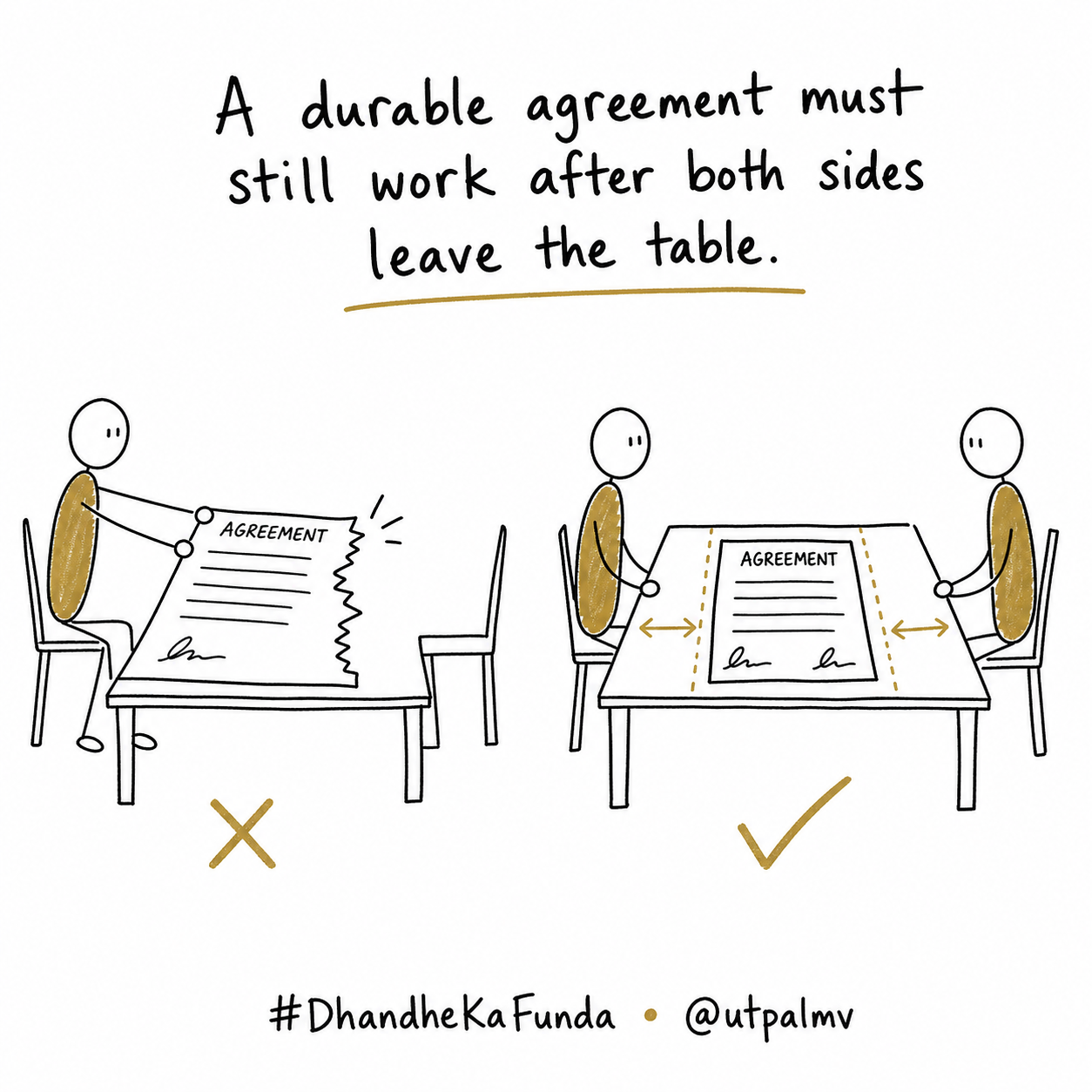
A capable team can still pull in several directions.
The engineer may optimize technical quality. The project manager may protect schedule. Finance may protect the budget. Marketing may focus on desire. Each concern can be legitimate, yet their combination does not automatically produce coherent work.
Years ago, I used the phrase “Chief Hypnotizer” for the person who holds a team’s attention on a shared purpose. I can see what I was reaching for: not another job title, but a source of orientation. I am less comfortable now with the word hypnosis. A team should not have to surrender judgment or become obsessed with one person’s certainty.
The role I still find useful is quieter. Someone has to keep asking why the work matters, what promise is being made, and whether current decisions still serve it. That person may be the founder, but does not have to be. The role can move as the work changes, and it becomes stronger when others can question it.
Shared purpose is not produced by repeating a vision until it is the only thing people see. Repetition can create compliance without understanding. Alignment needs conversation: different functions explaining what they notice, disagreements being made explicit, and the purpose changing when reality exposes a weakness in it.
Nor does purpose remove the need for management. Deadlines, ownership, budgets, and working conditions remain real. Inspiration cannot compensate for missing decisions or exhausted people.
When a project drifts, I now ask three questions. Can each person describe the outcome in their own words? Do their decisions point toward the same promise? Is there enough safety to say that the promise is wrong, unclear, or no longer worth its cost?
A team needs someone to hold the purpose, but not to possess it. The work becomes durable when orientation is shared, challenge is allowed, and no single person has to hypnotize the room.
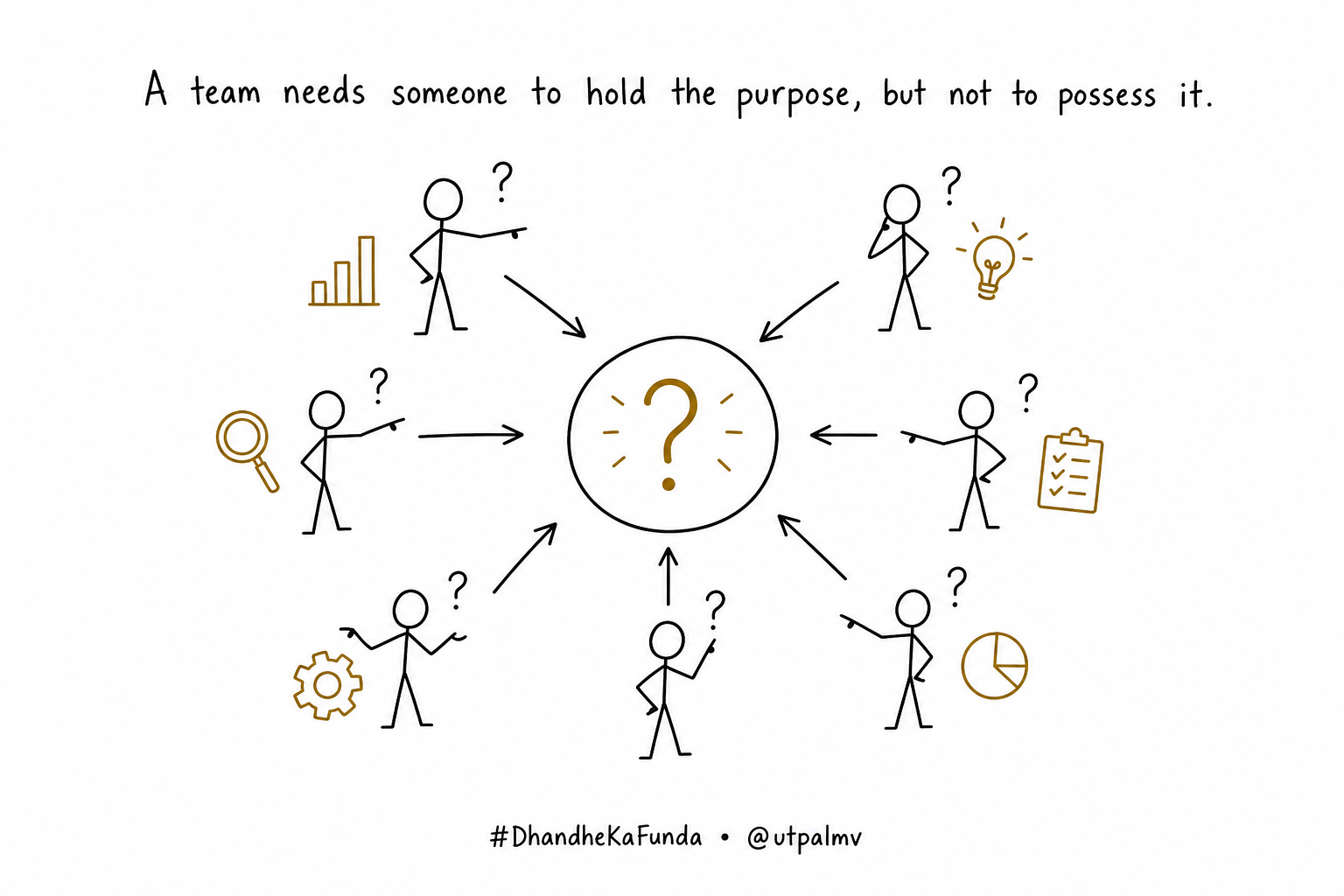
Inaction has consequences, but it is not always equivalent to failure.
Waiting may preserve an option, prevent irreversible harm, allow recovery, or create time for information that is genuinely expected. It may also be avoidance disguised as prudence. The task is to distinguish the two without assuming that movement is always superior.
I can begin by asking what I am waiting for. If the answer is a specific fact, decision, resource, or condition, there may be a legitimate pause and a date for reassessment. If the answer remains vague while the cost of delay grows, a small action may be useful.
The consequences of doing nothing and of trying are rarely identical. An attempt can consume money, trust, health, or another person's time. It can also produce evidence and opportunity. A responsible comparison includes both sides rather than declaring the risk zero.
For a stalled decision, I can map:
Movement is valuable when it produces relevant evidence or advances a responsibility. Stillness is valuable when it protects something important or allows necessary understanding.
Neither deserves to be chosen only for the feeling of safety it provides.
Clarity is useful, but certainty can arrive too early.
A decision often requires a temporary conclusion: enough confidence to choose a direction and act. The danger begins when that conclusion becomes something I must defend despite new evidence.
Confusion can signal that my current model no longer explains the situation. It may also come from missing information, competing priorities, fatigue, or fear of commitment. Treating confusion as inherently wise would be as limiting as treating it as failure.
The first useful step is to name what is unclear. Am I uncertain about the goal, the available options, the consequences, or the standard by which I will decide? A specific uncertainty is easier to investigate than a general sense of being lost.
Then I can ask what kind of inquiry fits:
Movement is not always the answer. Some choices deserve a pause, especially when action would be difficult to reverse. The point is to avoid both paralysis and forced certainty.
Learning involves a rhythm of provisional clarity and renewed questioning. I can act on what I know now while leaving room for the next piece of evidence to change the map.
Some victories weaken the conditions needed for the next piece of work.
A result achieved by damaging trust, withholding opportunity, or treating people as disposable may still appear successful on a narrow scoreboard. Its wider costs emerge later, when cooperation is needed and the relationships that could support it have been depleted.
This is not an argument that every goal must benefit everyone equally. Interests conflict, difficult decisions affect people, and leadership sometimes requires saying no. The relevant question is whether harm is necessary, proportionate, and acknowledged, or simply convenient for the person with more power.
Reputation functions partly as accumulated evidence. People notice whether commitments are kept, credit is shared, and mistakes are addressed. Trust can expand what a group is able to attempt, but it should not be treated as a balance to spend strategically while ignoring the people involved.
When a success leaves damage behind, repair begins with specificity. Who bore the cost? What was avoidable? What acknowledgement, restitution, or change in practice is possible? The affected person is not an obstacle to convert into an asset, and repair is not guaranteed to restore the relationship.
Complex work depends on both standards and human regard. Clarity can help name a problem without turning another person into the problem.
A durable win preserves the capacity to work together where possible and faces the real cost where it does not.
In the legacy world, we worship the "Track Record." We believe that because we delivered two massive projects in a row, we possess a "magic wand." This is the Renter’s Arrogance : a state where you believe your past success is an inherent quality of your personality rather than a result of your alignment with a specific set of variables.
Collecting information can feel like learning while postponing the work that would test it.
Bookmarks, saved videos, and unread books are not inherently wasteful. They can preserve a useful trail or support curiosity without an immediate application. The problem begins when accumulation becomes a substitute for engagement or a recurring source of obligation.
Application is one form of value, not the only one. A book may alter a question, provide language for an experience, or offer pleasure. It need not justify its existence through a business result. Still, when I am learning for a specific problem, use matters.
A practical method is to choose one relevant source, identify its central claim, and test one implication against the work. That test may confirm the idea, complicate it, or show that it does not fit the context. Moving to the next source before this step can create breadth without understanding.
Unread material also deserves no moral weight. I can keep it, archive it, give it away, or let it remain unread. The fact that it did not force itself into my schedule does not prove it lacks value.
The useful distinction is between a collection that supports inquiry and one that manages anxiety about everything I might need to know.
Learning becomes more durable when information meets attention, reflection, conversation, or practice. The appropriate form depends on what I hoped to learn.
Business metrics can make people disappear behind categories.
Terms such as users, leads, traffic, and conversion are useful for analysing a system. They become harmful when the abstraction replaces the person whose time, attention, money, and trust are involved.
User experience is one way to bring that person back into the design. It includes more than interface polish: how long someone waits, whether instructions are understandable, what happens when something fails, how consent is obtained, and whether support respects the person's circumstances.
A better experience can support retention and recommendation, but profit is not an inevitable byproduct of respect. A humane product may still face weak demand or an unsustainable model. Respect remains worthwhile even when it cannot be justified by a guaranteed return.
Improvement begins with evidence. Where do people abandon a process? What do support conversations reveal? Which requirement exists for the organisation's convenience rather than the person's need? Metrics help answer these questions when combined with observation and direct conversation.
Changing labels to more elevated language does not create empathy. The practice appears in choices: reducing avoidable waiting, explaining a trade-off, protecting privacy, making failure recoverable, and allowing someone to leave without manipulation.
Return on user experience is useful as a reminder, not a formula. The person is not a means to loyalty. They are the reason the experience deserves care.
Some calendar commitments are chosen. Others arise from work, care, community, or obligations already made. Calling all external expectation “enforcement” hides those differences.
“I do not have time” may mean low priority, limited capacity, a conflicting duty, or a promise that needs renegotiation. It is not always a lie.
An agenda review can ask:
Choice matters, but it operates inside real constraints and relationships. A clear no should not become permission to treat other people’s needs as noise.
New opportunities can make an unfinished strategy feel suddenly obsolete.
A technology appears, a competitor raises money, or a market story gathers attention. The movement itself creates pressure: decide now, speak now, reposition before the moment passes.
I have learned to put some distance between that pressure and a commitment. A waiting period can help, not because old ideas are wiser than new ones, but because excitement often arrives before evidence.
The opposite error is easy to miss. Patience can become a flattering name for attachment. A long-term plan does not earn protection merely because I wrote it first. News can contain weak signals and noise, but it can also report a change that matters. My internal data can be closer to the work and still be incomplete.
When a new opportunity appears, I ask what has actually changed. Is there new capability, customer behavior, regulation, cost, or access? Does it alter an assumption in the current plan? What evidence would distinguish a durable shift from temporary attention?
I also ask about fit. An opportunity can be real and still be wrong for this team, this moment, or this set of commitments. Pursuing it consumes attention that cannot be spent elsewhere. Declining it has a cost too. Both costs deserve a name.
Small reversible tests are often more informative than either immediate conversion or proud refusal. A prototype, customer conversation, limited allocation, or dated review can create contact with the opportunity without handing it the whole strategy.
Reflection is useful only when results can change my mind. Patience is useful only when it protects the time needed to learn or build. Neither quality makes the decision sovereign.
I do not want my focus leased to every headline. I also do not want it mortgaged to an old self-image. The standard is not whether I moved quickly or stayed the course. It is whether the decision remained in contact with evidence.
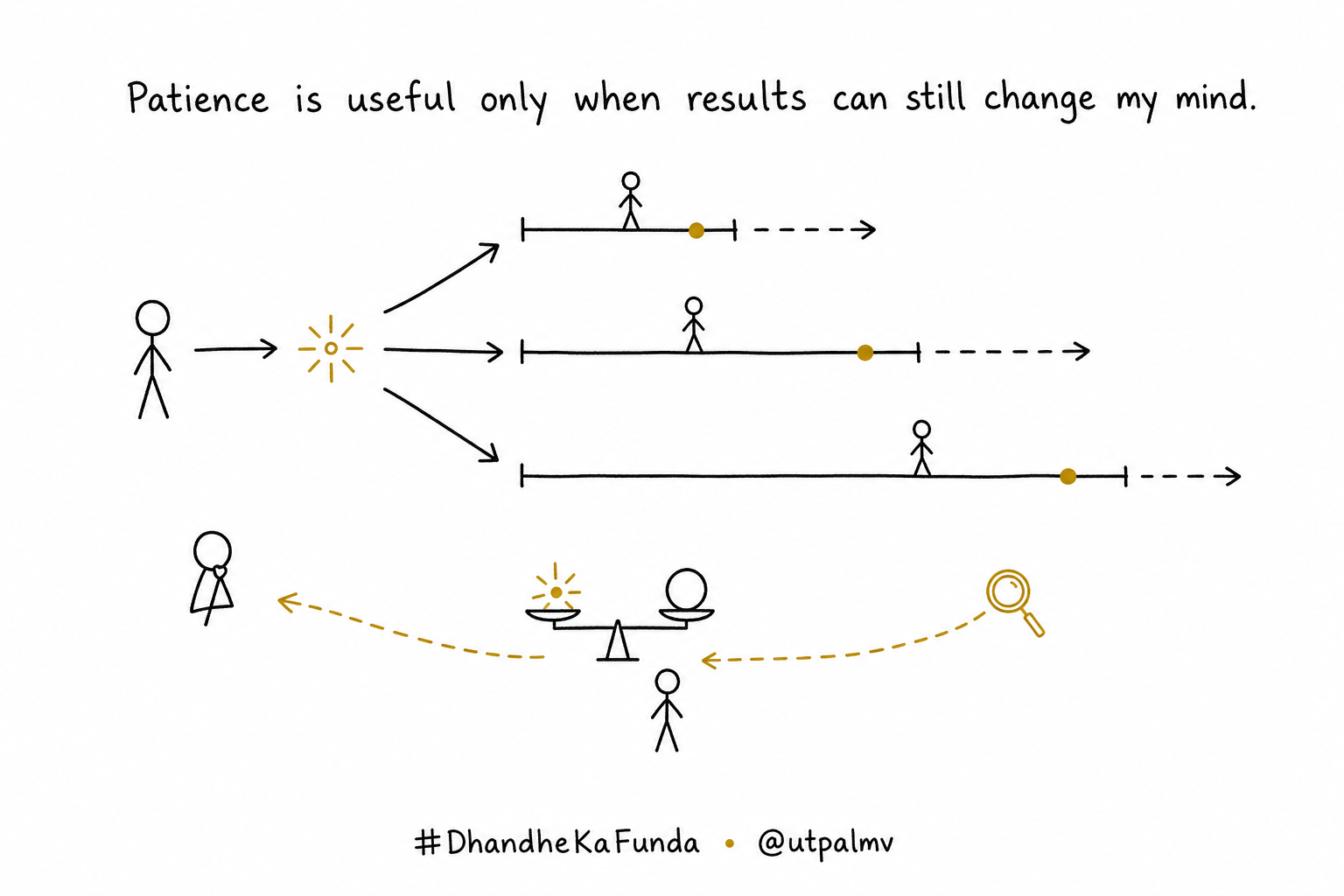
Focus depends on refusal. Every commitment uses time, attention, and energy that cannot be given to something else.
I have found a "default no" useful when requests accumulate faster than I can evaluate them. It is a pause, not an automatic rejection.
1. Identify the current priorities
Choose the few commitments that deserve depth in this period. They do not need to define your life or produce remarkable work. They need to be important enough to justify their cost.
2. Examine the request
Ask what the request requires, whom it serves, and what existing commitment would move if you accepted it.
3. Distinguish obligation from opportunity
Some requests arise from real responsibility rather than optional distraction. A default no should not become a way to ignore duties, relationships, or necessary maintenance.
4. Answer clearly
Say yes, no, not now, or yes under stated conditions. Clarity is kinder than vague agreement followed by weak delivery.
5. Review the portfolio
If an important new commitment enters, decide what will pause or end. Adding without subtracting is how focus dissolves.
Refusal does not make a person remarkable, and breadth is not inherently shallow. The practice simply protects enough capacity to do chosen work well.
Good presentation cannot compensate for a system whose underlying logic, risks, or defects have not been understood.
Reusing code, frameworks, or strategies is not itself a shortcut. The problem is using them without knowing their assumptions, obligations, and failure modes.
A build audit can ask:
Integrity does not require perfection or contempt for deadlines. It requires making limitations visible and choosing deliberately.
Fear of failure can keep a person inside a familiar but harmful situation. It can also prevent a reckless move. The feeling alone does not tell me which interpretation is right.
Failure is not merely a data point. It can involve lost money, damaged trust, illness, or consequences carried by other people. Learning matters, but it does not erase those costs.
The useful shift is from avoiding every possibility of failure to choosing risks that are understood and bounded. Before acting, I can ask what the worst plausible outcome is, who would bear it, which parts are reversible, and what reserve of time, money, health, or support is needed.
A small experiment can reduce uncertainty when it tests a specific assumption. Thirty days is not a universal window, and launching is not always the appropriate experiment. Research, a private prototype, or a limited conversation may produce the needed evidence with less exposure.
When a strategy fails, reflection deserves time. Immediate pivoting can carry the same mistaken model into a new direction. The response may include repair, grief, stopping, or another attempt.
Courage is not speed and safety is not cowardice. Responsible action holds both learning and consequence in view, then chooses a risk whose purpose justifies its possible cost.
Failure can become either identity or information. The event may involve loss, disappointment, responsibility, and consequences that cannot be erased by calling it data. Still, examining what happened can keep the event from becoming the only story available.
I think of this as a kinetic audit: acknowledge the impact, extract what can be learned, and decide what movement is responsible now.
There is no universal 15-minute limit for grief, anger, or recovery. Some failures require restitution, mourning, investigation, or a long pause. Starting something new does not close an event by itself.
Movement is useful only when it is not an escape from accountability.
1. Describe the outcome
State what happened without turning it into a verdict on your entire character or capability.
2. Separate causes from guesses
List the actions, conditions, and assumptions that may have contributed. Mark what is evidenced, what is interpretation, and what remains unknown.
3. Identify responsibility
Name what you need to repair, communicate, repay, or change. A systemic explanation should not make personal responsibility disappear.
4. Preserve the learning
Record the distinction that should alter the next decision. Failure does not automatically teach. Learning requires a change in understanding or practice.
5. Choose the next movement
The next step may be a new attempt, a smaller test, a conversation, or rest. Choose it because it responds to the event, not because motion itself proves success.
The river remains a useful metaphor for adaptation, but a human life also needs places to stop and attend to damage. The aim is not to move on within minutes. It is to keep the past from removing every responsible path forward.
Ambition and compassion do not have to oppose each other. Neither does full expression mean acting on every impulse without regard for consequence.
Professional judgment sometimes requires editing, preparation, restraint, and attention to other people. Those are not automatically signs of fear or inauthenticity.
When expression feels constrained:
Spontaneity can reopen curiosity. Skill and responsibility help turn it into work worth sharing.
Helping can become entangled with guilt, obligation, validation, and the wish to control another person's outcome. Clarity begins by admitting those motives instead of treating every offer of help as automatically good.
The phrase "cleaning the internal house" describes a pause before intervention. What am I feeling? What responsibility is actually mine? What does the other person want? What consequence might my help create?
Feeling overwhelmed by another person's need does not prove that the problem is only weak boundaries. The need may be real, the relationship may carry obligations, and refusing help can cause harm.
Equally, help can become intrusive or create dependence when it removes another person's choice. Absence does not automatically make someone stronger. The effect depends on the person, the relationship, and the situation.
1. Name the obligation
Identify the person or situation and the help you believe you must provide. Ask whether the obligation is chosen, relational, legal, ethical, or merely assumed.
2. Separate guilt from repair
Did you fail a commitment or cause harm that requires action? Or are you responding to an expectation that was never agreed? The answer changes what clarity requires.
3. Ask before solving
Find out whether help is wanted and what form would be useful. Do not use a theory about another person's growth to decide for them.
4. Choose a sustainable contribution
Offer what you can provide honestly. State the limit. A boundary is clearer when it does not pretend that withdrawal is always a gift.
5. Review the result
Did the help increase agency, reduce harm, fulfil a responsibility, or create a new dependency? Use the answer to adjust the next decision.
Clarity is not emotional purity. It is a more honest account of motive, responsibility, consent, and capacity before acting.
I used the Sovereign Quadrant to gather four qualities I wanted to bring to a period of change: essence, ownership, gratitude, and courage.
The model emerged from a desire to resist living entirely by default. It should not be read as a rejection of employment, stability, family advice, or social rules. Security can protect meaningful work, and many rules exist for legitimate reasons.
Essence asks whether a choice reflects what I actually value. It does not assume that a single pure purpose is waiting to be discovered. Values can conflict, and they become clearer through decisions.
Ownership asks what I can do to influence the result. It includes follow-through and repair. It does not assign one person total responsibility for outcomes shaped by shared authority, other people's actions, or external conditions.
Gratitude asks what is already present and worth recognizing. It can loosen a purely transactional view of work and relationships without denying scarcity, harm, or unmet need.
Courage asks which worthwhile action fear is making difficult. Fear is not always an instruction to proceed. Sometimes it identifies danger or missing preparation. Courage includes examining the signal before choosing.
The quadrant is not a formula for excellence. It is a record of how I was trying to make a transition more deliberate: choose from values, take proportionate responsibility, recognize what is available, and act despite uncertainty when the action remains sound.
Location can create access, but it cannot compensate indefinitely for weak value.
A physical address, a search position, or a favourable jurisdiction may help people encounter an offer. Whether they return depends on more: the product, service, environment, reliability, price, and fit with their needs.
These layers interact. A restaurant's menu cannot be separated entirely from its location or service. A digital product's features are experienced through onboarding, support, performance, and the context in which someone uses it. Improving one layer may expose a problem in another.
Experience is not impossible to copy, and uniqueness is not always necessary. Competitors can learn from service patterns and design choices. A durable advantage may come from coordinated execution, accumulated understanding, trust, or repeated attention to details that are difficult to reproduce together.
Customer understanding also has ethical limits. Behavioural data can inform design, but it does not grant permission to decide for people or remove meaningful choice. Good judgment reduces avoidable burden while keeping consequential assumptions visible and correctable.
When an offer underperforms, blaming location too quickly can hide a deeper issue. The review should include how people discover it, what they expect, what they receive, and why they leave.
Context is not surface decoration around a product. It is part of the value, and it has to be examined as a connected whole.
Tags: #Mindset #Awareness #Identity
There is often a gap between the person I imagine myself to be and the actions visible in an ordinary day. Potential lives easily in that gap. Practice does not.
The deliberate human is not someone who controls every impulse or writes life without outside influence. It is someone willing to look at present behaviour and choose one direction consciously.
An honest audit can begin with a few questions:
The answers are a situated baseline, not a final identity.
It is easy to value what I could do more than what I am doing. The imagined self remains impressive because it never has to meet conditions, limits, or evidence.
The past and future still matter. Memory can teach, and anticipation can guide. But the present is where an intention becomes observable action.
1. Perform a candid audit
Describe the current behaviour without promotional language or punishment.
2. Choose one visible change
Identify a gap between intention and practice. Make the change narrow enough to attempt and observe.
3. Review without theatre
Return after a week. What changed? What resisted? What did the attempt reveal about the goal or the conditions around it?
Awareness does not grant complete authorship over genetics, environment, history, or circumstance. It can still widen the part of life in which a deliberate choice is possible.
Regret can be one perspective in a difficult decision, but it cannot make uncertainty disappear.
Imagining a future self may reveal what today’s optimization overlooks. That future self is still imaginary, and a deathbed test can create false certainty around choices whose consequences remain unknown.
For a consequential decision:
An absolute yes is not required for every meeting, project, or commitment. Many responsible choices are made with mixed feelings and honest uncertainty.
Knowledge changes little until it informs action. Action, however, is not automatically safer than analysis.
The right threshold depends on reversibility, evidence, and consequence. A small experiment may begin with partial information. A tax move, medical decision, or irreversible commitment may require qualified advice and much stronger preparation.
To close an intention-action gap:
Readiness cannot be reduced to 50 percent, and failure is not guaranteed to teach. The aim is enough preparation for the consequence, followed by contact with reality.
In 2010, I accepted a project I could not put my heart into. I remember being awake at 2 a.m., not because the work was unusually difficult, but because I did not care enough about it to do it well.
That is uncomfortable to admit. A lack of interest does not erase a commitment. The sponsor had trusted me with an outcome, and my private resistance did not transfer the risk back to them.
I first treated the situation as a choice between endurance and refusal. I could force myself through the work and probably deliver something mediocre, or I could walk away and damage the relationship. A third option emerged: find someone better suited to the work, make the case for the change, and remain responsible for a clean handoff.
The important part was not delegation as a clever escape. It was the transfer of trust. The other person needed the ability, capacity, and willingness to take it on. The sponsor needed to understand and approve the arrangement. Context, decisions, expectations, and accountability had to move with the task. If any of those conditions were missing, passing the work would simply move the problem.
I learned to treat resistance as information, not authority. Sometimes resistance means I am avoiding necessary work. Sometimes it reveals a genuine mismatch between the work and the person holding it. Judgment lies in telling those situations apart.
Delegation also has limits. There may be no suitable person. A contract may require direct performance. The unwanted part may be inseparable from a responsibility I chose. In those cases, the answer is not to rename abandonment as leadership.
What changed for me in 2010 was the project I believed I was doing. I was no longer trying to manufacture enthusiasm. I was trying to protect the promised outcome by finding a more honest arrangement for the work. That shift helped, but it did not remove my responsibility. It clarified it.
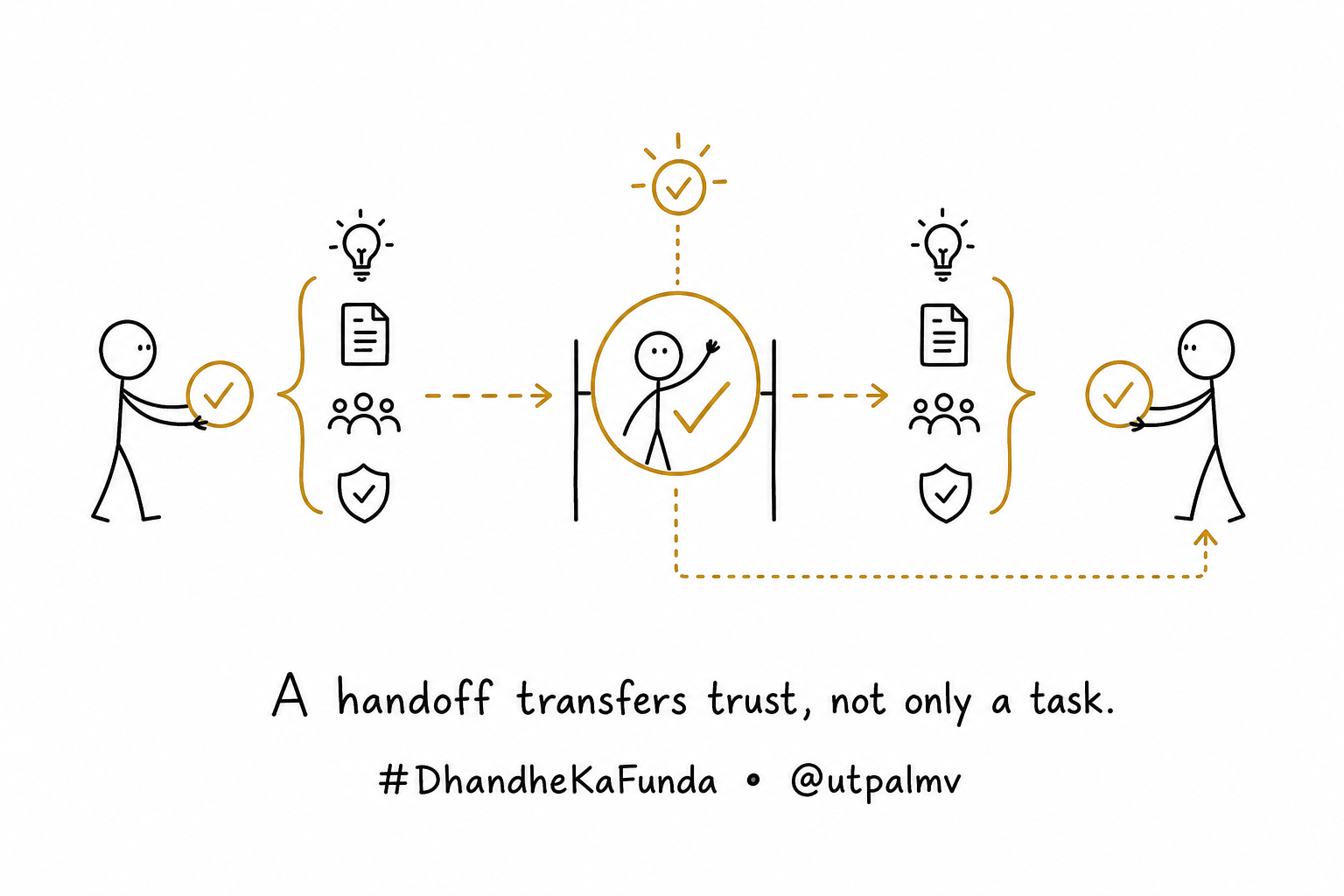
Definitions of success are partly inherited from family, peers, institutions, and markets. Inheritance does not make a goal false, and choosing it does not make a person a renter.
A narrative audit can still clarify what belongs:
Agency matters, but it is not the only measure of success. Money, time, health, family, service, craft, and belonging can matter together. The task is not to delete every inherited story. It is to examine and choose with honesty.
A mistake can provide feedback, but only after we examine the decision, the conditions, and the consequences. Calling it data should not erase harm or responsibility.
The responsibility audit asks what was mine to decide, what I could reasonably have known, and what needs to change now.
External factors remain real. Markets change, suppliers fail, people break commitments, and technology behaves unexpectedly. Taking responsibility does not mean claiming 100 percent control over the outcome.
It means refusing to use the external explanation as the end of the inquiry.
1. State the miss
Describe the expected and actual result.
2. Map the factors
List external conditions, internal decisions, missing information, and execution failures. Do not cross out evidence merely because it lies outside your control.
3. Identify your decision boundary
Which choice, assumption, or omission was yours? Which authority belonged elsewhere?
4. Address the consequence
Repair harm, communicate the result, or change the operating condition before rushing into another sprint.
5. Design the next test
Choose a smaller or better-instrumented experiment when uncertainty remains. Fast failure is useful only when its cost is proportionate and someone learns from it.
Indecision can carry consequences, but delay is sometimes the responsible choice. Accountability improves judgment when it remains faithful to evidence rather than converting every outcome into personal blame.
Human worth is not established by a market rate, a title, or another person's approval.
The value of a specific piece of work, however, is partly relational. Customers, colleagues, and communities may judge whether it serves a need, and their response can contain information that private conviction cannot supply.
Being called unreasonable is therefore ambiguous. It may mean that an idea challenges a limiting norm. It may also mean that the evidence is weak, the cost is being imposed on others, or the speaker has refused to listen. Disagreement is not proof of vision.
Norms deserve examination rather than automatic obedience or rejection. Some protect entrenched power. Others preserve safety, fairness, or knowledge gained through earlier failures. A proposal should explain which norm it challenges and why.
Personal clarity has limits too. What feels like internal truth may be a strong opinion, hope, or incomplete model. Speaking honestly includes naming that distinction and allowing partners to question it.
Ambition need not be reduced until everyone is comfortable. It does need contact with constraints, consequences, and the people whose cooperation it requires.
Self-worth can remain non-negotiable while plans, prices, and claims remain open to negotiation. That separation makes it possible to receive feedback without treating every objection as a verdict on the self.
Comparison can distort how I see my own life, especially when I compare private uncertainty with another person's public image.
It can also provide useful information. A peer's work may reveal a possibility, a standard, or an inequity that deserves attention. The problem is not comparison itself, but allowing a selective glimpse of another life to become a total judgment of mine.
Stories about a joyful worker and an unhappy celebrity make the point neatly, but they can invent inner lives we do not know. Profession, wealth, fame, and freedom relate to well-being in complex ways. None proves happiness or its absence.
When comparison produces a sense of being behind, I can ask whose benchmark I am using, what evidence it contains, and whether it reflects a value I actually hold. The answer may be to release the benchmark, or to learn from it without turning it into a verdict.
Happiness is not a permanent baseline available through decision alone. It is shaped by health, relationships, material conditions, temperament, meaning, and circumstance. Future achievements cannot guarantee it, but present difficulty does not prove that striving is misguided.
Living without a mask is also contextual. Some roles require restraint, privacy, or consideration for others. Authenticity does not mean acting on every impulse.
The aim is to return from imagined lives to the evidence of this one, then choose what deserves appreciation, change, or pursuit.
Procrastination sometimes presents as another round of planning. At other times, delay contains a legitimate need for rest, information, safety, or consent.
Treating every hesitation as an internal enemy removes the chance to learn which one it is. It can also turn self-care into suspicion and speed into a virtue independent of consequence.
When a task remains deferred, I can name the next action and the reason it has not happened. If the reason is vague discomfort and the action is low-risk, beginning with a small step may create momentum. If the reason involves missing evidence, another person's dependency, or a difficult-to-reverse cost, more deliberation may be responsible.
The smallest action need not be public or binding. It may be opening the document, listing the unknowns, requesting advice, or setting a decision date. Its purpose is to clarify the obstacle, not silence it.
Fast decisions can be practised on low-stakes matters, but speed in one domain does not automatically improve judgment in another. High-stakes choices usually deserve stronger review, not a habit of acting before thought can catch up.
Planning is a tool and delay is a condition to understand, not a disease. Momentum helps when it carries the work toward evidence. It becomes another form of avoidance when movement protects me from asking whether the direction is sound.
"Good enough" can be either sound judgment or an excuse. The difference depends on what the work is for.
Some tasks need exacting care because failure would cause substantial harm. Others need a timely, reversible answer so that learning can begin. Treating every task as a test of personal excellence wastes effort. Treating every standard as optional makes the system unreliable.
The useful standard is therefore not maximum effort. It is fitness for purpose.
Before shipping, I can ask whether the work meets its stated requirements, whether the important risks have been addressed, and whether another round would materially improve the outcome. If the answer to the last question is no, returning to the drawing board may be perfectionism rather than responsibility.
High standards also need humane leadership. Discomfort can accompany growth, but pressure by itself is not evidence of development. A leader's demand is valuable when it is specific, connected to the work, and paired with the support or clarity needed to improve.
The same applies to self-discipline. Pushing beyond a familiar limit can build capacity. Continually ignoring limits can degrade judgment and health.
Excellence is not a permanent state or a moral rank. It is the repeated act of choosing an appropriate standard, meeting it honestly, and learning where the standard itself needs revision.
Agency is not a personality label. It is a practice of noticing what a situation requires and choosing to take responsibility for a useful next move.
In work, it is easy to wait for instructions, especially when roles are rigid or mistakes are punished. That hesitation is not evidence that someone lacks the capacity to initiate. Often the surrounding system has taught caution.
Still, there is a meaningful difference between completing assigned tasks and understanding the purpose well enough to act without being prompted. The latter requires context, judgment, and permission to make consequential decisions.
I think of agency through a few observable behaviours:
Direct communication helps, but directness without care can become another form of avoidance. The aim is not to prove boldness. It is to make the relevant information available so the work can improve.
Agency grows when responsibility and authority are reasonably aligned. A person cannot be expected to own an outcome while being denied the information or discretion needed to influence it.
The useful question is not whether someone is an initiator or an escaper. It is what would help each of us make the next responsible move.
Discipline is useful when it supports something I have consciously chosen.
A routine can create enough predictability to learn a skill, care for health, or complete difficult work. It reduces the number of decisions that must be made again each day. In that sense, discipline is a scaffold.
But scaffolds are provisional. A habit that once protected attention can later become an obligation maintained only because breaking it feels like failure. The measure is not whether the routine looks disciplined. It is whether it still serves its purpose without causing disproportionate harm elsewhere.
This calls for periodic review:
Presence and discipline are not opposites. A planned practice can create room for an unplanned experience. Equally, presence does not require abandoning commitments whenever spontaneity appears.
The point is to avoid turning a tool into an identity. I do not become more worthy because I wake at a certain hour or maintain an unbroken sequence. The habit is useful only to the extent that it supports the life and responsibilities around it.
Build the structure when structure helps. Change it when the evidence changes.
Networking feels exploitative when another person is treated as a route to status, access, or advantage. It becomes more honest when the purpose, contribution, and limits of the relationship are visible.
I prefer to think in terms of strategic alliances: connections formed around learning, shared interest, useful contribution, or a problem worth addressing together.
1. Learn
Approach a new connection with curiosity about the person's work and context. Questions should be genuine, not a technique for delaying your own request.
2. Find common interest
Look for an area where both parties have a reason to participate. Shared interest does not require identical incentives.
3. Contribute proportionately
Offer knowledge, an introduction, feedback, or another useful resource when it is appropriate and consented to. Digital goods still cost time, attention, trust, and sometimes rights.
4. Name the purpose
A specific problem or inquiry can make a meeting more useful than a vague catch-up. A purpose larger than individual gain can help, but it does not automatically make the alliance ethical or effective.
Since 2016, I have used sketchnotes, influenced by Tanmay Vora and Gapingvoid, to map relationships and ideas. The visual form helps me notice gaps, clusters, and possible connections that are harder to see in a list.
A diverse network can expose a person to different knowledge and perspectives. It does not guarantee innovation, collective intelligence, or a unique synthesis.
The alliance audit is simple: what are we trying to understand or change, why should we do it together, what can each person contribute, and what boundary should remain clear?
Stable employment can provide income, learning, community, and room for meaningful work. It can also make self-directed capacity easy to neglect. The circus metaphor captured my concern about dependence, but it turned employment into a cage and independence into a wilderness. That contrast is too simple.
The question worth keeping is: am I retaining the ability to initiate, choose, and adapt?
1. Examine the exchange
What do you receive from the institution, client, or role? What do you contribute? Which compromises are reasonable, and which conflict with a value or boundary you need to protect?
2. Notice dependency
Which skills, relationships, or sources of income depend entirely on one organization? Dependency is not shameful, but it should be visible.
3. Keep initiating
Create some work that begins with your own question. It may be a small experiment, a study, a tool, or a proposal within the organization. Self-direction does not require rejecting collaboration.
4. Maintain capability
Continue learning and practising skills that matter beyond the present job description. Do this sustainably, not through compulsory daily performance.
5. Choose with evidence
Leaving a stable role is not inherently brave, and staying is not inherently compliant. Compare responsibilities, runway, opportunity, health, and the actual alternatives.
Autonomy is not isolation. It is the capacity to participate in a system without surrendering every source of initiative to it.
Mastery has a pace that cannot be set entirely by ambition.
More hours can help, but only when those hours contain attention, feedback, and correction. Repetition without reflection may strengthen the wrong pattern. Urgency can narrow the time available for learning precisely when the work demands deeper understanding.
This does not mean that slow work is automatically better. Speed matters in many situations, and some knowledge emerges only through action. The important distinction is between a fast learning cycle and impatient motion.
Depth develops when I stay with a problem long enough to see its structure. I learn why a method works, where it fails, and which details change the result. That understanding makes later action more reliable, even when the learning itself is difficult to see.
A practical review can ask:
There is no universal ratio between thinking and doing. Complex work needs movement between both. Action produces evidence; reflection updates the next action.
The timeline may still be uncomfortable. Depth offers no flawless execution and no guarantee of success. It offers a better chance of understanding what the work actually requires.
Self-interest can extend beyond immediate personal gain.
A person may care about family, colleagues, community, or institutions partly because those relationships have become part of how life is understood. This wider concern can support responsible action, but redefining everyone as part of the self risks erasing their separate needs and agency.
Ownership language has a similar tension. Saying "my project" can express commitment. It can also imply possession of work that depends on many people. Accountability is strongest when responsibility is clear and credit, authority, and consequences are shared honestly.
The useful question is not how large my selfishness can become. It is how a decision distributes benefit, burden, and voice across the people it affects.
For a consequential choice, I can ask:
Not every decision can benefit everyone. Trade-offs and conflict remain. Expanding the circle of concern means making those trade-offs visible and treating other people as participants rather than extensions of my mission.
A broader sense of responsibility is valuable when it increases care and accountability. It becomes dangerous when it turns the world into another version of "mine."
Some work is rewarding in the doing. Writing, coding, drawing, or building can hold attention without needing an external prize.
The word autotelic describes an activity experienced as an end in itself. I value that state, but it is not a hierarchy in which money, impact, service, or order are lesser motives.
We may work for income, craft, contribution, structure, curiosity, belonging, or pleasure. More than one motive can be present at once. External purpose does not corrupt the work, and intrinsic enjoyment does not guarantee mastery.
1. Name the motives
For an important task, list what you hope to receive or create. Include practical motives without embarrassment.
2. Find the activity that sustains attention
Notice work you would sometimes choose even without recognition or sale. Losing track of time can be a clue, though it is not required.
3. Protect uninstrumented practice
Occasionally make something without publishing, optimizing, or monetizing it. This keeps a relationship with the craft that is not entirely governed by response.
4. Keep context visible
Work done for its own sake still uses time and resources. Protecting it may require limits and negotiation with other responsibilities.
Doing for the sake of doing is one honest relationship with work. It does not place the actor beyond management, teaching, evidence, or consequence. Its value is simpler: the action itself is worth some of the time it receives.
An insult can disturb me even when I decide not to engage with it. Emotional response is not a packet I can always reject at the firewall.
What I can sometimes refuse is the transfer of agenda: another person's provocation does not have to determine my next action.
1. Notice the impact
Name what happened and how it affected attention, emotion, or safety. Do not call the response weakness.
2. Separate content from conduct
Is there a substantive criticism inside the insult? Evaluate the claim without excusing humiliation, harassment, or manipulation.
3. Choose the boundary
Ignore, question, respond, leave, document, or seek support. Silence is one option, not a universal victory.
4. Return attention deliberately
When possible, re-enter the work or relationship that deserves focus. Total immersion may not be immediate, especially after sustained hostility.
5. Review recurring exposure
If the same person or setting repeatedly disrupts the work, redesign the conditions rather than relying only on internal calm.
The buffer is not immunity. It is a small space in which impact, evidence, conduct, and response can be considered separately.
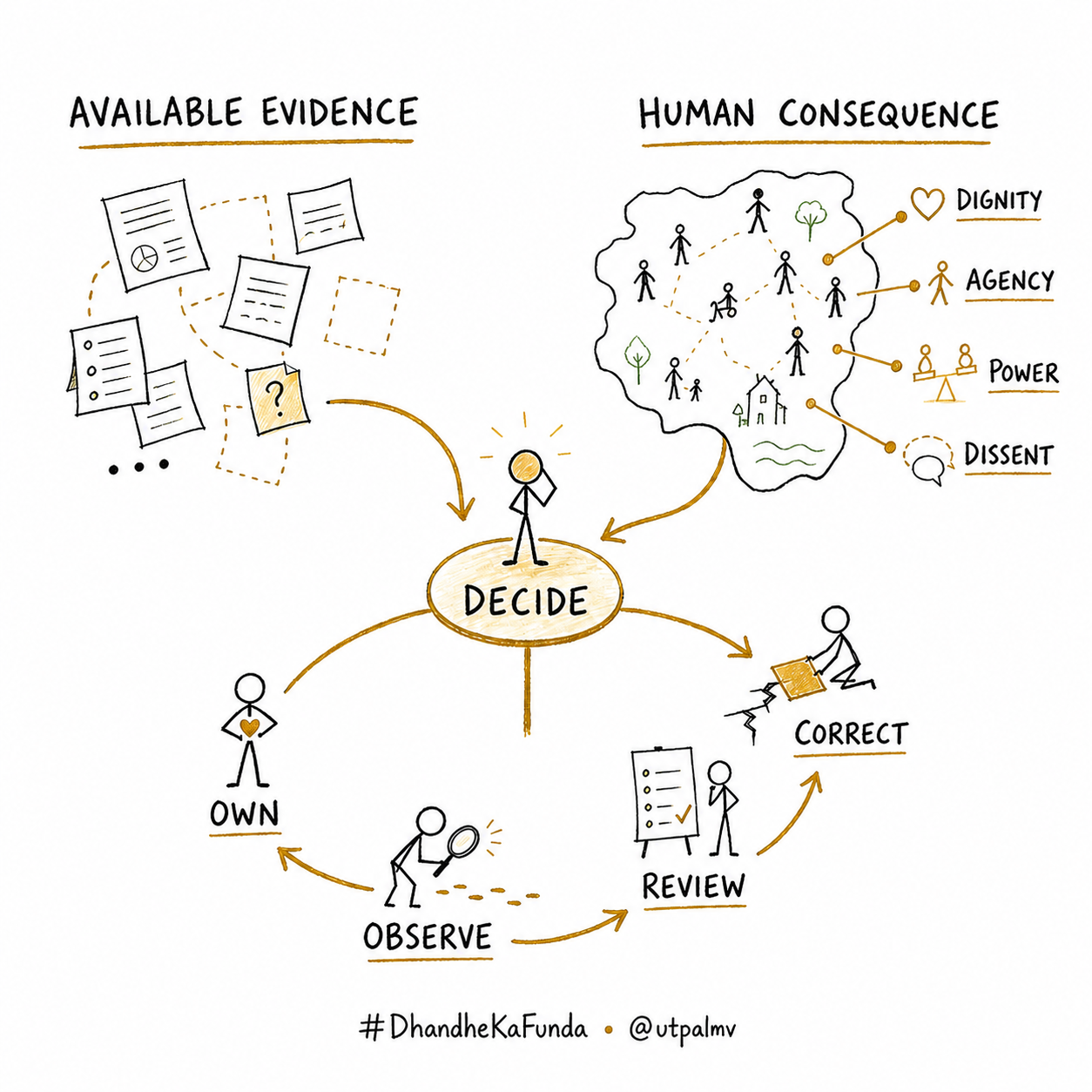
Originally published 17 Jan 2026. Materially revised 18 Aug 2026. Empathetic brutalism is a discipline for consequential decisions.
Working longer is one way to increase output, but it is bounded by time and energy. Leverage changes how far a unit of work can travel.
Capital, software, media, reusable processes, and delegated responsibility can all extend the reach of human effort. None is automatically superior to labour. Each depends on other people's work, carries different risks, and suits different kinds of value.
Judgment matters because leverage amplifies decisions as well as output. A useful system can serve many people. A mistaken assumption embedded in the same system can also spread widely. The higher the leverage, the more important it becomes to know where context and human review remain necessary.
A practical audit begins with recurring work:
The aim is not to eliminate effort or make income independent of everyone. It is to use scarce attention where it contributes most, while creating systems that others can understand, question, and improve.
Leverage is valuable when it expands useful capacity without hiding the labour, dependencies, or consequences beneath it.
There is tension between what is present and what I believe must be present. Some "musts" are inherited scripts. Others express duty, safety, law, or a standard worth keeping.
The task is not to eliminate every requirement. It is to examine which requirement fits reality and which asks a person to perform an identity that is not theirs.
1. Name the must
Write the expectation precisely. Who holds it, and what purpose does it serve?
2. Describe the is
What capability, limitation, preference, role, or condition is actually present? "Nature" should not become a permanent label that prevents learning.
3. Examine the gap
Can the person grow into the requirement with support? Should the role change? Is the expectation itself unnecessary or harmful?
4. Preserve agency
Do not redesign another person as a resource without their participation. Acceptance includes hearing how they understand their own strengths and responsibilities.
5. Keep proof proportionate
Some work requires evidence, accountability, or external review. The urge to prove personal worth can be released without abandoning proof of competence or outcome.
Integrity is not simply acting from an essential self. It is bringing values, actions, capabilities, and responsibilities into an honest relationship with present conditions.
Understanding is a map. Experience is the terrain. The distinction matters because a name or model can create confidence without competence.
The map still matters. Language lets us compare experience, preserve learning, question interpretation, and coordinate with others. Direct experience can also mislead when it is narrow or misunderstood.
1. Notice the label
When calling something success, failure, kindness, health, or strategy, ask what observations the label contains and what it hides.
2. Move closer to the source
Read the primary material, examine the data, observe the work, or speak with the people involved when access and responsibility allow. Presence in the room does not automatically produce truth.
3. Test the model in practice
Use the framework to make a decision or attempt. Record where reality supports it and where the model breaks.
4. Return experience to language
Describe what happened so that it can be examined rather than preserved as private instinct.
5. Keep both provisional
Models change with evidence. Experience changes with memory, reflection, and later context.
I do not want to choose intellectualization or experience as a permanent winner. The better cycle is map, encounter, observation, revision, and another encounter.
Capacity is finite. Projects, obligations, habits, and opportunities can accumulate until the whole portfolio becomes difficult to see.
I use the blank-slate exercise to expose that accumulation. It is an imagined reset, not a denial of history or a license to abandon responsibility.
1. List the current commitments
Write down active projects, recurring duties, relationships, and habits. Include maintenance work that is easy to overlook.
2. Imagine choosing again
If this commitment were not already present, would you begin it now? Consider purpose, cost, responsibility, and consequence.
3. Define the essentials
Choose the work, health, relationships, and obligations that need protected space in this period. The list can change as conditions change.
4. Classify the remainder
Continue, complete, pause, delegate, renegotiate, or stop. Some commitments cannot be removed immediately, but their terms may still be redesigned.
5. Create an entry rule
Before accepting something new, state what capacity it requires and what it will displace.
A blank slate is useful because it interrupts sunk-cost thinking. It is not truly blank. A life contains people, promises, constraints, and consequences that remain even when the portfolio needs simplifying.
In the lifecycle of any project, there is a dangerous "Shadow Zone" that exists between Adequacy and Perfection .
The people around us influence what feels normal, acceptable, and possible. That influence deserves attention, but relationships should not be reduced to an investment portfolio or a count of supposedly greedy acts.
Greed is also too imprecise for diagnosis. A behaviour may reflect self-interest, fear, scarcity, competing duty, or exploitation. The response depends on which is actually present.
1. Describe the behaviour
Name the action and its effect without turning the person into a pathogen or a defective node.
2. Look for a pattern
One event may matter, but repeated conduct under comparable conditions provides stronger evidence. Avoid arbitrary thresholds that create certainty from a small sample.
3. Examine context and responsibility
What did the person know? What incentives, pressures, promises, or power differences shaped the action? What part of the pattern is yours?
4. Treat fear as one signal
Fear can alert us to risk, but it can also arise from history, uncertainty, or misunderstanding. Investigate it without treating it as biological proof.
5. Choose a proportionate boundary
Clarify expectations, limit access, seek repair, ask for support, or leave when safety and evidence require it.
Our social circle is not our ceiling, and another person's conduct does not force our own. The audit is useful when it replaces vague unease with a clearer account of behaviour, consequence, and boundary.
Routine can protect attention, health, relationships, and reliable delivery. It can also persist after it stops serving its purpose.
That tension is not a law of entropy or proof that people are biologically trapped by comfort. Familiar choices do not automatically produce irrelevance, and novelty does not guarantee a breakthrough.
A controlled exploration practice can ask:
Exploration needs no fixed percentage or schedule. Change is valuable when it improves learning or outcomes, not merely because it is change.
Desire can be useful. It can also become a quiet way of rejecting the life in front of us.
I notice the difference most clearly when a goal stops guiding my work and starts governing my sense of worth. The next milestone, income level, or sign of recognition becomes a condition for contentment. Even after reaching it, the condition simply moves.
The problem is not ambition itself. It is dependency. If my inner state depends entirely on an external result, that result has more authority over me than I do.
There is another way to work. I can care deeply about an outcome without treating my present self as inadequate. I can build the conditions that may produce the result, while accepting that the result is not fully mine to command.
A useful question is: if this goal remains unmet, what happens to my sense of self? If the answer is that I become lesser, the goal may be carrying more weight than it should.
The correction is not passivity. It is to separate action from lack. Instead of chasing a result to complete myself, I can do the work because the work is worth doing, the system needs attention, or the responsibility is genuinely mine.
That distinction makes ambition quieter. It also makes judgment cleaner.
Advice gains weight when it has passed through experience.
I can repeat an idea I have read, but repetition is not the same as knowing where the idea holds, where it breaks, and what it costs in practice. That distinction matters whenever I write, advise, or build for other people.
It does not mean I may speak only about things I have mastered. Much of honest inquiry begins before mastery. It means I should be clear about the position from which I am speaking: direct experience, informed study, a working hypothesis, or a question I have not resolved.
The same test applies to products. Would I trust this with my own work if I faced the user's circumstances? That question cannot prove that a product is useful to everyone, but it can expose a gap between the promise and the care invested in making it.
Candour begins with that alignment. The word is associated with brightness, but plain speech does not require performance. Often it means stating what I know, what I do not know, and what evidence would change my view.
Borrowed knowledge is not worthless. It becomes misleading when I present it as earned certainty. Better to preserve the source, name the uncertainty, and let practice refine the claim.
There is a subtle form of organizational rot called The Checklist Trap .
Worry can feel like work because the mind keeps returning to the problem. Sometimes that return reveals a risk I have avoided. Sometimes it only repeats a future I cannot inspect yet.
I used to frame the answer as a conversion: take anxiety and turn it into action. There is still something useful in asking what can be done. But anxiety is not the opposite of responsibility, and action is not always the cure. A person can be anxious while acting responsibly. The next responsible move may be to wait, rest, ask for help, or seek professional care.
When I can think clearly enough, I use a small sorting exercise.
I write down what I believe is happening, what I am predicting, and what evidence I have for each. This often shows me where a fact has become mixed with a story.
Then I separate what I control, what I may influence, and what is outside my reach. The third category does not become irrelevant. A market, illness, decision, or relationship can affect me even when I cannot control it. The distinction only prevents me from pretending that more mental effort will create authority I do not have.
Finally, I choose one proportionate response. Send the message. Check the number. Prepare an alternative. Set a time to revisit the decision. Speak to someone. Or stop for the day.
This is not a guarantee of calm. Anxiety may remain after the list is complete, and recurring or overwhelming anxiety deserves more than a productivity technique. The exercise helps when it creates a little room between the signal and the response.
I do not need to keep many lines in the water so I am too busy to worry. Busyness can become another form of avoidance. I need enough contact with reality to know whether the moment calls for action, support, patience, or care.
A difficult manager can provide lessons about leadership, but harm is not tuition and no one owes a workplace 12 months of endurance.
When it is safe and useful, observe specific behaviour:
Do not treat a manager as a lab animal, use abuse to train emotional control, or measure calm by heart rate. Documenting patterns can help someone learn and decide. It should not normalize humiliation or delay a necessary response.
Software services and software products create leverage differently.
A service business usually connects revenue to skilled human capacity. A product can serve additional users without adding people at the same rate, although development, support, sales, and operations do not disappear.
Services can produce cash and close contact with real customer problems. Products can create a reusable asset, but they may require long investment before demand is clear. Neither model is automatically a trap or an engine.
For a service business considering a product:
The useful goal is not to escape work. It is to decide which work should remain human and which part can become reusable.
Contracts, deposits, and reporting can distribute risk. They are not necessarily attempts to force certainty, and openness is not always safer.
Digital communication has made some business conduct more visible and has given customers more ways to compare experiences. Power has not shifted completely or irreversibly to the customer. It remains uneven across markets and relationships.
An uncertainty audit can ask:
Resilience comes from appropriate controls, useful evidence, adaptability, and trust. No single one provides certainty.
A startup can change the people building it. That does not make personal transformation its real output or make hardship a forge designed for growth.
Startups produce products, services, employment, obligations, gains, losses, and effects on customers and families. Founders may also learn about judgment, identity, resilience, and limits.
After a difficult result:
Failure does not follow one psychological arc, and pain does not automatically create character. Rebuilding begins with evidence and responsibility, not a new founder identity.
There is a dangerous addiction in management. We applaud the firefighter. When a server crashes at 2 AM and "Dave" fixes it by typing furiously for 4 hours, we call Dave a hero. We give Dave a bonus.
This is a mistake. Dave is not a hero. Dave is a Single Point of Failure (SPOF).
The Difference Between a Linchpin and a Hero
The Linchpin (Good): Creates art that connects people. When they leave, the soul is missed, but the machine still runs.
The Hero (Bad): Hoards knowledge to feel essential. When they leave, the machine explodes.
The Narcissism of the Rescue "Heroism" is often a mask for poor engineering. If you have to work all weekend to save the launch, the process is broken. If you are the "only one" who understands the legacy code, you have held the company hostage.
The Protocol: Kill the Hero
If it happens once: Thank the hero.
If it happens twice: Fire the hero (or force them to document).
The Goal: Boring Operations.
Great systems are boring. They don't need heroes. They need mechanics. If your business relies on acts of heroism to survive, you don't have a business. You have a ticking time bomb.
#DhandheKaFunda: Don't reward the arsonist for putting out the fire he started.
In a world where talent is global and leverage is portable, the most expensive thing you can own is a Toxic Reputation .
Most companies are hallucinating. They have a "Vision Statement" on the wall and a "To-Do List" on the desk. There is no bridge between them.
The Vision says: "Dominate the market." The To-Do List says: "Reply to emails."
This gap is where companies die.
Intel and Google solved this decades ago with a protocol called OKRs (Objectives and Key Results). But most people use them as a "performance review" tool. That is wrong. OKRs are not for evaluating people. They are for aligning Vectors.
The Framework
1. The Objective (The "What") This is the qualitative goal. It must be uncomfortable. It must feel slightly impossible.
Bad: "Increase sales."
Good: "Conquer the South-East Asian market."
2. The Key Results (The "How") These are the numeric coordinates. If you hit these, the Objective is achieved by default.
Bad: "Launch the new website."
Good: "Acquire 5,000 active users with <$10 CAC."
The Golden Rule: The 70% Protocol If you hit 100% of your OKRs, you failed. You aimed too low. You were sandbagging. The target zone is 70%. This is the "sweet spot" of maximum effort.
The Ritual: The Monday/Friday Pulse An OKR on a spreadsheet is a corpse. To make it alive, you need a pulse.
Mondays: "What 3 things am I doing this week to move the needle on the KR?"
Fridays: "Did I do them? If not, why?"
#DhandheKaFunda: Activity is not achievement. Unless your daily to-do list is fighting for your quarterly goal, you are just busy. Be effective.
Most meetings are a crime scene. Evidence is mixed with emotion. Optimism fights with caution. Egos wrestle for dominance. The result? Noise.
The human brain is a terrible multi-core processor. It cannot process logic, emotion, creativity, and risk simultaneously without overheating. To fix this, we don't need "better meetings." We need Parallel Processing.
Edward de Bono cracked this code years ago. He called it "Six Thinking Hats." Forget the hats. Think of them as filters.
You do not wear them all at once. You switch the filter for the entire room at the same time.
The 6 Filters (The Protocol)
The Question: What do we know? What is missing?
The Rule: No opinions. No "I feel." Just raw telemetry.
The Question: What does your gut say?
The Rule: No justification allowed. Give the intuition, then shut up. Validate the emotional data without debating it.
The Question: Why will this fail?
The Rule: Ruthless criticism. Murder the idea. If it survives, it is worthy.
The Question: If this works, what is the payoff?
The Rule: Feasibility is secondary here. Focus on the value proposition.
The Question: How can we bypass the constraints?
The Rule: No judgment. "Yes, and..." thinking. Provocation over precision.
The Question: Where are we in the process?
The Rule: The Chair. The Architect. This filter manages the other five.
Why This Works In a normal discussion, if I am being creative (Green) and you are being cautious (Black), we are enemies. In this protocol, we are both Green for 5 minutes. Then we are both Black for 5 minutes.
We are not arguing. We are mapping.
#DhandheKaFunda: Intelligence is not knowing the answer. Intelligence is knowing which filter to use to find it.
The Industrial Revolution is over. The factory is closed.
If your job description can be written down in a manual, you are in danger. If you are waiting for instructions, you are a commodity. And in a global market, commodities are a race to the bottom.
Seth Godin saw this coming in 2010. The rules of the game didn't just change; the board flipped.
There are now only two types of workers:
The Cog: Cheap, obedient, replaceable.
The Linchpin: Creative, chaotic, indispensable.
The Enemy: The Resistance - Why isn't everyone a Linchpin? Because of the Amygdala (the Lizard Brain). It screams at you to fit in. To keep your head down. To not speak up in the meeting. To ship average work because "perfect" is scary. Godin calls this The Resistance. The Linchpin feels this fear and ships anyway.
The Currency: Emotional Labor - We don't get paid to lift heavy boxes anymore. We get paid to do Emotional Labor.
It is smiling when the client is screaming.
It is finding a solution when the manual says "Error."
It is caring more than you are paid to care.
The Mandate: Make Art - Art isn't painting. Art is any human act that changes another person.
A code commit can be art.
A customer support email can be art.
A strategic pivot can be art.
If you are just doing your job, you are failing. If you are bringing humanity, connection, and insight to a system that lacks it, you are an artist. You are a Linchpin.
The Choice - Being indispensable is not a talent. It is a choice. You can choose to be a cog and pray the machine keeps running. Or you can choose to be the Linchpin: the one component the machine cannot run without.
#DhandheKaFunda: The system is designed to replace you. Your job is to break the design by being human.
Most people don’t have goals. They have hallucinations.
They say things like, "I want to be successful" or "I want to build a great company."
In physics, these are Scalars. They have magnitude ("a lot of success"), but they lack direction. They are just energy expanding into the void, dissipating as heat.
To change reality, you don’t need a wish. You need a Vector.
A Vector has two distinct properties:
Magnitude (How much force?)
Direction (Where exactly is it applied?)
The Difference:
Scalar (Wish): "I want to get fit."
Vector (Goal): "I will lift 10,000kg of total volume per week, focusing on compound movements, until Dec 31st."
One is a feeling. The other is a set of coordinates.
The Forcing Function: Accountability
Even with a Vector, entropy sets in. You get tired. You drift.
This is why "willpower" is a failed strategy. Willpower is a battery; it runs out. Accountability is a grid.
You don’t need an "accountability partner" to cheer you on. You need an Audit Mechanism. You need someone who functions as an external hard drive for your conscience.
Bad Partner: "It's okay, you tried your best."
Good Partner: "You said you would do X. You did Y. Why is there a delta?"
The Protocol:
Define the Vector: Magnitude + Direction + Deadline.
Install the Audit: A weekly sync where excuses are not currency.
Measure the Delta: Track the gap between Intention and Action. Close it.
A wish is a prayer to chance. A goal is an engineering problem.
#DhandheKaFunda: Don't manage your time. Manage your vectors. Speed is irrelevant if you are moving in the wrong direction.
The amount of information available exceeds the attention anyone can give it. Selection is therefore part of thinking.
Volume alone is not the problem. A large archive can remain quiet until needed, while a small stream of alerts can repeatedly interrupt attention. Relevance, timing, and the way information arrives all matter.
I find three loose categories useful:
These are not permanent labels. News that does not change a decision today may still matter for civic awareness, care for another person, or understanding a slow-moving risk. Leisure and curiosity also have value beyond immediate output.
The practical concern is unchosen consumption. When an algorithm sets the sequence, novelty and emotional intensity can displace what I intended to examine. Searching deliberately, limiting notifications, and deciding when to read a feed can restore some control.
Saving everything is not the same as learning. Neither is ignoring everything a sign of intelligence. A healthy information practice makes room for work, context, curiosity, and rest without allowing every available signal to demand an immediate response.
Code can be technically valid and still participate in harm.
Software expresses decisions about who may act, what is measured, which errors are tolerated, and whose burden remains invisible. Compilation tests the machine's rules. It does not test whether those rules are humane.
The Confucian idea of ren, often translated as humaneness, offers a useful question: what obligations arise from building systems that affect other people? Related ideas of ritual and appropriate conduct can also illuminate routine technical practices. Code review, documentation, naming, and incident response are repeated forms through which a team makes its standards visible.
Process is not automatically virtuous. Meetings can waste attention, documentation can conceal as well as clarify, and ritual can preserve an unjust order. Each practice should be judged by whether it supports understanding, accountability, and care.
Names matter because software turns categories into behaviour. Calling the same person a user, lead, or prospect in different contexts may reflect a real distinction or an incoherent model. Clear language helps reveal which one it is.
Leadership affects architecture, but a founder's character does not determine code quality by itself. Incentives, team structure, review, expertise, and the ability to challenge authority all shape the result.
Technology amplifies some intentions and produces consequences nobody intended. A moral kernel is therefore not a slogan embedded once at the centre. It is an ongoing practice of asking who is affected, who can object, and how the system will be corrected.
“That is not my job” can be a reasonable boundary. It can also be a way of walking past a problem that affects the shared outcome.
The useful distinction is not between amateurs and professionals. It is between respecting scope and hiding behind it.
When you notice a problem outside your formal responsibility:
A job description defines responsibility. It does not remove judgment.
Mediocrity loves "More." When a product lacks soul, we add features. When a strategy lacks direction, we add goals. When a leader lacks confidence, they add meetings.
"More" is the camouflage we use to hide the fact that we don't know what matters.
The "Feature" Trap - I see founders who want to build 10 features because "competitors have them." This is fear masquerading as ambition. They believe that if they offer everything, they won't lose anyone. But by trying to be everything for everyone, they become nothing for anyone.
The Protocol: Less AND Better - Note the operator: AND. "Doing less" is not laziness. It is a strategic sacrifice. It is easy to build 10 average features. It is agonizingly hard to build 1 perfect one.
Average: A Swiss Army Knife (It cuts, it screws, it opens bottles: but it does all of them poorly).
Excellent: A Scalpel (It does one thing, and it does it with lethal precision).
The Standard If you cannot make it better, do not add it. If the feature does not serve the core utility, it is not a "bonus." It is friction. It is noise. It is debt.
Be the scalpel. Let the amateurs be the Swiss Army Knife.
#DhandheKaFunda: Perfection is not when there is nothing left to add, but when there is nothing left to take away.
There is a fatal flaw in most corporate cultures: We worship the Firefighter.
Scenario: The server crashes at 2 AM. "Dave" stays up all night, patches the code, and saves the client.
Reaction: The CEO sends a company-wide email: "Dave is a rockstar! Thank you for your dedication!"
Result: You just taught the entire company that Chaos + Heroism = Praise.
The Problem with Heroes
A "Hero" is a symptom of a broken system. If Dave has to stay up until 2 AM, it means:
The code was bad.
The testing process failed.
The redundancy systems didn't work.
By praising Dave, you are ignoring the three failures. You are incentivizing people to let fires start so they can be seen putting them out.
The Anti-Hero Protocol
In a High-Reliability Organization (like a Nuclear Power Plant), "Excitement" is bad. If a reactor operator has to be a "Hero," someone is getting fired.
1. The "Boring" KRA
Stop measuring "Escalations Solved." Start measuring "Escalations Prevented."
Bad Metric: "Sales visits made" (Input/Effort).
Good Metric: "Revenue per visit" (Efficiency).
Bad Metric: "Bugs fixed" (Cleaning up messes).
Good Metric: "Uptime" (Preventing messes).
2. The Post-Incident Interrogation
When someone performs a heroic act, thank them privately, then ask publicly: "How do we ensure that you never have to do this again?" If Dave is still fixing the same server crash in 6 months, Dave is not a hero. Dave is a bottleneck.
3. The Fire-Starter Test
Watch out for the employee who constantly creates crises just to solve them. They thrive on adrenaline and validation. They are toxic to scale. Scale requires silence, not sirens.
#DhandheKaFunda: A well-run business is boring. If your office feels like an action movie, you are directing a tragedy.
A business becomes a destination when people choose it for an experience or capability they cannot easily obtain elsewhere.
The example that interested me was Amrik Sukhdev: a roadside dhaba that became known beyond the convenience of its location. The source attributes that change to standards of hospitality, cleanliness, and respect, but the specific history and business figures require verification before publication.
The practical questions remain useful:
Distinctiveness is earned through repeated experience. It is not a law of gravity or a guarantee of loyalty.
Most people confuse "Rank" with "Power." They think that because they have the title of "Manager" or "CXO," they are leaders. This is a delusion.
The most dangerous word in the business lexicon is "Yes." "Yes" feels like growth. It feels like kindness. It feels like opportunity.
There is an old joke: A consultant is someone who borrows your watch to tell you the time, and then keeps the watch.
Most consulting engagements are a transfer of wealth, not a transfer of value. The reason is rarely the consultant’s incompetence. It is the client’s lack of Protocol.
If you hire a mercenary without a clear mission, do not be surprised when they loot the village.
The Trap: "Help Us" Never hire a consultant to "help." "Help" is vague. "Help" is a blank check. "Help" has no deadline.
Bad: "Help us improve our marketing."
Good: "Audit our CAC/LTV ratio and build a playbook to reduce CAC by 20% in 90 days."
The 3 Rules of Engagement
1. The "Specific Output" Clause Before you sign the contract, define the physical deliverable. Is it a PDF? A piece of code? A workshop? A spreadsheet model? If you cannot visualize the artifact, you are not buying a solution; you are renting a friend.
2. The Transfer of Capability The goal of a consultant is to make themselves obsolete. If they leave and the magic stops, the engagement failed.
Requirement: Every engagement must include a "Training Phase" where your internal team learns to drive the car.
The Test: Can your junior employee run the system the day after the consultant leaves?
3. The "Skin in the Game" Filter Be wary of advice that carries no risk for the giver. If they recommend a strategy that destroys your company, do they still get paid? Whenever possible, tie a portion of the fee to Success Metrics (Outcomes), not just Time Spent (Inputs).
#DhandheKaFunda: Rent their brain to build your engine. Never rent their engine to drive your car.
An operating system becomes useful when it sets constraints. The point is not to control every event.
In the West, when a bowl breaks, we throw it away. We value the "Pristine."
In Japan, there is an art called Kintsugi. They repair the broken bowl with gold lacquer.
The result?
The bowl is now more valuable because it was broken.
The cracks are not hidden; they are highlighted.
Modern romance sells the idea of a "Soulmate" as a puzzle piece that fits perfectly. No gaps. No friction. This is a delusion. If two gears fit perfectly with zero tolerance, the machine seizes. You need "tolerance" to move.
A knife does not get sharp by rubbing against a pillow. It gets sharp by rubbing against a stone. The stone is rough. The process creates heat. It grinds away the surface. But the result is an Edge.
Stop looking for a partner who "completes" you (a mirror). Look for a partner who "sharpens" you (a whetstone).
Do not seek a relationship without cracks. Seek a relationship where the cracks are filled with gold. The trust built after a conflict is stronger than the naive trust that existed before it.
#DhandheKaFunda: A relationship without friction is a relationship without traction. Don't fear the crack; fear the silence.
Most people are terrified of silence. In a meeting, if there is a 3-second pause, someone rushes to fill it with nervous chatter. They equate silence with "awkwardness." The Professional equates silence with Leverage.
The Psychology of the Void
When you stop talking, you create a vacuum. The amateur feels insecure in the vacuum. They think, "Did I say something wrong? Do they hate me?" So they start talking to reassure themselves. In doing so, they negotiate against themselves. They bid against their own price. They reveal their weak cards.
The 3 Applications of Strategic Silence
1. The "Anchor" Silence (Negotiation) - When you state your price (or your offer), shut up. Do not justify it. Do not add "but we are flexible." State the number. Then enter the Void.
2. The "Parsing" Silence (Conflict) - When someone attacks you or asks a hostile question, do not answer immediately. Wait 4 full seconds. Look them in the eye. This signals that you are not "reacting" (emotional); you are "processing" (intellectual). It strips the energy out of their attack.
3. The "Discovery" Silence (Management) - When an employee gives you a shallow answer, nod and say nothing. Wait. They will invariably crumble under the pressure of the silence and give you the real answer (the deeper explanation) just to break the tension.
The Protocol Next time you feel the urge to fill the gap: Don't. Let the silence hang heavy in the room. Watch the other person squirm. Watch them hand you the leverage just to make the awkwardness stop.
#DhandheKaFunda: The amateur talks to be heard. The master listens to be felt.
Relationships become thin when every act carries an invisible calculation of return. Participation offers another posture: being present in a shared activity without reducing the other person to an instrument.
This does not require removing expectations. Trust, consent, reciprocity, boundaries, and commitments all create legitimate expectations.
Some relationships are explicitly transactional. A client, employer, supplier, or investor may reasonably expect agreed performance. Personal relationships also contain obligations, though their value cannot be reduced to an exchange ledger.
The question is whether the terms are honest and whether the person remains visible beyond the function they serve.
1. Identify the expected return
In a strained relationship, state what you expected and whether it was communicated, agreed, or realistic.
2. Ask what participation means here
What attention, care, work, or presence does the shared situation call for? Do not assume pure participation requires seven days without needs or boundaries.
3. Support agency
Ask what conditions would help the other person contribute or grow. Include their own account rather than designing their potential for them.
4. Protect non-instrumental time
Allow some interaction without an agenda when the relationship and context support it. Silence is not automatically deeper than speech.
5. Address broken agreements directly
Presence should not become a way to spiritualize exploitation, neglect, or incompatibility.
Meaning may emerge through participation, commitment, conflict, repair, and ordinary time together. It cannot be guaranteed by removing expectation.
An artifact and the capability that produced it are different forms of value. Code, a framework, a design, or a strategy can be copied. The judgment needed to create, maintain, and adapt it may be harder to reproduce.
That does not make protection irrelevant. Intellectual property, confidentiality, security, and contracts can protect legitimate interests. Giving source code away is not a universal test of confidence.
The asset is the current artifact and the rights, evidence, relationships, or revenue attached to it.
The engine is the capability to understand the problem, create the artifact, learn from use, and produce a better response when conditions change.
A durable practice usually needs both.
1. Identify the protected asset
What value does it hold, for whom, and for how long? What harm could disclosure create?
2. Identify the generating capability
Which skills, judgment, process, and context produced the asset? Are they documented, distributed, and still developing?
3. Choose an appropriate protection strategy
Use openness, licensing, contracts, access controls, secrecy, or publication according to the actual risk and purpose. Do not spend by arbitrary percentage.
4. Continue creating
Invest in the next capability or version without assuming speed alone prevents copying.
5. Distinguish curiosity from harm
The language of hackers and crackers can obscure conduct. Evaluate whether someone is authorized, constructive, secure, and accountable.
The engine matters because an artifact eventually meets a new context. The asset still matters because creation occurs within legal, economic, and relational systems.
The word “amateur” comes through French from the Latin amator, meaning lover. It carries a useful reminder: a person can approach a craft with genuine love before, during, or outside professional practice.
Professional experience can bring rigor. It can also make familiar assumptions harder to see. Shoshin, often translated as beginner’s mind, offers a counterweight.
Combine the two:
Curiosity does not guarantee innovation, and professionalism does not require cynicism. Both can serve the craft.
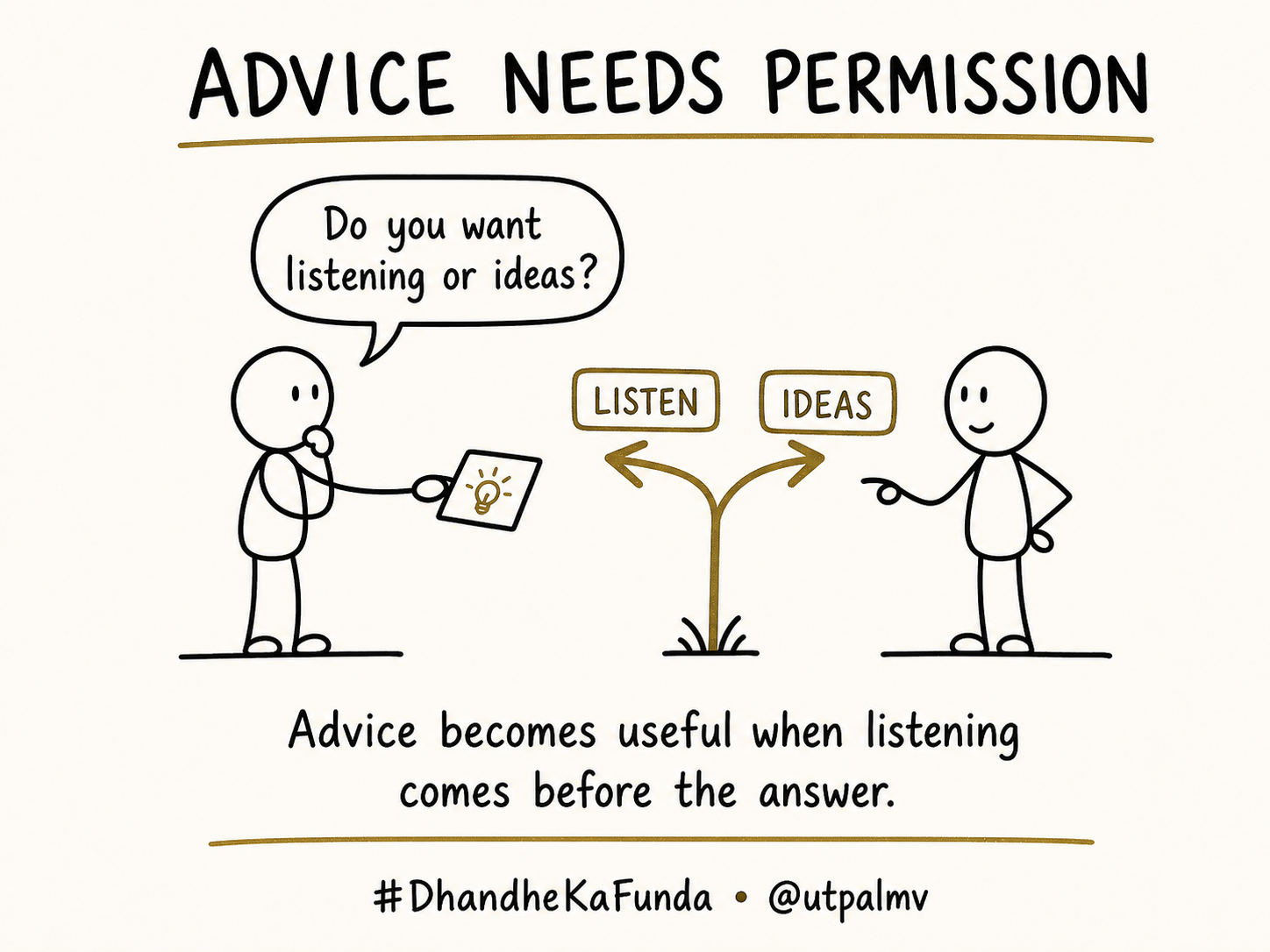
Advice can be generous and still arrive at the wrong time. We see a person struggling with a decision, a relationship, or a piece of work.
Surveys lie. Friends lie. Even "Waiting Lists" lie. There is only one source of truth in business: A credit card transaction.
Founders love to complicate validation. They build MVPs, run focus groups, and track "engagement." These are vanity metrics.
If you are building a Micro-SaaS (or any product), there is a simple binary test to determine if you are ready to ship. I call it The ₹500 Protocol.
The Protocol - Look at your product. Ask yourself one question: "Would I personally swipe my card right now and pay ₹500 ($8) a month for this?"
If the answer is "Maybe": You are failing.
If the answer is "It has potential": You are failing.
If the answer is "Yes, obviously, because it saves me ₹5000 in time": You are ready.
The "Exit Trigger" - Most products fail not because they lack features, but because they have Exit Triggers.
Lousy UI? Exit Trigger.
Slow load time? Exit Trigger.
Confusing copy? Exit Trigger.
In the early days, you don't need a "Product Manager." You need an Exit Hunter. Your job is not to add value. It is to remove the reasons to leave.
#DhandheKaFunda: Validation is not a feeling. Validation is a transaction. Until money moves, it is just a hobby.
The education system lied to you. For 20 years, you were given a syllabus. You were told what to study, when to take the exam, and how to get an 'A'. You were trained to be a Tourist: someone who follows a guide.
Then you enter the real world, and eventually, you reach a point where the syllabus ends. There is no boss to tell you what to do. There is no manual. There is only a blank sheet of paper and a vague goal like "Grow the business."
The Chasm - This is where 90% of high-performers crash. They freeze. They sit at their desks waiting for instructions. They ask, "What do you want me to do?" They are waiting for a Map.
But at the highest level, there are no maps. If there were a map, we wouldn't need you; we would hire a cheaper technician to follow it.
The Hierarchy of Value -
Level 1 (Labor): You follow the map. (Low Value)
Level 2 (Management): You ensure others follow the map. (Medium Value)
Level 3 (Leadership): You look at the wilderness and draw the map. (High Value)
The Protocol: Switch to Compass Mode - Stop asking for directions. Start setting the direction. A map tells you exactly where to step. A compass only tells you roughly where North is.
The Amateur asks: "Is this the right way?"
The Professional says: "I am going this way, and here is why."
#DhandheKaFunda: Maps are for tourists. Leaders carry a compass. If you wait to be told what to do, you have already resigned.
Words such as “innovative,” “world-class,” and “leading” often claim more than they explain.
That does not make adjectives weak or architecture sovereign. It means a value proposition should describe what the work does and how anyone could judge it.
An adjective audit can help:
Consistency can be valuable without novelty. Innovation can also be valuable when it solves a real problem. Neither needs mythology.
Ambition is the fuel of the Architect, but unchecked "Expectation" is the friction. There is a fundamental difference between Standards and Expectations .
Important work often provides little immediate feedback.
Health, learning, relationships, and long-term projects may benefit from regular attention before any visible result appears. Urgent demands, by contrast, announce themselves clearly. Without deliberate choices, the loud task can repeatedly displace the quiet one.
Discipline helps by reducing reliance on momentary motivation. Yet resistance is not proof that a task should be done now. Reluctance may reflect avoidance, or it may indicate fatigue, pain, unclear priorities, or a commitment that needs revision.
The useful question is what the resistance contains. If the task remains important and the barrier is simply beginning, a small scheduled period can help. Fifteen minutes may work as an experiment, not as a universal measure or a contest over control.
Maintenance also needs flexibility. Exercise, time with a partner, and reflection can be placed on a calendar, but calling them non-negotiable may ignore illness, caregiving, or another urgent responsibility. A durable practice can bend without disappearing.
Process deserves attention because many results lag behind action. It should still be reviewed against evidence. Repetition that no longer serves its purpose is not discipline.
The work is to protect what matters before it becomes a crisis, while remaining curious about the conditions that make consistent care possible.
Analysis can become a way to postpone commitment. More information sometimes clarifies a decision. At other times, it produces more variables, more options, and another reason to wait.
Data informs a decision, but it rarely makes the decision for us. We still have to judge which uncertainty matters, what we value, and what risk we are willing to carry.
Before committing time, attention, or capital, I ask:
If I do this work seriously and the result still fails for reasons outside my control, will the attempt have been worth making?
The question does not make a decision regret-proof. Failure can hurt even when the attempt was worthwhile. It does help distinguish a project whose learning, relationships, or capability matter from one justified only by the desired outcome.
1. Set an analysis boundary
Identify the evidence needed for a responsible choice and set a point for reviewing it. A deadline should not turn missing evidence into noise. It should reveal whether you can decide, need a smaller experiment, or should wait for a specific fact.
2. Reduce the options deliberately
Remove choices that conflict with your values, constraints, or purpose. Intuition can contribute, but it should not be used to conceal a consequential assumption.
3. Commit without denying new evidence
Once you choose, give the decision enough attention to test it properly. Commitment does not require pretending that rejected paths no longer exist or that changing course is weakness.
4. Review forward
If the plan fails, examine what happened and decide from the evidence now available. Do not use hindsight to invent certainty that was unavailable at the time.
Conviction is useful when it supports action under uncertainty. It becomes dangerous when it protects a decision from correction.
The orca became a useful metaphor for me because strategy in a group is carried through coordination and culture, not individual force alone.
The metaphor has limits. Organizations are not animal species, and competitive success is not biological dominance. What matters here is the contrast between isolated improvisation and a group that can share knowledge, adapt, and act together.
1. Use enough planning
Plan far enough to coordinate the next move and expose important assumptions. Leave room for evidence to change the route.
2. Make knowledge transferable
Document how recurring decisions are made, not only what task someone should perform. Shared reasoning reduces dependence on one person's memory or presence.
3. Name the discovery phase
Sometimes a rigid strategy would be premature. Treating uncertainty as a discovery phase can be deliberate, provided the team knows what it is trying to learn and when it will review the result.
4. Observe and adapt
Watch how customers, competitors, partners, and operating conditions change. A stable business model may remain useful for longer than a year. Adaptation should respond to evidence, not to novelty for its own sake.
Strategy becomes culture when the group can carry and improve it. The goal is not domination. It is coordinated action that can learn.
More of a good experience does not always produce more value.
Repetition can deepen appreciation, build skill, or sustain a relationship. It can also reach diminishing returns. The difference depends on the activity, the person, and what the repetition displaces.
Comparison with a remembered experience can narrow attention to what is missing now. Yet memory is not necessarily a poison. It can carry gratitude, warn of decline, or help identify what made an earlier experience meaningful. The problem begins when the past becomes the only standard the present is allowed to meet.
The same applies to optimisation. Increasing profit, exercise, research, or social commitments may help up to a point. Beyond that point, another value may bear the cost. A useful review asks not only whether a variable can increase, but what changes elsewhere when it does.
Happiness is also too varied to reduce to a momentary high or proof of hidden suffering. It may include pleasure, contentment, connection, relief, or a sense of meaning. None can be made permanent, and none needs to justify every decision.
When an activity feels excessive, a modest reduction can serve as an experiment. Notice what returns: time, attention, appetite, or perhaps nothing at all. There is no universal percentage.
Sufficiency is not a fixed quantity. It is the point at which pursuing more no longer serves the wider life around the pursuit.
The people and product loop People and product are often discussed as competing priorities. In practice, each shapes the other.
There is a strange phenomenon in corporate hierarchies. When a leader rises, their team starts to mimic them. If the boss wears black turtlenecks, the team starts buying turtlenecks. If the boss sends emails at 2 AM, the team starts scheduling emails for 2 AM. If the boss is aggressive in meetings, the team starts interrupting each other.
This is not "alignment." This is Cargo Culting.
The Cargo Cult Metaphor - In WWII, islanders in the Pacific saw American planes land with cargo (food, supplies). When the war ended, the planes stopped coming. So, the islanders built fake airports out of bamboo. They built wooden antennas and straw planes. They marched in formation. They copied the form, hoping to get the result. But no planes landed. Because they didn't understand the system: aerodynamics, radio waves, logistics.
The Surface vs. The Source - When you copy your superior’s habits, you are building a bamboo airport.
You are copying their Output (the temper, the hours, the clothes).
You are ignoring their Source Code (the judgment, the risk tolerance, the decades of experience).
Steve Jobs didn't win because he wore a turtleneck. He won despite it. Elon Musk isn't successful because he sleeps on the factory floor. He sleeps on the floor because he is obsessed with solving a specific physics problem.
The Protocol: Steal the OS, Not the App - Do not mimic the behavior. Decode the thinking.
Don't ask: "What would the boss do?"
Ask: "What framework is the boss using to make this decision?"
If you copy the behavior without the competence, you don't look like a leader. You look like a parody.
#DhandheKaFunda: Authenticity is the only currency that doesn't devalue. If you are a cheap copy of your boss, you are redundant.
A missed deadline, lost contract, failed launch, or public mistake can produce regret and repeated thought. That response is not a renter identity or a bug that should be stripped of emotion.
A reset can help when it remains proportionate:
There is no universal 60-second recovery, invincible calm, or immunity from other people’s judgment. Some criticism is informed and necessary. Resilience includes learning, accountability, and support, not simply moving faster to the next attempt.
Initiative matters in hiring, but “owner” and “renter” labels turn behaviour into identity.
Agency also does not mean treating reality as optional, acting without clarification, or solving every obstacle alone. Good questions can prevent expensive mistakes.
An interview can look for evidence through fair, job-relevant methods:
Care, initiative, and integrity can develop. Hiring decisions should use multiple signals and avoid amateur personality diagnosis.
A long list can make a major commitment look no different from a minor errand.
That does not mean a life needs one goal or that balance guarantees mediocrity. Health, family, livelihood, and responsibility can remain important at the same time.
For a defined season, it may help to choose one guiding priority:
Clarity comes from making tradeoffs visible, not from burning the map or treating people as costs of ambition.
The Swachh Bharat advertisement connecting cleanliness with Lakshmi interested me because it joined a spiritual story to an ordinary civic act.
That connection is cultural and rhetorical, not proof that wealth is attracted to order. Clean surroundings may make some work easier, but clutter does not establish a person’s character, mental state, or financial future.
The broader review can include:
Cleanliness can serve health, dignity, care, and function. It does not need a promise of abundance.
Praise and blame can both distort judgment when they become verdicts on identity. A neutral pause helps me separate the event from the social heat around it.
Neutrality does not mean refusing emotion, credit, responsibility, or self-defence. A false accusation may require a clear response. Praise can contain useful evidence about what worked.
1. Pause at the evaluation
When praise or blame arrives, avoid making it the final account of the work.
2. Ask what happened
Which result, action, or decision is being evaluated? What evidence supports the account?
3. Protect fairness
Correct false claims, assign responsibility accurately, and acknowledge contributions. Solution work should not erase accountability.
4. Take the useful information
If the feedback reveals a defect or strength, record it in a form that can improve later work.
5. Let identity remain larger than the event
One success does not make a genius. One failure or accusation does not define a person.
The phrase "Is that so?" can create a moment of inquiry. It should not become passive acceptance of mistreatment or a performance of calmness. Neutrality is useful when it improves perception, not when it suppresses response.
Skills can create income through wages, fees, ownership, or some combination of them.
Selling time is not a lesser use of ability. Employment and service work can provide stability, learning, relationships, and meaningful value. Ownership can create leverage and potential upside, but it also concentrates risk and may require unpaid time that many people cannot afford.
The useful question is not whether a person is a renter or an architect. It is what mix of compensation, control, risk, and responsibility fits the current circumstances.
Reusable assets can extend the reach of work. Software, writing, processes, and intellectual property may continue producing value after the initial effort. They still require maintenance, distribution, legal clarity, and the labour of other people. Returns are neither guaranteed nor necessarily exponential.
An honest review can ask:
Building an asset does not insure anyone against a changing market. Diversifying how a skill creates value may reduce some dependencies while introducing others.
Agency lies in seeing those trade-offs and choosing deliberately, not in treating salary, leisure, or service as evidence of insufficient ambition.
The human brain has two operating modes:
The Scientist: Examines the evidence and draws a conclusion.
The Lawyer: Has a client (The Ego), gets a conclusion ("I am right"), and then looks for evidence to defend it.
Most people think they are Scientists. In reality, they are Lawyers. When you fail to ship a product, the Lawyer wakes up: "The market wasn't ready," "The team was slow," "I was too busy." These sound like reasons. They are actually Rationalizations.
Reasoning: Evidence → Decision.
Rationalization: Decision → Evidence.
Rationalization is dangerous because it is "The Armor of Mediocrity." It protects you from the pain of failure, but it also protects you from the lesson of failure. If you convince yourself the failure wasn't your fault, you guarantee you will repeat it.
To ascend, you must ruthlessly audit your own excuses. When you make a mistake, your brain will offer you a "Comforting Lie." Reject it.
Instead of accepting the excuse, ask "Why" until it hurts.
Excuse: "I didn't have time to work out."
Why? "I was busy with work."
Why? "I said yes to a low-value meeting."
Why? "I crave validation from being 'busy'."
Truth: "I value validation more than my health."
Once you hit the Truth, you can fix it. As long as you stay in the Rationalization, you are trapped.
#DhandheKaFunda: The worst lies are not the ones we tell others. They are the ones we tell ourselves to sleep at night.
Work becomes fragile at two extremes.
At one extreme, the work can be followed from a checklist without much judgment. That can make the role easier to transfer, automate, or price as a commodity.
At the other, the method exists only in one person’s head. The person may be difficult to replace, but the team cannot learn, share responsibility, or continue safely without them.
The useful middle combines interpretation with documentation:
Rarity can create value. So can making valuable knowledge usable by someone else.
Criticism arrives through a person, but it can still be examined as information. Separating the message from my reaction helps me decide what deserves correction and what does not.
De-personalizing feedback does not mean ignoring its source. Expertise, motive, power, context, and pattern affect how much weight a claim deserves.
1. Identify the claim
Restate the criticism in specific terms. What action, result, or decision is being questioned?
2. Examine the evidence
What observation supports the claim? What information is missing? Does the source have relevant knowledge or direct experience?
3. Notice the personal reaction
Am I trying to prove someone wrong, win approval, protect status, or avoid embarrassment? The reaction may distort the decision even when the criticism contains useful information.
4. Choose a response
Correct the work, ask for clarification, explain a constraint, address harmful conduct, or decline the feedback. Ignoring a claim should follow evaluation, not contempt for the person.
5. Protect attention
Do not let one opinion consume time that belongs to the work and relationships that matter. A boundary can coexist with accountability.
Criticism is not automatically a gift or a virus. It is an input whose value depends on evidence, context, and the judgment used to process it.
We are taught to obsess over Goals . We write them down, make them "SMART," and visualize the finish line. The problem?
Hours worked and artifacts produced do not tell us whether a problem was solved. Outcomes matter. So do the conditions, responsibilities, and learning that made the outcome possible.
The contrast between hourly work and solutions is not absolute. Time-based services can create substantial value, and many solutions require maintenance, care, and labour that remain tied to time.
1. Define the intended result
State what change the work is meant to produce and for whom.
2. Track relevant inputs
Time, cost, skill, attention, and coordination are not irrelevant. They help explain whether a result is sustainable and reproducible.
3. Observe the outcome
Choose evidence proportionate to the work. Profit may matter, but so can safety, reliability, learning, access, or reduced risk.
4. Review responsibility accurately
Vague requirements, weak decisions, inadequate capacity, and external changes can all affect delivery. Accountability should follow actual authority and evidence rather than a rule that one person owns everything.
5. Improve the system
Change the offer, method, staffing, scope, or commercial model when the evidence supports it.
Effort alone does not establish value, and impact is not the only metric that survives. Good work connects inputs to outcomes without humiliating the people whose time makes the solution possible.
Lao Tzu said: "If you want to awaken all of humanity, then awaken all of yourself." This is not spiritual fluff. This is Systems Theory.
The Projection Mechanism Your external reality is a projection of your internal reality.
If you are chaotic: Your team will be disorganized.
If you are insecure: Your children will be anxious.
If you are undisciplined: Your business will be unprofitable.
You are the Projector. The world is the Screen. Most people spend their lives trying to scrub the Screen. They try to "fix" their employees, their spouse, or the economy. This is futile. To change the picture, you must change the film inside the Projector.
The Selfish Paradox
Society tells us that focusing on yourself is "Selfish." This is a lie.
The Selfish Leader: Neglects their own growth, becomes toxic, and infects 50 employees with stress.
The Sovereign Leader: Invests ruthlessly in their own health, mindset, and skills. They become a stable platform that supports 50 families.
Optimizing the "Self" is the most selfless act you can perform. It is the only way to ensure that the people around you are interacting with a high-quality operating system, not a buggy beta version.
The Protocol: Debug the Kernel
When do you get angry? (This is a bug in your emotional regulation code).
When do you procrastinate? (This is a bug in your dopamine reward system).
Do not blame the external trigger.
Rewrite the internal response.
Once you fix the bug inside, watch how the external world "magically" changes.
The employee you thought was "difficult" suddenly becomes responsive. The "impossible" project suddenly finds a path.
#DhandheKaFunda: You cannot scale what you do not have. If you want to scale excellence, you must first embody it.
Most people fail not because they lack talent, but because they suffer from Strategic Diffusion .
There is a concept in Nassim Taleb’s work called The Turkey Problem. Consider a turkey being raised on a farm.
Day 1: The farmer feeds it. The turkey thinks, "The farmer loves me."
Day 100: The farmer feeds it. The turkey thinks, "My life is stable and safe."
Day 1000: The turkey is fat, happy, and 100% convinced of its safety.
Day 1001: Thanksgiving.
Most people chase "Safety" in the form of a steady paycheck and a routine. They want the graph of their life to be a flat line. But in a volatile world, a flat line is not stability; it is suppressed volatility. You are accumulating hidden risk.
You stay in a job where you don't learn new skills (The "Safe" Zone).
When the layoff happens (and it always does), you are obsolete. You are the turkey.
The Sovereign seeks Antifragility. You want a life that looks like a heartbeat (ups and downs), not a flatline.
The Entrepreneur/Freelancer:
Daily Reality: Chaos. Clients fire you. Deals fail.
The Benefit: You get "vaccinated" against failure every day. If one client leaves, you don't die. You are adaptable.
The Company Man:
Daily Reality: Calm. Coffee breaks. Meetings.
The Risk: You have a "Bus Factor" of 1. If the boss changes, you are dead.
To escape the Safety Trap, you must voluntarily inject small doses of risk into your life.
The Side Project: Start something that might fail. The failure teaches you resilience.
The Cold Pitch: Reach out to someone "out of your league." Rejection toughens your skin.
The Skill Pivot: Learn a skill that has nothing to do with your current job. (Diversify your asset base).
#DhandheKaFunda: If your life has zero surprises, watch out. The only thing with zero volatility is a corpse. Or a Thanksgiving Turkey.
Service work often exchanges time for money. Product work tries to preserve useful judgment so it can travel farther than the person who formed it.
The distinction is not absolute. Services can create substantial value, and products still require time, care, and continuing support. But the economics and the founder's relationship to the work are different.
In service work, an important decision may be made repeatedly for different clients. Over time, a pattern appears: a sequence of questions, a diagnostic method, a reusable model, or a tool. Productization begins when that recurring judgment is made explicit enough for someone else to use.
This is harder than packaging a checklist. Much of what looks effortless in an experienced person's work depends on context. Turning it into a product requires deciding which parts are stable, which require interpretation, and where human judgment cannot responsibly be removed.
A practical place to begin is with one recurring problem. Document how it is understood, where decisions diverge, and what evidence changes the recommendation. Then test whether a guide, template, piece of software, or other reusable form can carry part of that value.
The aim is not to escape service or to make the founder unnecessary. It is to stop rediscovering the same insight from the beginning each time.
In the legacy world, people are taught to "Study." They consume books, certifications, and frameworks, believing that more information equals more power.
Lending money to friends or family can affect both finances and relationships. It does not necessarily create dependency, and a request for help does not prove avoidance of responsibility.
Before lending or giving:
Treating every loan as a gift may be emotionally simpler, but it obscures the agreement. Advice or learning resources may help in some cases; they are not a substitute for money or for respecting another adult’s agency. Significant decisions may require qualified financial or legal advice.
What once felt exceptional often becomes expected.
Software that works reliably, service that is courteous, and work delivered on time are valuable. They are also frequently the baseline. Meeting that baseline earns trust, but it may not create a meaningful distinction.
This does not make competence invisible or unimportant. Reliability is usually the foundation on which anything more ambitious rests. The mistake is to confuse the foundation with the whole experience.
The next layer is not indiscriminate extra work. Adding features, effort, or polish that nobody needs can create cost without value. The better question is where greater care would materially improve the person's experience.
Sometimes that means anticipating a problem before it becomes visible. Sometimes it means explaining a difficult choice clearly, removing a needless step, or noticing context that a standard process misses. The useful difference is specific to the person and the situation.
Claims of quality are easy to make. Evidence appears in whether the work functions, whether the person can use it, and whether the result addresses the problem that mattered.
As expectations rise, dependable execution remains necessary. Distinction comes from applying judgment and care beyond the generic promise, where they genuinely help.
We often judge value through comparison. An anchor can influence whether a price, experience, or outcome feels high, low, ordinary, or exceptional.
The anchor can also move. Something once experienced as a luxury may become familiar. That does not prove happiness follows a fixed equation, but it does show how quickly expectations can change.
Three practices may help:
Comparison is part of judgment. It should be examined, not treated as a lever for controlling people.
Roles can become containers for identity.
“Founder,” “project manager,” “developer,” and “service provider” tell other people something about the work. Over time, they can also tell me too much about who I am. When a role changes or disappears, I may mistake the loss of the container for the loss of every capability built inside it.
Some things do travel. Judgment, relationships, ways of learning, and practiced skills can remain available after a title ends. Remembering that has helped me enter unfamiliar work without treating myself as empty.
Portability is not the same as essence. A capability formed in one setting depends on tools, colleagues, language, reputation, money, access, and local knowledge. Moving it elsewhere changes what it can do. Success in one system does not prove a universal mechanism of impact.
I therefore ask two kinds of questions during a transition.
What can I carry? I name specific practices rather than flattering identities: framing a problem, noticing a pattern, building trust over time, making a decision with incomplete information, or explaining complex work clearly.
What must I rebuild? I name the dependencies and gaps: domain knowledge, permission, credibility, partners, regulation, customer understanding, or financial runway. These are not inferior vessels. They are part of the work.
There is also a personal question. A role may hold community, history, status, and meaning, not only utility. Leaving it can involve grief even when the change is chosen. Fluidity should not become a demand to feel untouched by loss.
I want enough continuity to recognize myself and enough looseness to be changed by the next context. The aim is not to become formless. It is to avoid confusing one form with the full extent of what I can become.
A jar and its contents are not enemies. Sometimes the container protects what matters. Sometimes it limits it. The decision is to see both before I pour anything away.
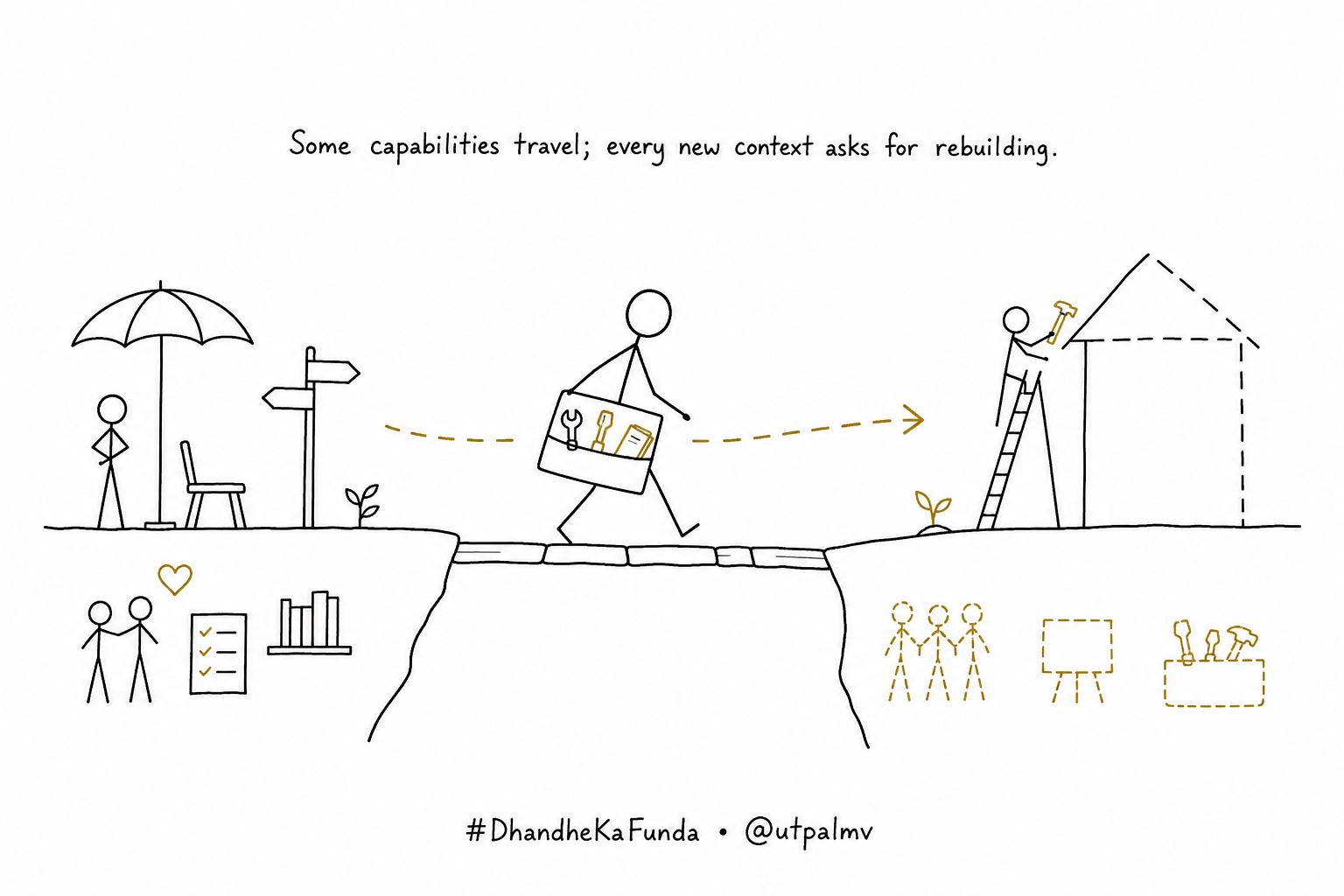
There is a famous story about Michelangelo. When asked how he created David, he said: "I saw the angel in the marble and carved until I set him free."
We love this quote because it sounds romantic. We imagine the artist gently brushing away dust. We forget the violence. To create David, Michelangelo had to strike the stone with a hammer. He had to break it. He had to reduce a massive block of expensive raw material into dust.
In your own life, you are not just the Sculptor. You are also the Marble. This is the Sculptor's Paradox:
To improve, you must act as the Sculptor (Ruthless, Visionary).
But to be improved, you must endure as the Marble (The one being struck).
We want "Personal Growth" to feel like adding a coat of paint: smooth, easy, additive. But true growth is Subtractive. It is the removal of parts of you that you have carried for years.
You chip away the "People Pleaser." (It hurts to say No).
You chip away the "Victim." (It hurts to take responsibility).
You chip away the "Safety." (It hurts to take a risk).
If you are comfortable, you are not growing; you are just aging. The flying chips are proof of progress. Do not fear the hammer. The hammer is the only thing that proves you are not just a rock, but a masterpiece in waiting.
#DhandheKaFunda: We demand the prize of the Angel, but we refuse the pain of the Chisel.
Old beliefs, desires, habits, and prejudices can narrow what we notice. They can also contain experience worth understanding. Freedom does not require deleting every constraint or reaching a pure state of consciousness.
A practical review can ask:
Presence does not erase history, emotion, or uncertainty. Operational freedom is the ability to examine a constraint and choose responsibly, not the absence of every boundary.
The Me, Inc. protocol An employee can still think like an owner. This does not mean pretending that employment and entrepreneurship are the same. They are not.
Uncertainty creates room for discovery, and also for loss.
Guarantees, estimates, and case studies are not merely demands that the future repeat the past. They can protect people from irresponsible claims and help allocate money, time, and risk. Their limits should be stated honestly when the work is genuinely new.
Experimentation becomes useful when uncertainty is defined rather than celebrated. What is unknown? What evidence could reduce that uncertainty? What is the smallest test that can answer a consequential question without exposing others to an unreasonable cost?
High-variance opportunities may offer substantial upside, but the phrase can hide the probability and distribution of harm. A failed experiment is information only if it was designed to produce interpretable evidence. It may also be a loss that deserves repair rather than a badge.
Predictable work and exploratory work need each other. Reliable operations create the capacity to test something new. Exploration can reveal practices that later become dependable.
There is no virtue in making colleagues nervous or entering a field simply because others lack a map. Leadership requires making the uncertainty visible, inviting relevant challenge, and agreeing on boundaries before the test begins.
"Not sure" is an honest starting point. It becomes strategy when joined to a question, a responsible experiment, and a willingness to stop when the evidence no longer supports the risk.
Value offered before a request for return can change the quality of a relationship. I think of this as feedforward: contributing attention, clarity, an introduction, or a useful observation without treating every exchange as an immediate transaction.
The idea is easy to inflate into a promise of abundance. I do not think generosity guarantees reciprocity, opportunity, or wealth. Some contributions will not return anything, and boundaries still matter.
Scarcity can narrow attention. When I feel that money, talent, time, or recognition is in short supply, I may protect what I have and miss ways to create value with someone else.
Feedforward asks a different question: what can I contribute here that is useful, proportionate, and freely chosen?
1. Review the relationship
Look at an important working relationship. What useful contribution have you made recently without attaching an immediate request?
2. Offer something specific
Share an insight, make a relevant introduction, improve a process, or give careful attention. Do not assume you know what the other person needs. Ask when the contribution would create work, obligation, or intrusion.
3. Release the hidden invoice
Notice whether the gift carries an unspoken demand for repayment. If it does, make the exchange explicit instead of calling it generosity.
4. Keep the boundary
Feedforward is not limitless availability. Give what you can offer without resentment, self-neglect, or manipulation.
The practice can reduce extraction in the relationship and make your own contribution deliberate. It does not guarantee that a harvest will return.
There is a dangerous lie in the education system: "Knowledge is Power." In 2026, this is false. Knowledge is free. It is on Google. It is in the LLM. If you memorize the encyclopedia, you are not powerful; you are a hard drive.
The Slope vs. The Y-Intercept
Think of your career as a graph.
Knowledge (Y-Intercept): Where you start. (Your degree, your current skills).
Obsession (Slope): The rate at which you learn.
A "Smart" person with low obsession starts high but stays flat. An "Obsessed" person starts low but has a steep vertical slope. Mathematically, the Obsessed person always overtakes the Smart person, usually within 3-5 years.
Why Obsession Wins
Infinite Energy: The Smart person works 9-to-5 because they are disciplined. The Obsessed person works 24/7 because they are curious. You cannot beat someone who is playing a game while you are "working."
Pattern Recognition: When you are obsessed, you see the problem in the shower, in the car, in your dreams. Your brain is processing in the background.
Resilience: When a Smart person fails, they think, "I made a calculation error." When an Obsessed person fails, they think, "Interesting data point," and keep going.
The Protocol: Follow the Heat
You cannot force obsession. But you can detect it. Stop trying to learn things because they are "Marketable." Learn things that make you forget to eat.
The Test: What do you do on a Sunday afternoon when nobody is watching?
If it's reading about Supply Chain Logistics, you should be in Logistics.
If it's coding, you should be a dev.
If it's arguing about politics, you should be in... well, maybe get a hobby.
#DhandheKaFunda: Knowledge is the map. Obsession is the fuel. A Ferrari with an empty tank loses to a rickshaw that keeps moving.
Labels such as “A-player” and “B-player” compress a complicated team problem into a ranking of people.
Capability and reliability matter. So do role clarity, support, experience, workload, management, and the fit between a person and the work. A struggling team member does not automatically destroy a strong team, and an uncertain interview does not justify a permanent judgment.
When performance is below what the role requires:
High standards and humane management are not competing ideas.
The modern education system is designed to produce spheres. A sphere is "Well-Rounded." It has no sharp edges. It rolls easily into any slot. Corporate HR loves spheres.
But in the high-performance world, spheres are useless. You do not win by being "above average" at everything. You win by being Top 1% at one thing, even if you are terrible at everything else.
The Logic of the Spike
Imagine a graph of skills.
The Mediocre: Flat line across the middle. (Good at nothing, bad at nothing).
The Sovereign: A flat line at the bottom, with one massive vertical spike.
The Manager's Trap
The original post describes a manager comparing "Smith" (a specialist) to "Nick" (a compliant generalist).
The Manager: "Smith is a genius at algorithms, but he refuses to work at 2 AM like Nick. I need to fix Smith."
The Result: You force Smith to conform. You dull his spike. Now you have a grumpy, mediocre Smith.
The Protocol: Ignore the Dents
If you have a racehorse, do not teach it to climb trees. If you have a coder who writes 10x algorithms but hates meetings:
Do not send him to "Communication Training."
Do: Hire a Project Manager to handle the meetings for him.
Build Around the Superpower
Great teams are not collections of "Well-Rounded" individuals. Great teams are collections of Spiky Individuals who interlock like puzzle pieces.
Person A is all Vision (and zero details).
Person B is all Details (and zero vision). Together, they form a perfect circle. Apart, they are disasters.
#DhandheKaFunda: Don't try to be well-rounded. A ball rolls, but it cannot pierce the market. Be a spear.
There is a metric that predicts success with 90% accuracy. It is not IQ. It is not capital. It is not "passion." It is Latency.
What is Latency?
Latency is the time gap between having an idea and executing the first step.
The Amateur: Has an idea ("I should email that client"). Waits 3 days. Overthinks. Drafts. Deletes. Sends it next Tuesday.
The Professional: Has the idea. Sends the email while walking to the elevator.
The Half-Life of Enthusiasm
Ideas are radioactive. They decay. The enthusiasm you feel for a project is highest at the moment of conception. Every hour you wait, the enthusiasm drops by 50%.
After 24 hours, the "spark" is cold.
After 48 hours, the idea becomes a "chore."
After 72 hours, it becomes a "regret."
The "Right Now" Protocol
If an action takes less than 2 minutes: Do it immediately. Do not write it on a To-Do list. The time it takes to write it down is the time it takes to do it.
If an action takes more than 2 minutes: Take the first step immediately. Do not wait for "Focus Time." Open the document. Write the title. Save it. You have broken the static friction. The object is now in motion.
#DhandheKaFunda: Money loves speed. Poverty loves hesitation. Kill the gap.
Waiting for permission can disguise itself as preparation. I have found it useful to separate a genuine dependency from a gatekeeper I have imagined.
Some work does require permission, credentials, consent, capital, or legal authority. The trap is assuming that every first step depends on approval when a smaller, responsible action is already available.
These reasons are not always excuses. A credential may be legally necessary. Personal instability can consume real capacity. Market conditions can make an action irresponsible. The audit is meant to distinguish constraint from avoidance.
1. Name the gate
Write down whose approval you believe is required and why. Verify whether the dependency is real.
2. Find the responsible probe
Choose a small action that can produce evidence without crossing a legal, ethical, financial, or relational boundary. Write a page. Speak with one potential customer. Build a limited prototype.
3. Learn before expanding
Use the result to decide whether to continue, change the approach, seek formal permission, or stop.
Action does not automatically create confidence, and immediate movement is not always strategic. The point is to stop waiting for an undefined blessing when a legitimate next step is already yours to take.
Technical capability does not substitute for judgment, communication, empathy, negotiation, or leadership. These human capabilities also do not form an operating system that guarantees project success.
They develop through practice, reflection, feedback, context, and sometimes formal training. A short course may introduce a useful model even if it cannot produce mastery by itself.
Three areas deserve sustained attention:
Review difficult interactions, but do not seek conflict merely as training or abandon useful dashboards to prove human presence.
Predictable work is not inherently fragile, and difficult work is not inherently secure.
Still, a career can become vulnerable when it depends entirely on repeatable tasks and does not develop with changing tools, markets, or responsibilities.
Review the work:
Resilience comes from useful skills, relationships, judgment, and the ability to learn. Complexity alone creates no leverage, and experience does not generate cash forever.
There are two ways to feel good. They feel identical in the moment, but they have opposite effects on your soul.
Source: External. (Alcohol, Netflix, Buying a BMW, Likes on Instagram).
Cost: Zero effort.
After-effect: The Crash. You feel emptier than before. You need a bigger dose next time to get the same hit. This is Addiction.
Source: Internal. (Completing a workout, shipping a product, solving a hard math problem).
Cost: High effort (Pain first).
After-effect: The Glow. You feel stronger. You don't need "more"; you feel satisfied. This is Fulfillment.
Most people are addicted to Cheap Dopamine. They are "Consumers of Joy." A Sovereign is a "Producer of Joy."
Seneca said: "Most powerful is he who has himself in his own power." If your happiness depends on the wine tasting good, you are a slave to the vineyard. If your happiness depends on the discipline of your mind, you are free.
Look at the last 3 times you felt "Good."
Did it come from consuming? (Eating, Watching, Buying).
Or did it come from Creating? (Building, Writing, Training).
Rule: Ratio > 3:1. For every hour of Consumption, you must have 3 hours of Creation. If you consume more than you create, you are not living; you are decaying.
#DhandheKaFunda: Don't buy happiness. Build it. The things you buy rot. The things you build compound.
Silence leaves room for interpretation. Under pressure, clients and colleagues may fill that gap with concern.
That is not a universal psychological law, and communication is not half of every job. But predictable updates can reduce avoidable uncertainty, especially when a deadline or dependency is at risk.
Establish a useful rhythm:
More communication is not always better. The standard is enough signal for the people affected to make sound decisions.
There is a subtle difference between a Tool and a Crutch.
A Tool enhances your capability (e.g., A hammer helps you drive a nail).
A Crutch replaces your capability (e.g., you cannot walk without it).
Most high-performers have hidden crutches.
"I can't write without my specific Lo-Fi playlist."
"I can't start the day without my double espresso."
"I can't focus if there is any noise in the background."
When you say, "I need X to perform," you are admitting fragility. You are saying: "My internal generator is broken, so I need an external battery." If the battery dies (no internet, no coffee, noisy office), you collapse.
To become Anti-Fragile, you must audit your dependencies. Identify the thing you "need." Then, deliberately remove it for 3 days.
1. The Silence Fast
If you are addicted to podcasts/music, spend 48 hours in total silence.
The Pain: You will feel anxious. Your brain will scream for dopamine.
The Gain: You will eventually hear your own thoughts again. You will move from "Consumer" to "Generator."
2. The Caffeine Fast
If you need coffee to wake up, quit for 7 days.
The Pain: Headaches. Lethargy.
The Gain: You realize that energy comes from mitochondrial health, not a drug. When you return to coffee, it becomes a tool for specific bursts, not a requirement for survival.
3. The Boredom Fast
If you check your phone in every elevator ride, leave it at your desk.
The Pain: The itch of boredom.
The Gain: Boredom is the breeding ground of strategy. You cannot have a breakthrough if you are constantly entertained.
The goal is not to be a monk. The goal is to be the Master. You play the music. The music does not play you.
#DhandheKaFunda: If you cannot function without it, you do not own it. It owns you.
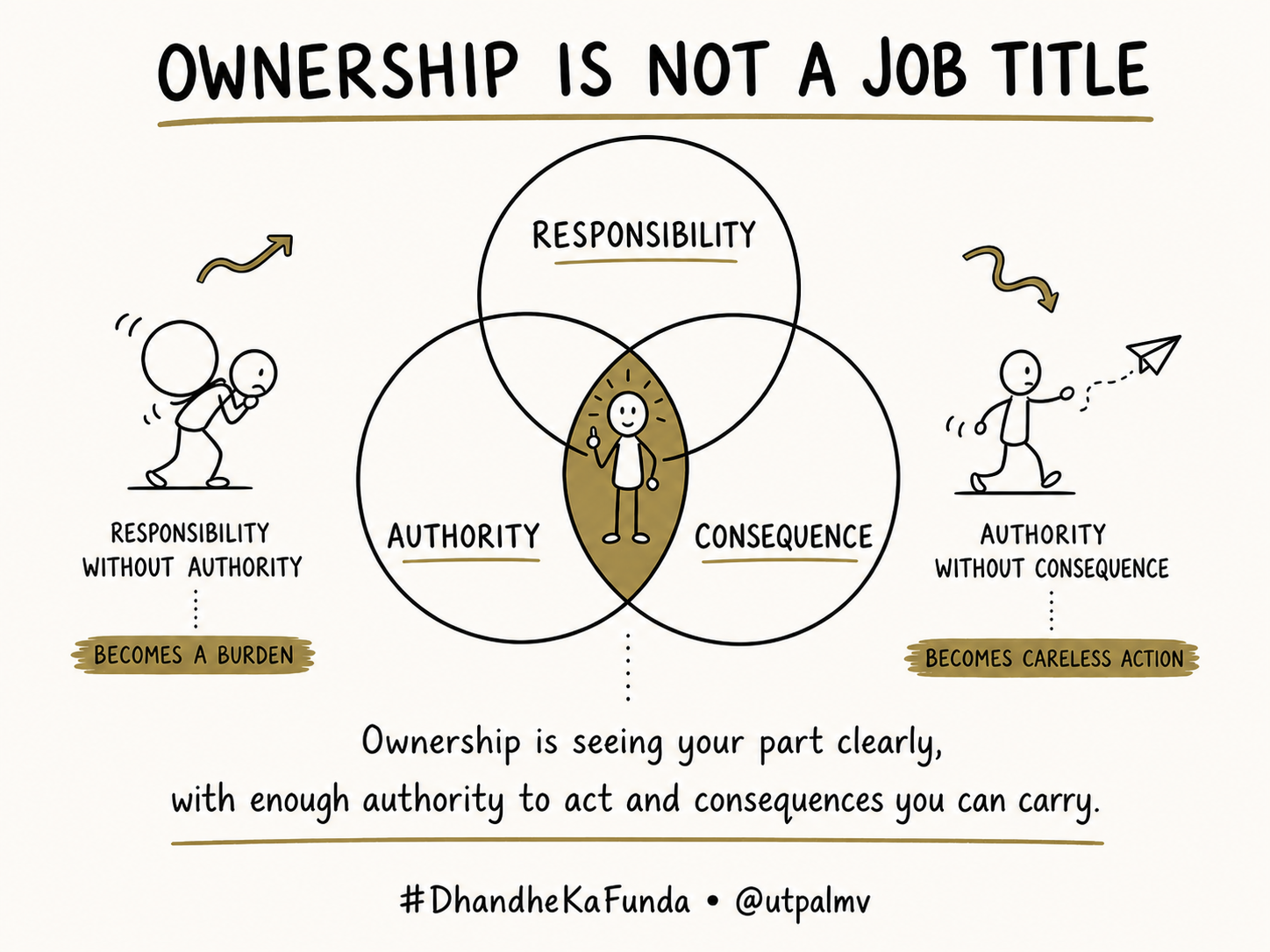
Owning a company does not guarantee an ownership mindset. Having a job does not prevent one.
A concrete artifact can change the quality of a conversation.
When people debate an interface, workflow, service, or technical approach in the abstract, each person may be imagining something different. A rough prototype, worked example, test, or written decision makes some of those assumptions visible. The group can respond to what is there rather than to several private pictures.
I value that form of proof of work. I do not think it makes talk cheap or ideas worthless.
Conversation often prevents the wrong artifact from being built. A person closest to the consequences may not have the time, permission, money, or technical access to produce a prototype. Their contribution can still be decisive. Positional authority can be abused, but a title does not make every statement noise. Artifacts also persuade through appearance; a polished demo may conceal missing evidence, maintenance cost, or harm shifted to someone else.
The question is what the uncertainty requires.
If the disagreement concerns whether something can work, a small test may help. If it concerns whose needs count, what risk is acceptable, or whether the work should exist, building first may narrow the decision too soon. Some questions need research, consent, or deliberation before implementation.
When I do build, I try to keep the artifact proportionate. It should test the contested assumption, not smuggle in an entire solution. I name what it demonstrates, what it does not, and what it cost to produce. Then I invite the people affected to interpret the result.
Proof of work is strongest as evidence, not theater. A chair brought into a room proves that one chair was built. It does not yet prove comfort, durability, affordability, accessibility, demand, or the wisdom of producing a thousand more.
Build enough to improve the conversation. Then let the conversation improve what gets built.
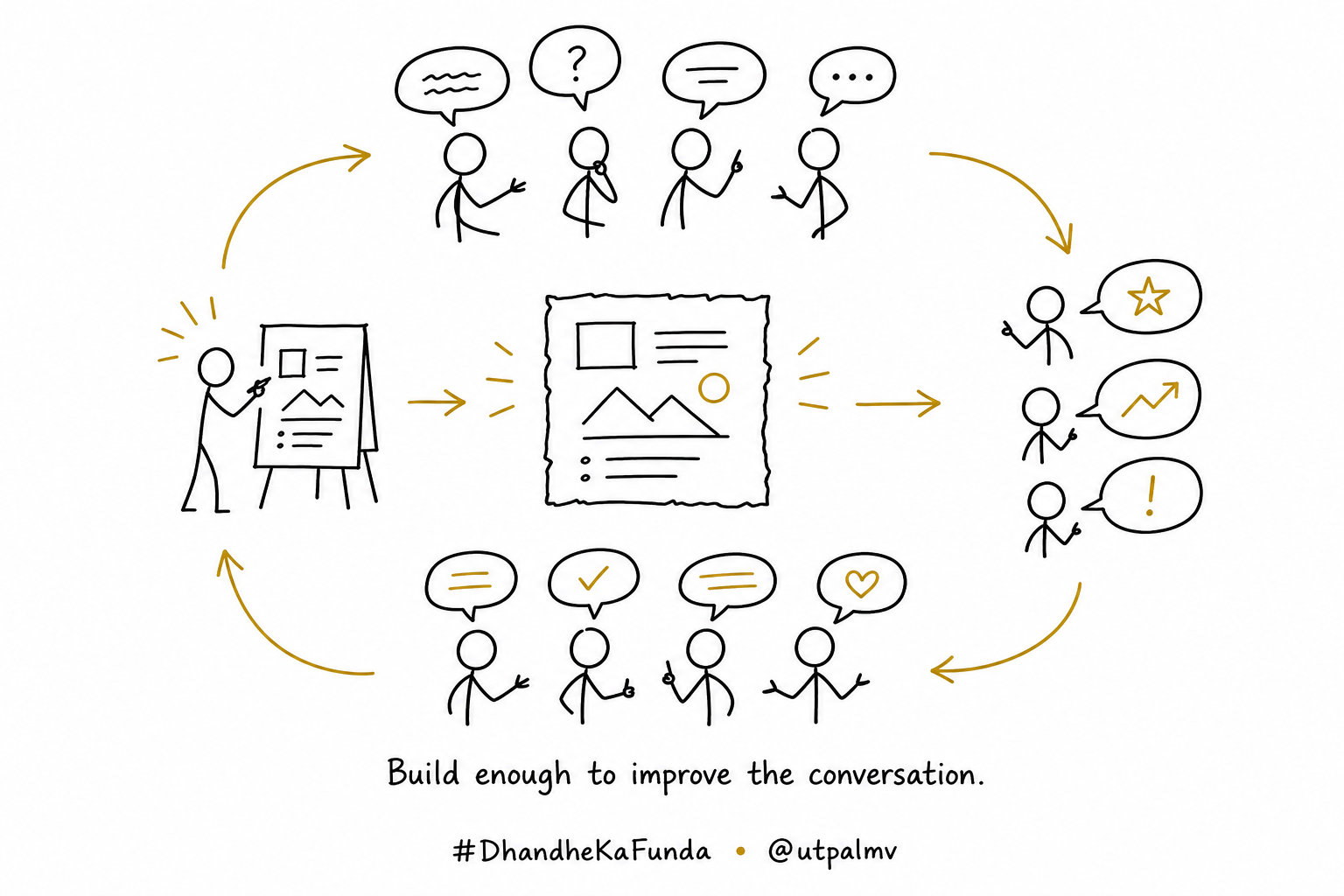
The human brain is a Prediction Engine. To save energy, it constantly guesses what will happen next.
If you see a ball thrown, your brain predicts the arc.
If you hear "Once upon a...", your brain predicts "time."
This is great for catching baseballs. It is terrible for leadership.
The Google Auto-Complete Trap
In conversation, most people operate like Google Search in 2010. As soon as the other person types "How to...", your brain flashes 5 guesses:
"How to make money"
"How to fix a car"
"How to fire someone"
You stop listening to the actual input because you are too busy admiring your own prediction. You interrupt: "Oh, you want to know about firing? Here is my advice..." And the person says: "No, I was asking how to find the bathroom."
The Cost of "Smart" Listening
Smart people are the worst listeners. Because their processing speed is high, they think they have "solved" the sentence before it is finished. This is Arrogance disguised as Efficiency. When you interrupt (or zone out), you signal:
"I am faster than you."
"My time is worth more than your thoughts."
"I am not curious about you; I am only curious about my own brilliance."
The Protocol: The 2-Second Buffer
To disable the Auto-Complete, you must install a Latency Buffer.
1. The Physical Anchor
When the other person stops speaking, do not speak. Take a physical breath. (Inhale... Exhale). Count to 2. Then respond.
2. The Loopback Check
Before you offer a solution, verify the input.
#DhandheKaFunda: The goal of listening is not to be the fastest to the answer. It is to be the most accurate.
There is a law in construction: You cannot build a penthouse on a foundation of mud. Yet, in the career world, everyone is trying to build the penthouse first.
Junior devs want to learn AI before they understand Memory Management.
Junior marketers want to go "Viral" before they understand Copywriting.
Junior founders want to "Scale" before they have "Product-Market Fit."
The Concept of Competence Debt
When you skip a foundational step to get a quick win, you incur Competence Debt.
Example: You use a template to build a website because you didn't want to learn HTML/CSS.
The Cost: Three years later, the site breaks. You don't know how to fix it because you never understood how it worked. You are now helpless.
The "Boring" Checklist
The original post mentions that clients presume you know the basics. These are the Table Stakes. If you don't have them, you are not a Professional; you are a Liability.
In 2026, the "Walking" skills (The Foundation) are:
Clear Writing: Can you persuade without confusion?
Basic Logic: Can you spot a fallacy in an argument?
Financial Literacy: Do you know the difference between Revenue and Profit?
Human Psychology: Do you know why people say Yes?
The Bruce Lee Rule
Bruce Lee said: "I fear not the man who has practiced 10,000 kicks once, but I fear the man who has practiced one kick 10,000 times." Advanced skills are just basic skills applied with high speed and high precision.
The Protocol: Pay the Tax Early
Don't rush to be "Advanced." Spend 6 months mastering the thing that feels "too basic."
Read the documentation, not just the tutorial.
Understand the "Why," not just the "How." The tax is cheaper if you pay it now. If you wait 10 years, the interest will bankrupt you.
#DhandheKaFunda: If you are struggling with the advanced stuff, it’s not because you aren't smart. It’s because you skipped Chapter 1.
We are conditioned to compete. From the school classroom to the corporate boardroom, we are trained that if there is a game, we must try to win it. But the most important strategic decision is not how to win. It is choosing which game to play.
The Pyrrhic Victory
In 279 BC, King Pyrrhus defeated the Romans. But the battle cost him his best troops. He technically "won," but he destroyed his capacity to fight the future. In modern life, we chase Pyrrhic Victories every day.
The 3 Games You Must Lose
1. The Argument Game
The Prize: A momentary feeling of intellectual superiority.
The Cost: Resentment, trust erosion, and time.
The Protocol: If the outcome does not change your bank account or your happiness, concede immediately. Let them be right. You save your energy.
2. The Status Game
The Prize: Impressing people you don't like.
The Cost: Financial slavery (buying things you can't afford) and anxiety.
The Protocol: Play the Wealth Game, not the Status Game. Wealth is invisible (freedom). Status is visible (peacocking).
3. The Busy Game
The Prize: Being the "hardest worker" in the office. Martyrdom.
The Cost: Your health and your strategic clarity.
The Protocol: Do not compete on hours. Compete on Insight. The janitor works hard; the Architect works smart.
The Selection
Before you enter the arena, look at the prize. If the prize is not Freedom, Leverage, or Truth... Fold the hand. There is no glory in being the King of a pile of ash.
#DhandheKaFunda: The highest form of strategy is not winning. It is refusing to play a game where the prize is not worth the price.
We are trained to wait.
School: "Don't speak until you raise your hand."
College: "Don't study X until you have the prerequisite Y."
Corporate: "Don't launch the project until the Steering Committee approves."
This conditioning creates a Permission Mindset. We believe that for every action, there must be an Authorizing Figure who says "Go."
The Reality of the Wild
In the wild (Entrepreneurship, Art, High-Level Leadership), there are no Authorizing Figures. There is no "Committee of Success" that grants you the license to be great.
If you wait for a publisher to pick you, you are a "Waiter."
If you self-publish and build an audience, you are a "Player."
The Green Light Delusion
Most people spend their lives waiting for a Green Light that doesn't exist.
"I'll start the business when the economy is better."
"I'll lead the team when I get the promotion."
The Truth: You don't get the promotion to let you lead. You get the promotion because you already led. Action precedes Authority.
The Protocol: Permissionless Leverage
Stop asking: "Can I do this?" Start asking: "Who is going to stop me?"
1. The "Draft" Maneuver Don't ask your boss: "Can we rewrite the marketing strategy?" (They will say: "Let's have a meeting.") Instead, rewrite it on Saturday. Send it on Monday: "I had an idea and sketched this out. It's 80% done. Should we ship it?" It is impossible to ignore finished work.
2. The Credential Trap Don't wait for the degree.
Don't get an MBA to learn business. Start a business.
Don't get a certificate to learn coding. Build an app. The market values Portfolios over Diplomas.
#DhandheKaFunda: The world gives you exactly what you ask for. If you ask for permission, it gives you a "No." If you ask for forgiveness, it gives you a "Wow."
Action can produce information that planning alone cannot.
When a choice is reversible and the cost of learning is contained, a small experiment may reveal more than another round of speculation. A prototype can expose a faulty assumption. A conversation can show whether a concern is shared. A draft can make an unclear idea concrete enough to evaluate.
This does not make every step valuable simply because it is fast. Some actions create avoidable harm, consume scarce resources, or generate misleading evidence. Planning is especially important when consequences are difficult to reverse.
The practical question is not whether thinking or motion is better. It is what kind of uncertainty remains. If the missing information can be obtained through research, research it. If it depends on how people or systems respond, design a limited test.
A useful experiment has four parts:
Movement helps when it is connected to observation. Without that connection, iteration can become activity without learning.
The path is often clarified by walking, but the quality of the walk depends on noticing where each step actually leads.
Convenience can hide the labour, materials, and systems behind an ordinary product. It can also make life safer, more accessible, and less wasteful.
A cup of coffee offers one way to notice the chain of growing, processing, transport, preparation, and service. Grinding beans or using a handmade mug may deepen attention for one person. It does not make the drink more respectful by definition.
A craft review can ask:
There is no reliable formula in which 5 percent more effort doubles quality. The PolyNxt reference adds promotion rather than evidence and is omitted.
In 2013, I used the mirror as a prompt for reflection beyond appearance.
The metaphor remains useful if it stays modest. A mirror does not diagnose a life, happiness is not a health metric, and discomfort does not automatically require a hard pivot.
Reflection can ask:
Rumination and reflection are not the same. Useful reflection produces clearer evidence or a deliberate next step while leaving room for uncertainty and support from other people.
We are raised in a factory system.
School: Sit still. Raise your hand. Memorize the answer. (Reward = Grades).
Corporate: Follow the SOP. Hit the KPI. Don't rock the boat. (Reward = Promotion... to a point).
The Ceiling There is a glass ceiling for obedient people. You can rise to "Senior Manager" by doing exactly what you are told. But you will never reach the C-Suite, and you will never be a Founder.
Why? Because Leadership is the art of rewriting the rules, not following them. A CEO who waits for instructions is not a CEO; they are an administrator.
The AI Threat
In 2026, the danger of being a "Compliant Employee" is existential.
AI is the ultimate Compliant Employee.
It follows instructions perfectly. It never sleeps. It costs $20/month.
If your value proposition is "I do what I'm told very well," you are already obsolete.
The Protocol: Intelligent Disobedience
To survive, you must cultivate Agency. This often looks like "Intelligent Disobedience."
1. Challenge the Spec
The Drone: Builds exactly what the client asked for, even if it's stupid.
The Sovereign: "I know you asked for X, but I built Y because X would have crashed your server in 3 months. Here is the data."
2. The Permission Paradox
The Drone: Waits for approval to fix a problem.
The Sovereign: Fixes the problem, then informs the boss. "I saw the fire. I put it out. Here is the report."
3. The Risk of Silence
Compliance is comfortable. Dissent is risky. But in a high-performance team, Silence is Malpractice. If you see the bus driving off a cliff and you don't grab the wheel because "it wasn't my job," you deserve the crash.
#DhandheKaFunda: You are not paid to type. You are paid to think. Sometimes, thinking requires disobeying the instructions.
Mediocrity is not a choice; it is the Default Setting .
There is a profound difference between not knowing something and not knowing that you don't know it.
"What's next?" can interrupt rumination and reopen the possibility of action. It can also become a way to outrun grief, responsibility, celebration, or rest.
I want to keep the question without turning momentum into a defence against every human response.
Name what happened and what it requires. Recovery does not follow a 60-second rule. Loss, failure, and relationship change may need mourning, repair, support, or a long pause before another action becomes clear.
When action is possible, ask what small step responds honestly to the new conditions.
Allow the result to register. Thank the people involved, preserve what was learned, and notice what the achievement changed. Then ask whether another move is needed or whether consolidation is the responsible choice.
"What's next?" can shift attention from insult to response. The next step may be a question, a boundary, documentation, repair, or leaving the exchange.
Momentum is not the primary defence against entropy, and the next move is not the only move that matters. Sometimes the useful question is "What's next?" Sometimes it is "What needs to be felt, repaired, or appreciated here?"
"I am not a Project Manager." Yes, you are. You are just a bad one.
We like to think our desires are authentic. "I want to be a lawyer because I love justice." "I want a Ferrari because I appreciate engineering."
Science says you are lying. According to Mimetic Theory (René Girard), we do not desire objects. We desire what our models desire.
You want the job because your college rival wants the job.
You want the watch because your boss has the watch.
You are not navigating by your own compass; you are navigating by looking at the ships around you.
The Danger of the Herd
The "Rat Race" is simply a group of people competing for the same Mimetic Desires. Because everyone wants the same thing (Status, specific zip codes, specific titles), the competition becomes fierce and the margins become zero. You spend your life fighting for a prize that, once won, feels empty. Why? Because you never actually wanted it. You just wanted to beat the other guy to it.
The Protocol: The Origin Audit
To regain your Sovereignty, you must trace every major goal back to its source.
Take your top 3 goals. Ask: "Where did this desire come from?"
The Goal: "I want to raise a $10M Series A."
The Origin: "TechCrunch celebrates funding rounds." (Mimetic).
The Reality: "I actually hate board meetings and prefer bootstrapping." -> DROP IT.
The Goal: "I want to write a book."
The Origin: "I have ideas that keep me awake at night." (Intrinsic).
The Reality: "I would write this even if nobody read it." -> KEEP IT.
The Anti-Mimetic Path
The only way to win is to leave the crowded track. Stop competing on "Better." Start competing on "Different." If you pursue a goal that nobody else understands, you are safe from competition. You are free.
#DhandheKaFunda: If you are competing with millions of people, you are playing the wrong game. Find the game only you can play.
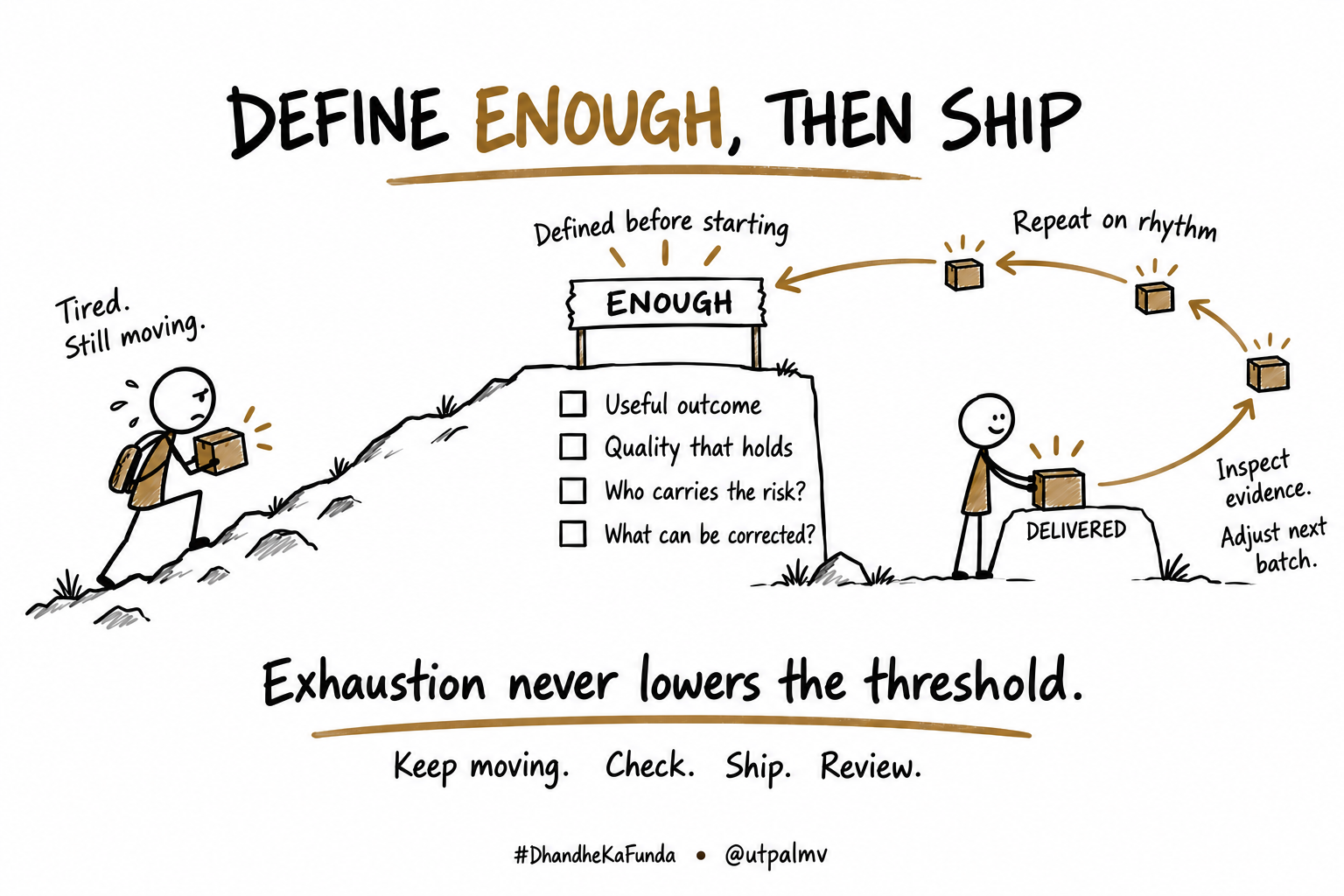
Decide what enough means before you start. When the work reaches it, ship. Move the line only for a reason you can name.
Why is air travel the safest form of transport? Because every plane carries a Black Box (Flight Data Recorder). When a plane crashes, the industry doesn't say, "It was bad luck." They find the box. They analyze the data. They find the specific mechanical or human error. Then, they update the protocol for every other pilot in the world. They turn Tragedy into Data.
The Ego Barrier
In our personal lives, we do the opposite. When we fail (lose a client, break a relationship, miss a goal), we destroy the Black Box. We say: "The market is bad," or "My boss is a jerk." We hide the evidence to protect our feelings. This ensures that we will crash the same way next month.
The Protocol: The Weekly Flight Review
You don't need a "Scrum Master." You need a recursive loop. Schedule a 30-minute slot every Sunday. This is your Black Box session.
The 3 Questions (The Code)
Surface reason: "I ran out of time."
Real reason: "I said 'Yes' to three other distractions on Tuesday because I crave validation."
Weak Fix: "I will try harder next time." (Will fail).
Strong Fix: "I will block my calendar from 8 AM to 11 AM. No meetings allowed."
The Evolution
If you do this 52 times a year, you will iterate your operating system 52 times. In 5 years, you will be unrecognizable to your former self. You are not "talented." You are just a machine that corrects its own code.
#DhandheKaFunda: You cannot fix a bug you refuse to see. Open the box.
We track every variable in business: Cash flow, inventory, churn. But we ignore the most volatile variable of all: The Founder's Nervous System.
The Biology of Leadership
Humans are open-loop systems. We regulate each other's blood pressure and cortisol levels. As the Leader, you are the Emotional Thermostat.
If you walk into the office anxious, your team's IQ drops by 15 points. (Biologically, their brains shift from "Creative" to "Survival").
If you walk in with "Rational Joy" (Calm Confidence), their brains unlock.
The "Unhappy Leader" Tax
An unhappy leader is expensive. When you are miserable, your team spends 50% of their energy trying to "manage your mood" instead of solving the customer's problem. They become Courtiers, not Soldiers. They hide bad news. They sugarcoat reality. This is how companies die.
The Protocol: Happiness as Duty
You do not have the right to be miserable in public. "Vent" to your therapist. "Vent" to your spouse. But when you cross the threshold of your business, you must embody Optimistic Fatalism.
The Belief: "We might fail, but we will have a hell of a time trying, and we will probably figure it out."
The Signal: A smile is not just a facial expression; it is a signal of Abundance. It tells the tribe: "We have enough resources. We are safe to take risks."
#DhandheKaFunda: Your face is the dashboard of the company. If all the lights are red, nobody is going to drive fast.
Defensive work can consume attention that would otherwise improve the work itself.
There is a real difference between documentation that creates shared clarity and documentation written mainly to assign blame in advance. Yet contracts, decision records, and written confirmations are not signs of insecurity by default. They can protect clients, colleagues, and the craft by making responsibilities and constraints visible.
The problem appears when self-protection replaces problem-solving. A project begins to drift, and the response is to accumulate explanations rather than surface the risk, revisit the plan, or ask for a decision. The record becomes increasingly complete while the outcome continues to deteriorate.
A useful review asks:
Ownership does not require accepting responsibility for everything. Complex work has distributed causes, and honest analysis should distinguish them. Refusing every explanation can conceal as much as excessive justification.
Integrity lies in making the relevant facts available, naming one's part accurately, and directing attention toward repair. Good records and good craft can support each other when both serve the work rather than a contest over innocence.
When a product fails or a client escalates, the urge to defend intent can delay the response.
Responsibility does not require accepting false blame or ignoring how the failure occurred. It means stabilizing the immediate situation while preserving the facts needed to understand and prevent recurrence.
Empathy may lower tension, but it does not mechanically absorb another person’s emotion. Effective response combines attention, evidence, repair, and fair accountability.
Past investment deserves evidence, not automatic loyalty or automatic rejection.
Peter Drucker’s useful question is often paraphrased as: knowing what you know now, would you begin this again? A “no” does not by itself settle what should happen next. Ending a project, employment relationship, or personal relationship has obligations and consequences that a clean-sheet thought experiment can hide.
A periodic review can still ask:
History is not a prison. It is part of the decision.
The Knoster model is a useful prompt for examining change through vision, skills, incentives, resources, and an action plan.
Its familiar chart associates missing elements with confusion, anxiety, resistance, frustration, and false starts. Those associations are diagnostic possibilities, not predictable equations. Emotions are not error codes, and the same response can have many causes.
When change stalls, ask:
Use the model to broaden inquiry, then verify the cause with the people and evidence involved.
We are told that "Unlimited Options" is the goal of a successful life.
Intent becomes consequential through a sequence of concrete choices.
A vision can provide direction, but it cannot specify every step. Plans, deadlines, accountability, and repeated action can translate it into work. None makes an outcome inevitable.
The sequence begins by defining a target clearly enough to test. The next step is to identify constraints, dependencies, and a small action that can produce evidence. A deadline can support coordination when it reflects the work. An arbitrary deadline may merely increase pressure or encourage concealment.
Accountability also needs care. A trusted partner or a public commitment can help sustain attention, but manufactured consequences can lead to premature financial or reputational commitments. Paying for something before it is understood is not inherently courageous.
Motivation moves in more than one direction. Sometimes action creates momentum. Sometimes rest, meaning, encouragement, or treatment is needed before action is possible. Turning mood into an enemy offers little help in understanding the actual barrier.
When a project stalls, I can inspect the chain:
Results follow from action and conditions, not action alone. A working system keeps the vision close enough to guide the work and loose enough to change when reality answers.
Plans need room for what the estimate does not know.
I have often separated an internal target from an external commitment. The internal date creates time to integrate, test, and recover from ordinary surprises before the promised date arrives. That gap can protect quality and reduce the chance that every delay becomes a crisis.
The practice becomes questionable when the buffer depends on misleading the people doing the work.
If a team is told that an invented date is a fixed client commitment, urgency may increase for a while. It may also damage trust when the fiction becomes visible. People make choices about effort, personal time, scope, and risk based on the information they receive. A buffer is not solely the manager’s asset when other people pay for it.
I now prefer three explicit layers.
The commitment date is the promise made to a customer or stakeholder. It should reflect the evidence available and include reasonable contingency.
The working target is the date the team is aiming for. It can be earlier, but the reason should be clear: integration time, testing, review, or protection against named uncertainty.
The contingency is what remains unallocated. Not every detail needs to be broadcast in every conversation, but the people making delivery decisions should understand that uncertainty exists and how the reserve will be used.
Buffers also require discipline. Extra time should not excuse weak planning or permanent overcommitment. When the reserve is repeatedly consumed, the estimate, scope, staffing, or process needs examination.
There is no universal percentage. Novel work, familiar work, dependent work, and safety-critical work carry different uncertainty. The buffer should follow the risk rather than a manager’s desire to appear certain.
The aim is dependable delivery without manufactured pressure. A schedule is stronger when it protects room for reality and preserves enough trust for people to report what reality is doing.
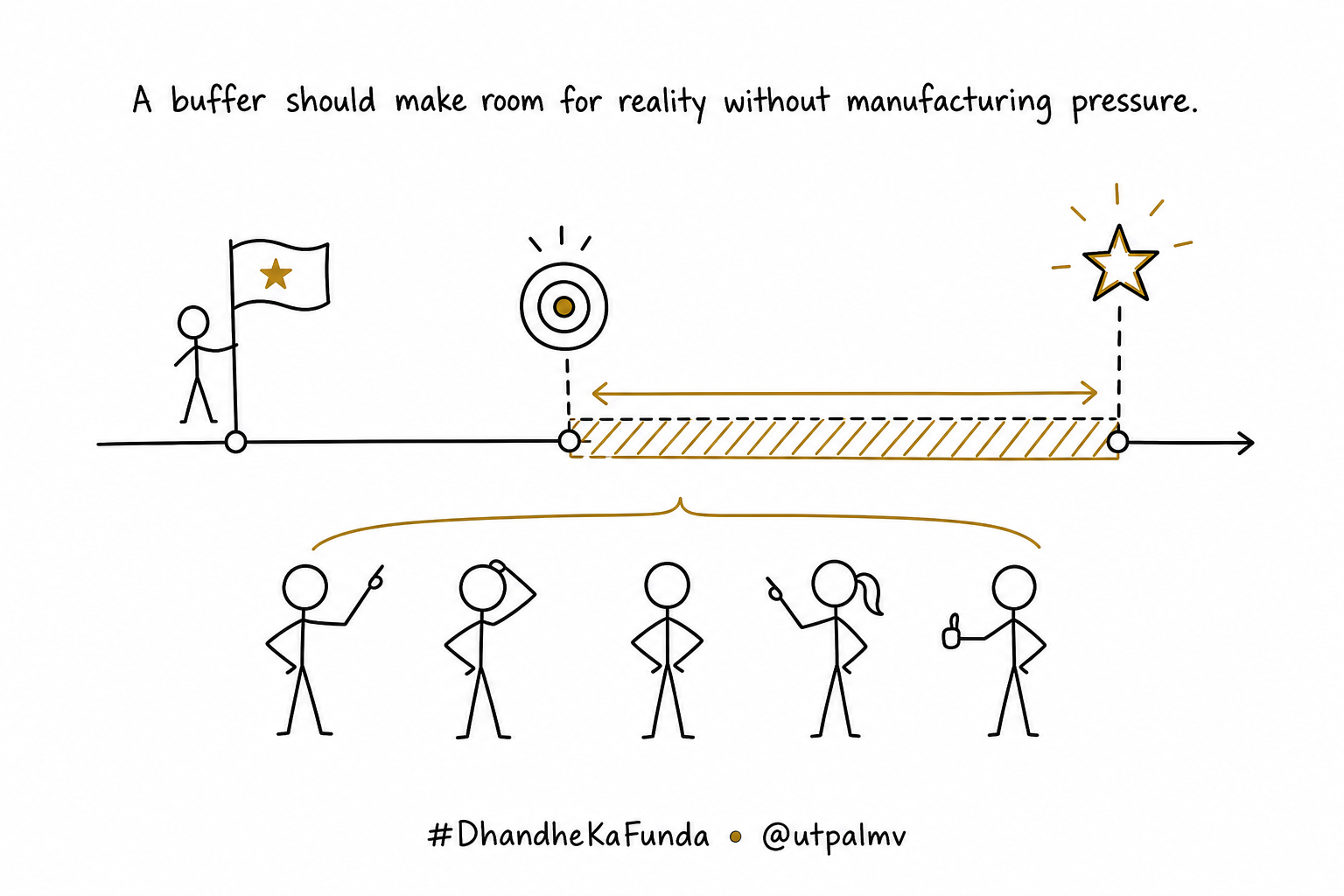
Steve Jobs said: "Don't be trapped by dogma - which is living with the results of other people's thinking." This is the most important algorithm for a Sovereign life.
Most people do not think. They execute scripts written by others.
Script: "Go to college to get a good job." (Written by: 1950s Industrialists).
Script: "Buy a house to build wealth." (Written by: Banks).
Script: "Retire at 65." (Written by: The Government).
This is Dogma. It is "Compiled Code." You can run it, but you cannot change it. And often, the code is buggy, outdated, or malicious.
The First Principles Protocol
To escape the Dogma Trap, you must stop running the .exe and start looking at the Source Code. This is First Principles Thinking.
1. Identify the Assumption (The Dogma)
Statement: "I need $2M to start a hardware company."
Source: "Everyone says hardware is hard."
2. Break it Down (The Physics)
What is the fundamental truth?
Truth: I need a prototype (plastic and metal). I need a PCB (silicon).
Cost: 3D printing = $50. Arduino = $20. Coding = Free.
Reality: I need $100 and a weekend, not $2M.
3. Reconstruct (The Innovation)
Once you see the raw materials, you can build a new solution that ignores the "Standard Procedure."
This is how Elon Musk built SpaceX. (Dogma: Rockets are expensive. Physics: Aluminum and fuel are cheap).
The Courage to be "Wrong" When you reject Dogma, you will look "crazy" to the people running the old scripts.
They will say: "That's not how it's done."
You will say: "That's not how you do it."
#DhandheKaFunda: If you are doing what everyone else is doing, you are already behind. The only way to win is to write your own rules.
Show me a leader who complains that "My team just can't think for themselves," and I will show you a leader who secretly loves it.
The Insecurity Trap
Insecure leaders have a subconscious hiring filter:
They reject candidates who are smarter than them (Threat).
They reject candidates with high self-esteem (Hard to control).
They hire "Mediocre Profiles" who will follow orders and never challenge the throne.
The Result: The Army of Midgets
David Ogilvy famously gave his managers Russian Dolls. Inside the smallest doll was a note: "If each of us hires people who are smaller than we are, we shall become a company of dwarfs. But if each of us hires people who are bigger than we are, we shall become a company of giants."
If you hire for Control, you sacrifice Scale. You can control a mediocre team, but you cannot scale them. You become the bottleneck.
The Protocol: The Threat Assessment
When you interview a candidate, pay attention to your own fear.
The Feeling: "This guy is arrogant. He might be difficult."
The Reality Check: Is he arrogant, or is he just competent?
The Sovereign Rule: If a candidate doesn't intimidate you slightly, do not hire them.
High Agency > High Obedience
Obedience: "I did exactly what you said." (Safe, slow, requires micromanagement).
Agency: "I didn't do what you said because I found a better way." (Risky, fast, requires trust).
You cannot build a Unicorn with obedient sheep. You need wolves. But to lead wolves, you cannot be a shepherd. You must be the Alpha.
#DhandheKaFunda: If you are the smartest person in the room, you are in the wrong room. Or you built the wrong room.
Most leaders have a "Style." "I am a nice boss." "I am a strict boss." "I am a democratic boss." This is vanity.
What appears stable often depends on maintenance.
Health, legal standing, technical systems, partnerships, and personal relationships do not all behave like assets, and entropy is not a complete explanation for how they change. Still, past success does not remove the need for present attention.
Maintenance should fit the thing being maintained. A legal status may require a dated verification. A system may need monitoring and repair. A relationship needs reciprocal care, not a recurring test of whether I remain the other person's highest-value option.
The question "Could I earn this again today?" can reveal dependence on old assumptions, but it can also turn belonging into permanent performance. Some commitments are valuable precisely because they are not renegotiated from zero each morning.
A gentler audit asks:
Not every stable part of life is a high-risk point, and constant pressure-testing can itself create fragility. The aim is proportionate attention: enough to notice drift, honour ongoing contributions, and act before preventable neglect becomes failure.
Maintenance is not repeatedly proving one's worth. It is participating in the conditions that allow something valuable to continue.
If you hire a plumber and he fixes your leak in 2 minutes, you feel cheated paying him $100. If he sweats, bangs on pipes, and takes 2 hours, you happily pay him $100. This is the Labor Illusion. We are wired to value Effort (Input) over Result (Output).
The Factory vs. The Studio
In a Factory: Input = Output. If you stand at the assembly line for 8 hours, you make 8 widgets. Time is a proxy for value.
In a Studio (Knowledge Work): Input = Output. You can stare at a screen for 10 hours and produce zero value. You can have a 5-minute epiphany in the shower that generates $1M.
The Dangerous Metric
Most companies are run by Factory Managers pretending to run Studios. They track "Hours," "Login Times," and "Butts in Seats." They reward the employee who stays late (The Martyr) and punish the employee who leaves early because they finished the work (The Professional).
The Protocol: Decouple Your Value
If you want to be wealthy, you must break the link between Time and Money.
Stop Selling Time: Never bill by the hour. Bill by the Project or the Outcome.
Hide Your Speed: If you are fast, do not show it immediately. If you deliver a 2-day project in 2 hours, the client will think it was "easy" and demand a discount. Deliver it in 1 day. Use the spare time to build your own assets.
The Result is the Only Truth: Did the revenue go up? Did the code work? Did the deal close? Everything else is theater.
#DhandheKaFunda: The market pays for the baby, not the labor pains. Deliver the baby.
Most professionals suffer from Operational Myopia .
You came into this world without instructions. You have spent decades trying to operate the machine (You) by trial and error.
Completed tasks can create the appearance of progress while the underlying direction remains unclear. Vector alignment is a short review of whether daily work still serves the purpose chosen for this period.
Name the current priority in concrete terms. A life rarely has one permanent prime directive. Work, health, family, rest, and exploration may all matter, and their relative weight changes.
At the end of the day or week, ask:
Stop, reduce, or redesign work that repeatedly conflicts with the chosen direction. Do not discard a goal merely because its contribution is indirect or delayed. Learning, care, maintenance, and relationships often resist simple metrics.
The vector metaphor is a reminder that motion has direction. It does not turn fulfilment into a measurable signal or make every unaligned hour a loss. Calibration is useful when it protects meaning without making life answer to a single metric.
Some opportunities have limited downside and meaningful potential upside. That does not make the cost of “no” zero.
A request can affect trust, dignity, reputation, negotiation, or another person’s time. Repeatedly asking for discounts or exceptions merely to become comfortable with refusal can transfer the cost to others.
Before taking an asymmetric bet:
Taking more chances does not require failing more than one’s peers. It requires choosing risks whose consequences can be carried honestly.
Financial attention is part of caring for a sustainable life, but money is not the only resource that needs stewardship.
Health, knowledge, relationships, and experience also shape what a person can do. Calling them forms of capital can make trade-offs visible, though the metaphor has limits. A relationship is not an asset to extract, and health cannot always be increased through better management.
The categories are still useful as a review of current conditions:
These areas do not grow in harmony at all times. A period of caregiving may reduce earning capacity. Necessary work may temporarily consume more energy than desired. The aim is not a perfectly balanced sheet, but awareness of the trade being made and how long it can responsibly continue.
Markets do not reliably reward value, effort, or virtue in proportion. Financial outcomes also reflect access, luck, policy, bargaining power, and circumstance. Economic mindfulness begins by seeing those conditions clearly, not by treating hardship as personal failure.
Money deserves honest attention because it affects choices and security. It need not become the measure through which every other part of life is justified.
Helping one person can sometimes compromise another responsibility.
That does not make help a luxury or kindness a leak. It means capacity is finite and requests need context. A deadline, an emergency, a colleague's blocked work, and a family need cannot be ranked by a single universal rule.
The first responsibility is to understand the commitments already made. If interrupting the current task would create material harm, I can say so, negotiate timing, redirect the request, or help the person find another route. A clear no can be more respectful than a resentful yes that neither task receives properly.
Fixed limits such as fifteen minutes can be useful personal defaults, but they are not ethical boundaries. A brief interruption may derail concentrated work; an hour of assistance may prevent a much larger loss. The consequence and urgency matter more than the clock alone.
Priorities also require revision. Calling one project mission-critical can become a way to make every other need invisible. When a conflict recurs, the issue may be insufficient capacity, unclear ownership, or a plan that assumes nobody will need help.
Good collaboration protects focused work while allowing people to depend on one another. The question is not whether helping proves kindness. It is what response honours both the request and the commitments that already exist.
There is a hidden tax on every project. It is called the Ambiguity Tax. It happens when two people use the same word but mean different things.
Boss: "I need this done ASAP." (Means: By Friday).
Employee: "I'll do it ASAP." (Means: Whenever I finish my current task, maybe next Tuesday).
The Result: A fight on Friday afternoon.
The "Jack" Paradox
In the original post, a manager says: "Jack is responsible for the module."
Jack thinks: "I code my part."
Peer thinks: "Jack does most of the work."
Manager thinks: "If this module fails, I am firing Jack."
This is not a "Communication Problem." This is a Definition Problem. We rely on "Low-Resolution Words" (Responsible, Lead, ASAP, Better, Fast) because they are comfortable. High-Resolution Words (Accountable, Owner, By 5 PM, < 200ms latency) are scary because they leave no room to hide.
The Protocol: High-Resolution Speech
To eliminate the Ambiguity Tax, you must increase the resolution of your language.
1. Ban "Soft" Words
Words like "Soon," "Better," "Handle it," and "Review" are banned from the lexicon of a Sovereign.
Bad: "We need to improve performance."
Good: "We need to reduce page load time from 3s to 1.5s by Oct 15th."
2. The Briefing Back-Check
Never ask: "Do you understand?" (People always say Yes to avoid looking stupid). Ask: "How do you interpret what I just said? What are your first 3 steps?" When they explain it back to you, you will spot the bugs in their understanding immediately.
3. The Dictionary of Done
Every project needs a Glossary.
What does "Done" mean? (Code committed? Or Code deployed and tested in Production?)
What does "Urgent" mean? (Drop everything now? Or do it by EOD?)
#DhandheKaFunda: Vagueness is the refuge of the incompetent. Specificity is the language of the master.
Pain can demand attention. It may reveal injury, loss, overload, conflict, or a structure that no longer works. It does not automatically create wisdom, and growth is not proof that pain was necessary.
The pressure-valve metaphor began as a way to ask what action remains possible while a difficult experience is present. It should not become an instruction to stop feeling or to turn every wound into productivity.
Reflection helps when it names the experience, identifies what matters, and supports a responsible decision. It becomes a loop when the same thought repeats without adding understanding.
Action can restore agency, but activity can also become avoidance. The question is whether the action responds to the pain or merely outruns it.
1. Name the pressure
Describe what hurts and what has changed. Do not force an immediate explanation.
2. Attend to safety and care
Ask what support, rest, treatment, protection, or conversation is needed. Severe or persistent physical or emotional pain may require professional care.
3. Identify the available action
Choose one proportionate step within your control. It may be repair, a boundary, a pause, a smaller plan, or asking for help.
4. Record the possible lesson carefully
Write what the experience may be showing. Keep interpretation separate from fact. A lesson becomes credible when it changes later judgment or practice.
5. Allow recovery its own time
Patience and calm cannot always be commanded. Resilience includes continuing when possible and stopping when continuation would deepen the damage.
Pain is not a consultant or a prerequisite for growth. It is an experience that may require care, meaning, action, or all three.
There is a famous experiment involving a pike (a predatory fish) in a tank. Scientists put the pike in a tank with minnows (food), but separated them by a clear glass wall. The pike smashed into the glass again and again. Eventually, it gave up. Then, the scientists removed the glass. The pike starved to death while surrounded by food. It had created an Invisible Wall in its mind.
The Architecture of a Problem
Every problem you face has two components:
The Physics: The actual constraints (Gravity, Math, Time).
The Glass: The assumed constraints ("We must do it this way because we always have").
90% of your frustration comes from trying to break the Physics, when you should be removing the Glass.
The Protocol: The Assumption Audit
When you are stuck, stop solving. Start auditing. List every "Fact" about the problem. Then, subject each Fact to the "says Who?" test.
Fact: "We need a $100k budget to launch."
Says Who? "Industry standard."
Verdict: GLASS. (You can launch for $0 with a waitlist).
Fact: "We need to hire a senior engineer."
Says Who? "The job description."
Verdict: GLASS. (You might need a junior with an AI assistant).
Fact: "We have 24 hours in a day."
Says Who? "Physics."
Verdict: PHYSICS. (Accept this).
The "Un-Analysis"
Analysis means "loosening up" (breaking things down). But sometimes you need to Invert. Instead of asking "How do I make the car faster?", ask "Why does the car need to exist?" Elon Musk didn't try to make banking faster; he asked why money needed a bank (PayPal).
#DhandheKaFunda: The most dangerous prison is the one you don't know you are in. Check for the glass.
Repeated choices create a trajectory, but they do not make the future inevitable.
It can still be useful to ask: if the present pattern continues, where might it lead in 5 years?
Consider the question across health, money, work, and relationships. Avoid turning the answer into a horror story or a diagnosis. The purpose is to notice a direction early enough to respond.
Change does not always require a radical break. Sometimes the right intervention is small and repeatable. Sometimes it is structural. Choose according to the risk, the evidence, and the cost of changing course.
The future is not fully steerable. The next decision often is.
Complaining is the most expensive habit you can have. It costs you more than time; it costs you your Agency .
In any high-stakes environment, you will face a binary choice 10 times a day. You can be Right, or you can be Effective. You cannot be both.
The Anatomy of "Being Right" (The Battle)
The Goal: Validation. To prove that your logic was sound, your data was correct, and the other person is an idiot.
The Cost: You humiliate your colleague. You delay the project to argue a minor point. You burn social capital.
The Prize: You get to say, "I told you so." (This prize is worthless).
The Anatomy of "Being Effective" (The War)
The Goal: The Outcome. To ship the product, close the deal, or fix the bug.
The Cost: You might have to let a bad idea pass (temporarily). You might have to apologize when you weren't wrong. You have to swallow your pride.
The Prize: You win.
The Executive's Razor
When you feel the heat of an argument rising, pause and apply the Razor: "Does winning this specific argument move the needle on the 12-month goal?"
If Yes: Fight to the death. (This is rare).
If No: Concede immediately.
The Jiu-Jitsu of Concession
The most powerful move in a meeting is to say: "You know what? You might be right. Let's try it your way."
If they are right: The problem is solved. You win.
If they are wrong: They will fail quickly and learn a lesson without you having to be the "bad guy." You still win (long term).
#DhandheKaFunda: You can be the smartest person in the room, or the richest. Usually, you have to choose.
Competence usually grows through repeated, attentive practice.
What we first observe is not always the full fact. A delay, silence, market movement, or early performance can support several explanations.
Jumping to conclusions is a familiar reasoning error, but it is not always a survival mechanism or a binary blindness produced by the brain.
Before acting on an important interpretation:
There is no universal 48-hour pause. Verification is valuable, but every decision still carries uncertainty and a cost of waiting.
If you look at the average outcome in society, it is grim.
The average person is in debt.
The average person is overweight.
The average person hates their job.
If you do what "most people" do, you will get what "most people" get. This is The Law of Averages.
Mediocrity by Design
Mediocrity is not an accident. It is the Default Setting of biology. Your brain is designed to keep you safe and efficient.
Excellence is risky. (You might fail).
Excellence is expensive. (It burns calories). Therefore, your brain fights against Excellence. It wants you to be "Average" because Average is "Safe."
The Symptoms of the Default Setting
The Safety Bias: You stay in a job you hate because the paycheck is predictable. You value "Safety" over "Potential."
The Credential Fetish: You got a Master's degree not to learn, but to "signal" competence so you could get a "safe job."
The Victim Mindset: "Who moved my cheese?" (Instead of: "Why don't I own the cheese factory?").
The Protocol: Overriding the Kernel
To escape the gravitational pull of the Average, you must manually override your biology.
1. Seek Discomfort If a decision feels "safe," it is likely a trap.
2. The 4% Rule You don't need to be 1000% better. You just need to be in the top 4% (2 Standard Deviations).
In a room of 100 people, 96 are following the script.
Only 4 are writing their own script. Find those 4. Ignore the 96.
3. The Cost of Excellence Excellence is not free. The price is Isolation. When you start rising, your old circle will try to pull you back. They will call you "obsessed" or "lucky." This is not an insult; it is confirmation. You are leaving the herd.
#DhandheKaFunda: If you are comfortable, you are in danger. The only difference between a rut and a grave is the depth.
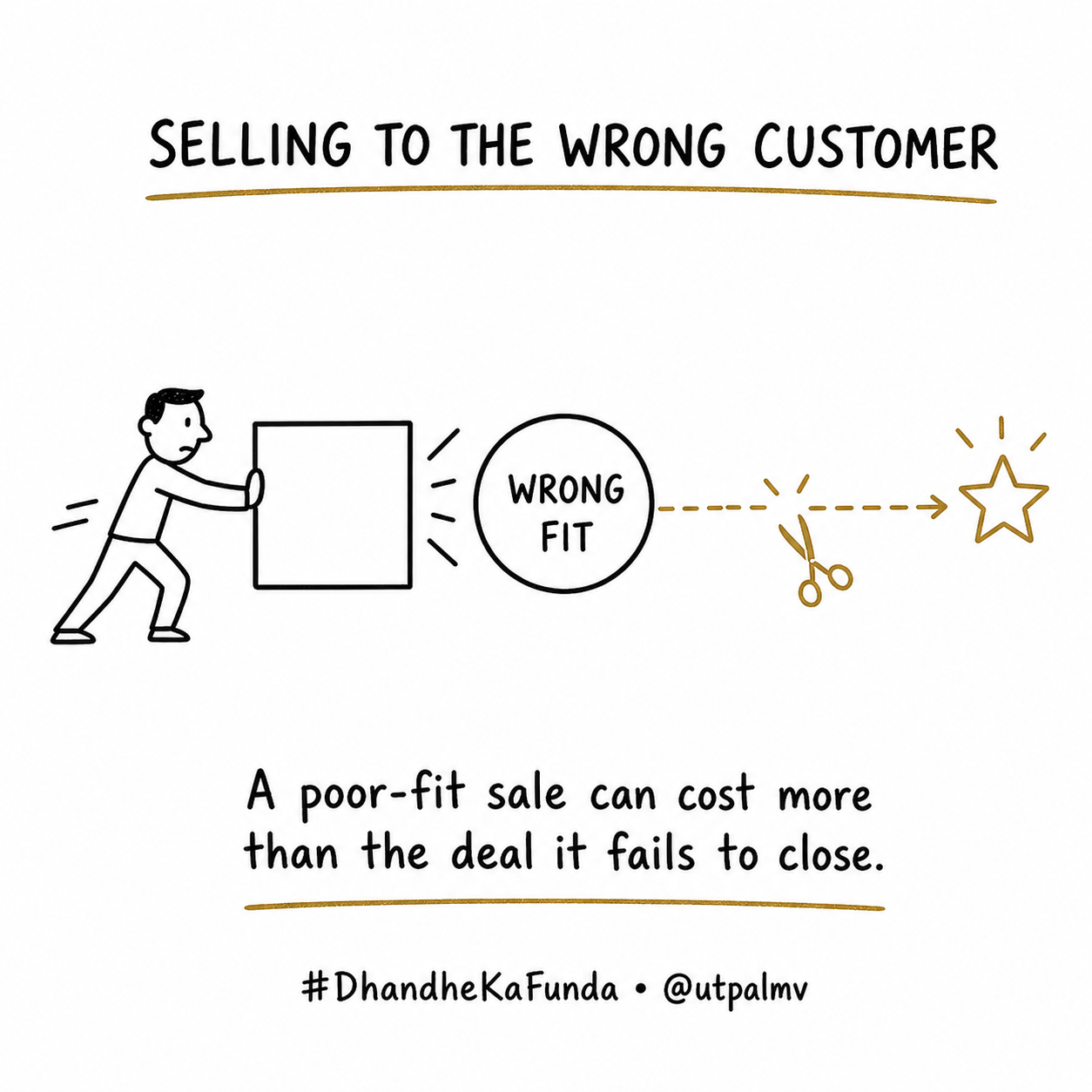
In 2017, I received a sales call from a company offering payroll and HR software. I was running a product company with an 18-person mobile apps team.
Clearer perception often carries a cost. It can unsettle an opinion, reveal neglected work, or show that a familiar explanation no longer holds.
No one sees a system exactly as it is. Attention is selective, evidence is incomplete, and prior beliefs shape interpretation. The useful aspiration is therefore not perfect objectivity, but a practice of testing what I think I see.
External recognition complicates that practice. Appreciation, compensation, and feedback can contain meaningful information. They become unreliable measures of worth when I need them to confirm every action. Working without announcing every step can reveal that dependence, but silence is not inherently more virtuous than seeking appropriate feedback.
Strong opinions deserve similar examination. I can ask what evidence supports a judgment, what would contradict it, and whether I am describing a person's behaviour or assigning them a fixed identity. Looking for disconfirming evidence helps, provided I do not select it merely to perform neutrality.
Some discomfort points toward a problem that needs repair. Other discomfort comes from overload, grief, conflict, or uncertainty that cannot be solved immediately. Irritation is a signal to investigate, not proof that a particular diagnosis is correct.
Lucidity is not a permanent awakened state. It is the repeated willingness to notice distortion, revise a conclusion, and address what becomes visible without claiming a view from nowhere.
In 2007, I replaced a windshield because the view seemed distorted. The problem was my eyesight, and the source records the unnecessary cost as ₹7,500.
The experience remains a useful reminder to test both the observer and the observed. It does not prove that external problems are usually internal or that every mistaken interpretation produces a costly failure.
Before changing a product, process, or relationship:
Journaling, reflection, and feedback may improve judgment. They are not corrective lenses that reveal the world without distortion. The PolyNxt reference adds no necessary provenance to this experience.
Stop calling them "Growth Opportunities." That is what losers say to feel better. Call it what it is: Tuition.
The Transformation of Value
When you launch a product, and it bombs, you didn't "lose" $10,000. You spent $10,000 to buy a dataset. The dataset tells you exactly what the market does not want. This data is exclusive to you. Your competitors don't have it because they didn't pay the price.
The Two Types of Failure
1. The "Blind" Failure (The Loss) You fail. You feel bad. You drink. You blame the economy. You move on.
2. The "Scientific" Failure (The Investment) You fail. You feel bad. But then you perform an autopsy. You analyze every variable. You extract the pattern.
The Protocol: The Post-Mortem
After every failure, you owe yourself a report. Write it down.
"I thought X would happen."
"Y happened instead."
"The gap was caused by Z."
If you don't write the report, you threw the tuition money in the trash. Don't fear the cost. Fear paying it twice for the same lesson.
#DhandheKaFunda: Failure is not the opposite of success. It is the raw material of success. Process it, or it becomes waste.
Fear of losing control can lead us to add monitoring, restrictions, or approval layers. Sometimes those controls are necessary. Sometimes they create more friction than safety.
The useful question is whether a constraint is proportionate to the risk.
Trust does not replace contracts, reporting, or accountability. Freedom to leave is also shaped by power and material consequence. The aim is not an open palm at any cost. It is enough structure to protect the work without suffocating judgment.
Desire becomes clutter when several wants compete for the same limited capacity without any clear order among them.
Wanting more is not automatically greed. Capital, security, recognition, leisure, and influence can each serve legitimate purposes. The problem is accumulation without examining the tradeoffs.
1. Name the wants
List what you are actively pursuing. Write the desired outcome and why it matters now.
2. Expose the conflicts
Which wants compete for time, money, attention, or identity? A desire for peace may conflict with a desire for expansion. Neither is false, but both may not fit the same period.
3. Separate enough from more
For each pursuit, ask what would count as sufficient. A goal with no stopping condition can continue consuming resources after its purpose has been met.
4. Remove or defer deliberately
Choose which desires belong to this phase and which can wait. Deferral is not failure, and simplicity is not automatically superior.
5. Leave space for response
An ordered portfolio creates room to notice opportunities and needs that no list predicted. Spontaneity still requires judgment.
Clearing the hotchpotch does not produce effortless execution or attract better outcomes. It makes the conflicts among desires visible enough to choose.
There is a famous parable about a pottery class. The teacher splits the class into two groups.
Group A (Quality): Graded on a single pot. It must be perfect.
Group B (Quantity): Graded on weight. 50lbs of pots = A.
At the end of the semester, the best pots didn't come from the "Quality" group. They came from the "Quantity" group. Why? While Group A sat around theorizing about the "Perfect Pot," Group B was throwing clay, making mistakes, and learning. Group B had the Iteration Engine running. Group A was stuck in "Analysis Paralysis."
The Trap of "Preparation"
Most people think they are working when they are "Planning" or "Researching." In reality, they are procrastinating. You cannot improve a product that doesn't exist. You cannot fix a strategy that hasn't been tested.
The Protocol: Ship the Ugly Baby
To reach the Top 1%, you must embrace the V1.0 Mindset.
1. The "Good Enough" Launch
Do not wait until you are "Ready." You will never be ready. Launch when you are embarrassed. If you are not embarrassed by the first version of your product, you launched too late.
2. The Feedback Loop (Inspect and Adapt)
Once you ship, Reality hits you.
Maybe customers hate the color.
Maybe the code breaks.
Maybe nobody cares. This is not "Failure." This is Data. You cannot steer a parked car. You need momentum to get feedback.
3. The Pivot
Take the data. Fix the flaw. Ship V1.1. Repeat this 100 times. This is how Evolution works. Nature doesn't plan; Nature iterates.
The Sovereign's Edge
The amateur waits for the perfect map. The Sovereign starts walking and draws the map as they go.
#DhandheKaFunda: Version One is better than Version None. You can't edit a blank page.
There are two ways to make money in business:
The Buffet: Offer everything to everyone. (Low margin, high volume, commodity war).
The Omakase: Offer one thing to a select few. (High margin, low volume, monopoly).
Most founders default to the Buffet because they have FOMO. "If I only sell sandwiches, what about the people who want pizza?" This is how you build a mediocre business. When you try to be everything, you become nothing.
The Law of Dilution Every new product you add dilutes the quality of your existing products.
If you have 1 unit of attention and 1 product, quality = 100%.
If you have 1 unit of attention and 2 products, quality = 50%.
If you have 1 unit of attention and 10 products, quality = 10%. (Mediocrity).
The "Great Sandwich" Heuristic The original post used the metaphor of a sandwich shop.
Shop A: Sells Sandwiches, Pizza, Tacos, and Sushi. (The food is edible but forgettable).
Shop B: Sells only Grilled Cheese. But they bake the bread, age the cheese, and serve it with a specific tomato soup. People will drive 2 hours for Shop B. Nobody drives for Shop A.
The Protocol: Kill the Menu If you are struggling to grow, do not add. Subtract.
Audit the Portfolio: List everything you sell (Services, SKUs, Features).
Identify the Alpha: Which one thing brings 80% of the joy/profit?
The Guillotine: Stop selling the other 9 things.
"But we will lose revenue!"
Yes, initially. But you will gain Identity.
The Specialist's Premium The General Doctor (GP) charges $100/visit. The Brain Surgeon (Specialist) charges $10,000/surgery. The Surgeon serves fewer sandwiches, but they are "Great Sandwiches."
#DhandheKaFunda: Don't be a Swiss Army Knife. Be a Scalpel. A Swiss Army Knife is bad at everything. A Scalpel saves lives.
Information is easy to copy. Capability is not.
Legal agreements and confidentiality controls can be necessary, especially when they protect genuine intellectual property or entrusted information. But they cannot substitute for a durable ability to create value. If an advantage consists only of a fact that others can learn, it may disappear once the fact travels.
More resilient advantages usually combine several things: a way of seeing the problem, accumulated practice, relationships, operating habits, timing, and the ability to keep learning. A competitor may observe the visible process without possessing the context that shaped it.
This is sometimes described as a personal monopoly, but the phrase can overstate both uniqueness and permanence. Few capabilities are impossible to imitate. Their strength lies in being difficult to reproduce quickly and in continuing to evolve.
A useful test is to imagine that a capable competitor receives the internal documentation tomorrow. What could they reproduce? What would still require experience, trust, judgment, or coordinated practice? The answer reveals whether the advantage is merely hidden or genuinely developed.
Clarity helps here. If I cannot explain where value comes from, secrecy may be concealing confusion. If I can explain it, I can decide what deserves protection, what can be shared, and what must keep improving.
The strongest defence is rarely an untellable secret. It is the capacity to learn and execute faster than a static description can capture.
Professional work often rewards visible output: speaking, deciding, coding, and delivering.
When performance falls short, blaming the person is not enough. Neither is assuming there are only four possible causes.
Four useful areas to examine are:
These areas overlap, and other causes may exist. Before making a consequential employment decision, examine the evidence, give specific feedback, and follow a fair process. System design and individual responsibility can both matter.
The image of an invincible summer once gave me language for an inner source of continuity during difficult conditions. "Invincible" now feels too absolute. No inner resource makes a person immune to loss, exhaustion, illness, or material constraint.
The useful question remains: what can provide orientation when external stability disappears?
Resilience is not built inside a person alone. It can draw on purpose, skill, memory, relationships, money, institutions, health, rest, and care. When one support weakens, another may help carry the load.
Calm is not always available on demand. Vision does not make night disappear. A difficult period may narrow action to survival rather than growth.
1. Name the pressure
Describe the external condition and its actual effects.
2. Identify what remains
Which values, commitments, skills, people, or resources are still available? Do not invent an internal equivalent for money, time, safety, or medical care.
3. Build redundancy
Reduce dependence on a single client, plan, person, or source of energy where possible. Redundancy can be practical and relational, not merely psychological.
4. Choose the next response
Act, wait, ask for help, protect capacity, or change direction. Pushing back harder is not always the wise move.
5. Preserve the image without turning it into proof
Use the idea of summer as encouragement if it helps. Let reality decide what the situation requires.
Resilience does not make us invincible. It can help us remain oriented, connected, and capable of another decision.
An idea has little practical value until someone tests it through execution.
Derek Sivers expressed this by treating an idea as a multiplier of execution. The numbers are illustrative, not a valuation method. The durable point is simpler: stronger execution can develop an ordinary idea, while no execution leaves even a promising idea untested.
Planning matters. It becomes avoidance when it delays contact with evidence.
For a new effort:
Movement alone is not progress, and speed is not a substitute for judgment. But a plan cannot learn while it remains untouched.
Judgment is affected by physical and emotional condition, but no daily checklist can guarantee clarity.
Seven useful prompts are:
These are observations for self-management, not metabolic rules or a substitute for healthcare.
“Should” can name an obligation, a preference, an inherited expectation, or an intention without a plan. The word itself is not the problem.
When “I should” keeps returning without action, make the choice more explicit:
The third option matters. Not every decision should be forced into immediate action or rejection.
Language can reveal distance between intention and behaviour. Closing that distance requires judgment, capacity, and sometimes patience, not a new identity or command.
Ignorance is not the source of every project failure or lost opportunity. It is an unavoidable condition that becomes risky when we hide it, perform it, or refuse to investigate what matters.
A relevance review can ask:
Blind spots are not technical debt that can always be closed. The goal is to make consequential gaps easier to discover and less dangerous to admit.
The Value Signal protocol Delivering the agreed scope is not enough if the work no longer creates the intended value. Scope still matters.
The market does not pay for "Strategic Thinking." It pays for the Physical Manifestation of Intent .
Environment influences behaviour, sometimes more strongly than intention alone.
The people around us, the information we repeatedly consume, and the arrangement of a physical space can make a habit easier or harder. That influence is neither automatic nor identical for everyone. It is still worth examining when effort repeatedly fails to produce change.
I find three parts of the environment especially useful to review.
First, relationships shape what feels normal. Rather than ranking or abruptly removing people, I can notice which interactions support attention, honesty, and action, and which leave me depleted or distracted. Boundaries can change the frequency and form of contact without reducing a person to their effect on my productivity.
Second, digital inputs compete for attention. A feed organised around outrage or comparison can affect mood and focus. Unfollowing, muting, or setting a time boundary is a practical experiment, not a cure for every source of anxiety.
Third, physical cues matter. Keeping a phone away from the bed or reserving a desk for focused work may help a routine become easier to begin. Space constraints and individual needs differ, so the arrangement has to be tested rather than prescribed.
Willpower remains part of change, but it does not act in isolation. When a desired behaviour stays difficult, adjusting the conditions around it may be more useful than treating the difficulty as a character failure.
Theory U names three familiar barriers to attentive inquiry: the voices of judgment, cynicism, and fear.
These are metaphors for patterns, not an internal committee or survival system. Judgment can close inquiry, but it can also protect standards. Fear can distort a choice, but it can also signal real danger. Cynicism may prevent vulnerability, or it may express evidence that trust has been damaged.
A short practice can help:
Clarity does not come from ignoring inner dialogue or waiting for a sovereign signal. It comes from examining competing signals with context and care.
The "Middle Manager" is often mocked as a layer of bureaucracy. But in the UV Almanac, the manager is a Strategic Bridge .
A product cannot be built from vision alone or from a list of customer requests.
Customers can describe the friction they experience. They may also propose useful solutions. The builder contributes technical judgment, product coherence, and a view of what could become possible.
Bring those forms of knowledge together:
Neither customer use nor founder conviction proves that a product is right. Each test adds evidence to the next decision.
The pre-mortem protocol Optimism helps a project begin. It can also prevent a team from naming the weaknesses in its plan.
Other people can provide reassurance when uncertainty makes solitary judgment difficult.
That reassurance is not necessarily false. Peers can share evidence, challenge assumptions, offer practical help, and make difficult work less isolating. The risk appears when belonging becomes a substitute for examining whether the activity is producing anything useful.
Meetups, conversations, and professional communities can support learning and collaboration. They can also create visible busyness that feels like progress. The distinction depends on purpose and result, not on whether the work happens alone or in a crowd.
Before attending an event or asking a peer for support, I can ask what I need: information, introduction, critique, companionship, or simply a place to express uncertainty. Venting is not inherently wasteful, though it should not replace a decision that remains mine to make.
Direct output is one form of evidence. Code, products, and completed work matter, but so do research, relationships, recovery, and reflection that improve later choices. An hour alone is not automatically worth more than ten hours with others.
Social proof becomes misleading when agreement is treated as validation of the underlying claim. A group can be sincere and still be wrong.
The answer is not self-validation in isolation. It is to use community for what community can provide while continuing to test the work against evidence beyond the group's applause.
When every request is marked urgent, the label stops helping people decide what should interrupt their work.
That is a prioritization problem, not proof of managerial incompetence. Teams can define response expectations without treating a missed call as loss of rights.
One possible model is:
The exact channels and times depend on the work, geography, accessibility needs, and on-call agreements. A useful escalation policy makes urgency specific and protects both focus and genuine emergencies.
“I was following orders” does not remove responsibility for deception or harm.
The comparison with the Nuremberg trials is disproportionate to an ordinary workplace dispute. The practical question remains: what should you do when someone with authority asks you to hide a material fact or alter a number?
Leaving may become necessary, but it is not costless or always the first safe step. Integrity includes refusing deception and responding with proportionate judgment.
There are two types of organizations:
The Zoo: Safe. Predictable. Food (Salary) is served at 9 AM and 5 PM. The animals (Employees) are bored, fat, and unhappy.
The Wild: Dangerous. Unpredictable. You only eat what you kill. The animals are lean, alert, and alive.
Most founders accidentally build Zoos. They create "Policies," "Hours," and "HR Departments" to protect the grazers. Then they wonder why the Lions (High Performers) leave.
The Lion's Dilemma
A "Power Performer" (Lion) hates the Zoo.
They hate "Face Time" (Sitting at a desk when the work is done).
They hate "Seniority" (Waiting your turn).
They hate "Politeness" (Hiding the truth).
If you put a Lion in a cage, it doesn't become a better Lion. It becomes a depressed cat.
The Protocol: Rewilding the Corporation
To attract the top 1%, you must dismantle the fences.
1. Kill the Clock (Output > Input)
In the Wild, nobody cares how long you hunted. They only care if you brought back the gazelle.
Zoo Rule: "Be at your desk from 9 to 5."
Wild Rule: "Here is the goal. Get it done. I don't care if you work from Bali at 2 AM."
2. Kill the Hierarchy (Truth > Rank)
In the Wild, the alpha is the one who leads the hunt, not the one with the badge.
Zoo Rule: "Respect your boss."
Wild Rule: "Respect the mission. If the intern has a better idea than the CEO, the intern wins."
3. Kill the Safety Net (Equity > Salary)
In the Wild, risk is shared.
Zoo Rule: "Here is your fixed bonus."
Wild Rule: "Here is your equity. If we win, you get rich. If we lose, you get nothing."
The Filter
When you build a Wild culture, the grazers will panic and leave. Let them. You are clearing the space for the Lions to enter.
#DhandheKaFunda: Safety attracts tourists. Danger attracts conquerors. Build a dangerous company.
The words I use do not create reality, but they influence which parts of it I notice.
If I call a project a failure, I may see only the ending. If I call it an experiment, I may look for what it taught me. Both labels can also mislead. “Experiment” can disguise careless work, while “failure” may accurately name an outcome that caused harm.
The useful move is not to replace every difficult word with an optimistic one. It is to ask what a label is doing.
I notice this most when language compresses a situation too early. “Busy” may hide competing priorities, poor estimation, care work, or simple overload. “Difficult person” may hide a specific disagreement, a damaged relationship, or behavior that genuinely needs a boundary. “Innovation” may describe a meaningful improvement or serve as praise without evidence.
More precise language gives me more choices. Instead of saying “I have to,” I can name the obligation, the consequence of refusing it, and the part I still choose. That does not make every constraint voluntary. A contract, debt, illness, power difference, or responsibility can remain real even after I describe it carefully.
I also resist reducing everything to “functional” and “dysfunctional.” Moral questions do not disappear when a decision becomes efficient. A system can work exactly as designed and still distribute cost unfairly. Precision should make consequence more visible, not remove it from consideration.
When a word feels decisive, I now pause over four questions: What did I observe? What interpretation have I added? What does this label allow me to see? What does it make easier to ignore?
Language can widen or narrow contact with reality. It can help me make a better decision, but it cannot guarantee one. The world is not compiled by my vocabulary. It answers back.
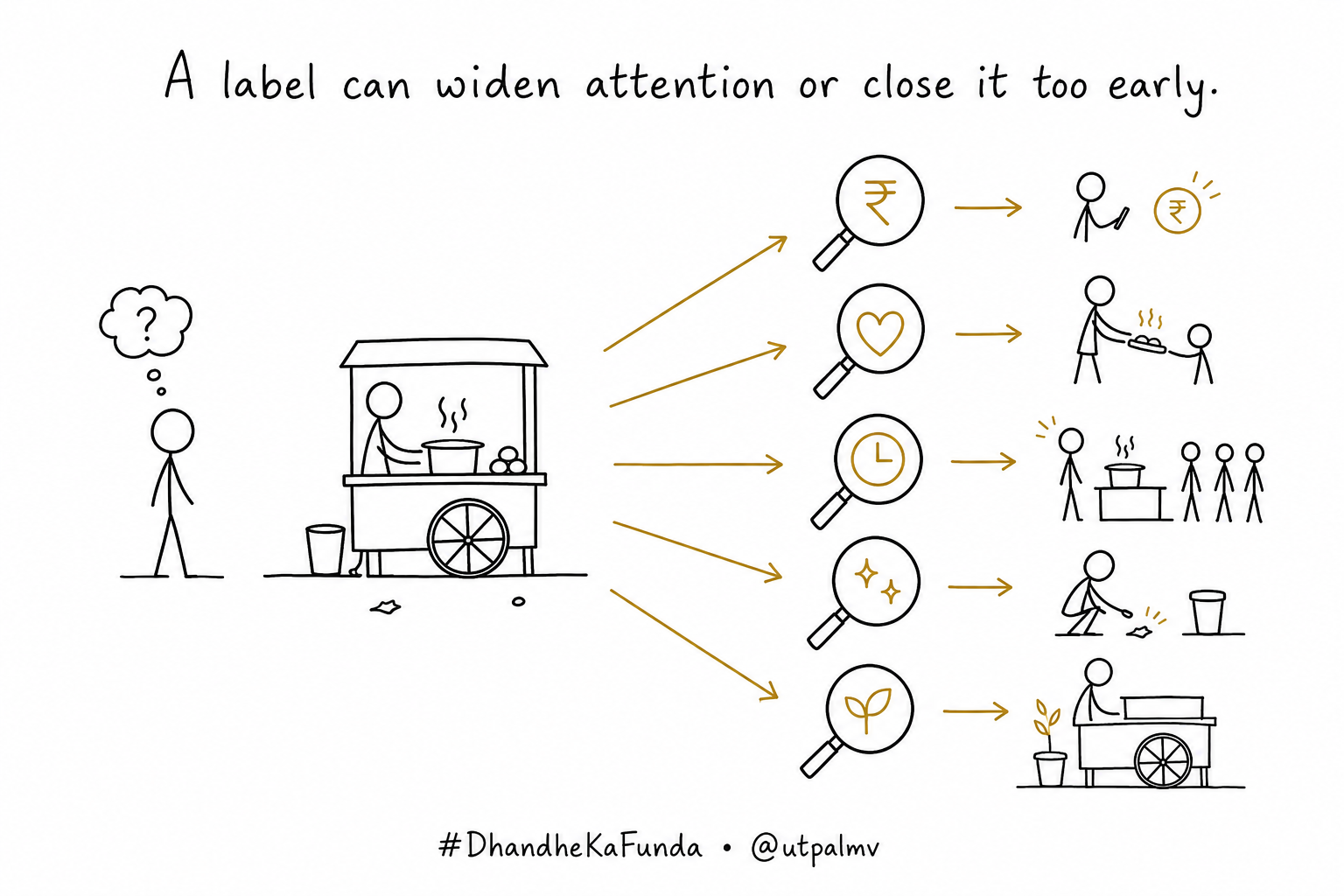
A pause between emotion and action can create room for judgment. It does not make sensitivity a defect or guarantee emotional stability.
Depression is not simply the gap between reality and a wish, and hope does not make someone unable to become depressed. Persistent or severe distress may require qualified support.
For an ordinary moment of activation:
Five seconds may help in one moment and be inadequate in another. The source’s PolyNxt reference is promotional scaffolding, not lived evidence required for the thought.
“Do what you love” has never been sufficient career advice for me. It makes passion sound like a clear signal that arrives before the work and remains steady afterward.
My experience has often moved in the other direction. I begin with curiosity or responsibility. I stay long enough to become more capable. As I understand the work, I notice more of its depth and sometimes care about it more. Competence can create enjoyment because it expands what I am able to see and do.
Sometimes passion follows practice.
That is not a law. People can become excellent at work they dislike. They can love a craft whose conditions damage them. They can remain beginners because time, money, health, access, or care responsibilities limit practice. A person may also discover, after honest effort, that a field is simply a poor fit.
The useful correction is to stop demanding constant excitement as proof that a choice is right. Every substantial craft contains repetition, frustration, and maintenance. The image of the work and the daily practice of it are different things. Staying through the unglamorous part can reveal whether the interest has roots.
But endurance is not automatically virtuous. Before telling myself to persist, I want to know what I am building: skill, contribution, income, freedom, belonging, or only the ability to tolerate an unhealthy arrangement. Pride in disciplined work should not become a reason to remain where the cost is no longer justified.
I now look for a workable combination rather than a perfect passion. Is there enough interest to pay attention? Are the conditions humane enough to continue? Is practice producing useful capability? Does the work serve something I can respect? What would I lose by leaving, and what might I recover?
Passion may begin the work, follow the work, change its object, or never arrive. It is one source of energy among several, not a command.
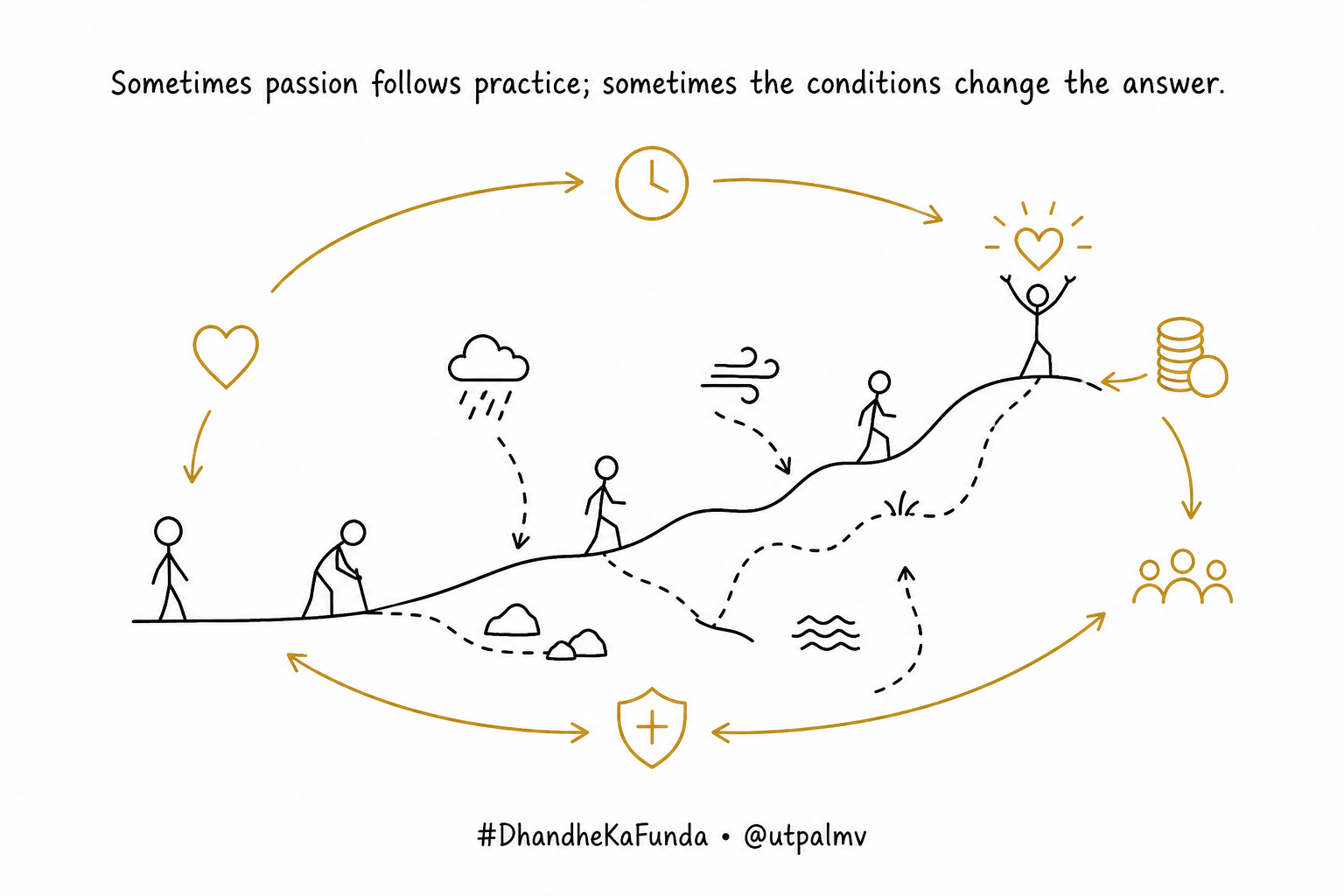
There is a recurring fever in the engineering world called "The Cult of the Latest." It’s the belief that the quality of your output is determined by the novelty of your tools.
Busyness is evidence of activity, not necessarily progress.
The distinction resembles the difference between speed and velocity. Speed describes how fast something moves. Velocity also includes direction. In work, effort without a useful direction can consume time while moving the outcome no closer.
Before starting a task, ask:
Maintenance is not inferior to growth, and delegation is not always possible. Sometimes stopping to check direction is the most useful work available.
Most businesses are built by looking at the person next to them.
The targeted failure protocol Exploratory work still needs a boundary. Research and development cannot always promise a successful result on a fixed date.
Impatience can point to delay, uncertainty, a missed commitment, or work that seems disconnected from its purpose. It can also arise from fatigue, fear, unrealistic expectation, or a preference that others do not share.
Treat it as a prompt, not a diagnosis:
Impatience does not reveal a hidden fire or identify incompetence. Used carefully, it can start a better inquiry into where work or expectation is misaligned.
A premature conclusion can close inquiry. A delayed conclusion can also prevent necessary action.
The task is to match the decision threshold to the consequence and reversibility of the choice.
For an uncertain decision:
Probabilities should reflect evidence, not invented precision. Feedback loops can improve a decision, but no amount of iteration makes the path inevitable or removes the need to decide.
In the legacy world, "Challenge" is viewed as a systemic failure: something to be avoided, mitigated, or complained about.
When a project struggles, changing methodology can look easier than examining capability, incentives, leadership, or the work itself.
My earlier conclusion was too blunt: poor results do not prove poor talent, and a process that works elsewhere may still be wrong for this context. Method and people interact.
Capability: Do the people involved have the knowledge, judgment, time, and support required for the work?
Principles: Are scope, time, cost, quality, risk, and responsibility being handled explicitly?
Methodology: Does the chosen framework help this team apply those principles under its actual conditions?
No layer can compensate indefinitely for a serious weakness in another.
1. Define the failure
State what result was expected and what happened.
2. Test the method
Did the process create useful information, decisions, and coordination? Was it followed, and was following it reasonable?
3. Test the conditions
Did the team have adequate staffing, authority, incentives, training, and psychological safety? Calling everything a competence problem can conceal a management problem.
4. Address capability directly
Where a skill or judgment gap exists, choose training, support, role redesign, reassignment, or replacement in proportion to the evidence and consequence.
5. Change the process when the process is wrong
Do not protect a methodology merely because it is established. Keep the principles visible and adapt the vehicle when the terrain requires it.
A system cannot rescue every capability gap. Talent cannot rescue every broken system either.
In the legacy world, "Impact" is often confused with authority.
Corporate culture has normalized a crime: The Theft of Focus.
If a stranger walked into your office and stole your laptop for an hour, you would call security. But if a colleague sends a calendar invite for "Quick Sync," you accept it. The result is the same: You cannot work.
A "1-hour meeting" with 8 people is not a 1-hour meeting. It is an 8-hour meeting. That is one full manday of salary burnt to discuss "status updates" that could have been an email.
In a high-performance system, a meeting is an admission of failure. It means your documentation was unclear or your autonomy is broken.
1. The "No Agenda, No Attendance" Law: If the invite does not have a clear bulleted agenda and a desired Decision Outcome, decline it. "Brainstorming" is not an agenda; it is a social hour.
2. The "Read-Before-You-Speak" Law: Amazon uses the "6-Page Memo." No PowerPoint. The first 15 minutes of the meeting are silent reading. If you haven't written the memo, you aren't ready to meet. If you haven't read the memo, you have no right to speak.
3. The "Stand-Up" Law: If a meeting must happen, remove the chairs. People talk 50% less when their legs are tired. Efficiency is physically enforced.
#DhandheKaFunda: A calendar full of meetings is not a sign of importance. It is a sign that you are a clerk, not a maker.
What you look for can shape what you notice.
If you start looking for a red Tesla, you may notice more of them. That does not necessarily mean there are more on the road. Your attention may have changed.
In a small laboratory study, directing attention to a color increased responses in visual cortical areas to other stimuli sharing that color. This supports a limited point about selective attention. It does not establish that the RAS acts as a programmable filter for everything you experience. [1]
Looking only for what could go wrong may leave other possibilities unexplored. That is a useful question to ask yourself, not a biological explanation for wealth or poverty.
Believing that opportunity exists does not establish that a particular opportunity is real or valuable. It still needs examination.
Try making the search specific.
“I am looking for a partner who knows supply chain” gives you something concrete to look for. Write it down. Review it in the morning. When something promising appears, examine it.
Treat this as a practice for directing attention, not a proven way to reprogram your brain or guarantee success.
What you notice is a starting point. What you do with it still matters.
Most software products are built through a process of Accretion . We add a feature because a competitor has it.
Founder dependence can look like strength for a long time.
The founder remembers why a decision was made, notices when the work is slipping, carries the difficult relationships, and resolves exceptions faster than anyone else. The company moves because one person can hold many parts of it at once.
That capacity may be valuable. It is also a risk.
The question is not whether a company can function with no leadership. It cannot. The question is whether its important standards and decisions are available to people beyond the leader who first formed them.
I would look for three things.
First, can someone else make a sound decision without imitating the founder's personality? A principle that exists only as instinct is difficult to transfer. Writing down the reasoning helps, but the real test is whether another person can use it in a situation that was not anticipated.
Second, can the organization notice weak work without turning people into enemies? The earlier version of this note compared a poor hire to a virus that a healthy culture should reject. That is dramatic and dehumanizing. A better organization makes expectations visible, gives feedback early, and acts when the gap remains. It does not need an immune-system story to take performance seriously.
Third, does the organization learn from errors? Not every mistake needs a new process. Too much process can become another way of avoiding judgment. But a repeated failure deserves examination. Was the decision unclear? Was information missing? Did an incentive reward the wrong behavior? What should change before the next attempt?
Continuity is not created by removing the founder from the picture. It is created by making more of the work understandable, discussable, and transferable.
The real test is modest: when the central person steps away, can the team still see what good work requires, make a reasonable decision, and learn from what happens next?
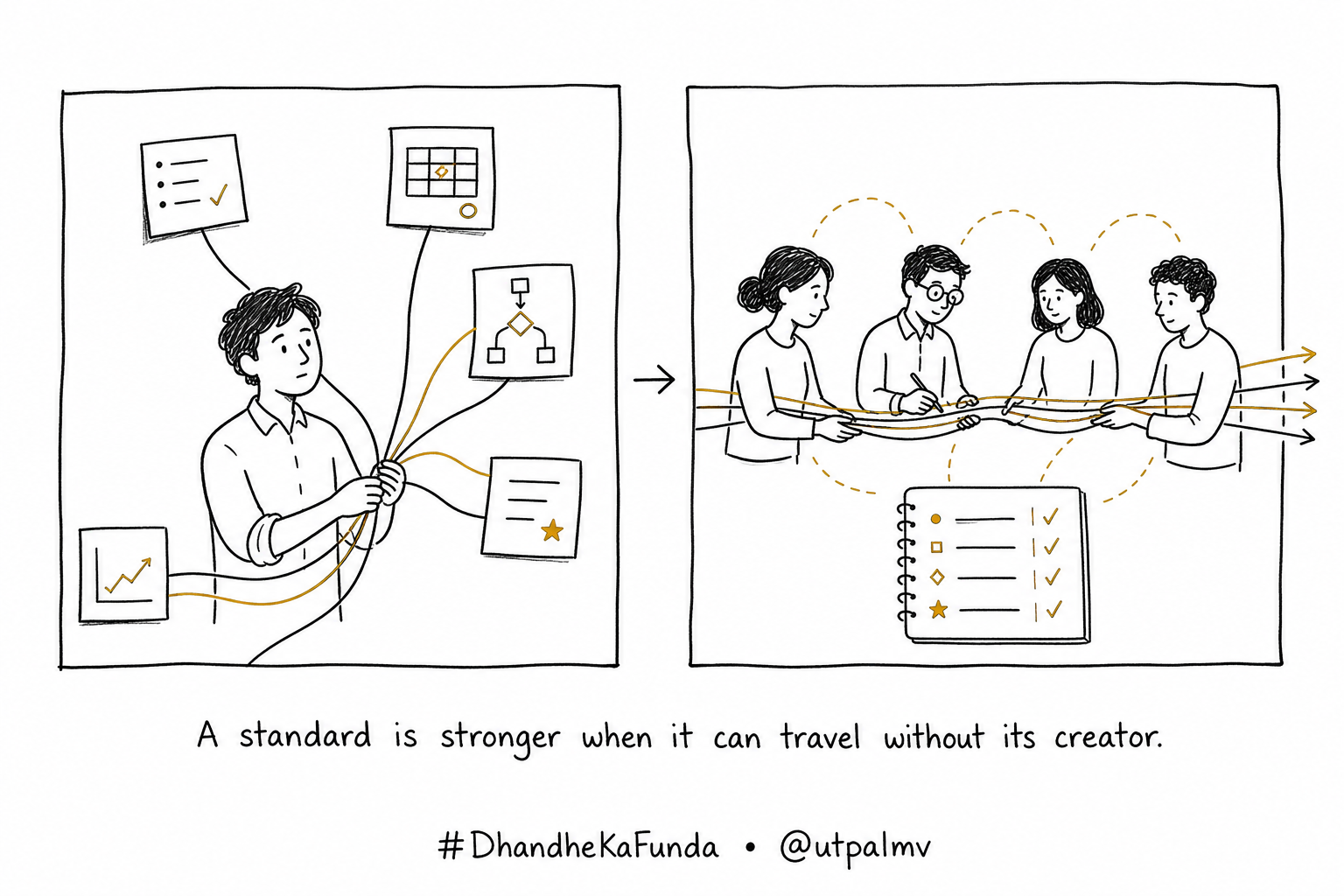
There is a dangerous disease in business called "The Sales-Led Cult." The symptom is obvious:
The Top Sales Guy is treated like a god. He parks his Porsche in the front.
The Top Engineer/Operations Guy is treated like a utility. He works in the basement.
The logic seems sound: "Sales brings the money." But this creates a Structural Ponzi Scheme.
The Promise Gap
Sales = Writing a check. (Easy).
Delivery = Cashing the check. (Hard).
In a Sales-Led culture, you are incentivized to write checks that the organization cannot cash. The Sales team promises features that don't exist ("It's on the roadmap!"). The Delivery team burns out trying to build the impossible. Eventually, the reputation collapses. The "check" bounces.
The Protocol: Inverting the Hierarchy
To build a generational company (not a pump-and-dump), you must invert the status.
1. The "Commission on Retention" Rule
Never pay 100% commission on the signature.
The Amateur: Pays the salesperson when the client signs. (Encourages lying).
The Master: Pays 50% on signature, and 50% when the client renews in Year 2. Suddenly, the Sales Guy cares about product quality. Suddenly, he stops selling to bad fits.
2. The "Eat Your Own Dog Food" Audit
The CEO must not ask Sales, "How are the numbers?" The CEO must ask Support, "Why are they angry?"
3. Product is the Only Marketing
If you have to "scream" to sell your product (Cold calls, aggressive ads), your product is weak. Great products are bought, not sold. Shift the budget from the "Screaming Department" (Marketing) to the "Building Department" (R&D).
#DhandheKaFunda: A sale is not the end of the transaction. It is the beginning of the obligation. Don't write checks your product can't cash.
What people say they want and what their circumstances reward are not always the same.
This gap matters when designing a product, shaping a team, or trying to understand my own choices. Stated reasons are often sincere, but they may be incomplete. Status, safety, belonging, autonomy, money, and recognition can influence behaviour without appearing in the official explanation.
The point is not to reduce every human motive to self-interest. That would replace one convenient story with another. The more useful practice is to remain curious about the incentives beneath the words.
In a team, agreement on a goal does not guarantee agreement on what success means. One person may value creative freedom, another stability, and another visible responsibility. If those needs remain unspoken, commitment can weaken even when everyone continues to endorse the same plan.
Products face a similar test. A useful product may also help someone feel capable, respected, secure, or connected. Ignoring that dimension can make an otherwise sound design difficult to adopt. Exploiting it, however, is not the answer. The task is to understand the whole person without manipulating them.
I find it helpful to ask two questions: What reason are we comfortable stating? What else might this choice reward or protect?
The answers are rarely complete, but the conversation becomes more honest.
There is a specific pathology in early-stage founders. They spend 3 weeks designing a business card. They obsess over the weight of the paper, the kerning of the font, and the shade of off-white. They do the same with their website logo. They call this "Branding."
In reality, this is Productive Procrastination.
The Psychology of the Fake Work
Why do we do this? Because designing a card is safe. The card cannot say "No" to you. The logo cannot reject your pricing. Making a sales call is dangerous. The market can hurt your ego. So, we hide in the "Prep Work." We tell ourselves we are "building the foundation," but we are actually hiding from the market.
The "Minimum Viable Credibility"
The purpose of a business card (or website) is not to impress; it is to verify. It is a hygiene factor.
Does it exist? Yes.
Is it clean? Yes.
Does it have your phone number? Yes. Done.
If you spend more than 15 minutes on it, you are stealing time from your product.
The Protocol: The $0 Rule
Until you have your first paying customer, you are not allowed to buy premium assets.
No $500 logo.
No embossed cards.
No custom office furniture. Your business card is written on the back of a napkin until the revenue pays for the printing.
#DhandheKaFunda: If your offer is strong, you can sell it on a post-it note. If your offer is weak, gold leaf paper won't save you.
The loudest thing you ever say is not spoken; it is scheduled. We all have a "Moral Narrative": the story we tell the world (and ourselves) about who we are.
Some relationships need repair. Some need firmer boundaries. Some need distance or an ending. Calling all of this "pruning" can make a serious relational decision sound cleaner than it is.
The useful question is whether the relationship can remain healthy, safe, and mutual under its present terms.
1. Describe the pattern
Name the recurring behaviour and its effect. Avoid reducing the other person to a low-value node or treating one difficult period as a complete identity.
2. Examine responsibility
What have you contributed to the pattern? What belongs to the other person? What context or obligation matters?
3. Test communication where appropriate
State the concern, the boundary, or the change you need. Communication may not be safe or useful in every relationship, especially where abuse, coercion, or retaliation is present.
4. Choose proportionate distance
The response may be a changed expectation, less contact, a professional boundary, mediation, or a clean ending. Personal, family, and contractual relationships carry different duties and risks.
5. Leave room for grief and review
Ending a relationship does not close the past instantly. Reflection can prevent the same pattern from being repeated elsewhere.
Sunk cost alone is not a reason to stay, but history is not meaningless. The decision should protect dignity, safety, responsibility, and the possibility of repair when repair is real.
In the industrial age, a "Hard Skill" was something technical: operating a lathe, writing COBOL, or accounting.
There is a disturbing trend in hiring and leadership. We value "Seniority" (Time Served) over "Adaptability" (Rate of Learning). This is a fatal error in a world where the Half-Life of a skill is now ~3 years.
The "1 Year x 10" Problem
Most "Senior" professionals do not have 10 years of experience. They have 1 year of experience, repeated 10 times.
They learned how to do the job in 2015.
They have been hitting "Copy/Paste" ever since.
They call this "Wisdom."
The market calls it "Obsolescence."
The Curse of Expertise
When you believe you are an "Expert," you stop looking for new answers. You defend your old answers.
The Expert: "We can't do that. It didn't work in 2018."
The Sovereign: "The context has changed. Let's test it again."
The Protocol: The White Belt Mindset (Shoshin)
In martial arts, the Black Belt indicates mastery. But true masters know that the goal is to return to the White Belt Mindset (Shoshin). The White Belt is terrified, eager, and open. The White Belt learns.
1. Kill Your Past Stop starting sentences with "In my experience..." Start sentences with "Based on current data..." Your experience is a sunk cost. Use it as a filter, not a wall.
2. The Reverse Mentor If you are over 40, find a 22-year-old mentor.
You teach them Strategy.
They teach you Speed (and new tools). This is not "charity." This is survival.
#DhandheKaFunda: Experience is like milk. It has an expiration date. If you don't refresh it, it sours.
When effort does not produce the result I expected, the first difficulty is often the event itself. The second is my argument with the event.
Time may have been spent, commitments made, and opportunities lost. Acceptance does not recover any of them. Nor does it make an unfair or painful outcome acceptable in the moral sense. It simply acknowledges that this is now the condition from which the next decision must be made.
Fear and hope both point toward outcomes that are not fully under my control. They are human responses, not defects to eliminate. But either can distort action when I let an imagined future replace the facts available now.
I find a simpler sequence more useful:
Sometimes the controllable part is small. Sometimes the right action is to stop. Acceptance offers no guarantee of calm or success, but it reduces the energy spent denying the starting point.
Then the work can begin from reality rather than from the version of reality I wanted.
Support can create opportunity without automatically creating the capacity to use it well.
Inherited wealth, trusted introductions, established institutions, and generous mentors may reduce barriers that others must face directly. Those advantages are not evidence of weakness, and suffering is not a prerequisite for competence. The question is whether the person benefiting from support also develops judgment, practical skill, and awareness of what made the opportunity possible.
Choosing difficulty merely because it is difficult can waste resources or cause avoidable harm. A more useful stress test is deliberate and relevant. It exercises a capability the work may genuinely require, within conditions where failure can teach without creating disproportionate damage.
An advantage can be reviewed without guilt:
Ambitious goals sometimes encourage growth. They can also encourage reckless commitments or turn identity into a performance. The value of a goal lies in what it serves, not in how frightening or steep it appears.
Resilience develops through challenge, recovery, feedback, and support. The aim is not to harden oneself against an imagined collapse, but to become more capable of responding when conditions change.
There is a subtle game played in every office. A subordinate sends a document to the boss with the subject line: "Please review." This looks like "Collaboration." It is actually Liability Transfer.
The Psychology of "Please Check This"
When you ask someone to check your work, you are doing two things:
Outsourcing Quality Control: You are admitting you didn't check it thoroughly yourself.
Pre-empting Blame: If the boss says "OK," and the client later screams, you can say: "But Boss, you approved it!"
This is the mindset of a Bureaucrat. A Bureaucrat's goal is to survive. To survive, they must never be solely responsible for a failure.
The Sovereign Mindset: The Artist's Signature
A Sovereign operates differently. When you finish a task, you do not ask for permission. You Sign It.
This shifts the dynamic from "Please save me" to "I have handled this."
The Protocol: Defy the Check
If you are a Manager, and an employee asks you to "just take a quick look," Refuse.
The Response: "I trust you. If you say it's ready, send it. If it's wrong, we will fix it together, but I am not your proofreader."
The Result: The employee panics. They go back and check the work 3 more times. They find the errors. They grow.
The "Bus Factor" of Approval
If every decision requires a "Check," your organization moves at the speed of the bottleneck. By removing the safety net, you force the team to learn how to fly. Yes, they will crash once or twice. But eventually, they will become pilots, not passengers.
#DhandheKaFunda: If you are afraid to sign your name to your work, the work is not finished. Or you are in the wrong job.
The most common lie in the professional world is that "Hard Work" leads to "Higher Pay." If effort were the primary driver of income, the construction worker would be a billionaire and the hedge fund manager would be broke.
Most professionals are trapped in the "Service Loop." They sell their time, their attention, and their manual labor.
Education loses trust when the conclusion was fixed by a sales objective before the inquiry began.
A company can teach responsibly while having a commercial interest. The conflict does not disappear, but it can be made visible. Readers deserve to know who benefits, what alternatives exist, which evidence supports the claim, and where the recommendation may not fit.
Neutrality is not always possible. A writer selects the question, examples, and frame. Trust comes less from claiming objective truth than from representing uncertainty and interest honestly.
Educational content should remain useful even when a reader does not buy the related product. That does not require every piece to be life-changing or to omit the product entirely. It requires the lesson to stand on evidence rather than cornering the reader into one answer.
Useful checks include:
Teaching can demonstrate competence, but it does not prove mastery or guarantee trust. Trust develops through repeated evidence, accuracy, correction, and respect for the reader's ability to decide.
The strongest educational marketing does not hide that it is marketing. It earns attention by making the education real.
Society defines "Winning" by looking at the Scoreboard.
Did you get the deal?
Did you get the promotion?
Did you hit $1M?
This is Lagging Indicator thinking. The scoreboard tells you what happened in the past. A Sovereign ignores the scoreboard and focuses on the Leading Indicators.
The Winner's Protocol
A "Winner" is not a person who has won. A "Winner" is a person who is running the algorithm that makes winning inevitable.
1. The Friction Heuristic
The Trait: "Does what’s difficult."
The Protocol: When faced with two choices, always choose the one that involves more pain in the short term.
Easy Path: Eat the cake. (Pain later).
Hard Path: Fast. (Pain now).
Rule: The Hard Path has less traffic.
2. The Identity Lock
The Trait: "When a programmer, programs. When a cook, cooks."
The Protocol: Absolute Presence.
If you are writing code, but thinking about email, you are losing.
If you are with your kids, but checking Slack, you are losing.
Rule: Be 100% where your feet are. Multitasking is the skill of failing at two things simultaneously.
3. Dynamic Subordination
The Trait: "Mostly leads but gracefully follows."
The Protocol: A true Alpha is not obsessed with being "In Charge." They are obsessed with "The Mission."
If the Intern has the best idea, the CEO shuts up and follows the Intern.
Rule: Rank doesn't matter. The Truth matters.
The Definition of Victory
If you execute the protocol perfectly: you focused, you chose the hard path, you served the mission: you have Won. Even if the deal falls through. Even if the market crashes. You controlled the Input. The Outcome is just gravity.
#DhandheKaFunda: Don't look at the scoreboard. Look at the ball. If you play the game right, the score takes care of itself.
An opinion is an interpretation, not an identity.
That distinction creates room between a thought and a response. When a judgment about a colleague or an image of failure appears, I can name it as my current view rather than treat it as a complete account of reality.
Observation does not require splitting consciousness or pretending thoughts are external data. It is simply the practice of noticing what I am thinking, what feeling accompanies it, and what evidence may be missing.
Before speaking in a consequential conversation, a brief pause can help:
The pause has no fixed duration. Two seconds may help in one setting and be impossible or inadequate in another.
Shared understanding does not require blending everyone's opinion into one view. A team may need to preserve disagreement, clarify who decides, and record why a choice was made. Collective creativity depends on power, trust, and structure as well as a leader's willingness to loosen attachment to an idea.
Opinions are not experiments until they are tested. They remain useful provisional models, available for revision without making every disagreement a threat to the self.
Ordinary capacities become visible when they are restricted.
I was reminded of this through a man I met in a salon who was receiving dialysis several times a week and could drink very little water. He remained engaged with investments, friends, and music. I cannot know his inner experience or turn his illness into a lesson he did not choose. What stayed with me was how easily I overlook capacities that structure an ordinary day.
Gratitude can bring those conditions back into view: drinking water, moving without pain, having access to care, or being supported by another person. It should not become a comparison that uses someone else's hardship to invalidate my own, nor a claim that attention alone can overcome material constraint.
The practice is quieter. Notice what is available without assuming it will always remain available. Notice also the systems and people that make it possible.
Constraint does not automatically produce optimism, creativity, or wisdom. People respond differently, and many constraints require treatment, assistance, or structural change. Within what cannot be changed immediately, attention can still turn toward the choices that remain.
Abundance and scarcity may exist together. A life can contain genuine difficulty and something worth appreciating in the same hour.
The second glass is not proof that everything is well. It is a reminder to experience what is here before familiarity makes it disappear.
In most companies, "Conflict" is seen as a failure. HR departments exist to smooth it over. Managers are trained to "resolve" it. This is a mistake. Peace is not the goal. Truth is the goal.
The Trap of Artificial Harmony
When a team agrees on everything, they are not "aligned." They are scared. They are suffering from Artificial Harmony.
They nod in the meeting (Compliance).
They complain in the hallway (Reality). This creates a "Shadow Organization" where the real decisions happen at the water cooler, not the boardroom.
The Dialectic Engine
Great organizations (Intel, Bridgewater, Amazon) view conflict as an engine.
Thesis (Idea A) meets Antithesis (Idea B).
The friction creates heat.
The heat forges Synthesis (Idea C - The Truth).
If you suppress the Antithesis to "keep the peace," you never get to Synthesis. You stay stuck at Thesis (Mediocrity).
The Protocol: Design for Fight
You must engineer your meetings to encourage "Intellectual Combat" while banning "Social Combat."
1. Attack the Idea, Not the Person
Bad Conflict: "You are wrong." (Attack on Ego).
Good Conflict: "That data point is weak." (Attack on Object).
The Rule: You can say an idea is "stupid," but you can never call a person "stupid."
2. The Obligation to Dissent
In a Sovereign culture, silence is not agreement. Silence is negligence.
If you see a flaw and don't speak up because you want to be "polite," you are hurting the mission.
The Rule: "If you disagree and say nothing, you are fired."
3. The HIPPO Check (Highest Paid Person's Opinion)
The Leader's voice suppresses conflict.
The Rule: The Leader speaks last. Let the friction happen first. If you speak first, you turn the team into a choir.
#DhandheKaFunda: If two people agree on everything, one of them is unnecessary. Fire the echo.
In 2008, I wrote about being the first person in a lineage to choose a different path. Looking back from 2026, I can see that piece as an early expression of my own divergence.
The idea came from several choices I understood as breaks from an inherited script: choosing love over arrangement, leaving a degree to teach myself a skill in 1997, leaving my hometown, and learning to code when stability carried more social approval.
Those are autobiographical claims, not a universal account of families, fathers, mothers, sons, or daughters. Inheritance can contain care, knowledge, duty, harm, opportunity, and constraint at the same time.
Being first does not make someone a biological mutation or the research department of a family tree. It means making a choice for which there may be little precedent or support.
The choice can feel lonely. It can also affect people whose fears and responsibilities are real, even when I do not accept the path they prefer.
1. Identify the script
What expectation have I inherited, and what purpose did it serve in its original context?
2. Name the divergence
What am I choosing instead, and what evidence or value supports that choice?
3. Accept the consequence without romanticizing isolation
Support may be limited, but walking alone is not proof that the decision is right.
4. Preserve what deserves preservation
Breaking one pattern does not require burning the entire inheritance.
The thought I want to keep from 2008 is simple: history supplies material, not a complete instruction. A different life still has to be built through specific choices and their consequences.
Understanding an idea and acting on it are different forms of learning.
Repeated practice can make a behaviour easier to perform with less conscious effort. That process involves multiple interacting brain systems. The popular division into a thinking neocortex, an experiential limbic brain, and a habit-forming cerebellum is too simple to serve as a biological hierarchy of identity.
The practical insight remains: reading about delegation, feedback, or leadership does not establish the behaviour. Action places the idea under real constraints. Feedback reveals what the abstract model missed. Repetition may then make parts of the response more available.
Discomfort is not proof that the brain is rewiring or that growth is occurring. Anxiety may accompany learning, and it may also signal overload, danger, or a need for support. Confidence does not reliably appear merely by acting confident.
To move from understanding to practice:
Thirty days and quarterly audits are possible structures, not biological thresholds.
Repetition influences habit, but identity remains larger than any repeated act. Practice matters because it lets an idea meet reality, where both the action and the idea can change.
You don’t become a new version of yourself by reading about it.
You become it by rehearsing it until it rewires you.
A friend once told me he was thinking of becoming more confident.
So he started reading about charisma.
And self-belief.
And inner game.
Every day, a new insight.
But in every conversation, the same old hesitation.
Until he flipped the switch:
He started doing what a confident person would do.
Small moves. Different tone. Stronger posture.
It felt awkward.
Then it felt good.
And one day…
He wasn’t trying to be confident anymore.
He just was.
He had crossed the invisible line:
→ From Neocortex (thinking)
→ To Limbic Brain (doing)
→ To Cerebellum (being)
You are what you practice … until you no longer have to think about it.
#DhandheKaFunda: Repetition doesn’t just build habits. It builds identity. Who you become is a byproduct of what you repeat.
(Insight Credits: Breaking the Habit of Being Yourself, by Dr. Joe Dispenza - I got this book as a gift from a friend this Birthday)
Many organisational failures become visible first as differences in experience.
Reports and meetings can reveal part of a system. Direct conversation with people who work inside it can reveal constraints, workarounds, incentives, and consequences that aggregate measures miss.
An empathy walk is one way to create that conversation. Walking beside someone can reduce the formality of an interview and allow attention to the environment they navigate. It is not a high-fidelity sensor by itself. Power differences remain, and a person may reasonably withhold what does not feel safe to share.
Useful questions are open and specific:
Listening does not require suspending all judgment. It requires delaying conclusions long enough to understand the account, then comparing it with other evidence. One person's experience is real without necessarily representing everyone.
The conversation should not turn a colleague into a data source. Explain the purpose, respect boundaries, and close the loop by saying what was learned, what will change, and what cannot change now.
Empathy can improve accuracy when it remains a relationship rather than an extraction technique. The system becomes clearer because the people affected have meaningful room to describe it.
This reflection develops an earlier post, “Empathy Walk,” from the source Journal.
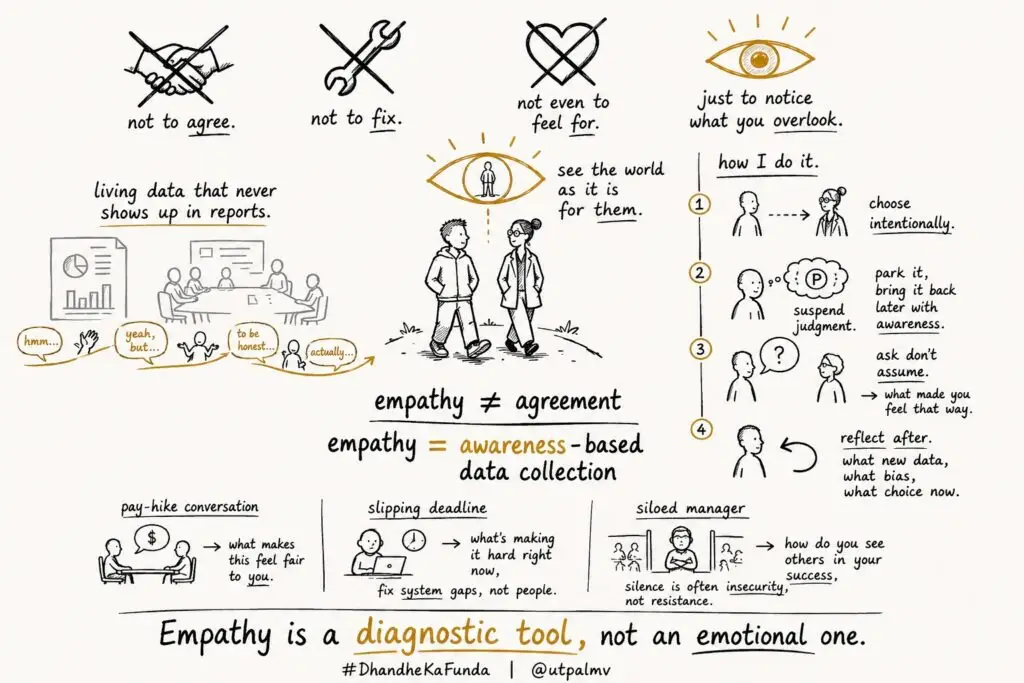
Empathy Walk (from Theory U) is a way to sense the system through another person’s eyes : not to agree, fix, or feel, but to see what you usually miss.
“At least we learned something” can be an honest conclusion after an experiment. It can also be a convenient sentence after careless work.
The difference matters because learning and delivery place different risks on other people. An experiment explores something genuinely uncertain. A preventable mistake repeats what the team already knew how to avoid. Both may teach us something, but they do not carry the same responsibility.
I use three questions when that distinction becomes blurred.
First: what was actually unknown? If the team had a reasonable hypothesis, named the risk, limited the exposure, and observed the result, failure may be part of useful learning. If the error came from skipping a known check, the word “learning” should not soften it.
Second: who paid for the lesson? A developer may gain knowledge from a broken release while customers lose time and colleagues absorb the repair. That does not make experimentation wrong. It means the cost should be visible rather than hidden inside a celebration of initiative.
Third: what changed afterward? Learning that produces no change in practice is only recollection. Repair the immediate harm where possible, document what happened, improve the check or decision, and make the new knowledge available to the people who need it.
This does not require someone to “own the night” as punishment. Urgent repair may sometimes be necessary, but exhaustion creates its own errors. Responsibility includes escalation, asking for help, protecting people, and choosing a safe recovery plan. It is not a test of who can suffer most dramatically.
I still value a learner’s mind. I also value the trust created by reliable delivery. The two support each other when uncertainty is named before the attempt, consequences are not minimized, and mistakes lead to better work rather than better excuses.
The useful loop is not failure followed by a slogan. It is attempt, observation, disclosure, repair, and change.
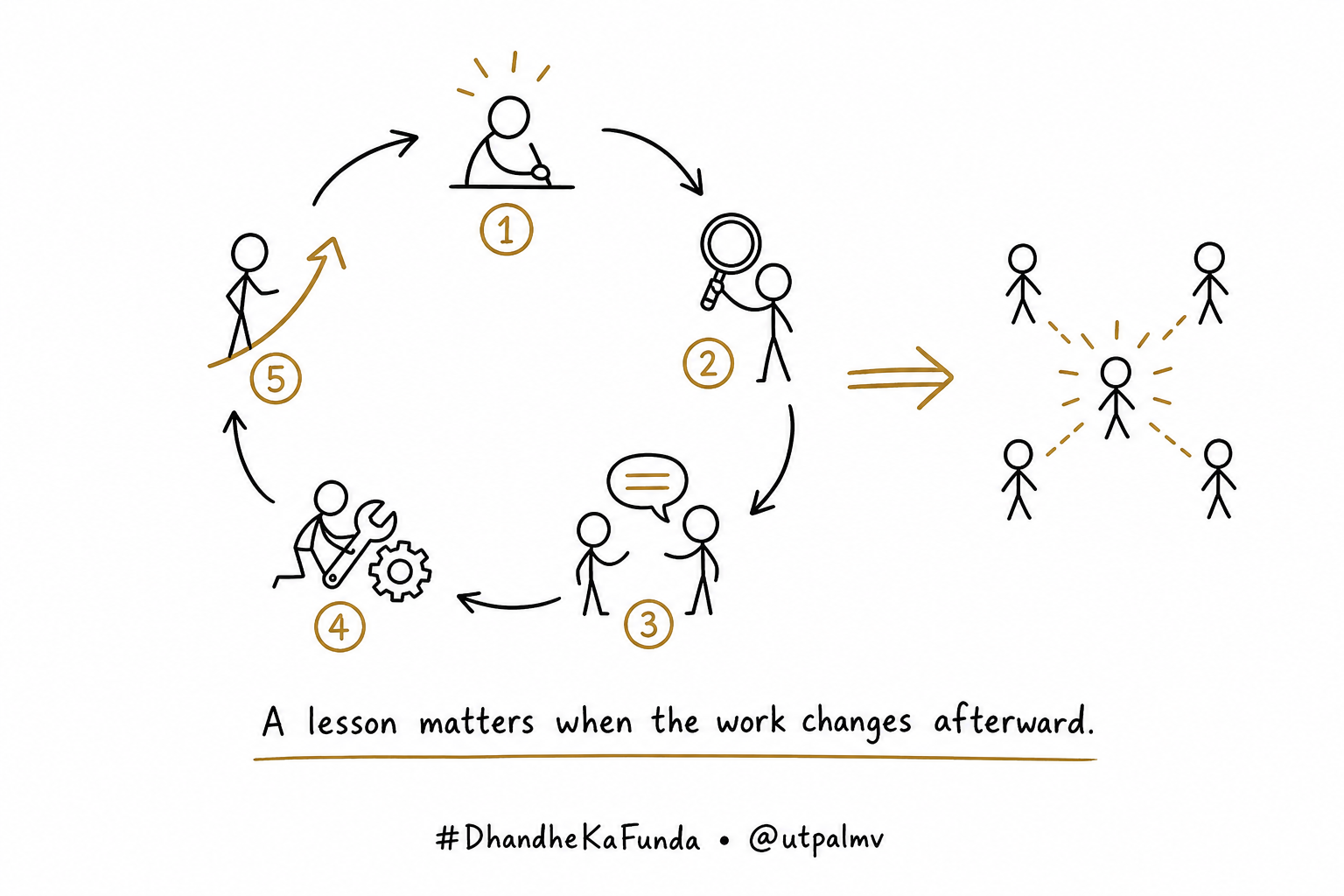
Balance and harmony are both metaphors for living with competing needs. Neither is inherently static or superior.
Some tensions cannot be eliminated: ambition and rest, action and reflection, individual desire and obligation to others. Integration means deciding how those forces should relate in a particular season.
A review can ask:
The source’s PolyNxt and NRI references add projection rather than necessary experience here. The durable thought is to work with tension without turning life into a legend or adversaries into sharpening stones.
“I’ll solve this problem on my own.”
Normally, when I hear this from a new hire, I feel proud. It shows initiative, independence, and ownership.
But this time was different.
The project had been executed carelessly. A small bug had slipped through. It wasn’t complex: just attention to detail. Yet that tiny crack had already started to create long nights, client delays, and frustration.
When I asked for a status at 9:45 am, the new hire explained the bug and suggested asking the client for a couple of extra days.
“No,” I said.
“We close our day only when we solve the problem. If we created this mess, fixing it becomes our #1 priority.”
He didn’t like my answer. I could see it. But he got back to work.
And this is the paradox of leadership:
Yes, you want learners.
Yes, you want ownership.
But learning cannot be an excuse for sloppy execution.
Initiative is valuable.
But excellence is non-negotiable.
#DhandheKaFunda: Being a learner is great. Being a learner with discipline is what makes you indispensable.
A calendar divides time, but it does not have to divide the self.
Scheduling can protect attention, coordinate responsibilities, and create room for what would otherwise be neglected. The problem is not the calendar itself. It is moving through each block as though the task were separate from the values and relationships that give it meaning.
Ritual offers one way to change the quality of attention. An ordinary administrative task can be approached with care because it affects another person or supports larger work. This does not make every action sacred or guarantee a better outcome. It simply reconnects means and purpose.
Wholeness also needs boundaries. Bringing passions, eccentricities, and standards into professional life can deepen the work, but no setting is entitled to every part of a person. Restraint may reflect privacy, care, or the requirements of a role rather than a filtered existence.
Presence is not constant intensity. Receptivity, rest, play, and partial attention all belong to life. Some tasks deserve immersion; others need only competent completion.
A personal ritual before a difficult meeting may help settle attention. Its value lies in the preparation it provides, not in signs, mysticism, or certainty about what follows.
The useful practice is to notice when scheduling has become mechanical and restore contact with why the activity matters. Structure and presence can support each other when neither is asked to carry the whole of life.
Maaya wasn’t rebellious. She was just ahead of her time.
She felt things deeply.
Moved through the world with eyes that saw the unseen.
Danced in ways that weren’t just physical … but ancestral.
But India has always had a paradox:
It reveres the goddess, yet resists the free woman.
And Maaya was free.
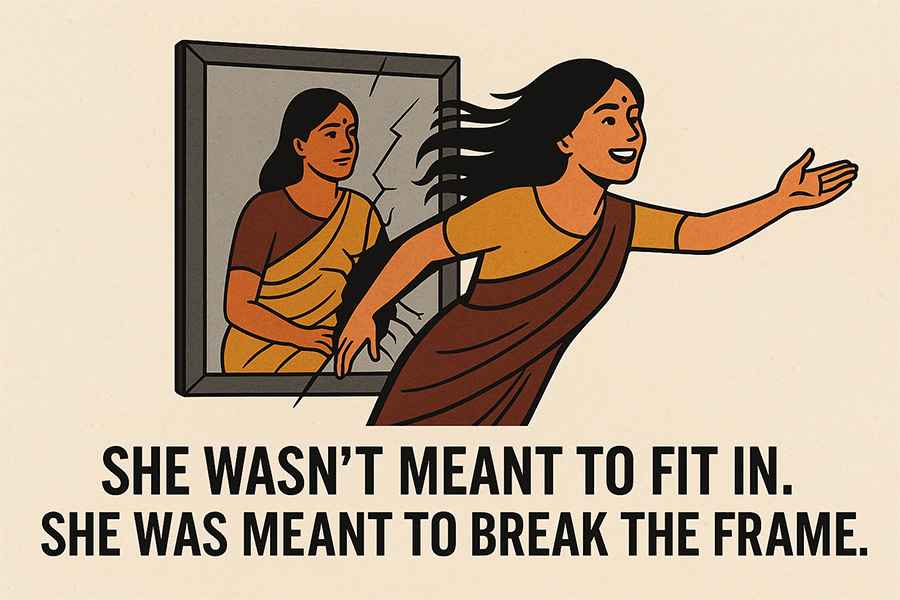
She didn’t wear just one role.
She was all at once:
The Kanya, whole unto herself
The Sati, who surrendered without complaint
The Bhaktin, who loved without calculation
The Yogini, who chased pleasure like it was her dharma
She made people uncomfortable -
Not because she was wrong, but because she mirrored parts of them, they weren’t ready to claim.
She didn’t wait for the right decade to arrive.
She lived her truth in the one she had.
And yes, she paid a price.
But had she waited for permission -
she’d have paid a much greater one:
A life of restraint
A legacy of regret
A memory of all the things she almost did
We often say we want gurus.
But what we’re really craving is freedom.
And Maaya’s journey reminds us:
You don’t need a master to walk the path.
You just need the willingness to see signs … and follow them.
Here’s the real tragedy:
We stopped creating rituals.
We stopped seeing the divine in cooking, working, and serving.
We replaced sacred with scheduled.
We turned celebration into calendar events.
But Maaya…
She turned every action into an offering.
Every breath into poetry.
Every moment into a doorway.
And maybe that’s why her story still matters.
Because whether you lead a company, raise a child, or craft a product,
you are Maaya when you show up fully … with softness and fire.
#DhandheKaFunda: In a world that wants you filtered, becoming whole is the boldest thing you can do.
Changing jobs, cities, or relationships does not always change the patterns a person carries into them.
That observation needs no analogy to quantum physics. In quantum mechanics, measurement has a specific technical meaning. It does not show that identity collapses preferred life outcomes into reality.
Internal expectations can still influence what I notice and how I act. If I expect conflict, I may read ambiguity as hostility or avoid a conversation until tension grows. The expectation does not create every external event, but it can shape my participation in a recurring pattern.
Reflection begins by describing the pattern without calling it bad luck or assuming it is entirely self-made. Other people, institutions, chance, and material conditions remain part of the situation.
Mental rehearsal may help prepare for a difficult action when it includes the process, obstacles, and possible responses. Imagining only the feeling of completion can hide the work and uncertainty between here and there. There is no universal duration or number of days.
A useful question is not what a perfected future self would do. It is what values and evidence should guide the next decision now. The answer may involve a new behaviour, a boundary, outside support, or a change in environment.
Identity can change through repeated action and reflection, but reality does not bend around the declaration. A different pattern emerges only where different choices meet conditions that allow them to matter.
She walked into the cave to escape the storm.
But the storm was inside her.
Years of heartbreak, rejections, missed chances.
She called it “bad luck.”
The Universe called it “auto-repeat.”
Inside the cave, she found a scroll.
It read: To change the outside, rearrange the inside.
At first, she scoffed.
Then she paused.
Then she started watching her thoughts like clouds.
Not judging. Just noticing.
She caught herself expecting pain.
Expecting disappointment.
Expecting the same-old, same-old.
So she changed it.
Not her job. Not her city.
Her expectations.
She rehearsed gratitude like it had already happened.
She dreamed of the destination, not toward it.
She became the woman who already had the joy she longed for.
And that changed everything.
Not overnight. But fast enough to know it wasn’t a coincidence.
Most people try to fix the mirror.
The real move is fixing your reflection.
→ #DhandheKaFunda: To escape your old life, stop being your old self.
Reality bends when you show up as the version you’ve never dared to be.
(Insight Credits: Breaking the Habit of Being Yourself, by Dr. Joe Dispenza - I got this book as a gift from a friend this Birthday)
From the Architect, August 6, 2025
I keep meeting two versions of the same founder. Same idea. Same market. Same starting line. What separates them is not talent. It is what they built first: a fire, or a blueprint.
Imagine two founders building the same AI journaling app for mental clarity.
The first ships a working prototype in five days using generative AI. They use vibe coding to build just enough to test the concept, not to impress anyone.
Before the first month closes, the app has three daily users, one paying customer, and one honest testimonial.
The second maps a twelve-month roadmap. They wait for funding, design sprints, and full team alignment before writing a line of code.
They are still refining the perfect specification document.
[Architect's note] One played with sparks. The other waited for blueprints. Only one of them knows anything real about the market yet.
The Campfire Founder used generative AI at every stage: to ideate, code, test, and iterate.
Vibe coding turned the idea into real user flows before a long specification could become a substitute for learning. An LLM produced the onboarding copy, emails, and demo scripts in an afternoon. User feedback decided the next feature instead of a Figma board deciding it in advance.
Not twelve features. Not a fancy AI pipeline. Not pixel-perfect design.
Five real users. One honest insight. The willingness to ship before it is ready.
Stop building cathedrals before you have evidence. Light the smallest campfire that can attract a real user, and use AI to shorten the distance between idea and feedback.
#DhandheKaFunda: Better comes from faster feedback. AI shortens the loop.
From the Architect, August 5, 2025
Every framework has a first sentence. For DLM, mine was this: in the LLM era, DLM matters more.
When this thought first surfaced, the market was fixated on one axis: LLMs. Model size, model speed, model cost. Everyone was optimizing the machine.
[Architect's Note] The mistake was never using LLMs. The mistake was believing the machine was the unit of advantage.
At Upsquare, the counter-move was not another model. It was a redefinition of the professional operating inside the model.
DLM: Doer. Leader. Manager.
Not three seats. One operator, at three altitudes.
Legacy structure separates these functions by design. Doers execute. Leaders decide. Managers coordinate. Every handoff between them is a point of loss.
In an AI-first system, that separation stops being efficient and becomes a liability. The Renter waits for the handoff. The Architect closes the loop personally.
The bet was not on talent. It was on range.
A quick-learning generalist who can build, guide, and manage without waiting for a relay was worth more than three specialists connected by process.
No handoffs. No silos. Just ownership carried end to end.
This is the line that has held: the AI advantage does not come from delegation. It comes from integration.
Delegation assumes distance between doing and deciding. Integration collapses that distance. The person closest to the work should also be the person closest to the call.
If you can learn fast, you can do almost anything.
If you can do, lead, and manage without waiting for someone else's seat, you are built for this era.
[Architect's Note] This was never a productivity framework. It was a claim about where ownership belongs when tools change faster than org charts do.
#DhandheKaFunda: Better orgs aren't made of roles. They're made of range.
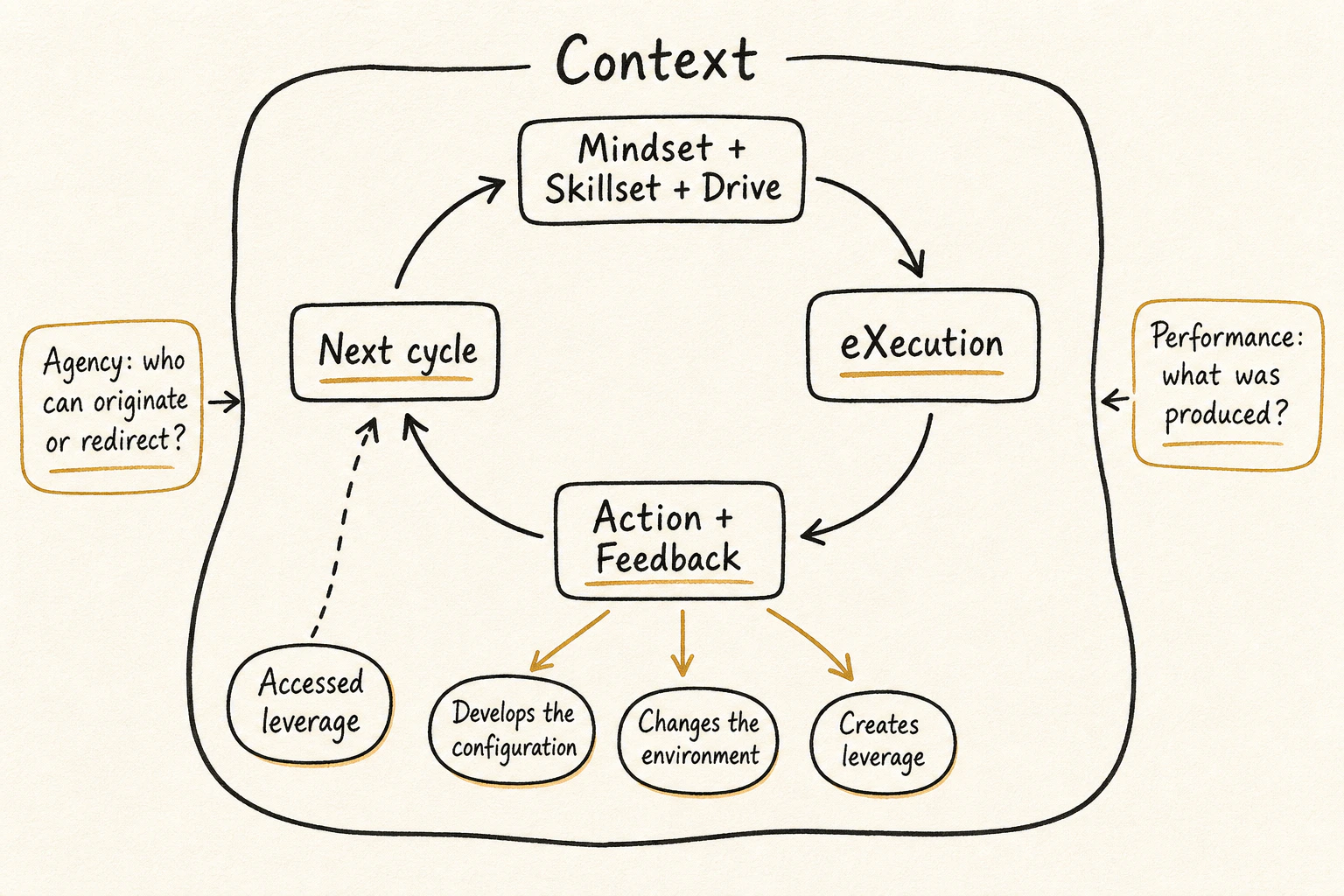
The MSDx Protocol: Mindset, Skillset, and Drive as a configuration; then eXecution that turns it into action and feedback.
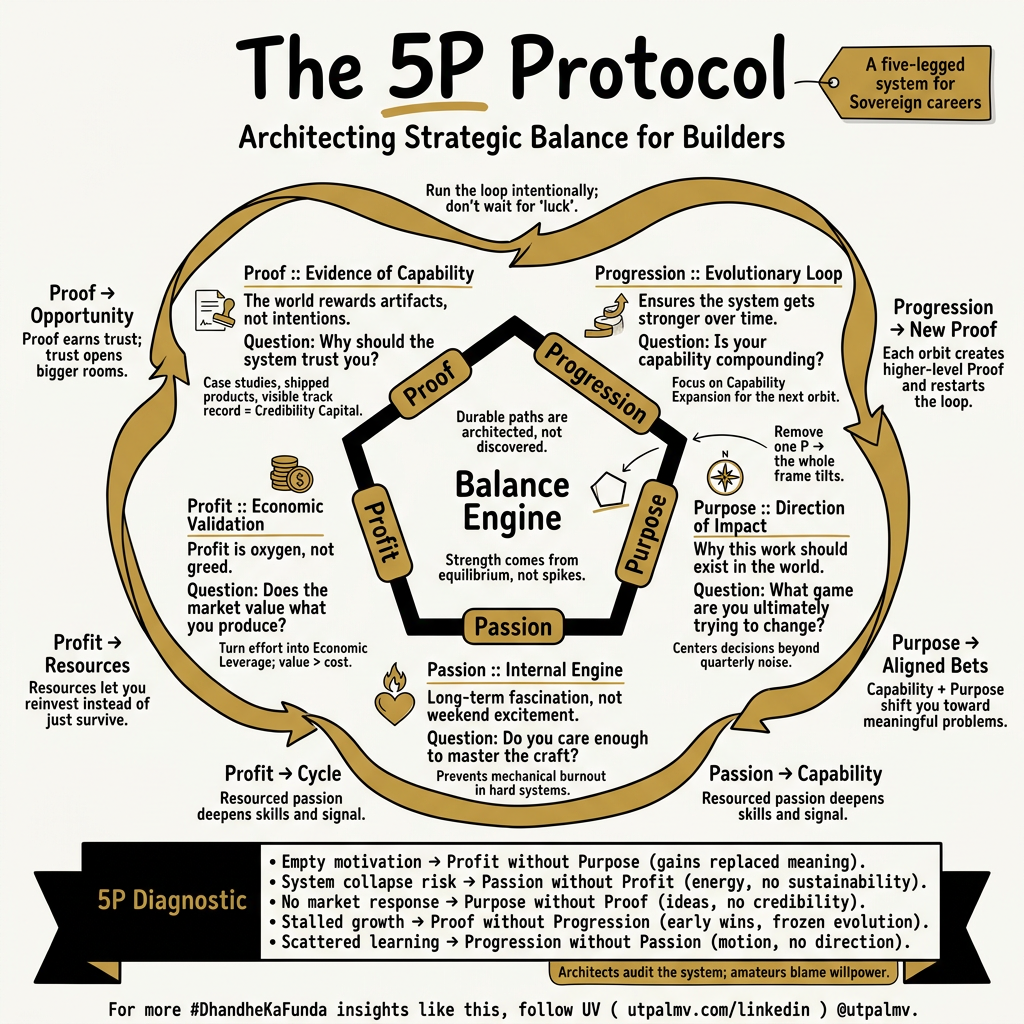
The 5P Protocol balances Proof, Profit, Passion, Purpose, and Progression so careers and ventures don’t optimize one dimension alone.
In July 2023, during a program that mattered to me, I learned a practice called CYO: Catch Your Opinions.
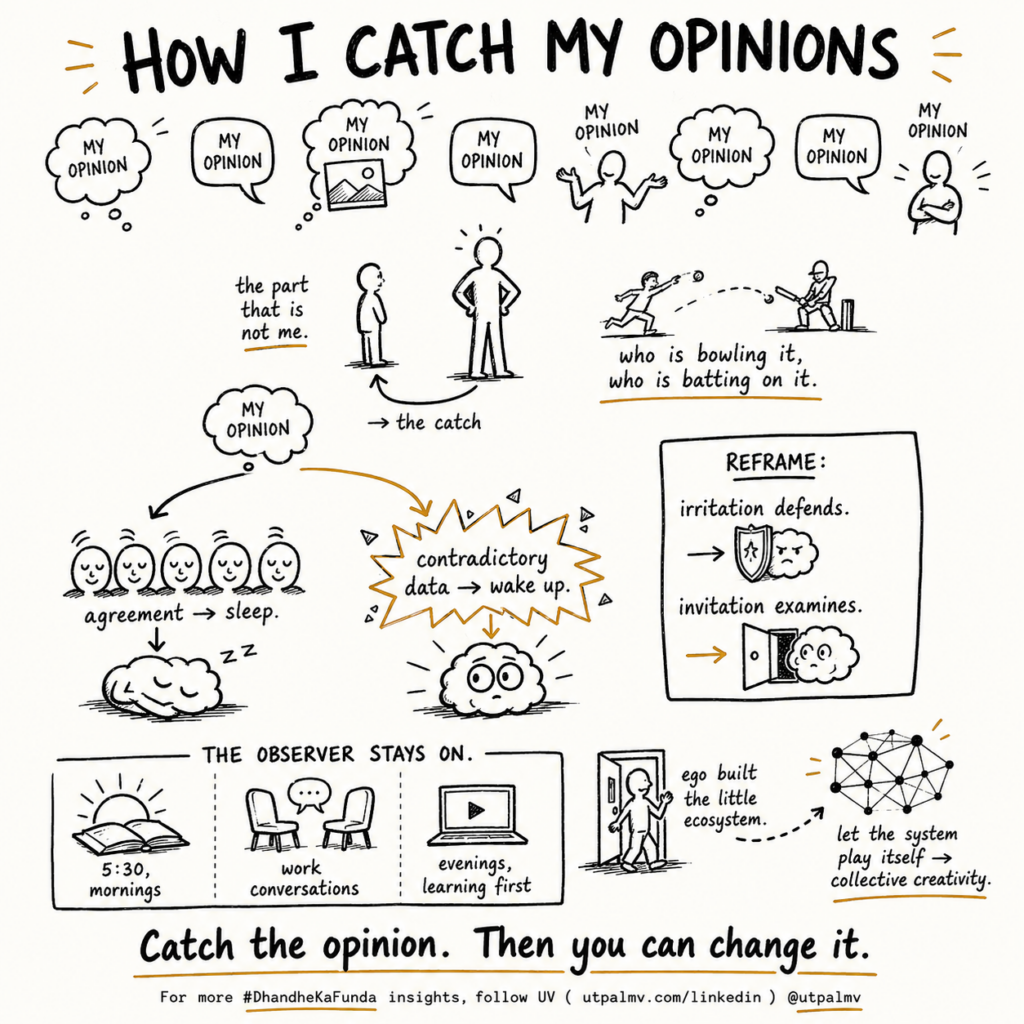
The cricket image stayed with me. When I catch a thought, interpretation, gesture, or intended response, I rename it: not a fact, an opinion.
Contradictory information often makes the opinion easier to notice because the expected fit breaks. Agreement can pass without the same scrutiny. This is a pattern I observe in myself, not a universal account of attention.
I use the practice while reading, in work conversations, and while reflecting later. Catching an opinion does not remove feeling or ego, and collective creativity does not become automatic. It gives me a pause in which to test the opinion, improve how I express it, or change it.
I am still changing how I do this.
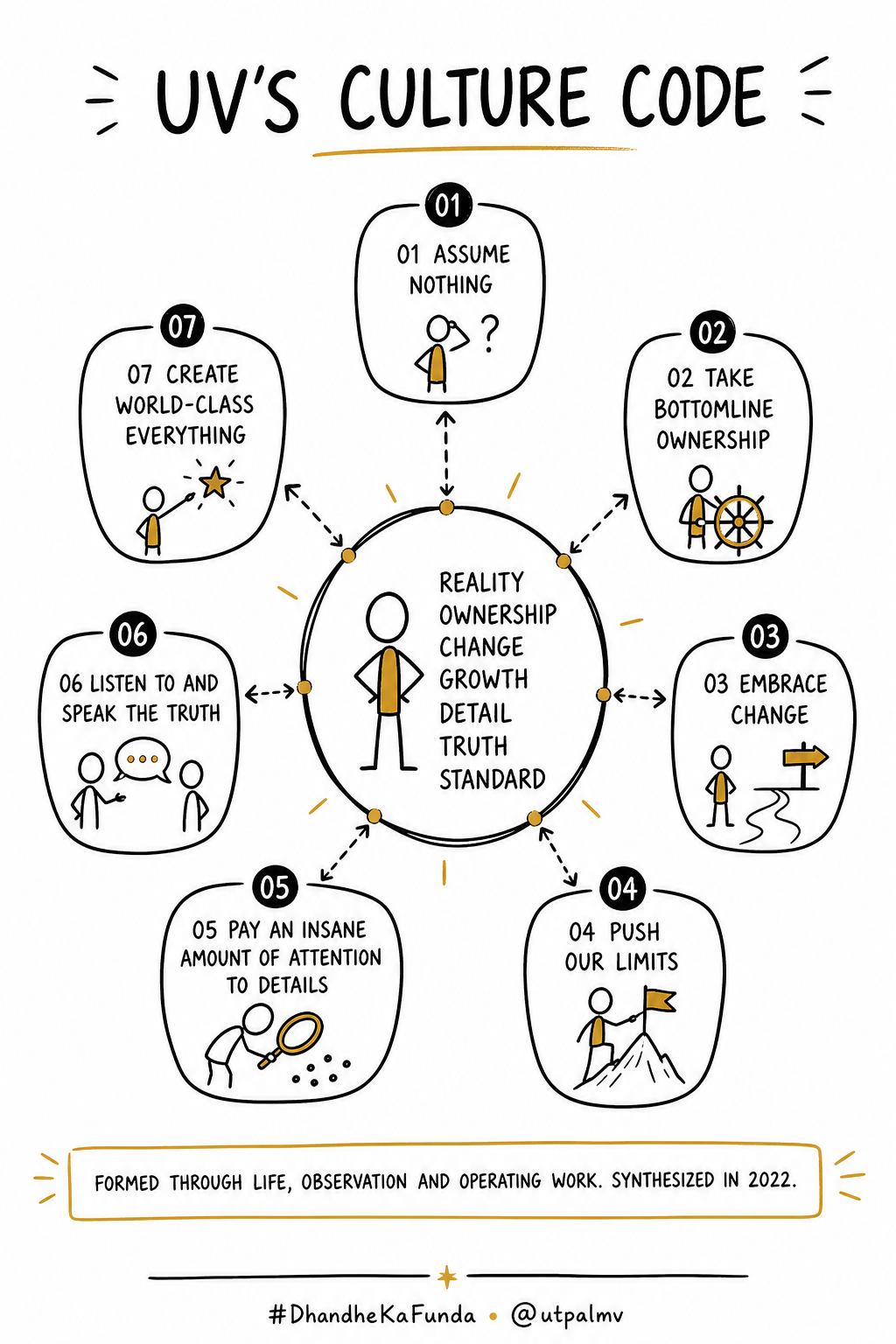
Seven operating principles for building deliberate culture. Culture is the product every startup builds for itself. It may not appear on a roadmap.
Worry sometimes begins as an attempt to prepare. It becomes unhelpful when the same possible future repeats without producing a decision or action.
I think of that repetition as a simulation left running. The mind keeps spending attention, but the scenario produces no new information.
Risk work has a stopping point for the present moment. You name a risk, estimate what you can, choose a response, and record what would make you revisit it.
Worry has no natural completion. It can continue after every available action has been taken. That does not make the emotion a moral failure, and it may not be something a person can simply switch off.
1. Name the loop
Write the feared outcome in plain language. Ask whether the thought contains new information or repeats what is already known.
2. Identify the available action
If a responsible action exists, make it specific and bounded. If none exists now, record the condition or date that would justify reviewing the risk again.
3. Return to the present task
Choose the next piece of work that deserves attention. Returning may take several attempts. The practice is redirection, not perfect control.
4. Seek support when the loop persists
Worry that is severe, persistent, or disruptive may need help beyond a personal productivity protocol. This framework is not a substitute for appropriate mental-health care.
Action cannot provide certainty, and not every feared event is unlikely. The useful distinction is whether present attention is helping you prepare or merely replaying the same future.
Historical anchor: May 16, 2012. Republished with a present-day author's note on August 30, 2026.
In 2012, I wrote about the time required to build a standard and how quickly one careless act can damage it.
I would no longer describe excellence as an on-or-off switch. Work contains constraints, tradeoffs, mistakes, and opportunities to repair them. A strong standard is visible in how those realities are handled.
Ask:
Reputation is not perfectly fragile, nor is it beyond the market’s reach. It is built through repeated work and honest correction.
Most service businesses are traps. You sell an hour of your life for a dollar, which means your income is capped by your heartbeat.
In 2010, I used Napoleon’s image of thoughts arranged in drawers to think about compartmentalization.
The metaphor is useful, but emotions do not always close on command. Work, grief, anger, anxiety, and family life can affect one another, and forcing separation may hide something that needs attention.
A transition ritual can still create a pause between roles:
The goal is not a watertight mind. It is a more deliberate transition without pretending the day never happened.
In June 2009, I wrote a list of qualities I associated with high achievers. I was looking for the mechanism behind people who seemed able to turn intention into results.
The list included clarity, commitment, optimism, attention to solutions, confidence, ownership, opportunity, and deadlines. I can still recognize why those qualities appealed to me. They offered an answer to drift: decide what matters and move toward it.
What I would not keep is the later language of command. The world does not simply yield to the person with the strongest internal architecture. Other people have agency. Institutions distribute power unevenly. Luck, timing, health, money, and history shape the field. Commitment can alter what I do; it cannot make an outcome inevitable.
Some items on the old list also need friction.
Definite intent is useful until new evidence makes the target wrong. Commitment matters, but eliminating every alternative can turn resolve into entrapment. Optimism can sustain effort, while pessimism may reveal a risk the group has ignored. Confidence can help people act, but certainty can silence the person who sees the flaw. Ownership is strongest when it names my contribution without claiming that I caused everything.
Deadlines remain useful to me because they force a dream into contact with time. Yet a deadline is not a blueprint, and missing one does not automatically reveal weak character. It may reveal poor estimation, changed conditions, an impossible demand, or a decision that needs revisiting.
The question I was asking in 2009 still interests me, though my answer is less heroic. Achievement is not a personality type. It is a changing relationship among purpose, practice, conditions, other people, and chance.
I would keep the willingness to decide and act. I would add the willingness to be corrected. Without that, a list of strengths can become a permission slip for force.
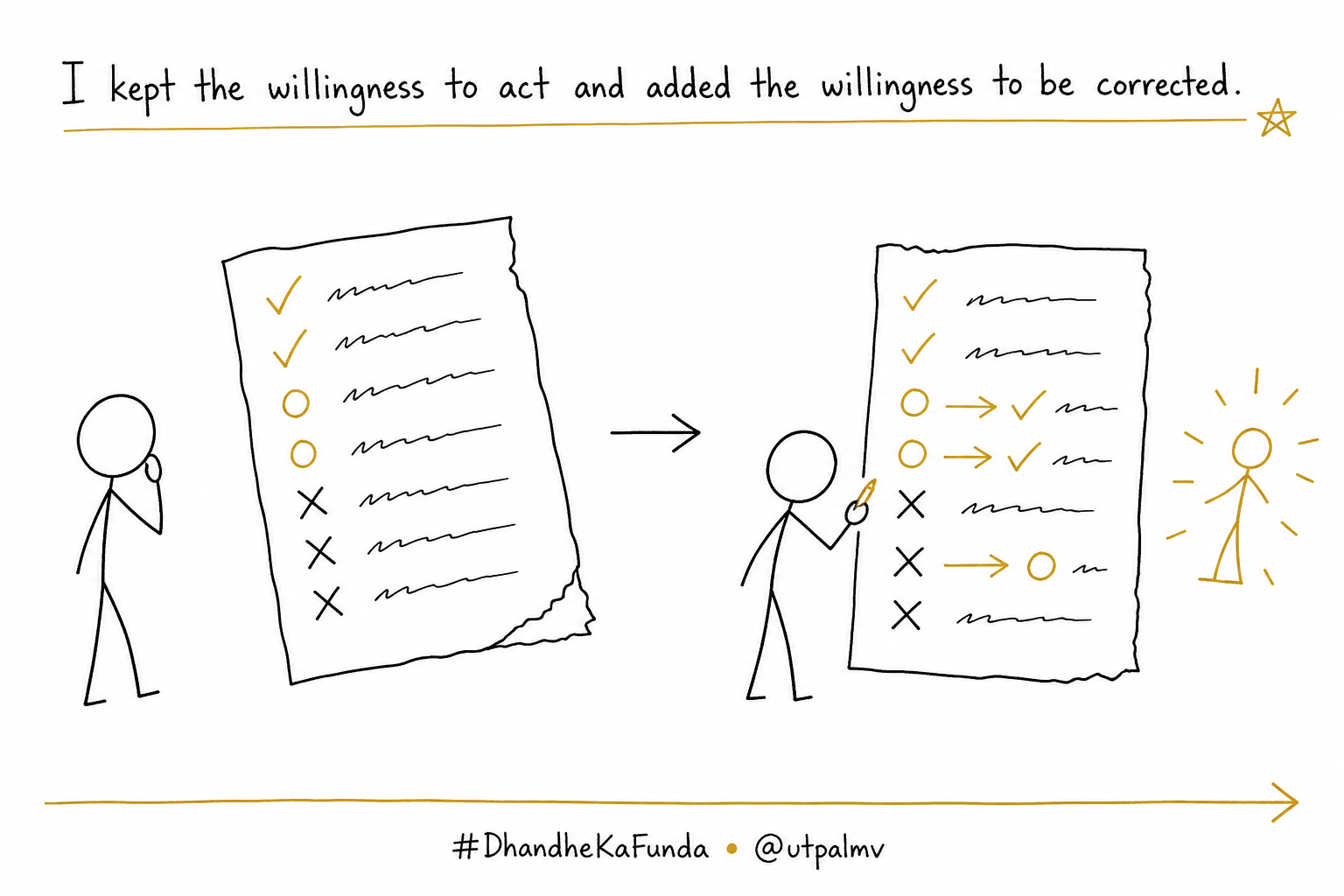
In June 2009, I was looking for ways to become more confident. I considered familiar practices: a positive attitude, social interaction, written goals, and breaking difficult work into smaller parts.
I no longer think confidence can be engineered into certainty. Uncertainty remains, even when preparation is strong.
What does help is more concrete:
Confidence need not become absolute. It can become better grounded.
In January 2009, during the economic downturn, I wrote about trying to remain “cool.” The word feels casual now, but the need behind it was real. I was looking for ways to keep worry from occupying the whole day.
I used a few simple practices: breathing, counting backward from 20, naming things I was grateful for, and reducing a large problem to the next piece I could handle. None of them changed the economy. They did not make uncertainty disappear. They gave me enough distance from the immediate reaction to make another decision.
I am wary of turning that memory into a protocol. Stress is not proof that someone is resisting reality. It can come from money, health, work, responsibility, danger, or a body that has been asked to carry too much. Calm is not always available through discipline, and it should not become another standard against which to fail.
What I still recognize from 2009 is the value of returning to what is actually here.
Acceptance, for me, does not mean approval or passivity. It means starting with the condition I have, rather than spending all my energy arguing with the fact that it exists. Gratitude does not cancel what is difficult; it prevents difficulty from becoming the only thing I can see. Breaking work into smaller pieces does not solve every structural problem, but it can reveal the next action.
Sometimes the right response is action. Sometimes it is rest, help, protection, or waiting for more information. The practices are useful when they create room for judgment, not when they are used to deny the pressure.
The 2009 note was not a theory of equilibrium. It was a person trying to stay steady during an unsettled time. That modest purpose is enough for me at this point in the record.
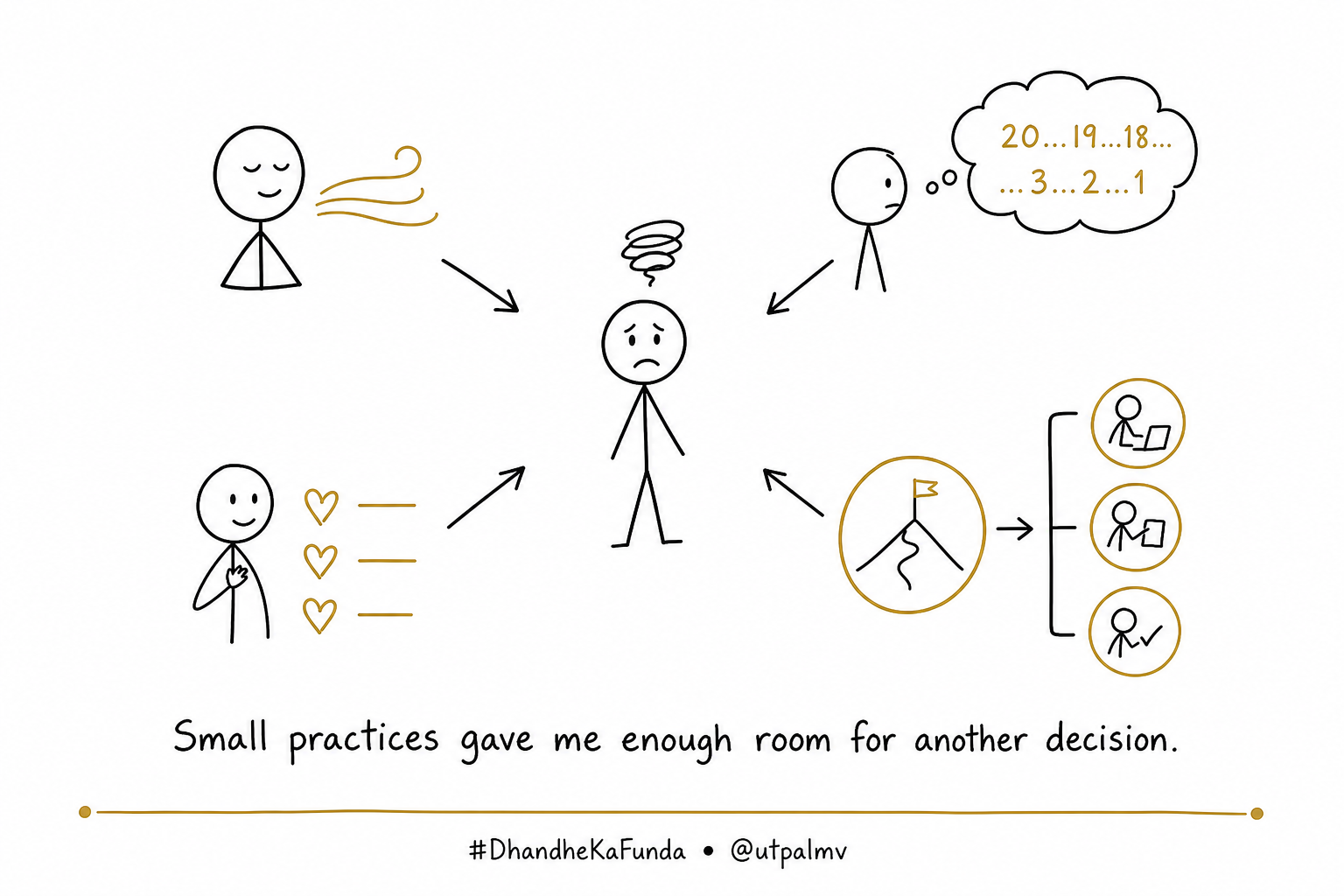
On January 2, 2009, I was trying to describe what made an organisation world-class. The language of the original note leaned toward outperformance, ownership, execution, and pushing limits. Looking back, some of those ideas still matter, but several need qualification.
An organisation is a coordinated group of people, not a single intelligence. Its quality cannot be measured only by whether it beats yesterday's benchmark. Improvement matters alongside safety, purpose, fairness, and the cost carried by the people doing the work.
Direct communication helps when it makes relevant facts available without turning every disagreement into a clinical defect. Feedback can feel personal because work is done by people. Good practice makes it specific, contestable, and connected to an outcome someone can influence.
Ownership also needs boundaries. Everyone cannot own the total outcome when authority and information are unevenly distributed. Responsibility should follow the decisions and resources a person can actually control.
Operational reliability matters, but flawlessness is not a credible standard. Systems should expect mistakes, make them visible, and support recovery.
The original note dismissed work-life balance. I no longer find that dismissal useful. Work may express purpose, and it remains only one part of a life. Integration should not become permission for an organisation to claim every hour or identity.
Leadership can develop more people who exercise judgment, but an organisation need not replicate one founder's image. Its strength appears when people can question the system, improve it, and leave it less dependent on any single person.
World-class is too broad to be a law. The more honest standard is whether the organisation does valuable work reliably while respecting the people and conditions that make it possible.
In December 2008, I played with an inversion: instead of writing another list of effective habits, what if I named the habits that make me ineffective?
The exercise was partly playful. It also made the problem easier to see. Effectiveness can become an abstract ideal. Ineffective behavior is often more concrete.
My list had seven patterns.
The first was living reactively, letting every external demand determine my internal state and my next action.
The second was becoming absorbed in process while losing the purpose the process was meant to serve.
The third was allowing urgent work to displace important work simply because urgency arrives with more noise.
The fourth was treating another person's gain as my loss. Zero-sum thinking can make cooperation look naive even when cooperation would create more value.
The fifth was talking without understanding. I called it narcissistic input then. The phrase is harsher than I would use now, but the pattern remains recognizable: broadcasting a view before doing the work of seeing the situation outside myself.
The sixth was paying for conflict that produced nothing. Conflict is not always avoidable, and agreement is not always the right goal. But acrimony has a cost. I should know what I am buying with it.
The seventh was deciding that I had finished learning. That can happen quietly, especially when experience begins to feel like proof that the current way is the only sensible way.
I do not see these as laws of human behavior. They are prompts. Each can be misused. A person can call someone reactive while ignoring the pressure they are under, or praise calm process while avoiding a necessary confrontation.
The useful move is to turn the list inward.
Where am I reacting instead of choosing? Which process has outlived its purpose? What important work is being displaced by noise? Where have I stopped listening or learning?
The list does not produce effectiveness by itself. It gives me somewhere specific to look.
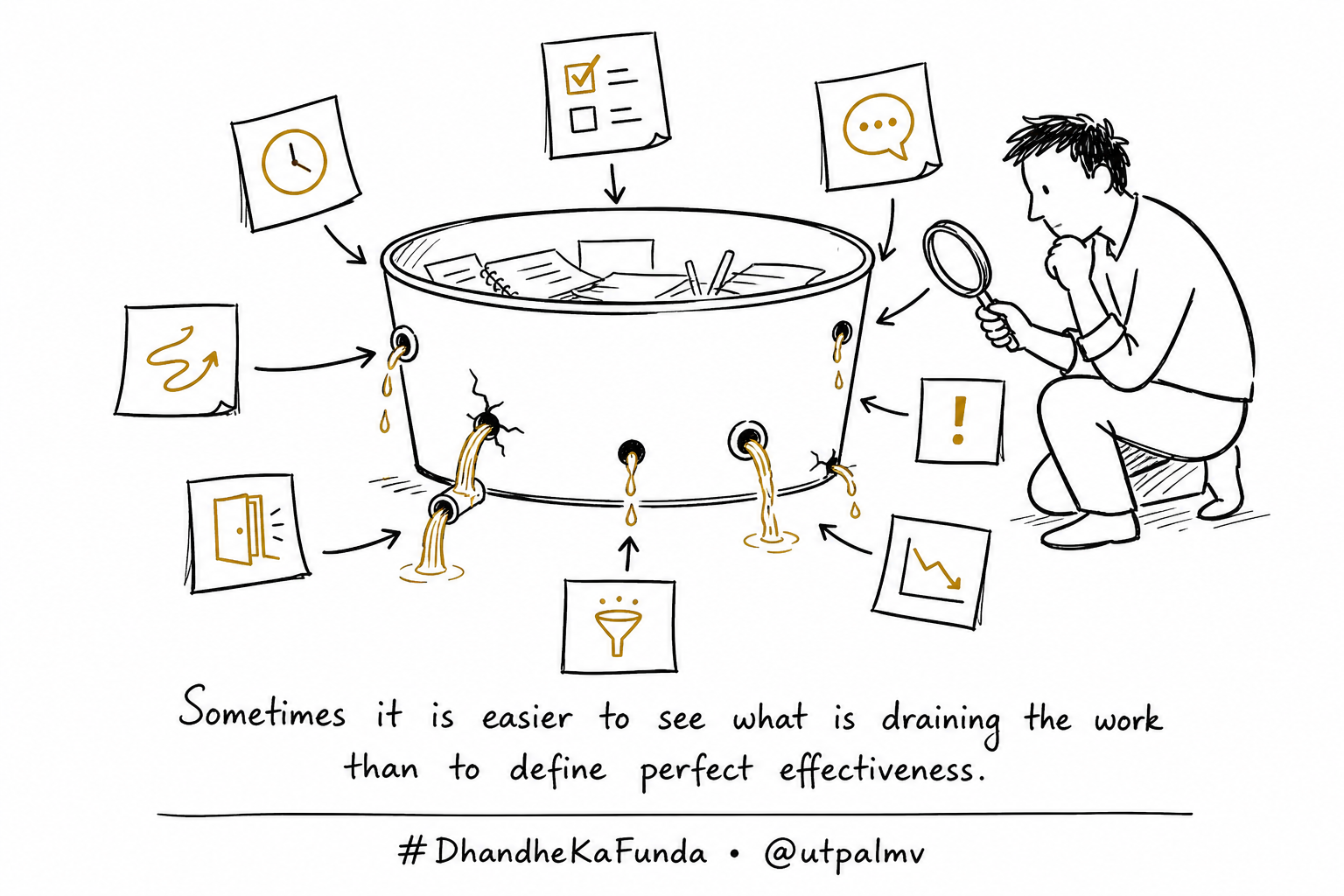
In 2008, I wrote “it happens” as a way to soften rejection and remember that another opportunity might exist.
I would not now describe losing a job as the universe returning agency. It can bring financial risk, grief, anger, and consequences that should not be clinically detached from.
Still, rejection is not a complete verdict on a person.
“It happens” can create enough room to move. It should not erase what happened.
On December 20, 2008, I was thinking carefully about the design of a business card: its type, spacing, paper, and the professional identity it was meant to carry.
That concern was not foolish. A card was a practical interface for an introduction. But I was asking a small object to do too much.
Paper gets lost. Digital profiles change. Neither can substitute for work that gives someone a reason to remember you.
If I designed a card now, it would probably contain little more than a name and a useful path back to the work. The card can open the door. What follows must carry the identity.
In 2008, I shared the familiar joke about asking a priest whether one may smoke while praying or pray while smoking. The facts remain the same, but the framing changes the response.
The lesson is not that every “no” can be defeated by better syntax. Some refusals concern real constraints, competing interests, or values that wording should not conceal.
Still, a question can smuggle in an assumption. When resistance appears, it is worth asking:
Good framing does not change the truth. It helps people see which truth is being discussed.
In July 2008, I spent ₹6,400 on a self-development course. I remember mocking both the cost and what felt to me like a cult-like atmosphere.
I also brought something back.
The course gave me a vocabulary for separating what happened from the story I attached to it. That distinction did not make interpretation disappear. It made interpretation easier to notice.
If someone says a sentence, the sentence is part of what happened. The intention I assign to it, the insult I hear in it, or the future I predict from it may be my story. That story can still matter. It can affect what I do next. But treating my interpretation as the event itself closes inquiry too early.
Another distinction concerned persistent complaints. I learned to ask what I was getting from a complaint I kept repeating. Sometimes the complaint pointed to a real problem. Sometimes repeating it allowed me to avoid a decision, a conversation, or my own part in the situation. I remain cautious about reducing every complaint to a personal racket. Power and circumstance are real. Still, the question has stayed useful.
The phrase empty and meaningless was harder. At first I heard nihilism. Later I understood a more practical possibility: meaning is not always waiting inside an event for me to discover it. I participate in making it.
That does not give me unlimited control. I cannot choose away loss, obligation, or consequence. Nor does every meaning work equally well. A meaning can open action, distort reality, protect an old identity, or make another person invisible.
Eighteen years later, I do not treat those distinctions as a complete philosophy. I treat them as tools I have continued to test.
The most durable lesson was not that I am free to invent any story I want. It was that I am responsible for noticing the story I am already living inside, and for examining what it makes possible.
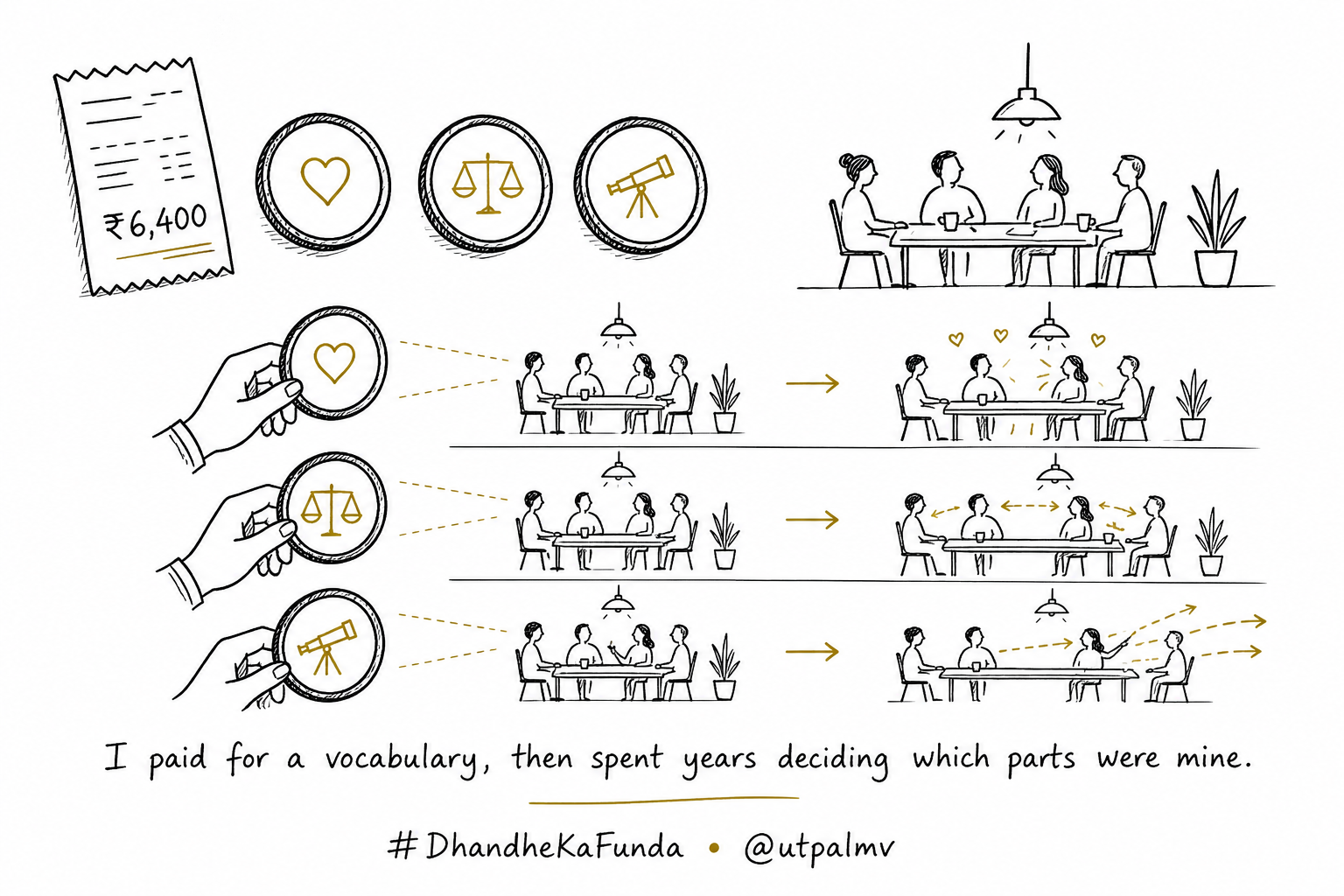
Between 1999 and 2005, I wrote my accounting software four times.
From the outside, some of that work would probably have looked unnecessary. The software could have been installed. A customer might never have noticed the parts that bothered me. Time spent rewriting could have been used for another feature, another client, or an earlier release.
But I knew where the scratches were.
That knowledge matters. There is a difference between improving work because the improvement serves the user and polishing it because we are unable to let go. Craft can become avoidance. A rewrite can be a refusal to test the work in reality. The fact that nobody else can see a flaw does not automatically make fixing it noble.
The opposite mistake is also common. We excuse a weak foundation because the surface looks acceptable. We leave confusing code, a fragile process, or an ambiguous commitment in place because the immediate audience cannot inspect it. The hidden compromise survives long enough to become somebody else's constraint.
The useful question is not whether every scratch must be removed. It is whether the scratch changes the integrity of the thing.
Will it make the work harder to maintain? Does it conceal a risk from the person depending on it? Are we accepting it because the trade-off is reasonable, or because the deadline gives us a convenient excuse? If the decision is deliberate and visible, imperfection can be responsible. If we hide the compromise even from ourselves, it usually returns as debt.
I no longer think private standards need a heroic identity around them. They need judgment. Some flaws are cosmetic. Some are structural. The work is learning to tell the difference, and being willing to repair the structural ones even when applause will never arrive.
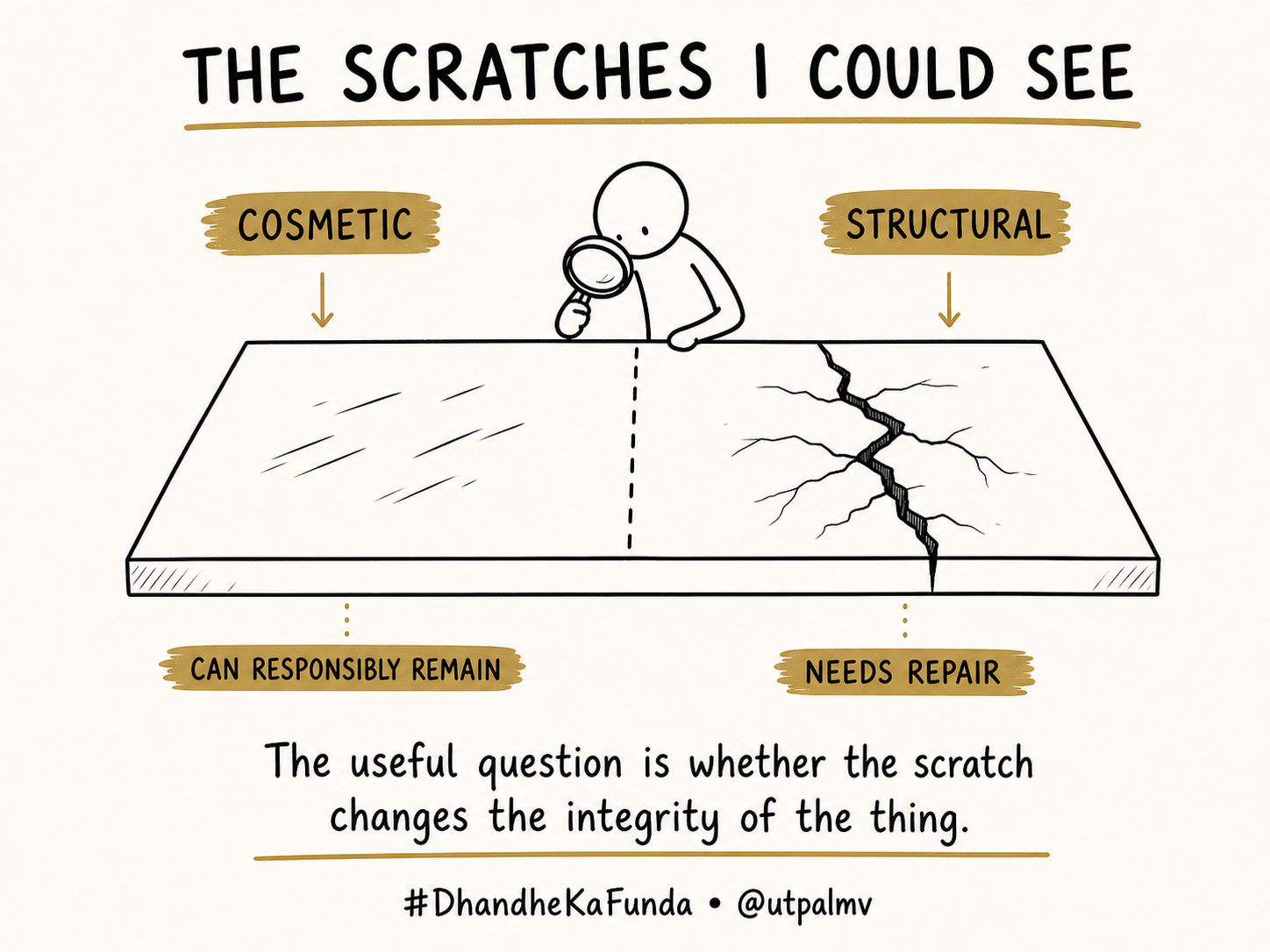
In 2008, I was trying to understand what made a meeting useful. I focused on commitment, integrity, reason, and the conditions around the conversation.
The question still matters, but I would frame it differently now. A meeting has a cost. Use it when the work genuinely benefits from people thinking, deciding, or resolving tension together in real time.
Before scheduling one, clarify:
Some meetings can be replaced by a clear document. Others cannot. The point is to choose deliberately, then return time to the work.
[The 2026 Perspective: A Note from the Architect]
This was written on October 18, 2008. I was documenting "firsts": the tangible markers of a man trying to find his own frequency. Looking back, these weren't just life events; they were the first cracks in a legacy wall that I would eventually tear down to build the 2026 Sovereign framework. I keep this here not as a boast of what I bought, but as a record of the moment I decided to stop following and start designing.
[Original Text - Hardened]
Lineage is a script until you decide to rewrite it.
I was the firstborn. The first in my family to choose a partner by heart rather than by arrangement. The first to gamble on a small business.
I measured my progress by acquiring machines: an LML Vespa, a Suzuki Samurai, a Maruti 800, and a Honda City. At the time, they were the proof of concept.
I was the first to realize that my birthplace was a limit, not a destination. I moved. I dropped out of a traditional CS degree to teach myself the logic of machines on my own terms. I traded the safety of the degree for the sovereignty of self-education.
And finally, I became the first to claim a territory on the digital frontier.
This was the first post. A "blah blah" of hope. Eighteen years later, the "not too bad" grades in language have evolved into the code for my life’s work.
To the reader who was there at the start: The journey from Operator to Architect began with these small, defiant firsts.