

The Atomic Thinking Protocol is a reality-contact practice for human judgment under consequence.
It concerns consequential decisions, not the machine-learning model or research codebase named AtomThink.
Thinking usually becomes visible after it has hardened into an opinion, explanation, decision, or action.
That is late for useful correction.
Atomic Thinking makes the construction of judgment visible earlier. It identifies small cognitive moves, composes them according to the situation, brings them into contact with reality, and leaves a trace that can be reviewed after action.
Its proposition is:
Better judgment comes from increasing contact with reality before commitment, then keeping the commitment corrigible after action.
"Atomic" is not a claim that human thought consists of indivisible particles. It identifies a practical level of work.
An atomic move is small enough to perform deliberately, express in an artifact, inspect, practice, combine, and revise.
Atomic Thinking does not replace critical thinking, systems thinking, probabilistic reasoning, creative thinking, strategic thinking, empathy, reflection, or execution. It supplies a practice layer across them.
The aim is simple:
Make the movement from signal to judgment visible enough to improve.
Field use
The Atomic Thinking Protocol has been exercised in operating work at Upsquare, EightQor, and House of Starts. That practitioner use is an opportunity to examine judgment under consequence, not evidence that the integration has passed practical validation. Its proposed contribution still needs the prior-art comparison and testing described below.
Why invisible thinking compounds
Poor thinking rarely announces itself as poor thinking.
It usually arrives as a reasonable sentence:
"The team lacks ownership."
"The customer is difficult."
"We need more people."
"We should add AI because execution is slow."
Each sentence may point toward a real problem. Each can also carry an unexamined definition, fused observation and interpretation, missing perspective, uncertain causal claim, or delayed consequence.
A weak distinction shapes the diagnosis. The diagnosis shapes the intervention. The intervention changes the system. Its effects become the starting conditions for the next decision.
Poor thinking compounds.
Precise thinking can compound too.
A better distinction can reveal the actual constraint. A different perspective can expose a cost carried outside the room. An honest estimate can convert a large irreversible commitment into a smaller responsible probe. A visible expectation can prevent hindsight from rewriting the decision.
Atomic Thinking makes those moves inspectable.
Set the deliberation threshold
Not every choice deserves the full protocol.
The first act of judgment is deciding how much judgment the situation earns.
Six conditions set the threshold.
Consequence
What can this decision create, damage, transfer, or make difficult to recover?
Consequence includes money and time. It also includes trust, dignity, reputation, safety, future options, and burdens placed on people without decision power.
Reversibility
Can the decision be undone? At what cost, after what delay, and for whom?
A decision can be reversible for an organization and irreversible for the person affected by it.
Uncertainty
What is known, inferred, estimated, disputed, or unknowable before action?
Uncertainty should change confidence and test design. It should not become a respectable reason to avoid commitment.
Expertise fit
Does the decision sit inside the relevant decision-maker's demonstrated competence?
If not, whose knowledge, challenge, or consent is required?
Knowing the edge of competence is not weakness. It is a control against invisible risk.
Time pressure
When must a useful decision exist? What does delay cost?
A delayed conclusion can be as irresponsible as a premature one.
Human consequence
Who experiences the decision, who implements it, and who absorbs the error?
This condition prevents a technically elegant local optimization from concealing transferred harm.
The depth of deliberation should rise when consequence, irreversibility, uncertainty, expertise mismatch, or human exposure rises. It should fall when a choice is low-cost, reversible, time-sensitive, and capable of generating clean feedback.
This is not a formula. It is a discipline of proportion.
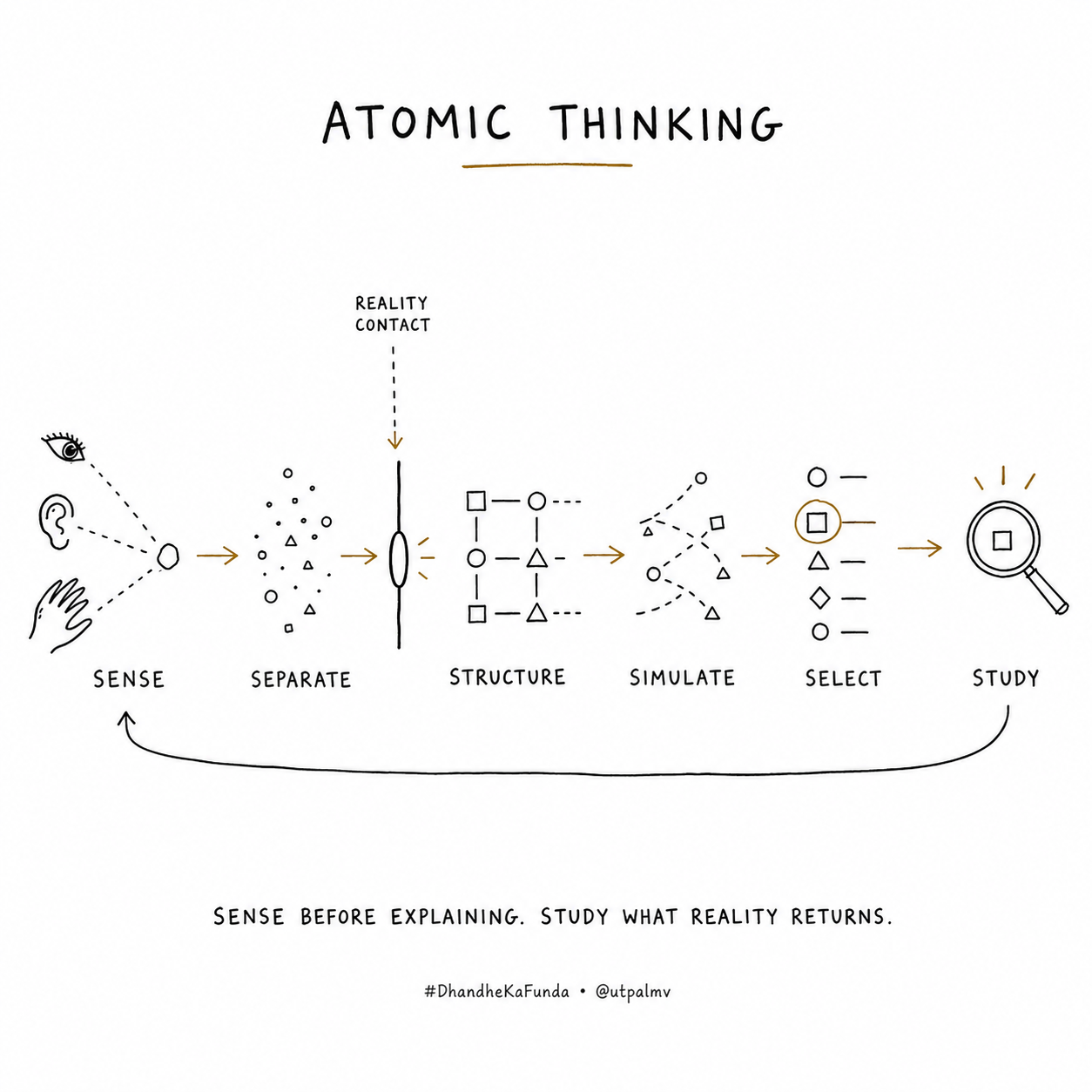
The reality-contact cycle
The protocol has 6 stages:
Sense -> Separate -> Structure -> Simulate -> Select -> Study
The sequence is easy to remember. It is not rigid.
A new perspective may change the definition. A test may reveal that the wrong resolution was selected. An outcome may force the entire model to be rebuilt.
1. Sense
Sense what is present before forcing it into the existing explanation.
The moves are:
- Attend: Select what deserves attention and state what is currently excluded.
- Observe: Record what happened in terms another person could inspect.
- Pause: Create distance between a signal and the action it appears to demand.
- Listen: Receive another account closely enough to revise your representation.
Emotion belongs here.
Emotion can register threat, attraction, friction, trust, or misalignment before a complete explanation is available. That makes it useful. It does not make the attached story true.
Ask:
- What did I directly observe?
- What am I feeling before I explain it?
- What changed?
- What is absent that I expected to see?
- When did I stop listening and begin preparing my answer?
The failure at this stage is premature explanation.
2. Separate
Separate elements that have arrived fused.
Activity is not progress. Intention is not effect. Confidence is not competence. Agreement is not commitment. A feeling is not a fact about another person's intent.
The moves are:
- Name: Give the decision or problem a working definition.
- Distinguish: State what it is not and which boundary matters.
- Classify: Separate evidence, inference, assumption, preference, uncertainty, and unknown.
- Locate: Identify the resolution, jurisdiction, and time horizon.
Ask:
- What exactly must be decided?
- What does this important word mean here?
- What would count as evidence that the condition exists?
- Which statements are observations and which are interpretations?
- Is this an individual, system, or system-of-systems problem?
- Is the visible symptom the problem or the last visible effect?
The failure at this stage is category error disguised as clarity.
3. Structure
Map how the relevant parts produce behavior.
This is the move from objects to relationships, from events to patterns, and from visible roles to actual flows of information, authority, incentives, work, and consequence.
The moves are:
- Decompose: Identify relevant parts, actors, variables, stages, or constraints.
- Relate: Label interaction, direction, delay, feedback, and uncertainty.
- Perspective: Examine what becomes visible from another position.
- Diagnose: Form competing explanations for the binding constraint.
Ask:
- What are the parts, and what holds them together?
- Where do information, decisions, work, and consequences travel?
- What reinforces this behavior?
- Where is the delay between action and visible effect?
- Who has responsibility without authority?
- Who has authority without exposure to consequence?
- What does the system make rational for each participant?
A systems map does not prove causation. It makes proposed relationships available for challenge.
The failure at this stage is fixing a visible part while preserving the relationship that keeps producing the behavior.
4. Simulate
Generate and test possible explanations, actions, and futures before the full commitment.
The purpose is not prediction without error. It is to expose the consequential assumption before reality exposes it at a higher cost.
The moves are:
- Generate: Produce materially different explanations, options, or scenarios.
- Estimate: Express likelihood, magnitude, delay, range, threshold, or confidence.
- Invert: Ask how failure could be produced and what the preferred account excludes.
- Test: Define evidence capable of changing the current model.
- Probe: Run the smallest responsible experiment that can answer a consequential question.
Ask:
- What are 3 materially different explanations?
- What option appears from an excluded perspective?
- What trade-off remains unseen?
- What happens next, and what happens after that?
- What would have to be true for this account to be wrong?
- Which assumption carries the most consequence?
- What is the smallest test that can reduce the uncertainty?
- Who absorbs the loss if the test fails?
- What is the stopping condition?
A failed experiment is learning only when it was designed to produce interpretable evidence. It may also be a loss that deserves repair.
The failure at this stage is confirmation theater.
5. Select
Convert judgment into a bounded commitment.
Selection names an owner, boundary, rationale, expected result, and review conditions. It also names what is deliberately not being chosen.
The moves are:
- Choose: Select the action or deliberate non-action.
- Bound: Define scope, authority, resources, constraints, and exclusions.
- Commit: Assign ownership and a decision date.
- Act: Bring the choice into contact with reality.
Ask:
- What are we choosing?
- Why is the available threshold sufficient now?
- Who owns the outcome?
- Does the owner have the required authority and information?
- What are we not choosing?
- What result do we expect, by when?
- What would trigger reconsideration?
- Is error survivable for the person asked to act?
Ownership without authority is theater. Authority without exposure to consequence is risk transferred to someone else.
The failure at this stage is analysis without responsibility.
6. Study
Compare expectation with outcome and modify the system.
Study protects the decision record from hindsight, separates process quality from luck, and converts repeated failure into a change in practice.
The moves are:
- Compare: Place the declared expectation beside the observed result.
- Attribute carefully: Examine plausible mechanisms without forcing one cause.
- Update: Revise confidence, model, decision, standard, or process.
- Institutionalize: Preserve useful learning in the system rather than one person's memory.
Ask:
- What did we expect?
- What happened?
- Which difference matters?
- Was the process sound even if the outcome was poor?
- Was the process weak even if the outcome was favorable?
- What surprised us?
- What should change?
- Where will this learning live?
A retrospective that changes nothing is documentation, not learning.
The failure at this stage is protecting the old story.
Compose the thinking lenses
The six stages form the operating cycle. Established thinking disciplines act as lenses within it.
Critical lens
Does the claim deserve belief?
Am I reasoning from evidence toward a conclusion, or recruiting evidence for the conclusion I already need?
Systems lens
What behavior do relationships, incentives, feedback, delays, boundaries, and resolution produce?
Am I fixing the visible part or changing what keeps producing it?
Probabilistic lens
What range, likelihood, threshold, or confidence does the evidence support?
Is "not sure" attached to a question, a responsible probe, and a stopping condition?
Strategic lens
Which commitment changes what becomes possible next?
Am I making a positional move or creating more activity inside the same board?
Creative lens
What have I dismissed because it does not fit the old map?
What does dissonance reveal that resonance keeps hidden?
Empathetic lens
What becomes rational from another person's information, incentives, constraints, history, power, and exposure to error?
Perspective-taking is a hypothesis to test, not access to another person's mind.
Reflective lens
What explanation protects me from the lesson this result contains?
What motive is reason learning to defend?
Execution lens
Did this work move an outcome?
Can the loop close without undocumented heroics or repeated escalation?
Empathetic Brutalism governs the protocol
Empathetic Brutalism is not one stage or lens.
It governs the whole protocol through reciprocal constraint.
Empathy constrains what truth claims I can responsibly make about another person's experience, motive, or capability.
Brutalism constrains the stories I tell to avoid evidence, consequence, ownership, or necessary conflict.
Reality constrains both.
This produces 3 disciplines.
Compassion in perception
See context, dignity, history, power, and exposure to consequence. Do not turn a participant into a defective component.
Precision in truth
State what is observed, inferred, uncertain, and required. Do not decorate the account to protect comfort, status, or self-image.
Responsibility in action
Act without transferring invisible costs or erasing agency. Preserve the possibility that the diagnosis is wrong.
Poor thinking by a person with authority can create downstream harm. That does not make every cognitive error a moral failure.
The duty rises with consequence, authority, and preventability.
A compact decision record
For a consequential decision, preserve:
- the decision and deadline;
- consequence, reversibility, uncertainty, expertise, time, and human exposure;
- observations, internal signals, inferences, assumptions, unknowns, and disputes;
- definitions, boundaries, resolution, relationships, feedback, and perspectives;
- alternatives, trade-offs, confidence, disconfirming evidence, and the smallest responsible probe;
- decision, owner, authority, scope, expected result, review point, and stopping trigger;
- outcome, surprises, process quality, and correction.
For a reversible decision, use 4 questions:
- What are we deciding?
- Which assumption matters most?
- What is the smallest responsible action that can teach us?
- When will we compare expectation with outcome?
Worked application: the team lacks ownership
A leader says the team lacks ownership.
The sentence sounds diagnostic. It remains an interpretation.
Sense: Observe escalations, delayed decisions, reversed decisions, and work waiting for approval. Listen to the costs of acting and waiting.
Separate: Define ownership as making bounded decisions and carrying them to an observable outcome. Distinguish unwillingness, inability, unclear authority, missing context, competing incentives, and learned caution.
Structure: Map where decisions travel. Identify who has information, who can approve, who can be blamed, and who pays for delay. Waiting may be rational inside the current incentive system.
Simulate: Test at least 3 explanations. Decision rights may be unclear. Context may remain concentrated in the leader. Independent error may be punished more visibly than waiting.
Select: Move one recurring decision right to the appropriate role for 4 weeks. Make the cost of waiting visible. Make reasonable error survivable.
Study: Compare escalation frequency, decision latency, reversals, and outcome quality. If behavior does not change, revise the diagnosis rather than repeating "take ownership" more loudly.
Training Atomic Thinking
Reading the protocol does not create skill.
Practice should move through 4 levels.
Isolated moves
Separate observation from inference. Replace a vague adjective with an observable standard. Draw one decision path. State one confidence range and what would change it.
Composed cases
Apply one or two stages to a bounded scenario. Score the reasoning artifact, not confidence or eloquence.
Prospective decisions
Record expectations before the outcome is known. Use real review dates.
System learning
Aggregate recurring patterns without flattening context. Change the assumption, handoff, decision right, or standard that repeatedly fails.
What Atomic Thinking inherits
Atomic Thinking is an integration, not a claim to have discovered the foundations of thought.
DSRP, developed by Derek and Laura Cabrera, names Distinctions, Systems, Relationships, and Perspectives. Those constructs remain explicitly attributed.
Systems thinking, critical thinking, metacognition, probabilistic reasoning, decision theory, deliberate practice, perspective-taking, inversion, and experimental learning each have substantial existing lineages.
Atomic Thinking's proposed contribution is the combination:
- a proportional deliberation threshold;
- a six-stage reality-contact cycle;
- small moves with inspectable outputs;
- thinking disciplines composed as lenses;
- one record connecting signal, model, commitment, outcome, and correction;
- Empathetic Brutalism as reciprocal constraint.
That integration may be original. It has not yet survived a full prior-art comparison or practical validation.
What the protocol does not claim
Atomic Thinking does not claim that:
- thought literally consists of cognitive atoms;
- one protocol can remove bias or uncertainty;
- visible reasoning guarantees a good result;
- an emotion is noise or an intuition is authority;
- a system map proves causation;
- every decision needs the full cycle;
- using the protocol validates it;
- faster or more polished output establishes better thinking.
The framework should be reduced or rejected if it creates documentation without improved judgment, consumes more time than its decisions warrant, duplicates an established framework without adding practical value, or allows Empathetic Brutalism to legitimize aggression or conceal power.
A maintained protocol
Atomic Thinking should be treated as a maintained framework.
Its move vocabulary, assessment dimensions, examples, and claims remain provisional. They should change when comparison, criticism, practice, or evidence exposes a better structure.
The protocol's first test is whether it can apply its own standard to itself.
#DhandheKaFunda: Sense before explaining. Study what reality returns.
Revision record
- 2026-08-23: Originally published.
Living means the definitions, application, and limits remain open to correction as evidence and practice change. These dates record the known publication history; they are not a complete account of the framework's development.
FAQs
What is the Atomic Thinking Protocol?
The Atomic Thinking Protocol is a reality-contact practice that makes the small moves from signal to judgment visible enough to inspect, test, and revise.
When should Atomic Thinking be used?
Use more of the protocol when consequence, irreversibility, uncertainty, expertise mismatch, or human exposure rises. For a low-cost reversible decision, use only enough structure to identify the decision, test the consequential assumption, act responsibly, and review the result.
What does Atomic Thinking not claim?
It does not claim that thought consists of literal atoms, that one protocol removes bias or uncertainty, that visible reasoning guarantees a good result, or that every decision needs the full cycle.
Use this workExplore with AI
Explore this canon
Take this work into your preferred AI system. Choose a ready-made prompt or add your own context. Nothing you enter here is sent or saved by utpalmv.com.
Use the work as a thinking lens without adding personal context.
Optional. Add details when you want the exploration grounded in your situation. Your context remains in this page and is included only in the prompt you copy.