

Some decisions are calculations. Others remain bets.
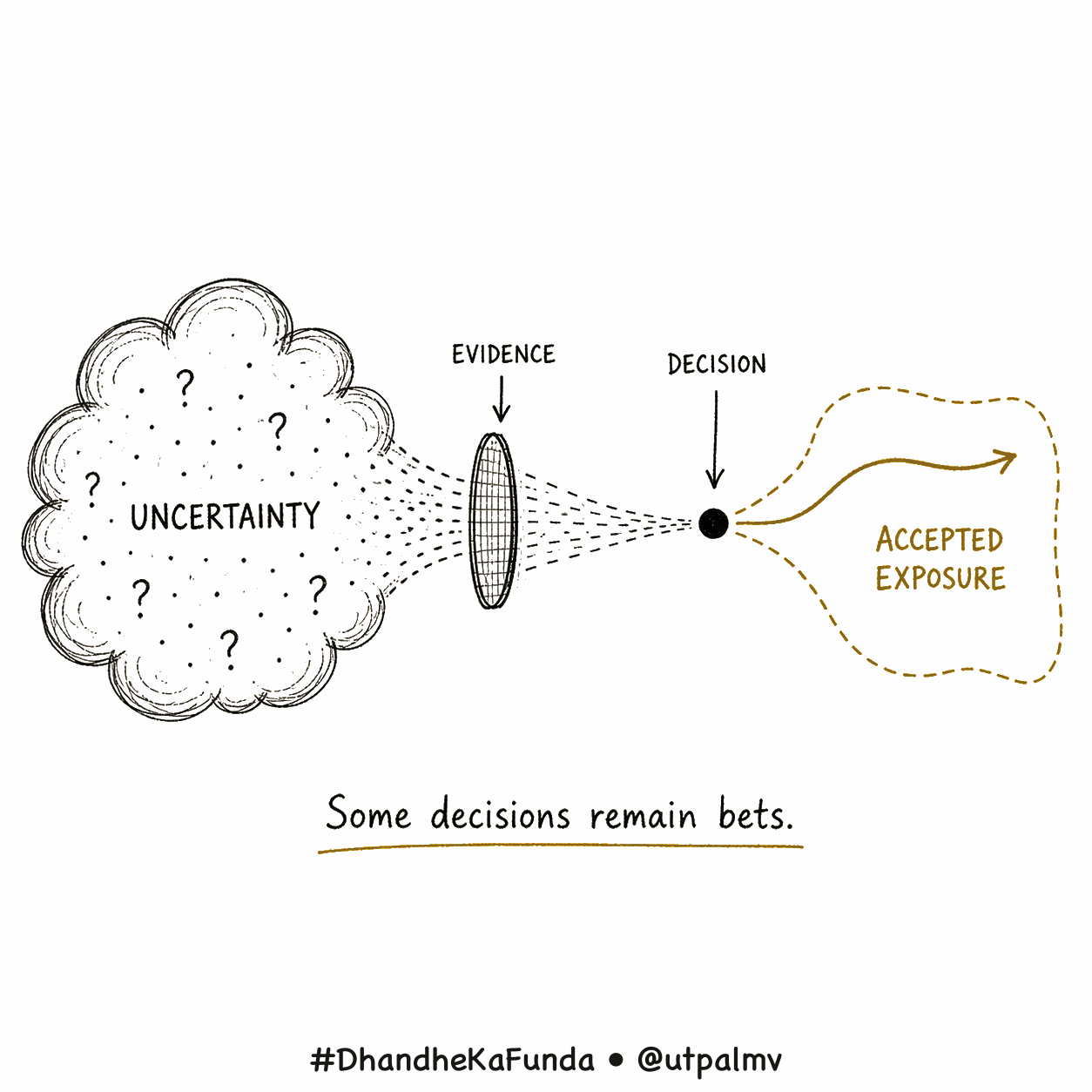
The distinction can disappear when a spreadsheet gives an uncertain future a precise number. Revenue forecasts, probabilities, weighted scores, and scenarios are useful ways to organize what we know. They do not automatically turn uncertainty into fact. A model can clarify a bet without ceasing to be one.
When the relevant evidence is available, use it. Check the assumptions, compare alternatives, and let the numbers correct preference. But also notice what the evidence cannot establish: how a market will respond, whether a partnership will hold, whether a person will grow into a role, or whether timing will make an otherwise sound move fail.
In those cases, decisional integrity begins with naming the uncertainty. Which assumptions are supported? Which are estimates? What are we choosing to believe because experience points that way? What would make the decision unacceptable even if the upside remains attractive?
Instinct belongs in this account, but it should not be disguised as data. Pattern recognition developed through experience can identify something before we can fully explain it. It can also carry bias, fear, pride, or attachment. Treat instinct as a signal worth examining, not as evidence that ends the examination.
The final question is often about exposure. How much money, time, trust, or reputation are we willing to place behind this incomplete view? Can the decision be staged? Is there a smaller commitment that preserves the learning while limiting the loss? If not, are we willing to carry the consequence without rewriting the story afterward?
A sound process does not guarantee a sound outcome. A good bet can fail, and a careless one can succeed. Integrity lies in remembering what was known at the time, what remained uncertain, and why the risk was accepted.
Calculation helps us see the bet more clearly. It should not be used to pretend that no bet remains.
Use this workExplore with AI
Explore this journal
Take this work into your preferred AI system. Choose a ready-made prompt or add your own context. Nothing you enter here is sent or saved by utpalmv.com.
Use the work as a thinking lens without adding personal context.
Optional. Add details when you want the exploration grounded in your situation. Your context remains in this page and is included only in the prompt you copy.