

Seven operating principles for building deliberate culture.
Culture is the product every startup builds for itself.
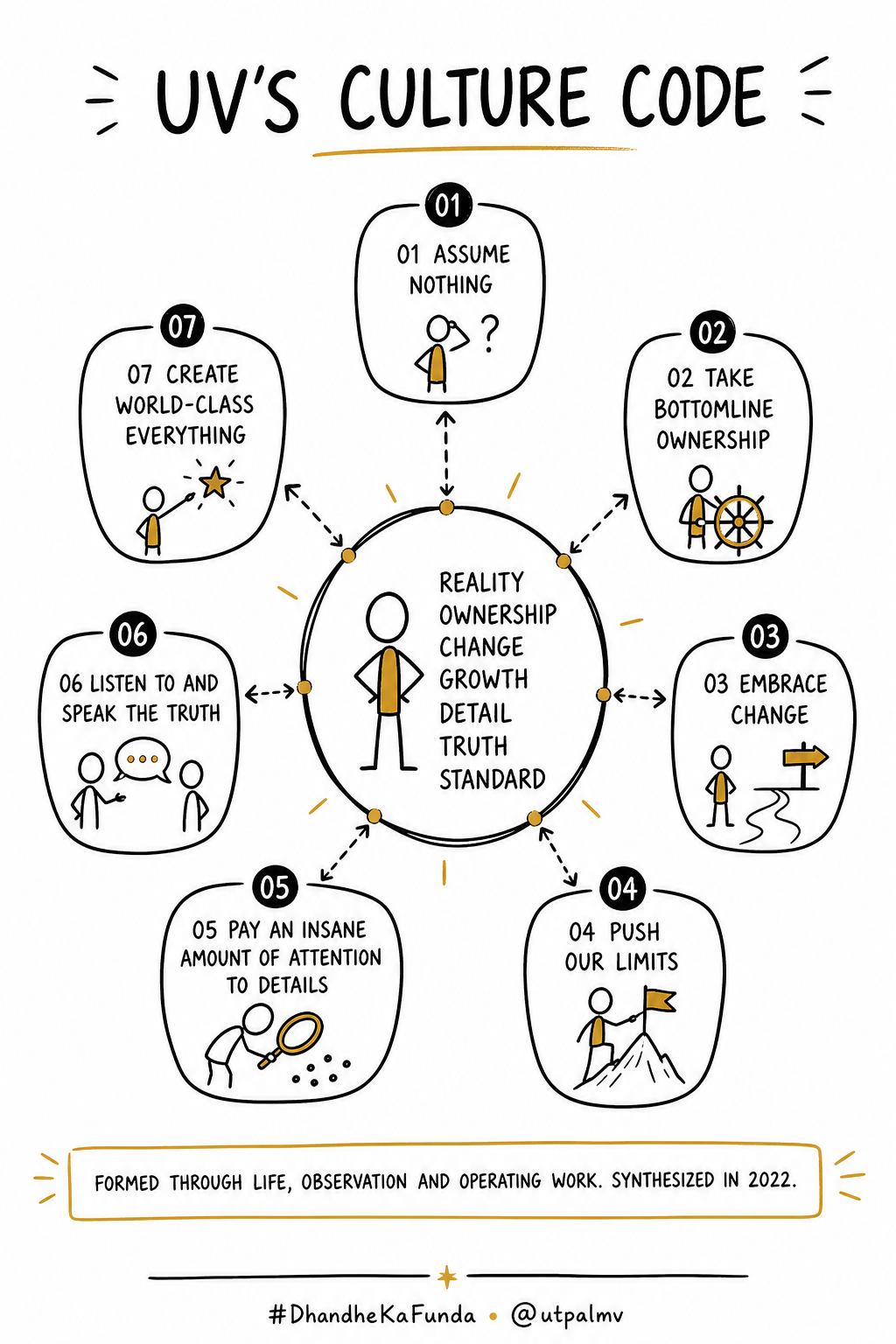
It may not appear on a roadmap. It may never have a formal product owner. Yet it shapes how people think, decide, execute, disagree, respond to change, and define good work.
Culture develops whether we build it deliberately or leave it to accident.
My Culture Code brings together seven principles that have taken shape through reading, observation, lived experience, and operating work. I did not invent the underlying ideas. My authorship lies in selecting them, naming them, bringing them together, and applying them as one operating code.
1. Assume Nothing
Do not build decisions on unverified assumptions.
Incomplete information is unavoidable. Treating an unknown as established truth is not. Separate what is known, what is unknown, and what is being assumed. Then verify what matters.
This does not mean waiting for perfect certainty. It means refusing to disguise an assumption as a fact when a question, test, conversation, or direct observation can bring us closer to reality.
2. Take Bottomline Ownership
Own the final outcome, not only the task assigned to you.
Completing a task is not the same as producing the intended result. Bottomline ownership asks us to understand what the work must ultimately achieve, identify what could prevent it, and stay with it until the loop is closed.
The question is not only, "Did I do my part?"
The question is, "Did it work?"
3. Embrace Change
Treat change as an input, not only as a disruption.
Change is not an exception in a startup. Markets move. Customers learn. Technology changes. Teams discover reality by acting.
A deliberate culture examines what has changed, preserves what remains true, and adapts what no longer serves the outcome. Direction can remain stable even when the plan changes.
4. Push Our Limits
Deliberately expand what we are capable of doing.
Meaningful work often sits near the edge of our current skill, judgment, speed, or confidence. Pushing our limits means stepping beyond familiar capability and building the strength required for the next level of work.
This is not a celebration of exhaustion. Burnout is not evidence of ambition. The purpose is to expand capability, not merely increase workload.
5. Pay an Insane Amount of Attention to Details
Quality is often decided by details that are easy to ignore.
A broken interaction, an unclear sentence, an inaccurate report, or an unfinished handoff may look small from inside the organization. To the person receiving the work, it can define the whole experience.
Attention to detail is not perfectionism or micromanagement. It is the discipline of identifying which details carry trust, inspecting the actual work, and correcting the system that allowed important mistakes to pass.
6. Listen to and Speak the Truth
Stay oriented toward reality, especially when reality is uncomfortable.
A team becomes weaker when people protect comfort, hierarchy, or appearance at the cost of truth. Problems then remain hidden until their consequences become expensive.
Truth requires evidence, context, care, and the willingness to be corrected. It also requires making disagreement and bad news discussable before they become fatal.
Reality is the only ground sturdy enough to build on.
7. Create World-Class Everything
Build work that can become a benchmark, not work that merely clears the next task.
World-class is not a claim we make about ourselves. It is a standard expressed through the work.
An early version may be simple or incomplete. It should still demonstrate seriousness, clarity, care, and respect for the person who will use it. Every output teaches people what level of work they should expect from us.
How the principles work together
Assume Nothing and Listen to and Speak the Truth keep us close to reality.
Take Bottomline Ownership keeps responsibility connected to the final outcome.
Embrace Change and Push Our Limits help the system learn and expand.
Pay an Insane Amount of Attention to Details and Create World-Class Everything make the standard visible in the work.
Together, the seven principles form an operating code for how a culture examines reality, accepts responsibility, adapts, grows, and produces work it can stand behind.
How the principles formed
The seven principles did not begin as a framework.
Each developed through different experiences, observations, encounters, reading, and moments of realization. Some were already part of how I worked long before I had language for them. Others became clearer when a particular event helped me recognize a pattern I had seen repeatedly.
I used these principles in different contexts before bringing them together as one Culture Code.
December 2022 was therefore not their point of invention. It was a point of synthesis. Lessons formed across different periods of my life and work were named, summarized, connected, and presented as one operating code.
The Lonavala gathering
On December 16, 2022, I brought together 14 people from the Upsquare team in Lonavala. I had chosen them as potential leaders.
That was when I formally introduced the Culture Code to them.
I spoke about the principles, interacted with the group, and used examples to explain what living the Culture Code would require. The purpose was to help them act with greater agency.
"Go, make something happen."
That was the slogan I gave them. They were encouraged to experiment, act, and co-create without allowing the fear of failure to stop them.
Shared goals were the main focus of the gathering. I taught the importance of SMART goals. When high-agency leaders have clear individual goals, the leader of those leaders has a different responsibility. The job is not to direct every action. It is to orchestrate those individual goals into shared goals.
This preserves individual ownership while creating collective direction.
Co-creation was part of the vocabulary at the time, although it became more important and more precise in my thinking later. What mattered in Lonavala was the movement from separate goals to shared goals, and from individual initiative to something people could create together.
Looking back, I can see roots of MSDx, DLMx, and my later work on co-creation in these experiences. This does not mean those frameworks existed in their finished form in December 2022. They developed later through further learning, reflection, and application.
Application and limits
This Culture Code is an operating framework. It is not a universal law, a scientific model, an employment policy, or legal guidance.
Organizations should interpret and test the principles in their own context. Repeating the language without practicing it merely creates another values poster.
The purpose of the Culture Code is not to make culture sound impressive.
It is to make culture deliberate.
Provenance and revision note
This version restores the Culture Code to the principles and language through which it originally developed. It has been edited for clarity while preserving the work’s meaning and history.
Use this workExplore with AI
Explore this canon
Take this work into your preferred AI system. Choose a ready-made prompt or add your own context. Nothing you enter here is sent or saved by utpalmv.com.
Use the work as a thinking lens without adding personal context.
Optional. Add details when you want the exploration grounded in your situation. Your context remains in this page and is included only in the prompt you copy.