

Originally published 17 Jan 2026. Materially revised 18 Aug 2026.
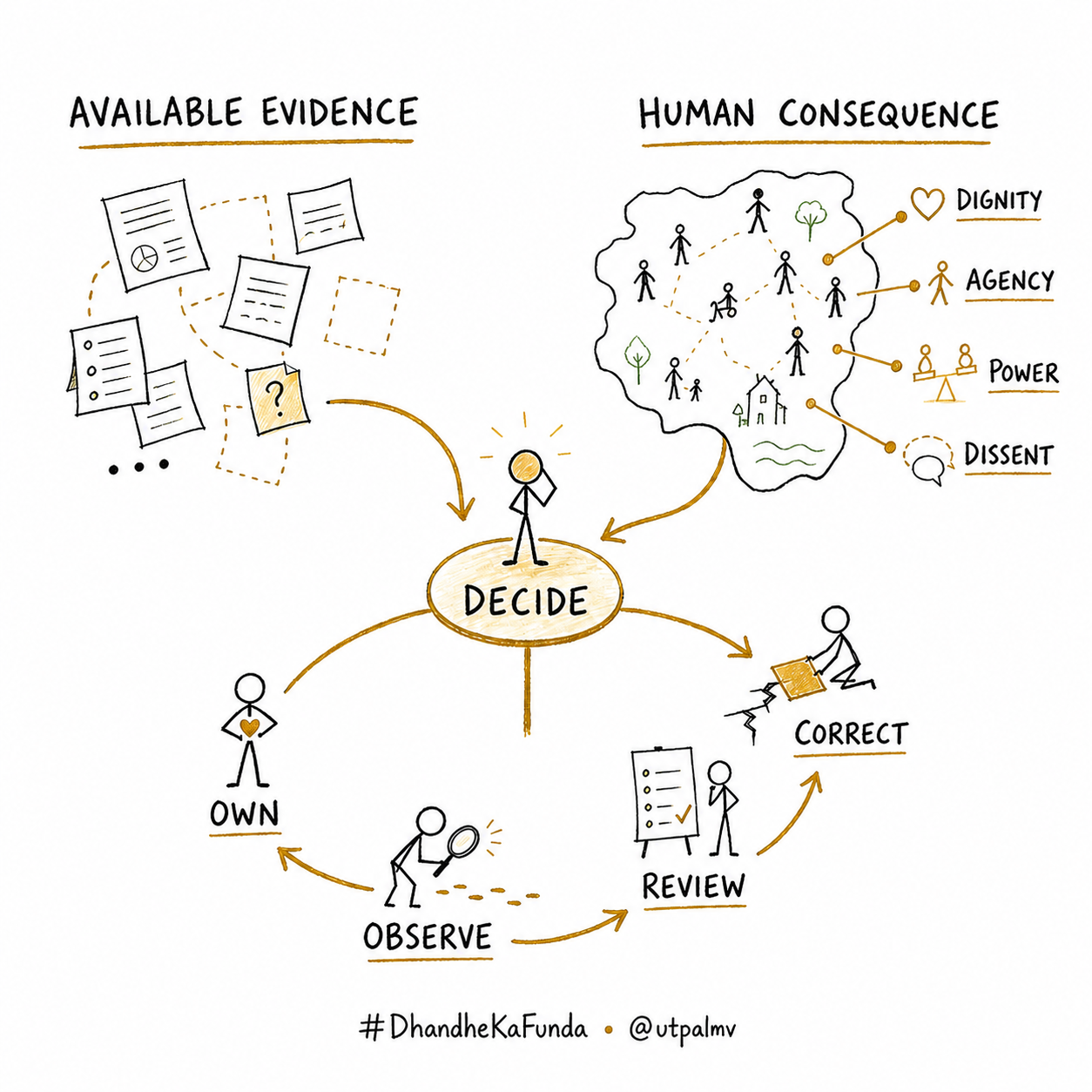
Empathetic brutalism is a discipline for consequential decisions. It asks us to face the system as honestly as the available evidence permits, while accounting for what the decision does to dignity, agency, power, and visible consequences.
The name holds a deliberate tension. Empathy without honesty can become avoidance. Honesty without empathy can become domination. Neither is enough.
The brutalism is directed at distortion, evasion, and convenient stories. It is not permission to be brutal with people.
Face what can be known
A consequential decision begins with reality, but reality does not arrive as a complete, neutral picture. Evidence can be partial. Measures can be misleading. The person with the most authority can still be wrong.
So the first obligation is epistemic humility. Separate what is observed from what is inferred. Name what remains unknown. Test the account against evidence that could change the decision, not only evidence that supports it.
This changes the language of honesty. Instead of declaring, "This is the truth," say what the evidence supports, how confident you are, and what would cause you to revise your view. Precision is stronger than certainty performed for effect.
See the human consequence
Empathy is not agreement, rescue, or protection from every difficult consequence. It is the work of seeing the people inside the system as people.
Ask who bears the cost, who receives the benefit, whose options narrow, and whose voice can be ignored without consequence to the decision-maker. Look beyond intent. A well-intended decision can still strip dignity, reduce agency, or concentrate power.
Visible consequences matter, but so do predictable consequences that appear later or elsewhere. The people closest to the impact often see these before those with formal authority do.
Make dissent possible
Power changes what can be said safely. An invitation to disagree is weak if disagreement risks status, livelihood, belonging, or access.
The person holding authority carries a larger burden. They must make dissent usable: ask for disconfirming evidence, hear affected people before the choice is fixed, provide a route to challenge the decision, and prevent retaliation. Where people cannot speak freely in the room, create another channel and protect it.
Do not confuse silence with consent. Do not call compliance alignment. Do not use urgency to erase participation when the decision can still be improved.
There are moments when time is genuinely constrained. Even then, name the constraint, narrow the decision to what is necessary, and preserve a way to review what was done.
Decide, then remain responsible
Empathetic brutalism does not end when the difficult sentence is spoken or the decision is announced. Responsibility continues through implementation and consequence.
State who owns the decision. Explain the evidence and tradeoffs in language the affected people can understand. Define what will be observed, when the decision will be reviewed, and what threshold would trigger correction or reversal.
If harm appears, do not hide behind good intent or procedural compliance. Acknowledge it, repair what can be repaired, and change the system that produced it. Accountability is not self-punishment. It is the refusal to abandon the consequence.
A practical decision protocol
For a consequential decision, work through these questions:
- What is the decision? State it plainly, including what is outside its scope.
- What do we know? Separate observations, interpretations, assumptions, and unknowns.
- What could prove us wrong? Seek evidence and perspectives that could change the choice.
- Who is affected? Examine dignity, agency, distribution of benefit and cost, and second-order consequences.
- Where is the power? Identify who decides, who can dissent, and what dissent may cost them.
- What alternatives remain? Compare viable options, including delay, a smaller intervention, or a reversible test.
- Who owns the consequence? Name the accountable decision-maker, the review date, and the correction path.
- How will we communicate? Be direct about the decision, evidence, uncertainty, tradeoffs, and next review.
The protocol does not remove judgment. It makes judgment more inspectable.
Failure modes
Empathetic brutalism fails when honesty becomes a performance of certainty, when empathy becomes an excuse to avoid a necessary decision, or when authority uses directness to close discussion.
It also fails when the process becomes theater: dissent is requested after the choice is fixed, evidence is selected to justify a preference, responsibility is diffused across a committee, or a review date arrives with no real willingness to change course.
The standard is not whether the decision felt hard or sounded candid. The standard is whether it faced the system honestly, protected the conditions for agency and dissent, made power visible, and remained accountable for consequences.
#DhandheKaFunda: Face the evidence without pretending it is complete. See the people without avoiding the decision. Own what happens next.
Use this workExplore with AI
Explore this canon
Take this work into your preferred AI system. Choose a ready-made prompt or add your own context. Nothing you enter here is sent or saved by utpalmv.com.
Use the work as a thinking lens without adding personal context.
Optional. Add details when you want the exploration grounded in your situation. Your context remains in this page and is included only in the prompt you copy.