

Owning a company does not guarantee an ownership mindset. Having a job does not prevent one.
I use renter and owner as descriptions of how we sometimes relate to work, not as permanent identities. The distinction can be useful, but only if it helps us examine a situation rather than rank people.
A renter stays inside the narrowest interpretation of an agreement. An owner notices what the agreement may have missed. If the roof is leaking, the renter may reasonably call the person responsible for repairs. The owner may act immediately because delay will make the damage worse.
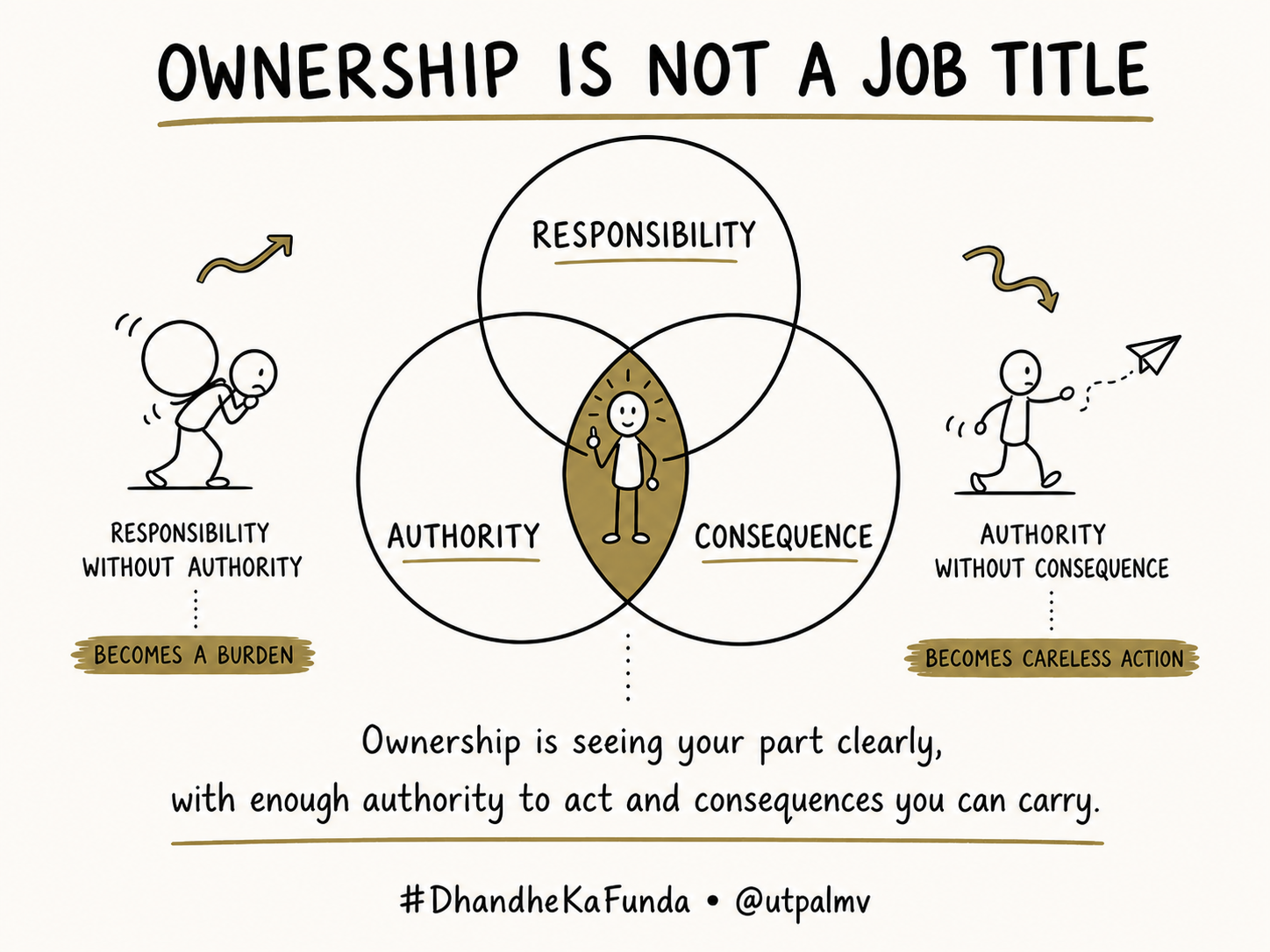
Neither response is automatically right. Ownership without authority can become interference. An organization that praises initiative while withholding information, access, or decision rights is asking people to carry responsibility they cannot exercise. “Take ownership” can also become a convenient way for leaders to transfer risk downward without transferring power.
The useful form of ownership begins with seeing the whole situation. What outcome are we responsible for? What is at risk? What can I decide? What requires consent, expertise, or escalation? If a gap falls outside my role, can I still make it visible and stay with it until the right person accepts it?
This is different from treating every problem as mine. Total responsibility sounds admirable until it produces duplication, exhaustion, or one person quietly compensating for a weak system. Mature ownership includes knowing where responsibility should move.
The same person can act as an owner in one context and a renter in another. I have done both. Sometimes I have stepped beyond a job description because the outcome mattered and waiting would have been costly. At other times, staying within a boundary was the responsible choice because somebody else held the knowledge, authority, or risk.
Entrepreneurship is one place where ownership becomes unavoidable because consequences arrive quickly. But the practice is not reserved for entrepreneurs. It appears whenever someone looks beyond the assigned task, understands the consequence, and acts within honest limits to improve the outcome.
Ownership is not a title. It is a relationship with responsibility, authority, and consequence. The test is not whether I can claim the whole problem. It is whether I can see my part clearly and help the work move without pretending that every part belongs to me.
Use this workExplore with AI
Explore this journal
Take this work into your preferred AI system. Choose a ready-made prompt or add your own context. Nothing you enter here is sent or saved by utpalmv.com.
Use the work as a thinking lens without adding personal context.
Optional. Add details when you want the exploration grounded in your situation. Your context remains in this page and is included only in the prompt you copy.