

Logic is essential. But logic has a limitation. It is exceptionally good at reasoning from what already exists.
Creation asks a different question: what should exist that does not exist yet? That changes the sequence.
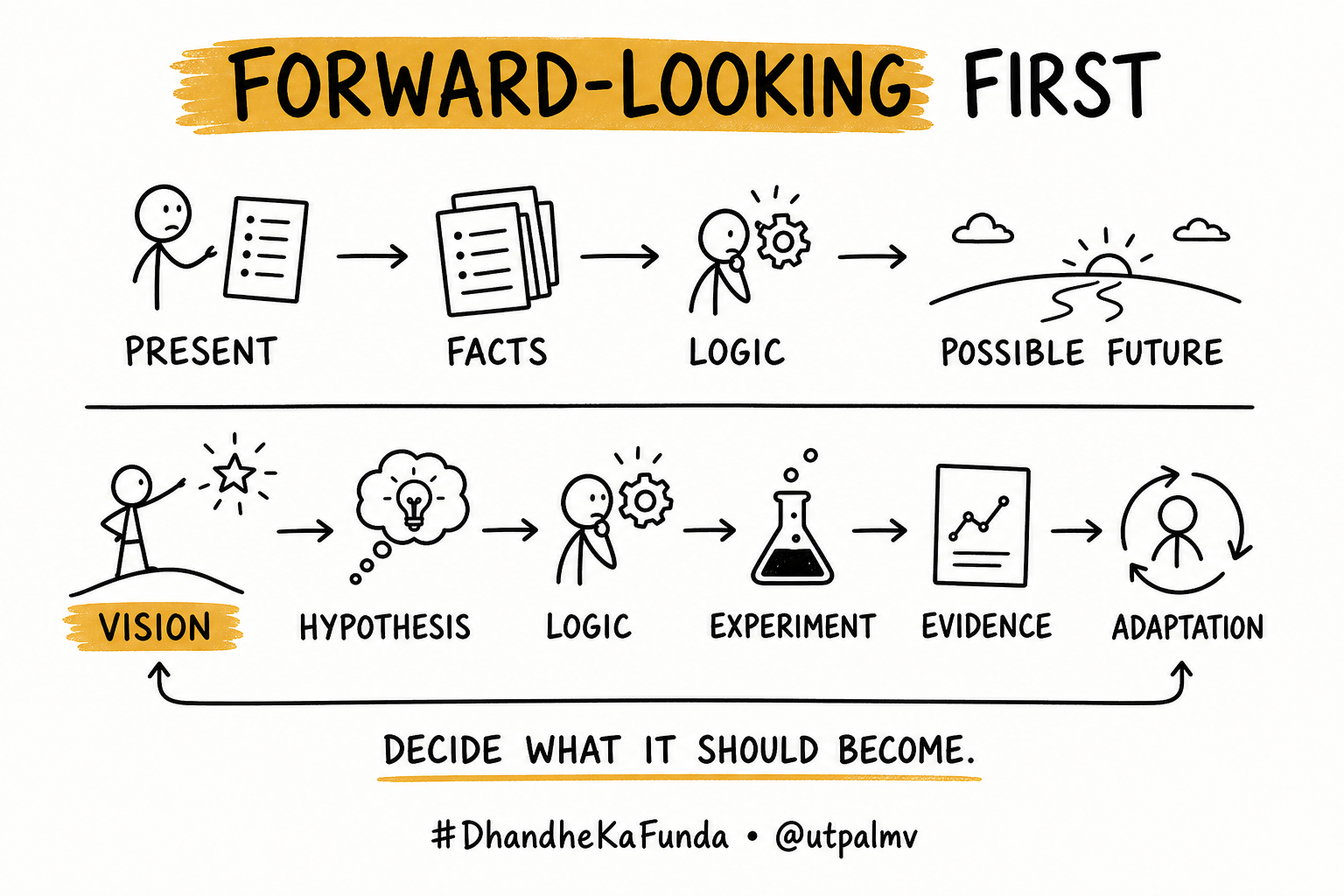
Most of us are trained to look at the present, collect the facts, apply logic, and determine what is possible.
Present → Facts → Logic → Possible Future
This works wonderfully when solving known problems. It can fail badly when creating something new. Because today's facts can give us perfectly logical reasons why tomorrow's possibility cannot exist. The evidence for a new future often arrives only after someone starts creating that future.
Decide what it should become
A builder sometimes needs to reverse the sequence.
First: what should it become? Not what can it become based on everything we know today. Not what is the safest version. Not what can be defended in a spreadsheet. What should it become?
Then bring logic back. Ruthlessly.
Vision → Hypothesis → Logic → Experiment → Evidence → Adaptation
Vision determines the destination. Logic helps us navigate. Evidence tells us when to change the route.
This is not an argument against logic. It is an argument about when logic gets its turn. If logic gets the first vote, the future is constrained by the present. If vision gets every vote, we enter fantasy. If evidence never gets a vote, vision becomes stubbornness.
Creation needs all three. Just in the right sequence.
Forward-looking first
I have started thinking of this as being forward-looking first rather than present-logic first.
A present-logic-first person asks: given everything we know today, what can we reasonably do?
A forward-looking-first builder asks: what future is worth creating? And then: what must become true for that future to exist?
That second question creates hypotheses. Hypotheses create experiments. Experiments create evidence. Evidence improves logic. And eventually, something that once looked unreasonable becomes obvious.
We have seen this repeatedly with technology. Before something becomes normal, there is usually a period when explaining why it will not work is easier than building it. After it works, everyone can explain why it was inevitable. The interesting work happens in between.
Frugal while building. Expansive while promoting.
There is another duality here. Frugal while building. Expansive while promoting.
Creation does not require careless spending. Quite the opposite. When the hypothesis is still uncertain, build intelligently. Use small teams. Reduce complexity. Test cheaply. Preserve optionality.
But don't make the ambition equally small. Think disproportionately big about distribution, positioning, opportunity, impact.
The experiment can be small. The imagination doesn't need to be.
Build yourself out of the critical path
There is one more consequence of thinking forward.
In the beginning, creators are often linchpins. That is natural. The founder knows the context. The architect knows the system. The creator carries much of the vision.
But being a linchpin and being a single point of failure are not the same thing. One creates leverage. The other destroys optionality.
A good builder therefore builds two things simultaneously: the thing, and the system that can eventually build the thing without them.
That is a strange transition. Initially, your presence increases the probability of success. Eventually, excessive dependence on your presence decreases the value of what you created.
Perhaps one measure of leadership is therefore: can what I created continue creating without me?
The creator's contract
None of this guarantees success. That is not the contract.
The contract is to give a worthy hypothesis everything it reasonably deserves. Build frugally. Promote expansively. Commit deeply. Measure honestly. Change when evidence demands change. Stop when the hypothesis no longer deserves capital, time, or attention.
But don't allow today's logic to reject tomorrow's possibility before you have even run the experiment.
First decide what it should become. Then use logic ruthlessly. Then let reality answer.
That is what I mean by Forward-Looking First.
#DhandheKaFunda
Use this workExplore with AI
Explore this journal
Take this work into your preferred AI system. Choose a ready-made prompt or add your own context. Nothing you enter here is sent or saved by utpalmv.com.
Use the work as a thinking lens without adding personal context.
Optional. Add details when you want the exploration grounded in your situation. Your context remains in this page and is included only in the prompt you copy.