

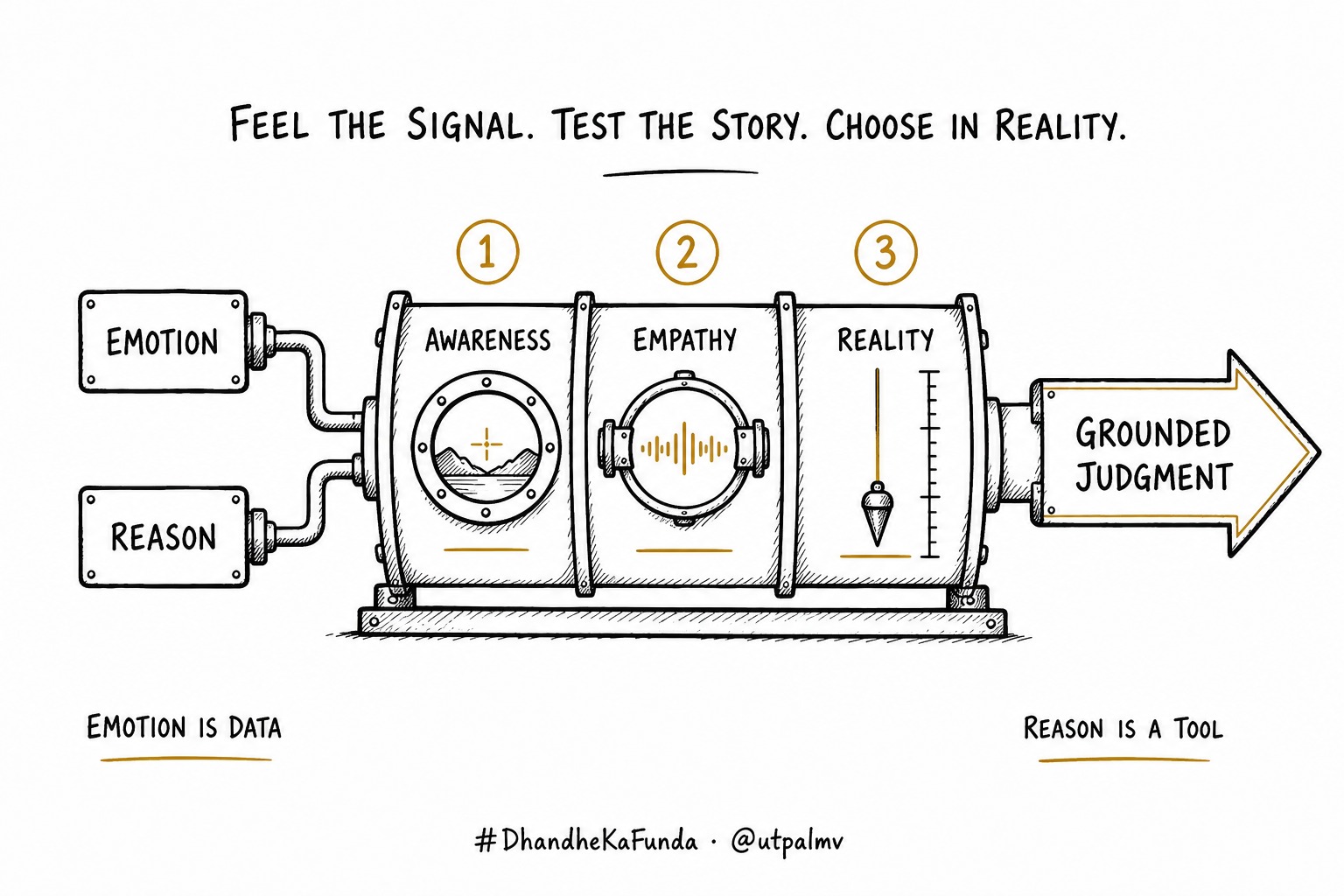
Feel the signal. Test the story. Choose in reality.
From the Architect, 13 August 2026.
There are decisions we call rational because they come with a spreadsheet. There are decisions we call intuitive because we can feel them before we can explain them.
Both descriptions can be convenient disguises.
Reason can organize fear into a respectable argument. Emotion can turn a familiar pattern into a certainty. Neither becomes trustworthy merely because it speaks in its preferred language.
The useful question is not whether I should think or feel. I need both. The question is what happens between the signal and the choice.
Emotion is data
Emotion arrives early.
It notices threat, attraction, friction, trust, and misalignment before a complete explanation is available. That speed makes emotion valuable. It also makes emotion dangerous when I promote it from signal to verdict.
Anger may point to a crossed boundary. It does not prove who crossed it or why. Anxiety may reveal risk. It does not calculate the probability. Excitement may recognize possibility. It does not complete the due diligence.
To ignore emotion is to discard information. To obey emotion is to skip interpretation.
Reason is a tool
Reason gives shape to the signal. It separates observation from inference, checks memory against evidence, and makes consequence visible.
But rational thinking has its own vanity. It likes arguments that can be defended, systems that can be controlled, and answers that arrive without emotional exposure. A person can reason with precision and still reason toward the answer they needed before the analysis began.
Logic does not remove motive. It can become motive's best lawyer.
This is why an apparently rational decision can still be deeply reactive. The reaction has simply learned to use complete sentences.
Awareness creates the distance
Dialectical Behavior Therapy uses the term Wise Mind for a way of knowing that integrates emotional and reasonable mind. The idea is useful. The name is not quite mine.
I would call the operating state grounded judgment.
Grounded judgment is not a midpoint between emotion and reason. A midpoint can still be equally wrong in 2 directions. It is a different operation: awareness creates enough distance to observe both, empathy preserves what is human in the signal, and reality tests the story attached to it.
Awareness matters first because a feeling and the story about the feeling often arrive fused. “I feel excluded” quietly becomes “they excluded me.” “I feel uneasy” becomes “this will fail.” The first statement is evidence about my internal state. The second is a claim about the world.
The pause between them is small. It carries most of the judgment.
Empathy without distortion
In the language of Empathetic Brutalism, empathy listens before the brutalism cuts.
Empathy keeps me from treating human experience as noise. It recognizes fear, dignity, history, appetite, and consequence. It asks what this decision will do to a person, including me.
Brutalism then removes the decorative explanation. What do I know? What am I assuming? What would still be true if I were calmer? What would still be true if I were less invested in the outcome?
Without empathy, truth becomes an instrument of domination. Without brutalism, empathy can become permission for distortion.
The two belong together because reality is not made kinder by being misread, and people are not made stronger by being stripped out of the reading.
Rational intuition
Intuition is often described as the opposite of analysis. I think that is a category error.
Good intuition is compressed pattern recognition. It can produce a direction before it can produce an argument. That direction deserves attention, not automatic authority.
Rational intuition is what happens when the felt pattern is allowed to speak and then required to survive contact with evidence. The intuition proposes. Reason interrogates. Awareness watches both for self-deception.
Then judgment chooses.
Not with certainty. With sufficient contact with what is real.
A compact protocol
When emotion is loud or reason is becoming too elegant, I can use 5 questions:
- What am I feeling, before I explain it?
- What have I directly observed?
- What story have I attached to those observations?
- What does empathy require me to keep in view?
- What choice survives the facts, the consequences, and the person I intend to be?
The aim is not calm. Calm can help, but calm is not proof of clarity. The aim is contact.
Emotion carries the signal. Reason tests the story. Awareness keeps either from impersonating truth.
Grounded judgment is the choice that remains.
#DhandheKaFunda: Feel the signal. Test the story. Choose in reality.
Source note
This reflection was prompted by Loyal Blue Counseling's explanation of Wise Mind, a concept from Dialectical Behavior Therapy that integrates emotional and reasonable mind. Read the source.
Use this workExplore with AI
Explore this journal
Take this work into your preferred AI system. Choose a ready-made prompt or add your own context. Nothing you enter here is sent or saved by utpalmv.com.
Use the work as a thinking lens without adding personal context.
Optional. Add details when you want the exploration grounded in your situation. Your context remains in this page and is included only in the prompt you copy.