

Imagine a software team with 12 people and 40 AI agents.
The agents can inspect code, propose architecture, write tests, open pull requests, and prepare a release. A human still approves production deployment. Then one agent changes a shared dependency, another optimizes against an incomplete test, and a third produces a confident explanation of why the release is safe.
Who is leading whom?
Path-goal theory was built around a practical idea: leaders improve motivation, satisfaction, and performance by helping people see a path to worthwhile goals, removing obstacles, and providing what the person or environment lacks.
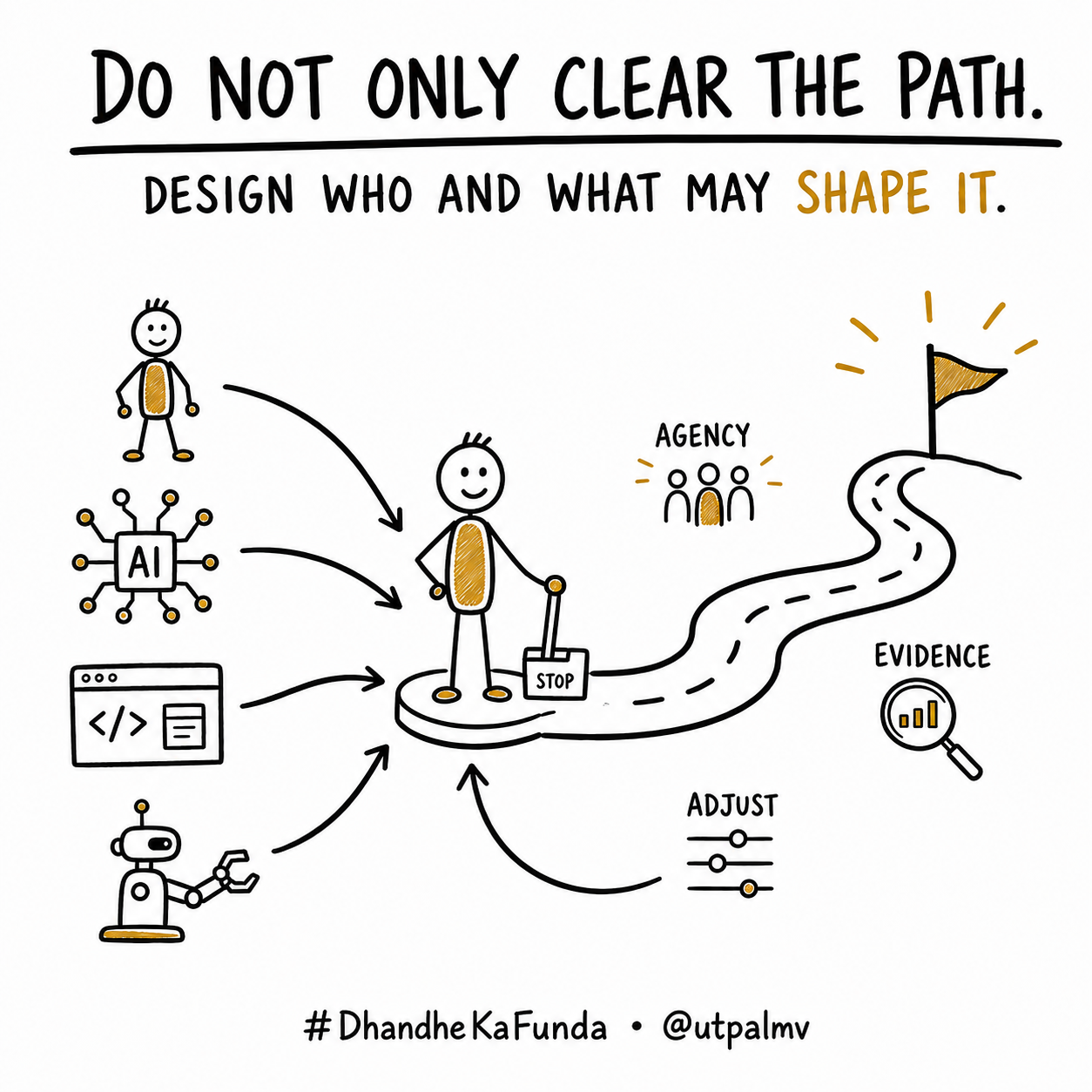
That idea remains useful. But the path now contains autonomous systems. The environment can observe, recommend, generate, decide, and act. Leadership therefore has to move beyond choosing a style. It has to design agency.
What path-goal theory got right
Robert House's original path-goal theory described 4 familiar leadership behaviors:
- Directive: clarify expectations, procedures, and standards.
- Supportive: attend to people's needs and make difficult work more humane.
- Participative: involve people in decisions that affect the work.
- Achievement-oriented: set challenging goals and express confidence in people's abilities.
The theory did not argue that one behavior was always superior. Leader behavior was expected to work differently depending on the person, task, and environment.
This contextual logic is the theory's durable center.
House's 1996 reformulation widened the model to 8 classes of behavior. It added work facilitation, group-oriented decision processes, work-group representation and networking, and value-based leadership. It also placed greater emphasis on empowerment, abilities, work-unit effectiveness, and the conditions under which a behavior might help or fail.
That reformulation matters because it shows that path-goal theory was never meant to stop at a four-style personality quiz. It was a developing account of how leadership behavior can complement what a working system needs.
It also remains a theory with contested evidence. A meta-analysis of 120 studies found support for some moderators, inconsistent results for others, and substantial weaknesses in the research base. Any AI-age extension should therefore be offered as a set of testable propositions, not as a finished law of leadership.
What changed
Classic path-goal theory largely assumes a human leader, human subordinates, and a work environment around them. Human-AI work changes all 3.
The environment became an actor
An AI coding agent can alter the work it was asked to inspect. A robot can convert a decision into physical movement. A recommendation system can change what users, operators, or managers see next.
The environment is no longer only a source of obstacles and support. Parts of it now exercise delegated agency.
The path became partially observable
People may not know which data shaped an output, which tools an agent called, which intermediate decisions it made, or how another agent changed the context. The system may reach the requested result through a path nobody intended.
Clarifying the goal is no longer enough. The path itself needs an appropriate degree of visibility.
Performance became an incomplete outcome
An AI system can improve speed while reducing reliability. A robot can improve throughput while making operators less able to detect or recover from failure. A software agent can close more tickets while increasing security risk.
Performance, satisfaction, and motivation still matter. So do safety, rights, quality, resilience, reversibility, and the distribution of consequences.
Leadership can become fluid without becoming ownerless
In a human-autonomy team, the member best placed to guide the next action may change with the situation. Research on human-autonomy teaming treats leadership as potentially fluid while generally retaining higher-level human objectives and constraints.
An AI agent may lead a search, sequence a diagnostic procedure, or coordinate a bounded response. That does not erase the human and organizational responsibility for deciding what authority the agent receives, under which conditions, and with what means of intervention.
A proposed extension: from path-goal to path-goal-agency
The original model asks how leader behavior can complement the person and environment. The proposed extension asks how leadership can configure a human-machine system so that agency remains aligned, legible, bounded, and correctable.
It adds 6 design questions.
1. Is the goal still worth pursuing?
AI makes it easier to optimize a stated objective. It does not make the objective sound.
Before clearing the path, ask who benefits, who carries the risk, which tradeoffs are hidden, and what evidence would justify changing or abandoning the goal.
2. Where does agency sit?
Map who or what can recommend, decide, act, approve, override, and stop.
Do not treat “human in the loop” as an answer. Name the human, the decision, the information available, the time allowed, and whether intervention is realistically possible.
3. How legible must the path be?
Not every intermediate machine operation requires human inspection. But the system needs enough traceability for the consequence involved.
A reversible formatting change and a production authentication change should not carry the same evidence or approval burden.
4. Which leadership behavior does the system need now?
Direction, support, participation, challenge, facilitation, representation, and values remain useful behaviors. The choice should depend on uncertainty, capability, time pressure, reversibility, and potential harm.
The behavior should also be explained. Unexplained flexibility looks like inconsistency. Explained flexibility helps the team update its shared understanding.
5. What evidence will change the response?
Every chosen response should carry an observation plan.
What will we measure? Which weak signals matter? Who can challenge the interpretation? What result would make us reduce autonomy, widen participation, change direction, or stop?
6. Can authority be withdrawn safely?
Delegation without revocation is surrender.
The system needs a practical way to pause, roll back, isolate, override, or decommission an agent or machine. Revocability is part of leadership design, not merely an emergency feature.
The resulting loop is:
Goal integrity → agency map → path legibility → leadership response → evidence → adjustment or revocation
How the classic behaviors change
| Path-goal behavior | Human-AI application | Failure to watch |
|---|---|---|
| Directive | Define authority, constraints, evidence, escalation, and stop conditions | Turning oversight into approval theater |
| Supportive | Protect the ability to question automation, report uncertainty, and recover from system strain | Treating discomfort as resistance to technology |
| Participative | Include builders, operators, domain experts, affected people, and accountable decision makers | Inviting input after the consequential choices are fixed |
| Achievement-oriented | Set demanding goals with explicit quality, safety, and rights constraints | Optimizing a visible metric while exporting hidden costs |
| Work facilitation | Remove tool, data, coordination, and capability barriers | Automating a broken path faster |
| Group decision process | Decide how humans and agents contribute to judgment | Mistaking aggregated output for collective understanding |
| Representation and networking | Connect the team to external expertise, oversight, and affected parties | Keeping system knowledge inside the builder group |
| Value-based | Make non-negotiable boundaries visible when tradeoffs become difficult | Publishing values that have no effect on decisions |
Three experiments a team can run
These are not tests of the full theory. They are bounded ways to examine whether the extension improves a real working system.
Experiment 1: Map agency before adding autonomy
Choose one workflow in which an AI agent or robot can influence an outcome.
Write the six verbs on a page: recommend, decide, act, approve, override, stop. Assign each verb to a named person, role, system, or shared protocol. Mark any verb with no clear owner or more than one conflicting owner.
Run the workflow once without changing authority. Observe where people assumed the machine or another person was responsible. Then correct one ambiguity and run it again.
What to learn: whether an agency map reduces hesitation, duplicated control, or ownerless action.
Experiment 2: Match leadership response to reversibility
Select two tasks with similar effort but different consequences. For example, ask an AI coding agent to improve internal documentation and to modify authentication logic.
Keep the delivery goal clear in both cases. Change the autonomy, review evidence, approval, and stop conditions according to reversibility and potential harm.
What to learn: whether the team can vary control without treating every AI-assisted task as either harmless or forbidden.
Experiment 3: Make adaptation visible
For one week, record every meaningful change in leadership response:
- What changed in the situation?
- Which behavior changed?
- Why was the change made?
- What evidence should show whether it helped?
Review the log with the team. Ask whether each shift felt responsive, arbitrary, too late, or unnecessary.
What to learn: whether explaining the response improves shared understanding and whether the evidence supports the leader's interpretation.
Propositions worth testing
For researchers and universities, the extension suggests a practical research agenda. These propositions are deliberately falsifiable.
- Agency-fit proposition: leadership behavior will produce better human-AI team outcomes when decision and action authority match capability, risk, and reversibility.
- Legibility proposition: the fit between leadership behavior and context will matter more when the reason for changing behavior is visible to the team.
- Revocability proposition: delegated machine autonomy will support performance and trust more reliably when people can detect problems and withdraw authority in time.
- Participation-boundary proposition: participative behavior will improve decision quality only when participation includes relevant operators, domain experts, accountable owners, and materially affected parties.
- Plural-outcome proposition: leadership systems evaluated across performance, safety, quality, resilience, rights, and recovery will make different autonomy choices than systems evaluated primarily for output.
- Shared-model proposition: path clarification in human-AI teams will depend not only on human understanding of the goal, but also on a workable shared model of roles, capabilities, limits, and handoffs.
Possible studies could compare teams with and without an explicit agency map, test whether response explanations moderate trust and performance, or examine how revocability changes reliance on an AI teammate under time pressure. Research on shared mental models in human-AI teams provides one foundation for defining and measuring the shared-model proposition.
What becomes possible
Path-goal theory began by asking how a leader could help people travel a difficult path. In the AI age, that question can grow without losing its center.
Leadership can become the deliberate design of a path across human and machine capability. An AI agent can clarify, facilitate, or coordinate within a bounded domain. People can retain meaningful judgment instead of serving as ceremonial approvers. Authority can expand when evidence supports it and contract when conditions change.
The NIST AI Risk Management Framework calls for clear responsibilities, multidisciplinary perspectives, ongoing monitoring, and defined human oversight. A path-goal-agency lens can make those governance requirements operational at the level of everyday leadership behavior.
The takeaway is compact:
Do not only clear the path. Decide who and what may shape it, make the consequential parts visible, and preserve the power to change course.
Historical source note
This essay grows from “Path-Goal based approach in project leadership,” which I published on PMCraft on April 22, 2010. The present work retains its contextual question, incorporates the theory's later development, and proposes a testable extension for human-AI and human-robot systems.
Use this workExplore with AI
Explore this journal
Take this work into your preferred AI system. Choose a ready-made prompt or add your own context. Nothing you enter here is sent or saved by utpalmv.com.
Use the work as a thinking lens without adding personal context.
Optional. Add details when you want the exploration grounded in your situation. Your context remains in this page and is included only in the prompt you copy.