

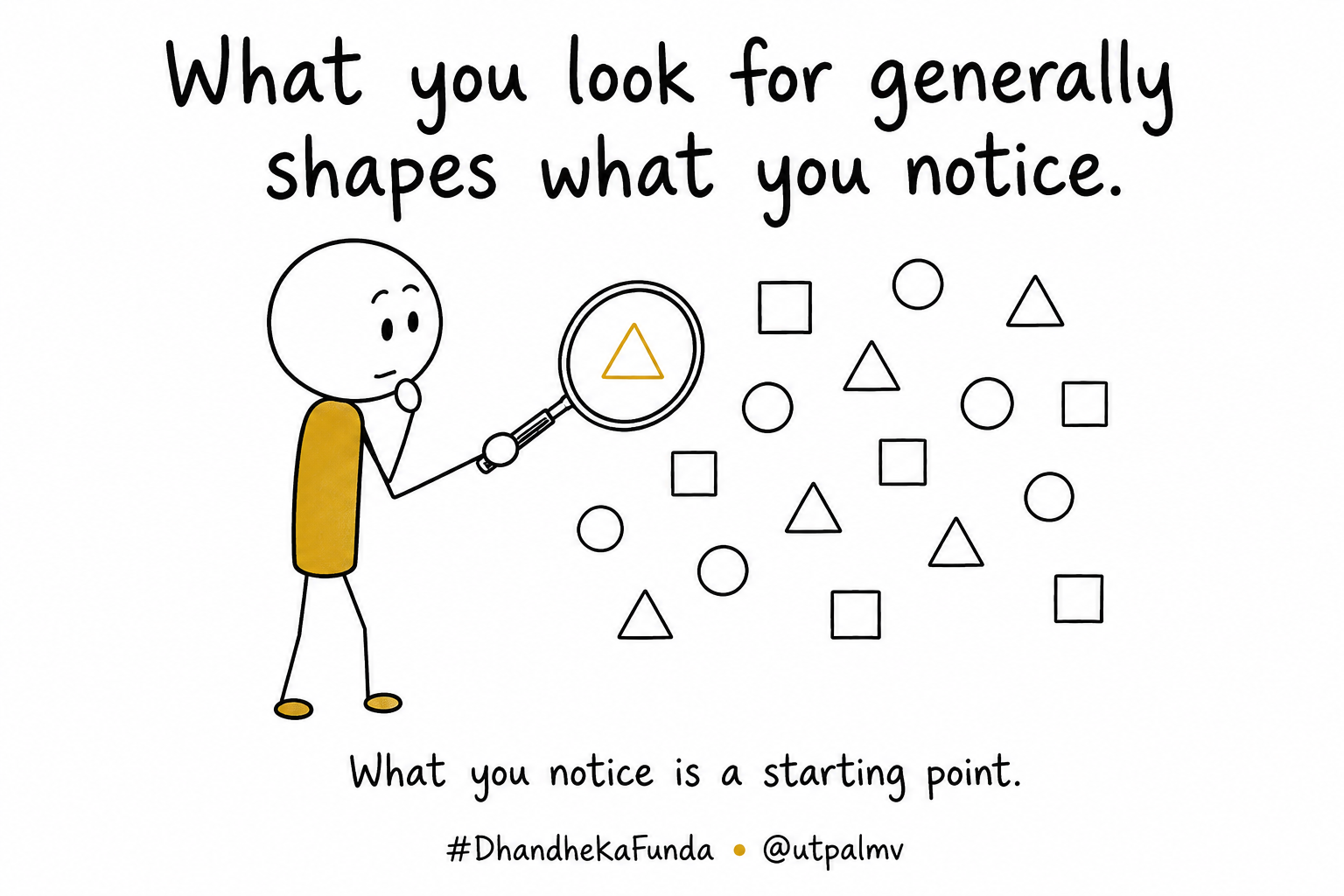
What you look for can shape what you notice.
If you start looking for a red Tesla, you may notice more of them. That does not necessarily mean there are more on the road. Your attention may have changed.
In a small laboratory study, directing attention to a color increased responses in visual cortical areas to other stimuli sharing that color. This supports a limited point about selective attention. It does not establish that the RAS acts as a programmable filter for everything you experience. [1]
Looking for opportunities
Looking only for what could go wrong may leave other possibilities unexplored. That is a useful question to ask yourself, not a biological explanation for wealth or poverty.
Believing that opportunity exists does not establish that a particular opportunity is real or valuable. It still needs examination.
Define what you are looking for
Try making the search specific.
“I am looking for a partner who knows supply chain” gives you something concrete to look for. Write it down. Review it in the morning. When something promising appears, examine it.
Treat this as a practice for directing attention, not a proven way to reprogram your brain or guarantee success.
What you notice is a starting point. What you do with it still matters.
Source
- Saenz, Buracas, and Boynton, “Global effects of feature-based attention in human visual cortex,” Nature Neuroscience, 2002. The experiments used controlled visual stimuli, with three participants in each experiment. They did not test car purchasing, business opportunities, or financial outcomes.
Use this workExplore with AI
Explore this journal
Take this work into your preferred AI system. Choose a ready-made prompt or add your own context. Nothing you enter here is sent or saved by utpalmv.com.
Use the work as a thinking lens without adding personal context.
Optional. Add details when you want the exploration grounded in your situation. Your context remains in this page and is included only in the prompt you copy.