

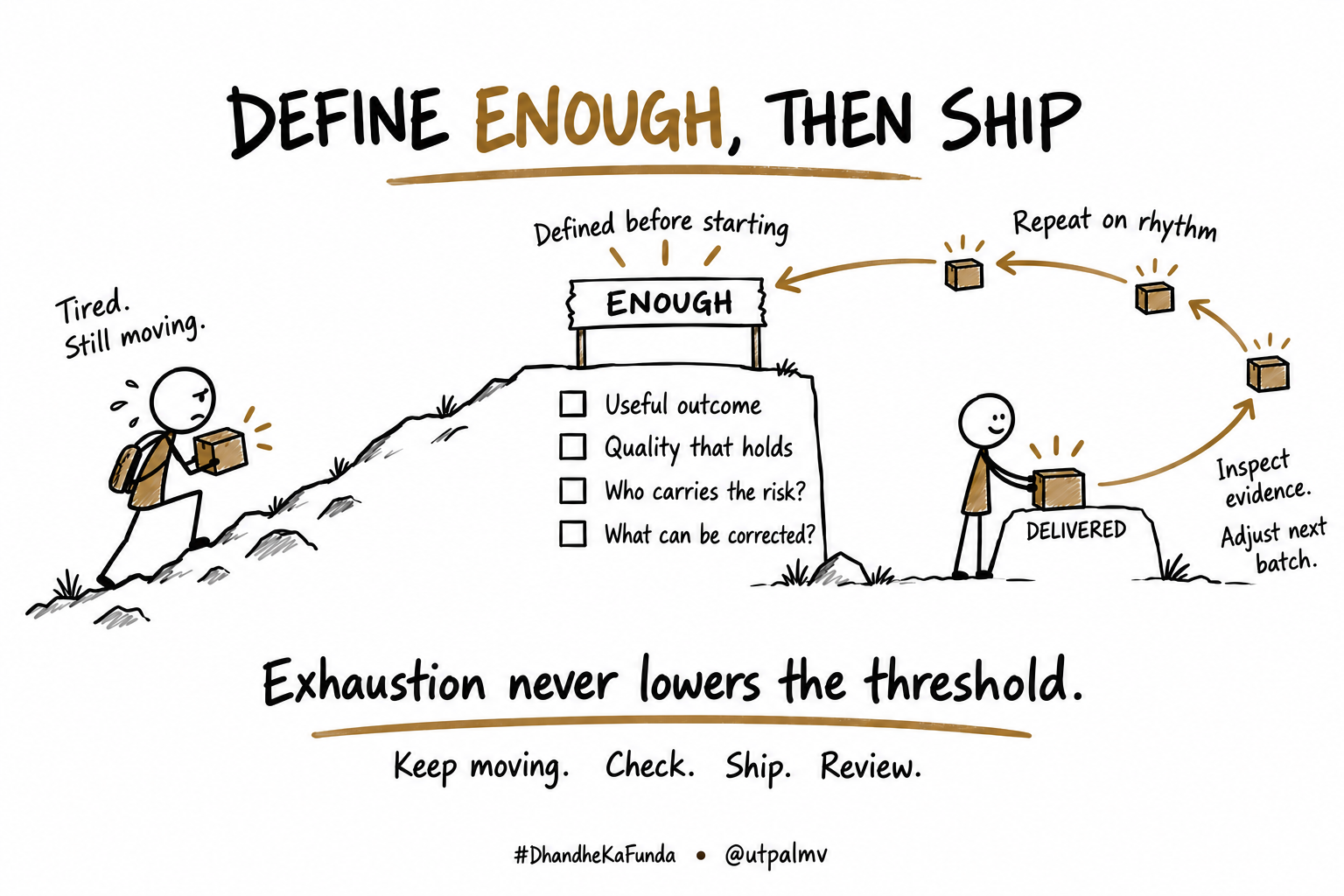
Decide what enough means before you start. When the work reaches it, ship. Move the line only for a reason you can name. Feeling uncomfortable about showing the work is not that reason.
Define the delivery
Write the Minimum Viable Delivery before starting. Name the useful outcome, who it serves, and the quality you will not trade away.
Keep the batch small. It still has to deliver something useful. More releases mean little if none helps the person who receives the work.
In Ship an imperfect product, I explain why enough needs an explicit standard; here, I put that standard into practice.
Make cadence a practice
Set a rhythm for completing, checking, releasing, and reviewing small batches. Follow it without waiting for inspiration.
In 2012 I wrote about the mountaineer who keeps moving when exhausted. I still hold it: even exhausted, the master keeps moving.
Exhaustion never lowers the threshold and never excuses stopping. If the batch is not ready, narrow it, run a private trial, or fix what blocks it. Keep moving toward a release that meets the standard. Do not wait for energy to return.
Shipping is a muscle, not a mood: define enough, name who carries the risk, then release on rhythm.
Look at your lurking time. When you are watching others ship or gathering more information, ask: what decision is this research serving? Give the research a job and a stopping point.
Check the consequences
Before release, answer four questions:
- What useful outcome does this version give the user?
- Which quality conditions must hold even while other parts are rough?
- Who carries the risk if it fails, and how will you notice the failure?
- What can be corrected, and what damage would remain?
Use the answers to decide whether the batch meets the threshold. The deadline alone does not answer them.
When to hold the release
Hold the release when essential quality is missing, a serious failure would go undetected, or its consequences exceed what you are prepared to carry. Keep working on what makes the batch ready.
Safety, payments, and personal data raise the threshold. A release is not ready just because its visible features work.
Shipping creates evidence. It does not guarantee learning or success. After release, review what happened and change the next batch accordingly.
Source note
This protocol develops the delivery and exhaustion argument in Keep delivering, published January 7, 2012. The retained WordPress capture identifies that work at its historical URL.
It also draws on the August 20, 2026 Journal adaptation Ship an imperfect product, whose source note identifies the original PMCraft note of December 16, 2012.
Use this workExplore with AI
Explore this canon
Take this work into your preferred AI system. Choose a ready-made prompt or add your own context. Nothing you enter here is sent or saved by utpalmv.com.
Use the work as a thinking lens without adding personal context.
Optional. Add details when you want the exploration grounded in your situation. Your context remains in this page and is included only in the prompt you copy.
Revision record
: Reworked the protocol around an explicit Minimum Viable Delivery, release consequences, and a repeatable cadence. Removed unsupported numerical claims, added limits and provenance, restated the exhaustion position, changed the subtitle, and connected the protocol to Ship an imperfect product. Earlier wording remains below as history.
Earlier wording: retained pre-revision version
The Shipping Protocol: Why Done is Better Than Safe
This earlier version was observed September 27, 2026. Its source modification date was February 23, 2026. The current protocol appears above.
Creativity is an act of exposure. Every time you commit code, hit "Publish," or launch a product, you are handing the world a stick to beat you with.
The natural response to this risk is Delay. We call it "polishing," "researching," or "waiting for the right time." In reality, it is fear masquerading as excellence.
The Hazard of the Safe Harbor
A passive life feels safe because it is quiet. But in a global, high-velocity economy, "Quiet" is synonymous with "Obsolete."
If you aren't shipping, you aren't learning.
If you aren't learning, you are decaying.
The most dangerous place to be is in the "Safe Harbor" of the known. While you are polishing your perfect idea in the harbor, the world is being reshaped by people who are willing to ship "Good Enough" and iterate in public.
The Exhaustion Threshold
The original post used the metaphor of a mountaineer. Everyone gets exhausted. The difference between the master and the amateur isn't that the master has more energy; it's that the master has systematized their exhaustion.
They don't wait for "inspiration" or "energy." They follow a shipping cadence that is independent of their mood.
The Protocol: The Ship-to-Learn Loop
To move from a passive consumer to a Sovereign producer, you must adopt a Shipping Protocol:
Reduce the "Batch Size": Stop trying to ship the "Grand Masterpiece." Break your work into the smallest possible units that provide value. If it takes 6 months to ship, you only learn once every 6 months. If it takes 6 days, you learn 25 times more often.
Define "Good Enough" Early: Before you start, define the "Minimum Viable Delivery." Once you hit that mark, you ship. Anything beyond that is "Gold Plating" and is subject to the law of diminishing returns.
Audit Your "Lurking Time": How much time do you spend watching others ship versus shipping yourself? If the ratio is higher than 2:1, you are in the Safe Harbor.
#DhandheKaFunda: Shipping is a muscle. If you don't use it, it atrophies. Don't wait for the work to be perfect; ship it so the market can tell you how to make it better.