

The bystander effect names something narrow. A room full of people watches an emergency and nobody moves, because responsibility spreads thin enough that no single person feels they are carrying it.
I keep seeing a version of it now, with a machine in the room.
Nobody announces it. That is what makes it hard to catch. It shows up as a small pause where thinking used to be. The model probably handled it. Someone will check. The draft looks fine.
None of those are decisions. They are assumptions, and assumptions do not leave a trace you can review later.
What worries me is where this concentrates. Not at the entry level, where people are still proving they can think and know it. Further in. Fifteen years in, with a title, a scope, and enough pattern recognition to know which meetings actually matter.
That professional has the most context in the room and often contributes the least judgment. They forward. They align. They wait for the direction to become obvious, then support it competently.
Here is the part I do not want to soften. In many organizations, this reading is correct in the short run. Nothing bad happens when you stop thinking. The person who raises the awkward objection absorbs the cost. The person who defers absorbs nothing.
So it is not always laziness. Sometimes it is an accurate response to a system that punishes judgment and pays for compliance. Two different things can look identical from the outside, and I think we mislabel them often.
The distinction matters because the fixes are opposite. One person needs a push. The other needs the incentive changed, and no amount of encouragement will substitute.
What I am confident about is the boundary.
You can outsource retrieval. You can outsource drafting, structuring, first passes, and most of the work that used to fill a week. That trade is straightforwardly good.
You cannot outsource what you consider worth doing. You cannot outsource the decision to speak when the room has settled. You cannot outsource being the one who is wrong in public.
Those three are the actual job now. Everything else is being absorbed, quickly.
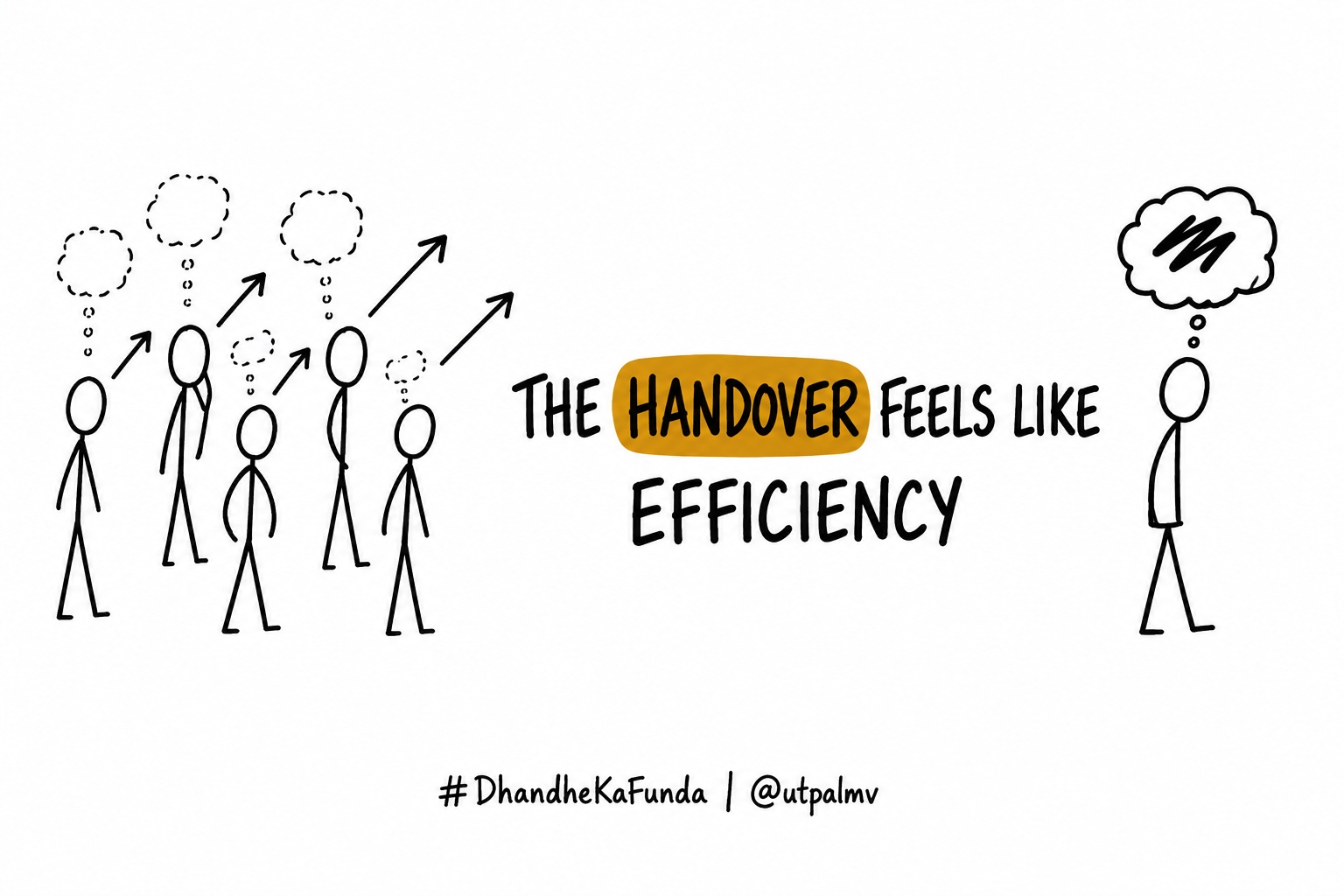
I do not think most people are choosing to give them up. They just don't notice the moment they hand them over, because the handover feels like efficiency.
The machine will keep getting better at the parts that can be handed over. That leaves a smaller set of things that are unmistakably yours, which is either a loss or the clearest job description anyone has had in a while.
Use this workExplore with AI
Explore this journal
Take this work into your preferred AI system. Choose a ready-made prompt or add your own context. Nothing you enter here is sent or saved by utpalmv.com.
Use the work as a thinking lens without adding personal context.
Optional. Add details when you want the exploration grounded in your situation. Your context remains in this page and is included only in the prompt you copy.