

Tools can improve execution, but they cannot decide which problem deserves attention. The Strategy Stack is a five-layer diagnostic for connecting thinking, action, decisions, adaptation, and leadership.
The layers move from the inside out. That sequence is a guide, not a rigid hierarchy. Work may begin at any layer, and evidence from an outer layer may require revisiting an inner one.
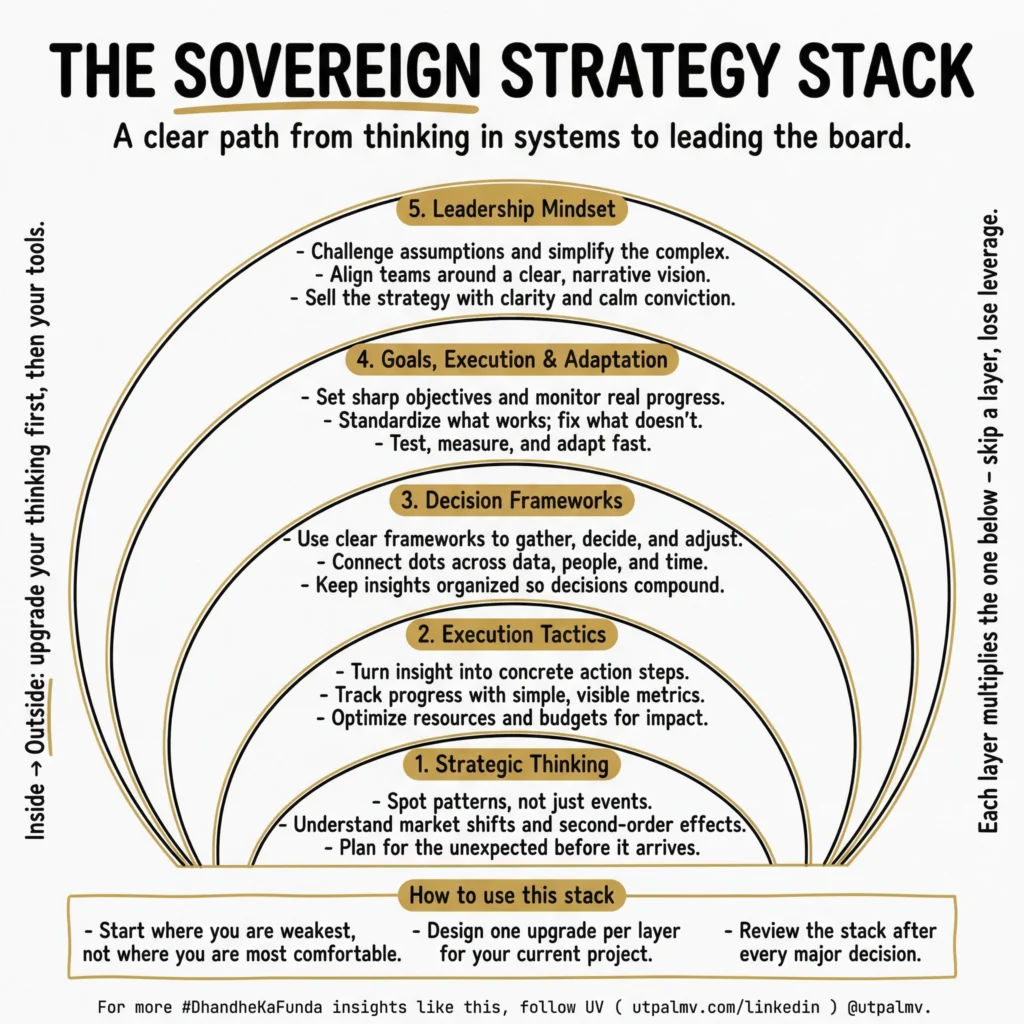
Layer 1: Strategic thinking
Strategic thinking frames the problem. It looks beyond isolated events toward patterns, relationships, constraints, and possible second-order effects.
The practical question is: what system is producing the current result, and which assumption about that system needs examination?
Strategy cannot predict every surprise. Its value is to improve orientation before resources are committed.
Layer 2: Execution tactics
Tactics convert a strategic choice into concrete work. They define who will do what, with which resources, and how progress will be observed.
Activity is not evidence of execution. A tactic should connect to the strategic purpose and produce information about whether the work is moving it forward.
Layer 3: Decision frameworks
Decision frameworks make recurring choices more consistent and inspectable. They help gather relevant information, compare options, record reasoning, and revisit a decision when conditions change.
A framework should reduce avoidable confusion without pretending to remove judgment. If it obscures context or produces ritual compliance, it needs revision.
Layer 4: Goals, execution, and adaptation
This layer creates the feedback loop. Set a specific objective, act, observe the result, and adapt the plan.
Standardize a practice only after there is evidence that it works under the relevant conditions. When a result fails, distinguish a weak tactic from a mistaken goal or strategy before discarding it.
Layer 5: Leadership mindset
Leadership connects the strategy to collective action. It requires a clear account of the direction, the reasoning behind it, the uncertainties involved, and the role each person will play.
Conviction can help a team move, but certainty should remain proportionate to evidence. Alignment is not the absence of disagreement. It is enough shared understanding to act and learn together.
The stack as an interdependent model
The layers affect one another. Weak strategic framing can direct excellent execution toward the wrong problem. Poor decision records can make the same mistake recur. A rigid feedback loop can preserve a plan after reality has changed. Unclear leadership can fragment otherwise sound work.
This interdependence is sometimes written as a multiplier:
Total leverage = strategy x tactics x decisions x adaptation x mindset
The equation is a metaphor. The layers do not have objective numerical values, and a weakness in one does not mathematically reduce the whole system to zero. Its purpose is to remind us that improving one layer may have little effect while another remains the binding constraint.
The strategy audit
| Symptom | Layer to examine | Diagnostic question |
|---|---|---|
| Repeated surprise | Strategic thinking | Which pattern, dependency, or uncertainty was ignored? |
| High activity with unclear progress | Execution tactics | What outcome is the activity intended to change? |
| Recurring mistakes | Decision frameworks | Was the earlier reasoning recorded and reviewed? |
| Strategy remains fixed despite new evidence | Adaptation | What threshold would justify changing course? |
| Team members act from different interpretations | Leadership mindset | Is the direction and its reasoning understood in the same way? |
These are starting points. A stalled project can have several causes, and the apparent layer may only be where the deeper problem becomes visible.
How to use the stack
- Identify the symptom that matters now.
- Locate the layer most likely to contain the current constraint.
- Gather evidence before accepting the diagnosis.
- Design one bounded change.
- Observe what changed and revisit the stack.
The aim is not to accumulate frameworks or tools. It is to connect the work being done to the thinking that gives it direction, then keep that direction open to evidence.
Use this workExplore with AI
Explore this canon
Take this work into your preferred AI system. Choose a ready-made prompt or add your own context. Nothing you enter here is sent or saved by utpalmv.com.
Use the work as a thinking lens without adding personal context.
Optional. Add details when you want the exploration grounded in your situation. Your context remains in this page and is included only in the prompt you copy.