

There is a version of being smart in business that I no longer find especially useful. It treats every negotiation as a contest of extraction: get the highest price, give the least ground, and make sure the other person leaves with less than you.
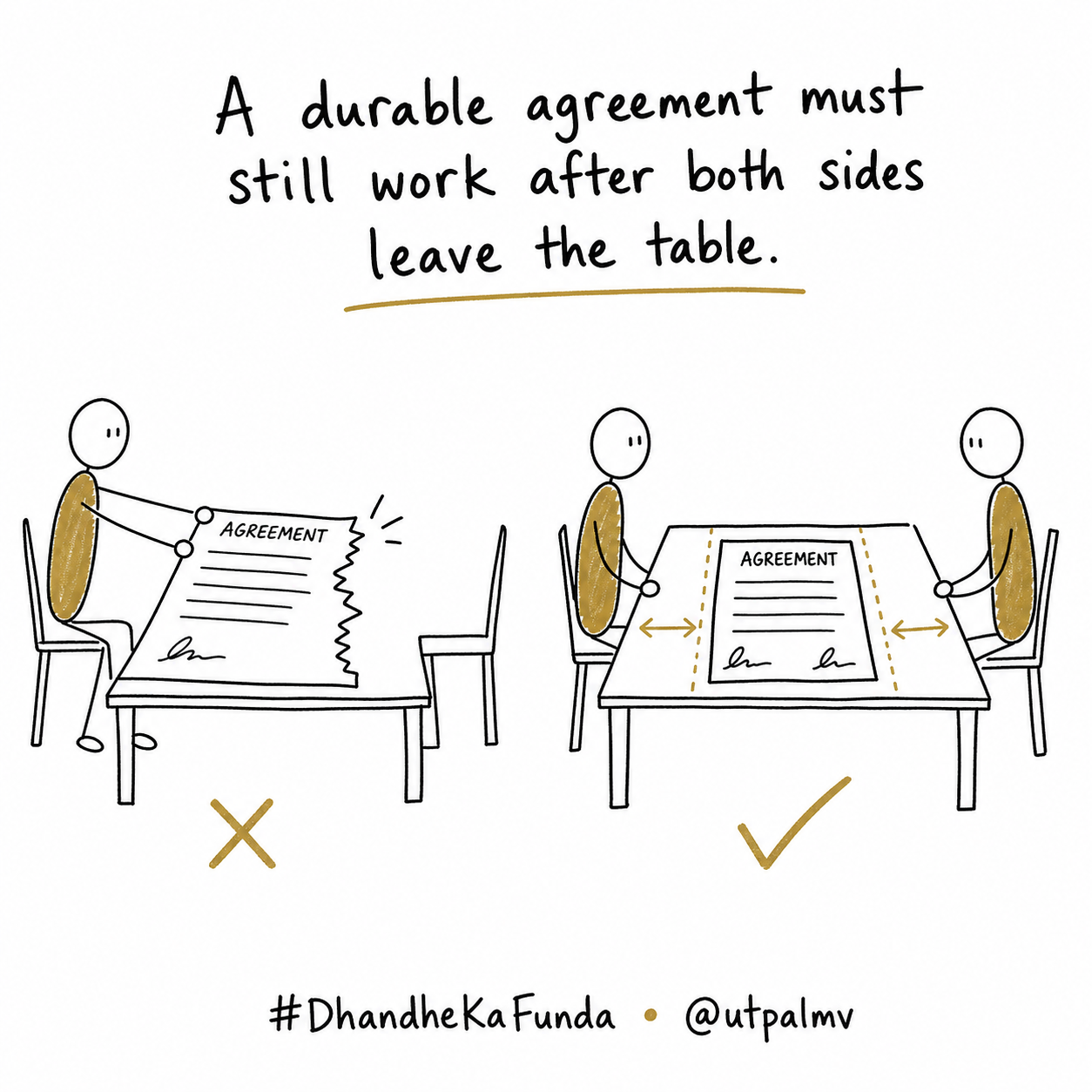
Sometimes that works. You may get the contract, protect a percentage point, or secure a term that favors you. But the agreement continues after the negotiation ends. The other side still has to deliver, cooperate, solve problems, and decide whether they want to work with you again.
That is where an apparently clever deal can become expensive.
I am not arguing that every negotiation should end in equal shares or that generosity automatically creates trust. Some situations are genuinely adversarial. Some people take advantage of openness. Boundaries and commercial judgment still matter.
The narrower point is this: if an agreement works only because one side has not yet understood how badly it serves them, the agreement is unstable.
I would rather make the other side's benefit explicit. What are they getting? What risk are they carrying? Which term matters to them more than it matters to me? Is there a way to increase the total value before we fight over its division?
Leaving room for the other side to win is not softness. It is an attempt to build an arrangement that can survive contact with reality.
This also changes how I think about concessions. A concession is not automatically a loss. If a small point matters greatly to the other person and very little to me, giving ground may improve the agreement without weakening my position. The mistake is not conceding. The mistake is conceding without understanding what is being exchanged.
The best negotiation is not always the one in which I can prove that I was the smartest person at the table. It is the one that still makes sense when the work begins.
Use this workExplore with AI
Explore this journal
Take this work into your preferred AI system. Choose a ready-made prompt or add your own context. Nothing you enter here is sent or saved by utpalmv.com.
Use the work as a thinking lens without adding personal context.
Optional. Add details when you want the exploration grounded in your situation. Your context remains in this page and is included only in the prompt you copy.