

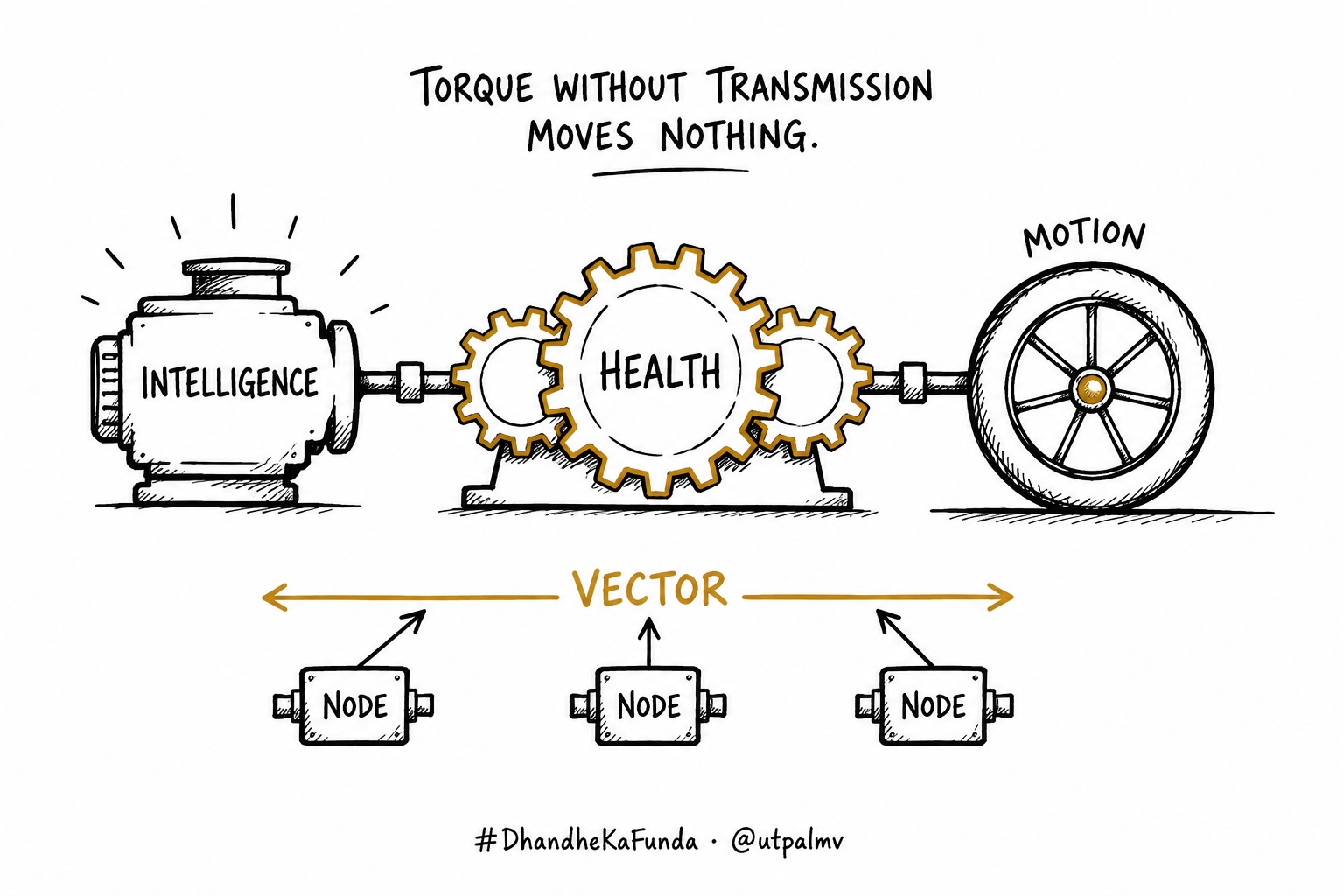
Health is not the opposite of smart. It is the transmission.
From the Architect, 09 August 2026.
I read Patrick Lencioni's The Advantage this week not as a management text, but as a component under test.
The pressure that made me pick it up was specific. I do not run a single company. I work across a federation: multiple entities, different leadership groups, and operating contexts that do not answer to the same logic.
Most organizational books assume one building. I am maintaining a district.
So the question I brought to the book was narrow. Does organizational health scale past the boundary of one leadership team, or does it stop at the door?
The claim under test
Lencioni's argument is simple enough to state in a sentence. Companies spend nearly all their effort on the smart side of the ledger, meaning strategy, finance, technology, and analytics, and almost none on the healthy side, meaning trust, clarity, communication, and accountability. He argues that the healthy side is the larger untapped advantage.
Most readers hear this as a soft argument dressed in hard language. It is not.
Read it as a claim about throughput and it becomes structural. Intelligence is torque. Health is the gearbox. You can double the torque and move the vehicle exactly zero meters if the transmission is shot. Every strategy deck I have seen die in the last decade died in transmission, not in generation. The thinking was fine. Nothing reached the wheels.
That reframe is what makes the book worth the time. Health is not a nicer alternative to intelligence. It is the multiplier applied to it, and multipliers below one destroy value no matter how large the input.
Discipline one, and where it stops
Lencioni's first discipline is a cohesive leadership team. Vulnerability-based trust at the top, productive conflict, commitment without unanimity, peer accountability, and collective results over personal agendas.
Inside one company with one room, this is correct, and I have watched it work.
At federation scale it does not translate cleanly. The mechanism requires a single team with shared exposure to a single outcome, sustained over enough time for vulnerability to become safe. A federation often violates all three conditions. Leadership groups can be connected without sharing the same operating exposure. Partners and counterparties may share only part of an outcome, and sometimes only for a limited period.
So the first discipline has to be rebuilt, not merely scaled. What travels across a federation is not a cohesive team. It is a cohesive layer: a thin set of people who hold the same definition of winning and can be relied on to make the same call in the same situation without a meeting. That layer is assembled deliberately, and it is smaller than anyone's organizational chart suggests.
Between nodes, where the layer does not reach, trust may be unavailable on Lencioni's terms. It has to be substituted structurally. Mutual clauses, scoped obligations, named owners, and a clock. This is what a contract can be: not merely a defense against betrayal, but a trust prosthetic installed where trust cannot be earned inside the available time.
Lencioni writes primarily for employees and leadership teams. He has much less to say about counterparties. That is the largest gap in the book for anyone operating across entities rather than inside one.
The six questions, which are the real product
Strip the book to one artifact and this is it. Six questions every organization must answer consistently at the top.
Why do we exist? How do we behave? What do we do? How will we succeed? What is most important right now? Who must do what?
I ran my own structure against these questions this week. Four of the six were answerable in a sentence. Two were not, and the two that failed are the two that always fail.
Question five broke first. The single overriding priority. Lencioni's rule here is a good rule with a bad boundary. Inside one team, "if everything is important, then nothing is" is exactly right. At federation level it can be wrong because a federation may carry parallel, unrelated priorities. Forcing them into one number produces theater, not focus. The priorities of separate operating nodes are not necessarily competing statements of the same thing.
The correction is not one priority. It is one priority per node, plus a coherence vector above them that states what all nodes are pointed at this year. Scattered energy of high individual quality still produces low collective displacement. The vector is what converts individual quality into direction.
Question six broke second. Who must do what? Not because roles are undefined, but because in a federation the same person can appear in several structures with different authority in each. Few systems state which role is load-bearing when those roles conflict. That is not merely a clarity problem. It is a decision-rights problem, and it is more expensive than it looks because it tends to surface under pressure, which is the worst possible time to discover it.
Overcommunication, and my own failure mode
Lencioni's third discipline is repetition. Leaders stop repeating the message roughly at the moment the organization starts hearing it.
I want to be precise about my own position here because the mirror is uncomfortable.
I publish outward at high frequency. Essays, frameworks, journal entries, and weekly sessions. Anyone following the work externally has heard my thinking many times over.
Internally, I repeat far less. I say a thing once, clearly, in a well-constructed message, and then move on because saying it a second time feels like insulting the room. That instinct is Renter logic wearing Architect clothing. It optimizes for how I feel while delivering the message rather than for whether the message survives in the system after I leave.
The correction is mechanical, not emotional. Same message, three surfaces, six weeks. Not rephrased for freshness. Repeated for retention.
Reinforcement, which is the only discipline that actually holds
The fourth discipline is where the book earns its keep. Culture is not what you say. Culture is what your hiring, reviews, promotions, meetings, and compensation systems reward. Misaligned systems eat stated values without effort.
I have direct evidence for this one, which is why I trust it more than the rest.
In one operating context, external activity was tied to a conversion outcome, the evidence was reviewed at leadership level, and the framework carried the accountability so no individual had to play enforcer. Behavior changed within a cycle. No speech, no offsite, no values poster. The system did the confronting.
This is the part of Lencioni I would defend against any critic. Systems create behavior. Everything else is intention.
What did not survive
Three claims did not hold under my conditions, and I am recording them because a book that survives intact was not tested.
Vulnerability-based trust as a universal prerequisite. It requires tenure, low turnover, and a shared fate. In fast-moving structures with contractors, partners, and counterparties, those conditions are frequently absent. Waiting for them is not patience. It is stalling. Structure the trust instead.
Peer accountability as strictly superior to managerial accountability. This is true only when the peers carry shared exposure to the same outcome. Remove shared exposure and peer accountability degrades into peer complaint, which is worse than no accountability because it looks like a functioning system while producing nothing.
Health as the greatest advantage, singular. Lencioni overreaches. Health is a necessary condition and a powerful multiplier. It is not sufficient. A perfectly healthy organization pointed at a dying market executes its way into the ground with excellent morale. Strategy still decides direction. Health decides whether you arrive.
Installed, not admired
Four changes, dated and owned, or this entry was entertainment.
- The six questions, written per entity. One page each, one named owner, complete by 31 August. Any entity that cannot answer all six on one page does not have a clarity problem. It has an existence problem.
- One priority per node, plus one federation vector. Both stated in writing, both reviewed at leadership level, both dated. No node holds more than one.
- Decision rights written for conflicting roles. Where the same person holds authority in two entities, the resolution rule is written down before it is needed, not during the conflict.
- Repetition schedule installed. One internal message, three surfaces, six weeks, unrephrased. My instinct will call this excessive. That instinct is the error the book identifies.
Compression
Health is not the opposite of intelligence. It is the gearbox between intelligence and motion, and a federation needs one gearbox per node, plus a shared direction, because coherence does not scale by repetition. It scales by being structured.
#DhandheKaFunda: Trust you cannot earn in time; you must build in structure.
Reference
Patrick Lencioni, The Advantage: Why Organizational Health Trumps Everything Else in Business (Jossey-Bass, 2012). Official book page.
Use this workExplore with AI
Explore this journal
Take this work into your preferred AI system. Choose a ready-made prompt or add your own context. Nothing you enter here is sent or saved by utpalmv.com.
Use the work as a thinking lens without adding personal context.
Optional. Add details when you want the exploration grounded in your situation. Your context remains in this page and is included only in the prompt you copy.