

Imagine this.
At 11:47 p.m., the office was dark except for one meeting room. Mira stood before a project board carrying the same red label for the third time in six months: BLOCKED.
Behind her, twelve people argued about effort.
Engineering wanted a week. Sales wanted two more features. Someone suggested adding two people.
Instead, Mira erased every name and drew only handoffs.
One arrow went in circles. Another ended at an approval nobody owned. A third began only after the work was supposedly finished.
The team had not been moving too slowly. It had been moving quickly through a design that produced delay.
They changed the handoffs, not the headcount.
The next launch was not heroic. It was simply on time.
The pieces had not changed.
The board had finally become visible.
The blocked label was the event. Three failed launches were the pattern. The handoffs, incentives, and unowned decisions were the board.
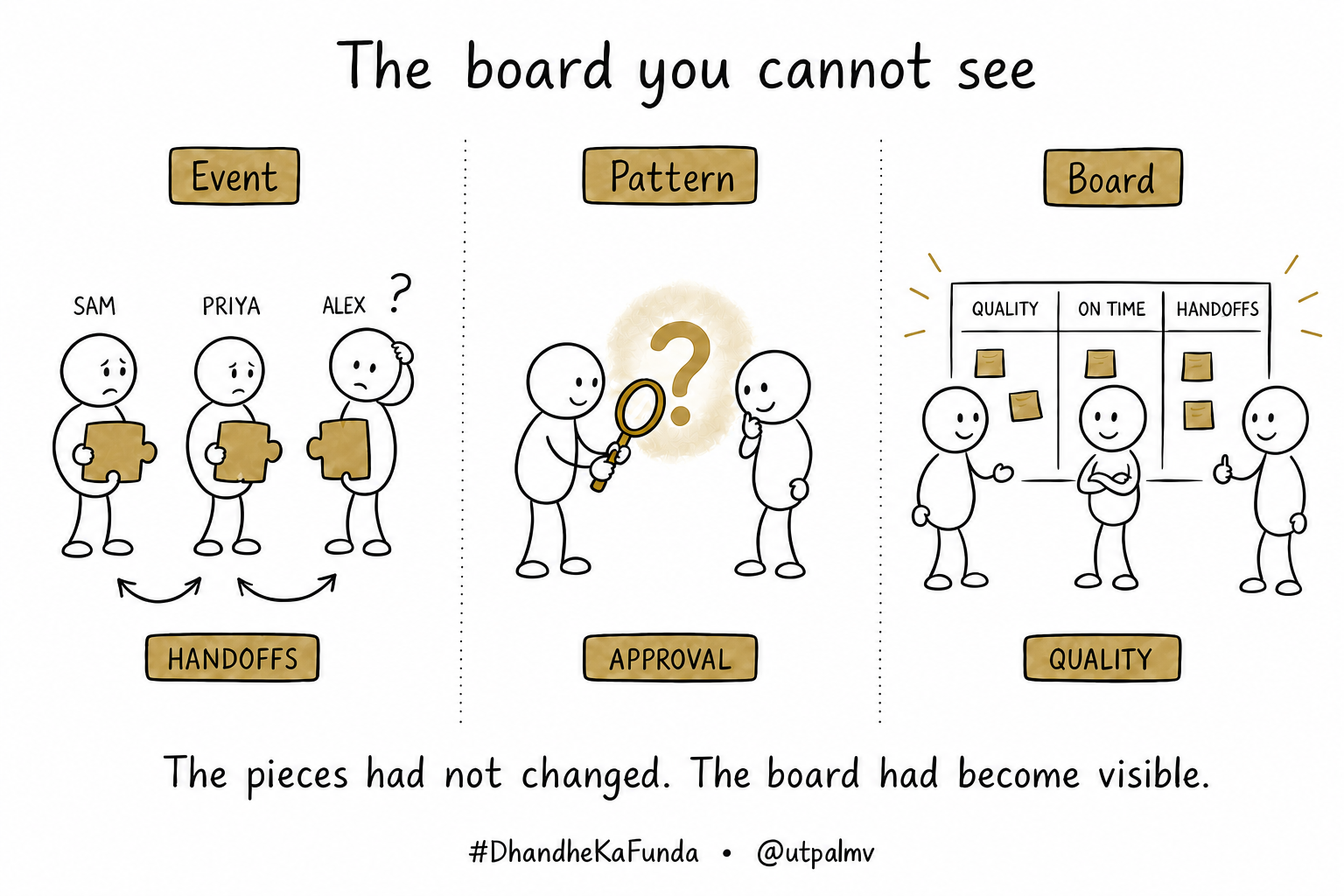
Most operating problems reach us first as events.
A deadline slips. Revenue stalls. A decision returns for another round. A capable person leaves. A customer raises the same complaint again.
The event is visible, immediate, and usually attached to someone. It invites an immediate response.
Do more. Add more. Push harder.
The underlying model looks like this:
Input + Effort = Result
That model works when effort is genuinely the limiting factor. A neglected task may need attention. A difficult skill may need practice. A real capacity gap may need another person.
But repetition changes the question.
When the same result returns through different people, plans, and cycles, the problem may not sit inside the latest event. It may sit in the relationships that keep producing it.
This is the board.
The board is not a secret plan hidden by someone at the top. It is the arrangement within which everyone is already moving.
It includes formal rules and informal permissions. It includes who can decide, who must wait, what gets rewarded, when information arrives, where quality enters, which assumptions remain unspoken, and how long consequences take to appear.
The board is difficult to see because no one person holds all of it.
Sales sees the promise made to the customer. Engineering sees the change that arrived after work began. Quality sees what becomes testable near the end. Leadership sees a date that keeps moving.
Each view can be accurate and still incomplete.
This is why adding effort often feels more reasonable than examining structure. Effort is visible. Hours can be counted. Meetings can be added. New people can be assigned. Pressure produces movement that looks like progress.
A relationship is harder to inspect.
An incentive may reward the behavior that the stated goal discourages. An approval may sit outside the workflow even though the entire workflow depends on it. A delay may separate an action from its consequence so completely that the two no longer appear connected.
Nobody needs to be lazy or incompetent for the system to produce a poor result.
Sometimes an individual decision is the problem. Systems thinking should not become a way to dissolve responsibility into abstraction.
But when a result keeps surviving changes in people, effort, and tactics, the structure deserves attention.
A recurring result is not proof of one hidden cause. It is evidence that the latest event may be too small a frame.
Drawing the board begins by changing what we represent.
Mira erased the names and drew the handoffs. That did not excuse anyone. It made the dependencies visible without allowing blame to end the inquiry too early.
The practical questions are simple:
- Where does work wait?
- Who can decide, and who remains accountable without decision rights?
- What behavior does the system reward in practice?
- Where does information arrive too late to remain useful?
- Which constraint appears only near the end?
- What pattern has survived changes in people or plans?
The questions matter more than the beauty of the diagram.
A board can be drawn badly. Its boundary may be too narrow. It may leave out the customer, the incentive, the delay, or the person whose approval governs everything. It may capture the official process while missing how work actually moves.
No map reveals the complete system.
The purpose is to make enough of the board visible to distinguish a weak move from a structural problem.
That distinction should lead back to action.
Systems thinking is not a reason to remain in analysis until every relationship is understood. It is a way to stop spending force on a position created by the board itself.
We may still need greater effort. But the effort now has direction.
We can change a handoff, move an approval, expose a delay, repair a relationship, alter an incentive, or redraw the boundary of the problem.
Mira's team did not discover that people had stopped caring. They discovered that the design of the work made delay predictable.
The visible result was where their attention began.
It was not where their thinking ended.
Before moving another piece, draw the board.
Use this workExplore with AI
Explore this journal
Take this work into your preferred AI system. Choose a ready-made prompt or add your own context. Nothing you enter here is sent or saved by utpalmv.com.
Use the work as a thinking lens without adding personal context.
Optional. Add details when you want the exploration grounded in your situation. Your context remains in this page and is included only in the prompt you copy.