

I was writing long before I had a website.
As a teenager, I wrote poetry in Gujarati, Hindi, and English. I cannot remember all of what I wrote, and I cannot claim that it was particularly good. But writing gave form to something inside me. A thought, feeling, or observation could leave my mind and become something I could see.
Writing was one form of self-expression. It was not the first, and it would not be the last.
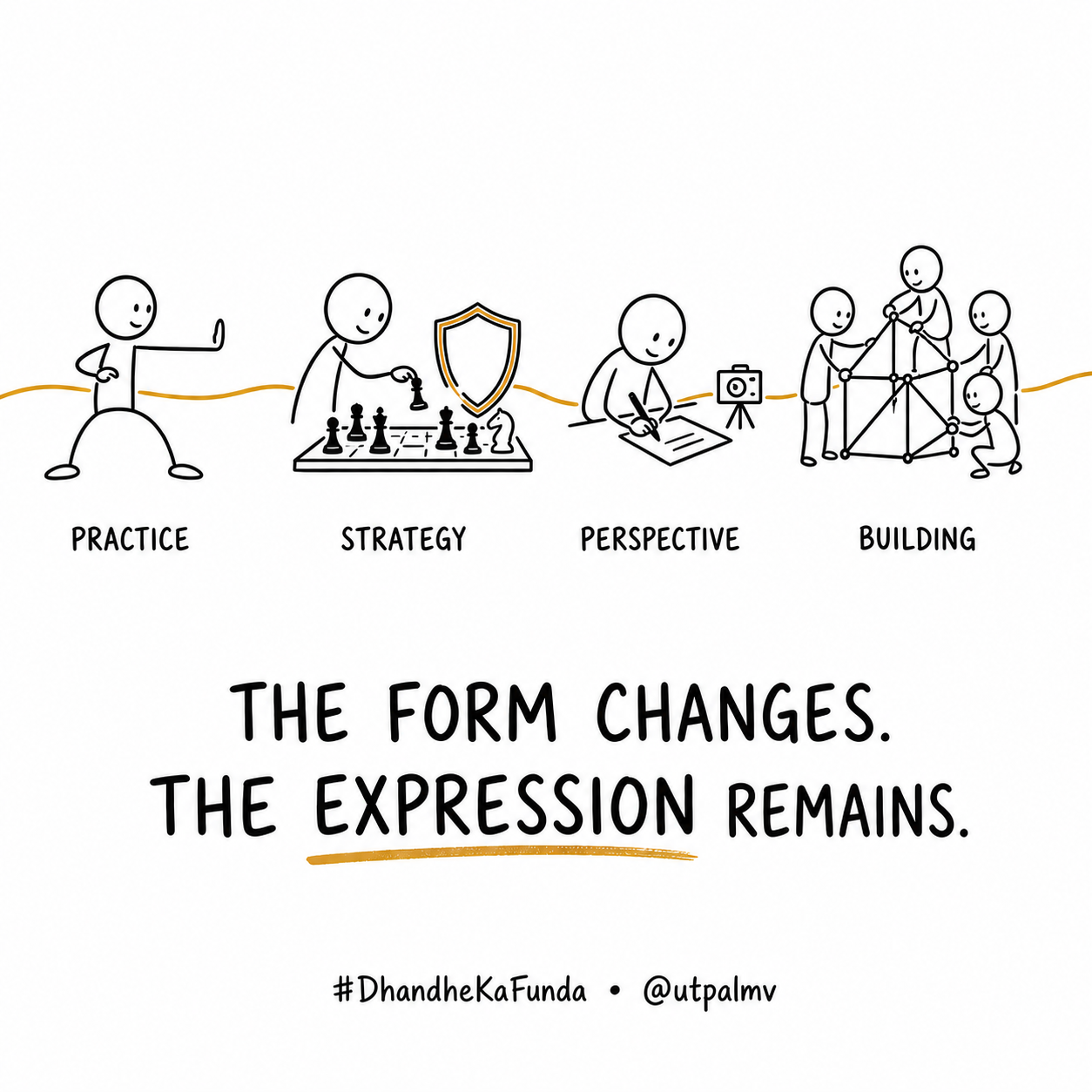
Over the years, I found self-expression through martial arts, chess, photography, writing, project leadership, building businesses, and now private equity. Even the frameworks and reusable systems I create are forms of self-expression.
The form kept changing. The underlying movement did not.
Learning through form
Wing Chun gave expression a physical form.
Chess gave it a strategic one.
I became deeply absorbed in chess. At one point, I had mastered more than 15 opening lines and developed an excellent middle game. I was naturally an attacking player.
Chess also taught me the power of focus and the possibility of finding many paths toward the same goal. A position could be approached in more than one way. Preparation mattered, but so did the ability to respond to what was actually happening on the board.
In my second year, I began learning to play defensively. That did not come naturally to me. As an attacking player, I also experienced the fears that came with committing to an attack. Learning defense made me more complete, but defense was never my natural instinct.
Once I felt I had mastered it, I returned to attacking play.
I did not return as the same player. I could attack with a better understanding of what I was exposing, what I needed to protect, and what the other player might do in response.
Looking back, I can see a pattern that continued far beyond chess. I have often moved toward a goal through instinct, learned the structure needed to sustain it, and then returned to the instinct with greater range.
Learning to see
Photography taught me another form of expression.
The subject could remain the same while the image changed completely. Position, distance, timing, light, and framing determined what became visible and what disappeared.
I began to understand perspective more deeply.
A perspective is not the whole truth. It is a position from which something becomes visible. Moving the camera can reveal what the previous position concealed.
Writing does something similar for me. When I try to express an idea, I am forced to choose a position. I begin to see what I mean, what I cannot yet explain, and what may look different from somewhere else.
UV Writes
When I began writing online, I started with utpal.net and called the site “UV Writes.”
The name was inspired by Tina Lorenz, whose site I remember as “Tina Writes” at tinawrites.com. I liked the simplicity of the name. It did not make a large claim. It simply said that Tina writes.
So I became UV Writes.
I wrote about different subjects. My writing was not great, but I felt I was doing something important.
There was a high in being able to express myself. Something that existed only in my head could become a page that another person might read. I was discovering that expression itself mattered to me, even before I had developed the clarity or discipline to do it well.
I did not begin with a publishing strategy. I had interests, experiences, opinions, and questions. A website gave them somewhere to go.
Giving each interest a home
Eventually, one website did not seem sufficient.
I created pmcraft.com for project management. I created scrumzen.com as my interest in Scrum developed. I created selfhelpzen.com, influenced in part by the simplicity, clarity, and minimalism I found in Leo Babauta's writing. At another point, I built reusablethoughts.com.
Each site gave one part of my thinking its own container.
Naming a site made an interest feel more definite. It gave the subject a boundary and gave me a place to explore it.
But interests do not always respect the containers we build for them.
I stopped sharing on ScrumZen when my attention shifted from process toward solutions. PMCraft ended less deliberately. I missed the domain renewal and never rebuilt it. Other sites became quiet as my work and attention moved elsewhere.
Not every ending was intentional. Not every experiment reached a conclusion.
My personal site moved from utpal.net to utpalvaishnav.com, then to utpalmv.com.
The addresses changed. The subjects changed. The need to express did not.
Expression beyond the individual
In 2008, I participated in the Landmark Forum and the Landmark Advanced Course. I later joined the Self-Expression and Leadership Program, commonly called SELP, but dropped out.
I dropped out because I felt I had received what I needed from it: an understanding of self-expression at the level of community.
Until then, I had experienced self-expression primarily as something personal. Poetry, martial arts, chess, photography, and writing all began with the individual. SELP helped me see that expression could move through a community. It could organize people around something larger than an individual act.
I did not need to complete the program to carry that insight forward.
Project leadership became another form of self-expression. Building businesses became another. Neither is usually described that way, but both require a person to take something that does not yet exist and give it structure in the world.
A project expresses what a group believes is worth making.
A business expresses choices about value, people, responsibility, risk, and time.
Leadership expresses itself through the systems it creates, the behavior it permits, the decisions it delays, and the consequences it is willing to own.
From process to judgment
My movement away from ScrumZen reflected a wider change in my thinking.
Earlier, I was deeply interested in process. Process offered structure. It helped people coordinate work and make progress visible.
Over time, I became more interested in whether the process produced a useful result.
A method could be followed correctly while the underlying problem remained unsolved. A team could become efficient at work that did not matter. A framework could organize our actions without improving our judgment.
My questions moved from how a process should be performed toward what the system was actually producing.
This was not a clean intellectual transition. I did not announce one day that I was leaving process behind. My attention simply moved toward different problems.
The reusable systems and frameworks I now develop continue that movement. They are practical structures, but they are also expressions of how I see a problem.
A framework is never neutral. It reveals what its creator considers important enough to name, separate, connect, or leave out.
Building as self-expression
My professional life moved through software, project management, delivery leadership, engineering, entrepreneurship, mobile applications, venture building, and private equity.
Some periods brought progress. Others brought prolonged struggle. There were ventures that did not work as intended, decisions I had to reverse, and responsibilities that changed what I could give my attention to.
Building became a demanding form of expression because the world answered back.
A poem could remain private. A photograph could preserve one perspective. A framework could appear coherent on a page.
A business had to survive contact with people, markets, money, timing, and consequences.
Expression was no longer only about what I wanted to say. It had to contend with what the system produced.
A record of expression
The UV Almanac is the current home of this journey.
It brings together writing from different periods without pretending that I have always believed what I believe now. Some earlier ideas remain useful. Some need context. Some have been replaced by experience. Others are still developing.
That is why the Almanac preserves dates and changes in thought. I do not want to rewrite the past so that the present looks inevitable.
I began with poetry in 3 languages. I explored expression through Wing Chun, chess, photography, writing, project leadership, businesses, frameworks, reusable systems, and capital.
These may look like unrelated pursuits.
To me, they belong to the same journey.
Self-expression is not confined to saying what I feel. It is how an inner position takes form in the world. Sometimes that form is a poem. Sometimes it is an attack on a chessboard. Sometimes it is a photograph, a website, a team, a business, an investment decision, or a framework.
The form changes because I change.
The work is to express what I can see now without pretending that it is the only perspective, or the final one.
That is what the Almanac allows me to continue doing.
#DhandheKaFunda
The form changes. The expression remains.
Use this workExplore with AI
Explore this journal
Take this work into your preferred AI system. Choose a ready-made prompt or add your own context. Nothing you enter here is sent or saved by utpalmv.com.
Use the work as a thinking lens without adding personal context.
Optional. Add details when you want the exploration grounded in your situation. Your context remains in this page and is included only in the prompt you copy.