

Talent is not enough by itself. It always appears through conditions.
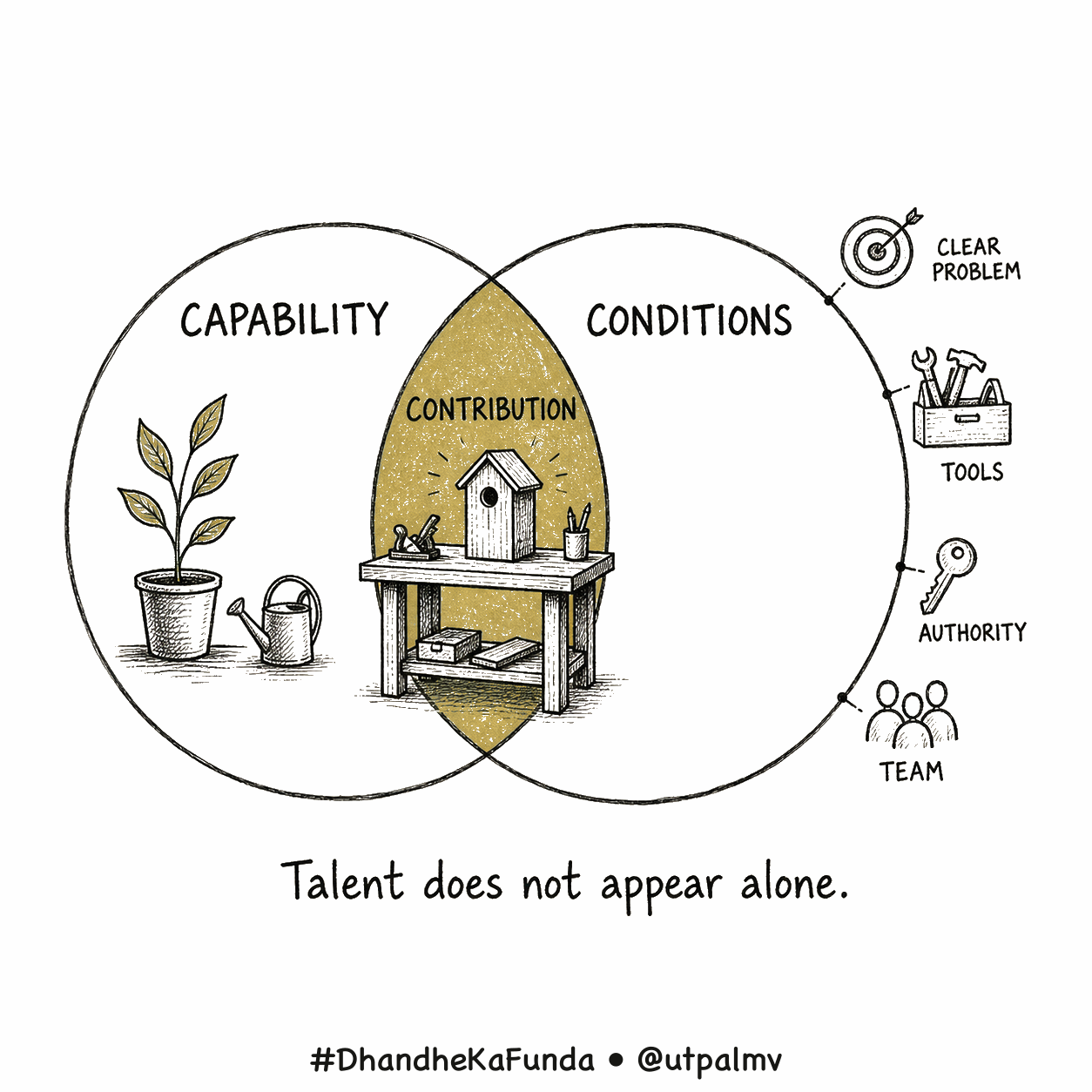
We often describe performance as if ability were a fixed quantity carried from one job to another. Someone succeeds, so we call the person talented. Someone struggles, so we question the talent. This account is convenient because it places the explanation inside the individual. It also ignores how much work depends on the problem, tools, standards, authority, incentives, and people surrounding that individual.
A capable person can look average in a role that rewards the wrong strengths. A careful thinker may fail in an environment that treats every pause as weakness. A decisive operator may become ineffective when authority is unclear. Someone who thrives with a difficult customer problem may be wasted on work whose only measure is internal compliance. None of this means that every mismatch excuses poor performance. It means that performance is evidence about an interaction, not only about a person.
Good conditions are not the same as comfortable conditions. Demanding work, direct feedback, and high standards can reveal talent. The important question is whether those pressures help the person contribute or merely create noise. A role should stretch capacity without making success depend on guessing hidden rules.
This changes the manager's responsibility. Hiring is not finished when a capable person arrives. The organization must make the problem clear, provide enough authority to act, establish useful constraints, and notice where the surrounding system blocks contribution. It must also be willing to name a genuine mismatch rather than indefinitely redesigning the role around one person.
For the individual, the same lens can replace a global judgment with a better diagnosis. Instead of asking, “Am I talented or not?” ask which conditions allow the talent to become useful, which skills are actually missing, and which parts of the environment cannot be changed.
Talent matters. So does the place where it is asked to perform. Management includes understanding both.
Use this workExplore with AI
Explore this journal
Take this work into your preferred AI system. Choose a ready-made prompt or add your own context. Nothing you enter here is sent or saved by utpalmv.com.
Use the work as a thinking lens without adding personal context.
Optional. Add details when you want the exploration grounded in your situation. Your context remains in this page and is included only in the prompt you copy.