

Repeatedly fixing the same avoidable problem can look like commitment.
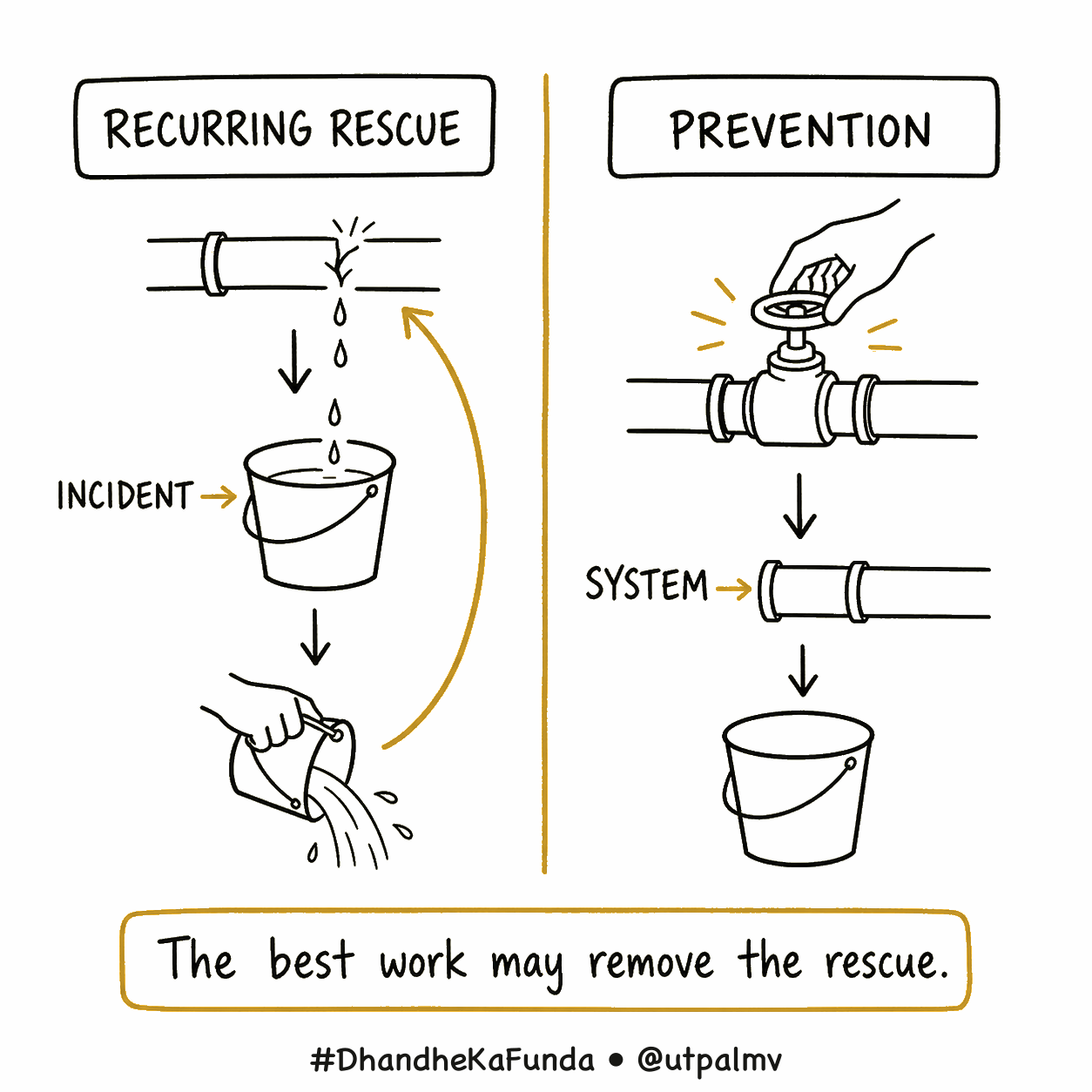
Someone notices the failure, stays late, restores the service, calms the client, and gets thanked for saving the day. The effort may be real. Sometimes the intervention is genuinely necessary.
The trouble begins when the same rescue becomes part of how the organization expects work to happen.
Recurring emergencies create a distorted picture of contribution. Visible recovery receives attention. Quiet prevention does not. The person who repeatedly fixes the failure can appear more valuable than the person who removed its cause.
That incentive is expensive. It rewards responsiveness while allowing the underlying weakness to remain.
The better questions come after the immediate problem is contained:
- Why was this failure possible?
- Had it happened before?
- Which warning was missed or ignored?
- Was ownership unclear?
- What change would make recurrence less likely?
The answer will not always be another process. It may be a simpler handoff, a clearer decision right, a test closer to the source, better documentation, or the removal of a dependency nobody had questioned.
Prevention also needs proportion. Not every unlikely problem deserves an elaborate control. A system burdened with safeguards can become harder to operate than the risk justifies. The aim is not to eliminate every surprise. It is to stop paying repeatedly for failures we already understand.
This changes what leaders should recognize. If praise goes only to the rescuer, people learn that prevention is invisible work with little reward. Recognition should also reach the person who reduced the need for rescue, even when the result is harder to dramatize.
This kind of work is easy to miss because its evidence is an absence. The incident does not recur. The client does not need calming. Nobody stays late.
When prevention works, there may be no heroic story to tell. That is often the point.
Use this workExplore with AI
Explore this journal
Take this work into your preferred AI system. Choose a ready-made prompt or add your own context. Nothing you enter here is sent or saved by utpalmv.com.
Use the work as a thinking lens without adding personal context.
Optional. Add details when you want the exploration grounded in your situation. Your context remains in this page and is included only in the prompt you copy.