

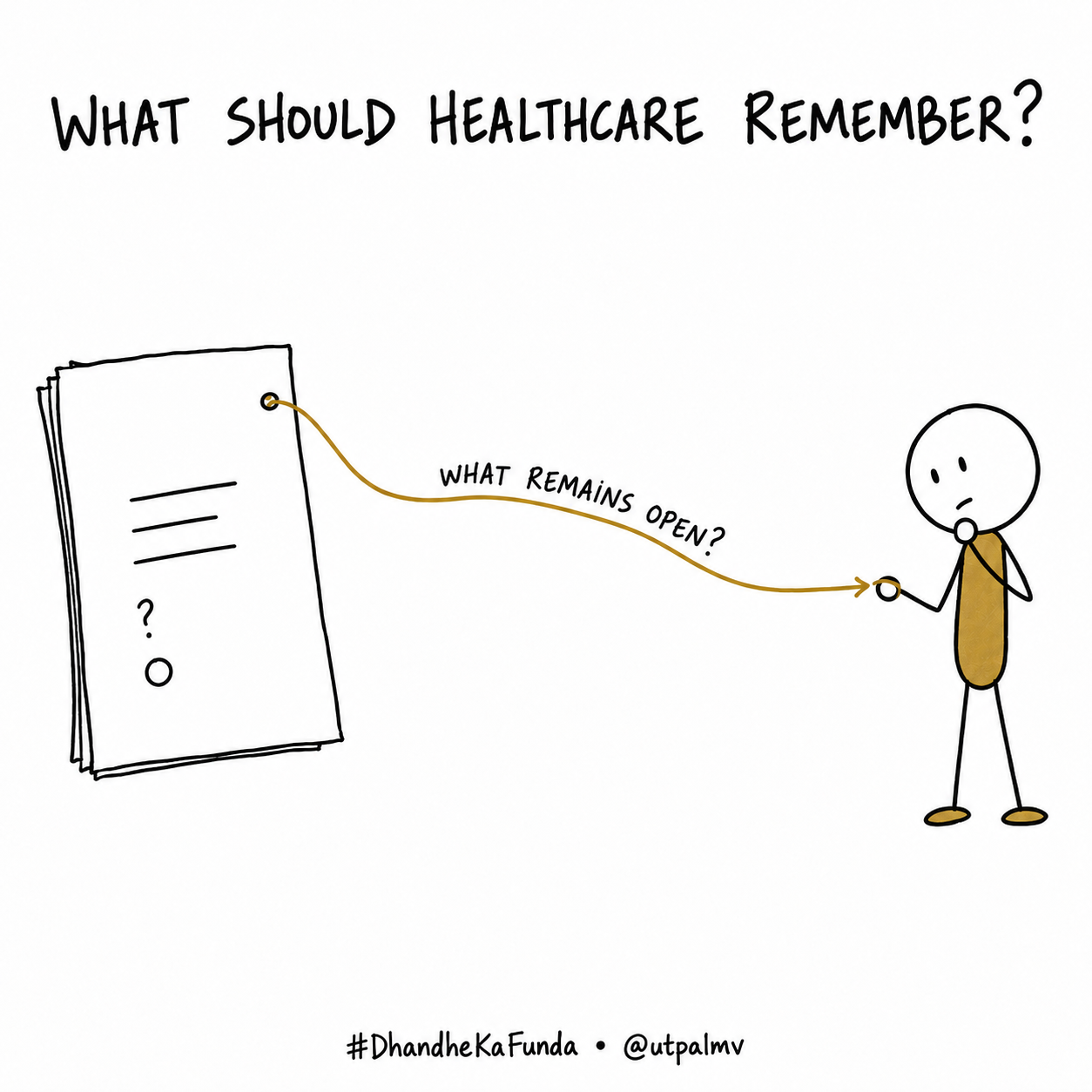
A record can preserve what happened. Care also depends on what someone notices, carries forward, and acts upon.
I keep returning to a question: which parts of that memory can a system responsibly support?
My working hypothesis is that healthcare may need a second brain. I mean a way to help the people responsible for care find what matters, see where it came from, and know what remains unresolved. I do not mean an artificial doctor.
That distinction is easy to say. It is harder to design.
Consider a decision made during one encounter. A note can record the decision. It may also need to preserve why it was made, what evidence was uncertain, who will follow up, and what would make the team reconsider. Those are different kinds of memory. A system that captures more text without making the next action clearer may add to the load.
The first design question is therefore not, "How much can we store?" It is, "What must the next person be able to understand and act on?"
I am asking this as a systems architect, not as a clinician. I cannot decide which clinical detail is safe to compress, which signal requires escalation, or when a prior judgment should be reopened. Those are questions for the people who carry clinical responsibility, and for patients and caregivers who live with the consequences.
There is also a serious risk in the metaphor. Calling a system a second brain can make it sound more complete and more trustworthy than it is. A summary may be wrong. A source may be stale. A plausible suggestion may hide a missing fact. The World Health Organization's guidance on large multimodal models describes risks of false, biased, or incomplete outputs and of people overlooking errors because they defer to automation.
So provenance matters. A useful aid should distinguish a recorded fact, a patient's account, an inference, and an unanswered question. It should make correction possible. It should reveal who is expected to act. It should give people a way to say, "This does not fit."
Even that may be insufficient. The information can be available and still fail to reach the right person at the right time. Or it can arrive with no clear owner. The problem may be in the handoff, the workload, or the incentives around it. I do not want to assume that AI is the missing part before looking at the work itself.
I want to pursue these questions in the open and share what I learn. Where does useful context disappear? What is already being carried well? Which workarounds help, and which ones create new risk? What should a system remember, what should it let a person correct, and what should it never presume to decide?
If the answer turns out to be a clearer handoff or a better practice rather than another tool, that is an answer worth finding.
Source note
The healthcare AI risk statement above is attributed to WHO's January 18, 2024 guidance. The second-brain thesis and proposed design questions are hypotheses, not reported findings or clinical advice. No patient example or interview is represented here.
Use this workExplore with AI
Explore this journal
Take this work into your preferred AI system. Choose a ready-made prompt or add your own context. Nothing you enter here is sent or saved by utpalmv.com.
Use the work as a thinking lens without adding personal context.
Optional. Add details when you want the exploration grounded in your situation. Your context remains in this page and is included only in the prompt you copy.