

The DLMx Protocol is an operating protocol for how work moves from intent to outcome in people, organizations, and federations.
It is unrelated to the DMX or DMX512 lighting-control standard.
The DLMx Protocol is a diagnostic model for examining how work moves from intent to outcome. It asks four questions:
- What useful output is being created?
- What direction and trade-offs have been made clear?
- What discipline makes the work owned, repeatable, and improvable?
- What multiplier changes the scale or speed of the result?
The model can be written as:
Outcome velocity = (D × L × M) × X
The equation is a structural metaphor, not literal mathematics. It emphasizes one property: a serious weakness in doing, leadership, or management constrains the whole. Multipliers amplify the operating system they are attached to, including its weaknesses.
DLMx is a companion to the MSDx Protocol. MSDx examines capability architecture: what powers a person or system. DLMx examines operating architecture: how that person or system converts intent into outcomes.
One asks what the engine is made of. The other asks how it is being driven.
Field use
The DLMx Protocol has been exercised in operating work at Upsquare, EightQor, and House of Starts. These are settings for practitioner use, not proof that the scorecard predicts outcomes. Its instruments and stage definitions remain open to revision as operating evidence exposes what the diagnosis misses.
The premise
Professional work has historically been organized through role separation. One person executes, another directs, and a third manages the process.
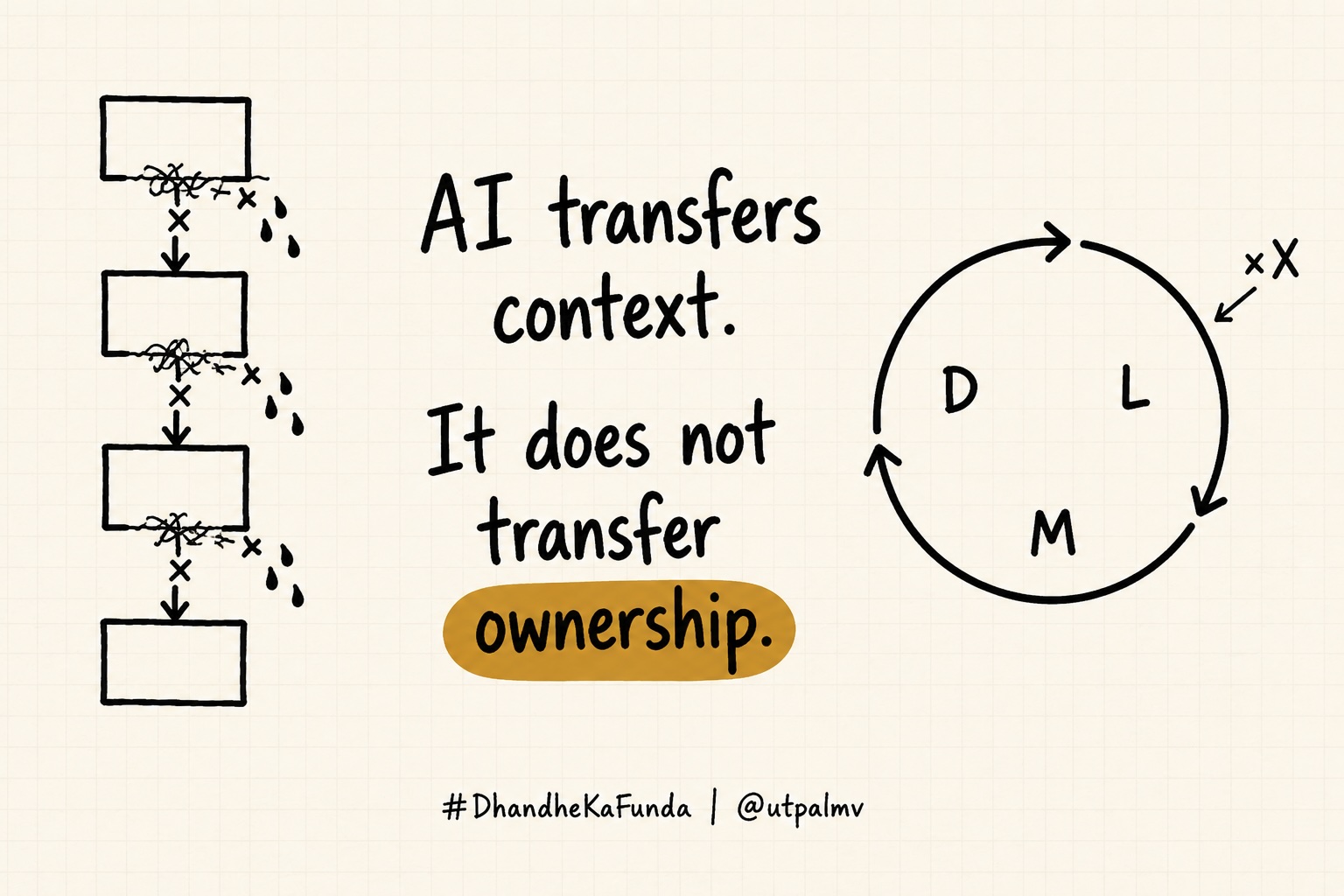
Specialization has value. But every handoff also creates a place where context can degrade and ownership can leak.
AI can reduce some of this coordination cost. It can help document work, translate between specialties, synthesize status, and make information easier to move. It does not assume accountability when the objective becomes ambiguous or the work fails.
AI can transfer context. It cannot transfer ownership.
This is why DLMx centers on loops rather than roles.
A loop closes when one accountable unit carries an outcome from definition to delivery. That unit may draw on specialists, systems, and tools, but it does not surrender ownership between them.
DLMx does not eliminate specialization. It challenges helplessness outside specialization.
It also does not require equal strength in every capacity. It asks whether each capacity is strong enough for the loop to close.
Three resolutions
Like MSDx, DLMx can be applied at three resolutions. The variables remain constant, but the unit being examined changes.
The individual: One professional’s capacity to do, direct, and improve their own work.
The system: An organization, company, or venture. The variables describe how work moves through the structure and whether teams can close loops without repeated escalation.
The federation: A system of systems, such as a venture builder, holding group, or ecosystem. The variables describe whether member units operate as accountable loops or as fragments requiring central coordination.
This distinction matters because a problem diagnosed at the wrong resolution invites the wrong repair.
An individual with strong operating range can still be trapped inside a system that fragments every outcome across departments. Several well-run ventures can still consume a federation’s attention because ownership between them is unclear.
D: Doing capacity
Doing capacity is the conversion of intent into useful output.
It is not activity or task completion. The output must move an outcome.
At the individual resolution, doing capacity is the ability to ship. A person can take an objective, create a path, and produce work that survives contact with reality.
At the system resolution, doing capacity is throughput without heroics. Ask what the organization can reliably produce when no one is performing rescue work. Then examine how much of its activity becomes shipped outcomes rather than intermediate artifacts.
At the federation resolution, doing capacity is distributed across the member units. If their output repeatedly depends on intervention from the center, the federation has a doing constraint within its nodes.
L: Leadership clarity
Leadership clarity creates direction through decisions, priorities, trade-offs, and alignment.
It is not a vision statement. It is clarity that another person can act on.
Critical thinking belongs within this capacity. Someone who cannot separate signal from noise or examine the assumptions behind a plan cannot produce reliable direction.
At the individual resolution, leadership clarity appears as the ability to turn ambiguity into a decision, including decisions no one explicitly assigned.
At the system resolution, it appears in decision architecture. Are decision rights clear? Are trade-offs made deliberately or by default? Does the organization know its stopping conditions as well as its goals?
At the federation resolution, leadership clarity governs direction across units. It determines who sets priorities, how conflicts are resolved, and where capital and attention move when priorities compete.
M: Management discipline
Management discipline makes work owned, visible, repeatable, and improvable.
It is not status collection. It is the discipline of building a system that learns from its operation.
Systems thinking belongs within this capacity. Improving a workflow requires seeing its inputs, dependencies, feedback loops, and recurring failure modes.
At the individual resolution, management discipline appears in work that does not depend on memory. Commitments are tracked. Useful processes are documented. Repeated mistakes become adjustments.
At the system resolution, four instruments can make this capacity observable:
- Loop closure rate: The share of outcomes shipped without founder or senior leader intervention
- Decision latency: The time between a question being raised and a decision being communicated
- Handoffs per outcome: The number of ownership transfers between definition and delivery
- Repeat problem rate: The share of current problems that also appeared in the previous operating period
These instruments do not explain the system by themselves. They provide evidence for examining it.
At the federation resolution, management discipline determines whether recurring coordination runs through documented processes or through the memory and goodwill of a few people. This includes shared services, capital allocation, cross-unit learning, and the resolution of common dependencies.
X: Multipliers
Multipliers change the scale, speed, or reach of the loop.
DLMx distinguishes between operating multipliers and asset multipliers.
Operating multipliers change how the work is done. They include AI fluency, automation, documentation, data, and learning velocity. These can be developed within a person, team, or organization.
Asset multipliers change what the unit can draw on. They include capital, network, brand, distribution, and community. They are real and often decisive, but they belong primarily to strategy rather than to this operating protocol.
Multipliers do not repair the loop they are attached to.
Applied to a clear loop, they compound it. Applied to a confused loop, they can increase output and accelerate cycles while preserving the same dysfunction.
This is the practical meaning of the multiplication sign. X multiplies what D, L, and M have produced, including their weaknesses.
The gate
DLMx scores each variable from 1 to 5.
The profile is written as:
D · L · M | X
A profile of 4 · 3 · 2 | 4 represents strong doing capacity, moderate leadership clarity, weak management discipline, and strong multipliers.
The operating level is set by the lowest of D, L, and M. In this example, the unit operates at level 2. Its multipliers may make the work move faster, but they do not repair the management constraint.
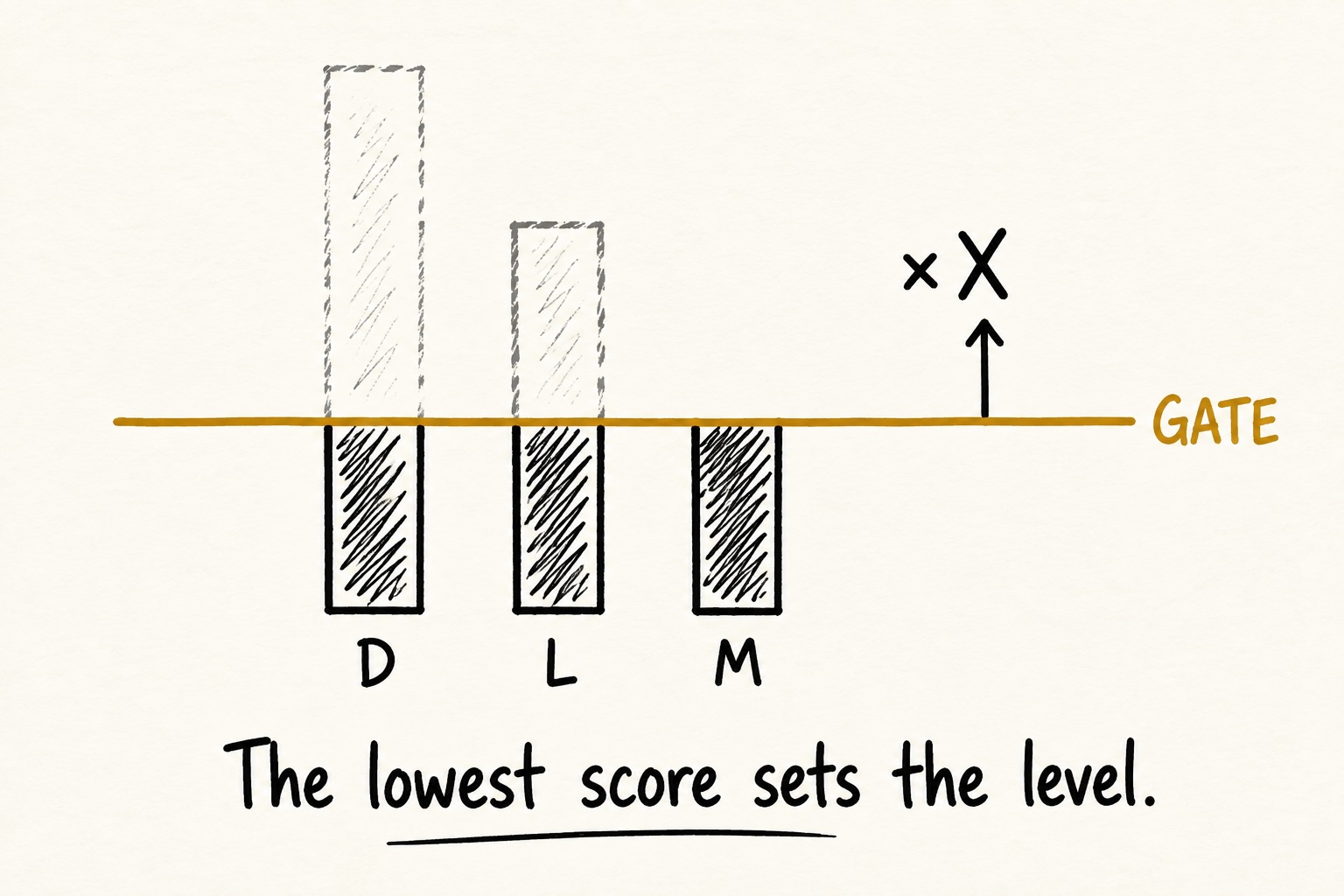
The gate can be interpreted through five stages:
| Gate | Stage | Character |
|---|---|---|
| 1 | Tool access | AI tools are available, but the operating model remains unchanged |
| 2 | AI-aware | Experiments and energy exist, but repeatability is weak |
| 3 | AI-ready | Loops close, work is visible, and systematic change becomes possible |
| 4 | AI-integrated | Systems learn from operation and managers improve the structure |
| 4 or higher, supported by strong multipliers and operating evidence | AI-native | The operating system demonstrates the claim rather than merely adopting the label |
No individual scorecard is enough to establish that a company is AI-native. That conclusion requires system-level evidence from loop closure, decision latency, handoffs, and repeated problems.
The diagnostic sequence
Begin with the resolution.
- Is the constraint located in the individual, the system, or the federation?
- Which of D, L, or M is setting the gate?
- What observable evidence supports that diagnosis?
- What is the smallest repair that would test it?
- Which multiplier should be applied after the loop improves?
Recurring symptoms can guide the inquiry, but they are not proof:
| Symptom | Possible constraint | Investigative direction |
|---|---|---|
| Tasks move, but results do not | Leadership clarity | Examine whether outcomes are defined and competing priorities have been removed |
| The founder remains the control room | Leadership and management at the system level | Examine decision rights and where ownership actually lives |
| Managers spend most of their time collecting status | Management discipline | Examine whether cadence, owners, and useful measures exist |
| The same problems recur | Management discipline | Examine whether repeated issues become changes to the operating system |
| AI produces more documents but not better decisions | Leadership clarity amplified by multipliers | Examine decision criteria and review standards |
| AI adoption is high but outcomes remain flat | A weak operating gate | Examine D, L, and M before adding more tools |
The order matters. Multipliers come last.
Adding AI to an undiagnosed loop does not automatically improve the operating system. It may simply produce faster and more polished versions of the existing confusion.
The audit rhythm
DLMx is most useful as a recurring examination rather than a permanent label.
Individual
- What did I create, and did it move an outcome?
- What direction did I clarify without being asked?
- What system did I improve so the same work costs less next time?
- Which multiplier did I attach, and to what?
System
- How are loop closure, decision latency, handoffs, and repeated problems changing?
- Which loops still route through one person?
- What behavior do promotion and review actually reward?
- Where is AI multiplying noise rather than outcomes?
Federation
- Which units operate as accountable loops?
- Which units remain dependent on central coordination?
- Where are capital and attention stuck behind unclear ownership?
- What advantage exists because the units are connected?
- Is that advantage demonstrated in the structure or merely assumed?
The incentive question matters. A structure tends to reproduce the behavior it rewards. A DLMx examination that ignores incentives may miss the mechanism sustaining the problem.
DLMx does not prove why an outcome occurred. It provides a disciplined way to locate an operating constraint, identify the missing evidence, and test the smallest useful repair.
The protocol is being applied inside the author’s operating companies. Its scorecard, instruments, and stage definitions remain subject to revision as operating evidence accumulates.
What the DLMx Protocol does not claim
The equation is a structural metaphor, not literal mathematics. Scores and recurring symptoms do not prove why an outcome occurred. An individual scorecard cannot establish that a company is AI-native; that claim needs system-level operating evidence. Multipliers do not repair an undiagnosed loop.
Revision record
- 2026-08-07: Originally published.
Living means the definitions, application, and limits remain open to correction as evidence and practice change. These dates record the known publication history; they are not a complete account of the framework's development.
FAQs
What is the DLMx Protocol?
The DLMx Protocol is an operating protocol with a diagnostic model for examining how work moves from intent to outcome. It looks at doing capacity, leadership clarity, management discipline, and the multipliers attached to that operating loop.
What four questions does DLMx ask?
It asks whether the unit can do the work, whether direction and decision rights are clear, whether work is owned and repeatable, and which multipliers change the loop's scale, speed, or reach.
Who can DLMx be used for?
The DLMx Protocol can be examined at three resolutions: an individual, an organization or operating system, and a federation of connected systems. The resolution must be named because the same symptom can require a different repair at each level.
Use this workExplore with AI
Explore this canon
Take this work into your preferred AI system. Choose a ready-made prompt or add your own context. Nothing you enter here is sent or saved by utpalmv.com.
Use the work as a thinking lens without adding personal context.
Optional. Add details when you want the exploration grounded in your situation. Your context remains in this page and is included only in the prompt you copy.