

The MSDx Protocol is a practitioner diagnostic for Mindset, Skillset, Drive, and eXecution. For a specified outcome, Mindset, Skillset, and Drive form a context-dependent configuration. eXecution converts that configuration into action and feedback. Execution can develop the configuration, alter the environment, and create leverage for subsequent cycles.
August 2026 Working Edition
Originally published March 2024
Status: Living, versioned body of work
The MSDx Protocol is a context-aware diagnostic for turning Mindset, Skillset, and Drive into action, feedback, and leverage. The lowercase x stands for eXecution.
This is the stable center of the current MSDx body of work. It is a practitioner framework under development, not a validated scientific model.
Field use
The MSDx Protocol has been exercised in operating work at Upsquare, EightQor, and House of Starts. This is practitioner use of a diagnostic for a specified outcome and context. It does not establish scientific validation, universal causality, or a reliable prediction of another person's performance.
Begin with the outcome
MSDx has no useful diagnosis until the outcome is defined. The same person can perform well in one role and be poorly configured for a different responsibility. A team can execute its assigned work while the surrounding system prevents the result that matters.
Begin with 6 questions:
- Unit: Who or what is being examined? A person, a team, an organization, or another bounded system?
- Outcome: What result is required or desired? Who considers it valuable?
- Timeframe: By when, and over what period, should the result be examined?
- Context: What constraints, opportunities, relationships, rules, and environmental conditions apply?
- Responsibility: Who can decide, act, redirect, or change the conditions?
- Evidence: What is happening now, and what observable evidence distinguishes movement from progress?
Without these boundaries, a diagnosis can become a retrospective judgment about character or ambition. MSDx is not a score for a person. It is a diagnosis of a configuration in relation to an outcome.
The core protocol
M: Mindset
Mindset is the governing interpretation of the situation, the outcome, and the responsibility involved. It includes the assumptions through which the unit notices signals, frames risk, judges possibility, and chooses what deserves attention.
Mindset is not positive thinking. It is not a moral label, a personality type, or a claim that belief can overpower material constraints. A mindset diagnosis should identify the specific assumption directing action and the evidence that could challenge it.
S: Skillset
Skillset is the demonstrated capability relevant to the outcome. It includes the knowledge, judgment, technique, and coordination required to perform the actual work under the stated conditions.
Skillset is not a list of credentials, years of experience, or general potential. Capability has to be matched to the work. Strong capability in one setting may transfer partially, poorly, or not at all to another.
D: Drive
Drive is sustained, directed mobilization toward the outcome. Its sources may include ambition, duty, fear, necessity, identity, incentives, commitment, or competitive desire.
Drive is not temporary motivation, visible busyness, or a moral virtue. High activity can be poorly directed. Strong Drive can also deplete the person or system if the work is not sustainable.
x: eXecution
eXecution converts the current Mindset, Skillset, and Drive configuration into completed, feedback-producing action. It is where an interpretation meets reality, a capability is exercised, and a direction becomes observable work.
Execution is not activity alone. It does not guarantee a desirable outcome, and it is not the same thing as leverage. A completed action can expose a poor assumption, reveal a missing skill, exhaust Drive, or amplify harm. Its diagnostic value comes partly from the feedback it produces.
Conditions and diagnostic dimensions
MSDx contains 4 named core elements, but the cycle cannot be understood without Context, Agency, Performance, Identity, and Leverage. These are not additional acronym letters.
Context
Context conditions the entire cycle. It includes the environment, operating rules, available time, incentives, relationships, institutions, market conditions, tools, constraints, and degree of autonomy.
Context can support or suppress the expression of Mindset, Skillset, Drive, and eXecution. It can also specify parts of the work through procedures, supervision, or infrastructure. That is why the same configuration can produce different results in different settings.
Sometimes the useful intervention is not to improve the person. It is to change the role, workflow, environment, decision rights, or surrounding system.
Agency and Performance
Agency and Performance are separate diagnostic dimensions.
Agency concerns the extent to which the unit can originate, redirect, adapt, and assume responsibility for action. It depends on both the actor and the authority or room available in the context.
Performance concerns how well the specified outcome is being produced against stated evidence and timeframe.
A person can perform strongly inside a bounded role while exercising limited agency over the system. Another person can exercise high agency while still producing weak early performance. Neither dimension creates a moral hierarchy.
Identity
Identity is an upstream influence. It can shape which responsibilities a person accepts, what they notice, and how they direct Drive. Repeated execution and feedback can then reinforce or revise identity.
Identity is not another MSDx component, and the relationship should not be treated as a demonstrated causal law. It is a plausible influence to examine when a role or responsibility changes.
Accessed and created leverage
Accessed leverage is an advantage already available to the cycle, such as tools, capital, authority, distribution, reputation, relationships, information, or reusable infrastructure. It can make execution easier, faster, broader, or more consequential.
Created leverage accumulates through execution. It may take the form of learning, trust, reusable systems, intellectual property, distribution, reputation, capital, or a changed environment that improves later cycles.
Leverage is therefore separate from eXecution. Accessed leverage conditions execution. Execution can create leverage. Both forms can amplify error as well as sound work.
The feedback loop
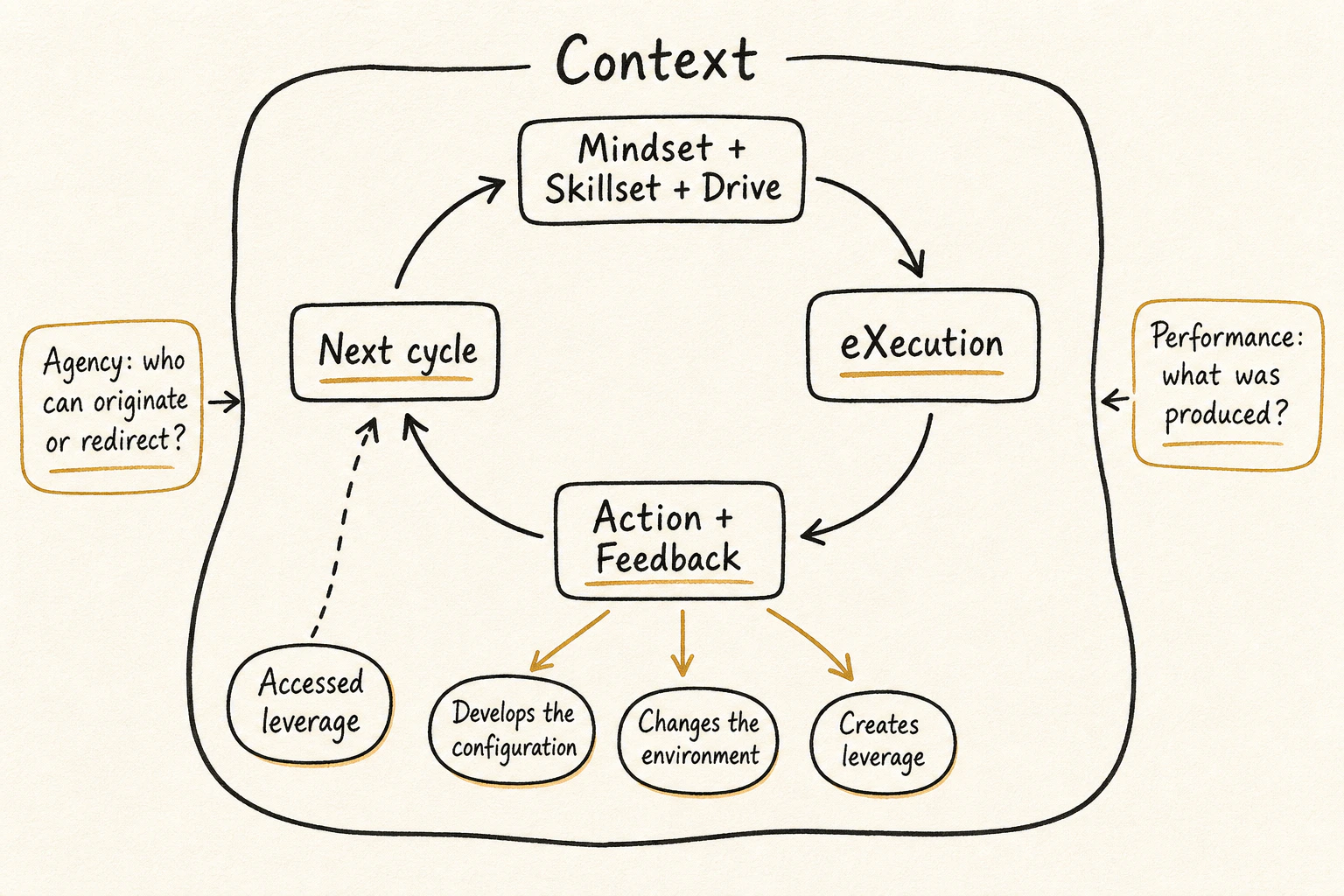
The sketchnote is a practical map, not literal mathematics. Read it clockwise: Mindset, Skillset, and Drive form a configuration for a specified outcome. eXecution converts that configuration into action and feedback. The feedback can develop the configuration, change the environment, or create leverage for the next cycle.
Context conditions the whole loop. Accessed leverage can support any stage. Agency asks who can originate or redirect the cycle. Performance asks what the cycle actually produced against the defined outcome.
The loop matters because diagnosis should change after action. If feedback does not alter the next interpretation, capability, direction, method, or environment, MSDx has become a label rather than a working protocol.
Find the binding constraint
The binding constraint is the condition currently limiting meaningful movement toward the outcome. It may sit inside the unit, in the execution method, in the environment, or in the leverage structure.
Use this sequence:
- Restate the unit, outcome, timeframe, context, responsibility, and evidence.
- Describe the gap without assigning a cause.
- Examine Mindset, Skillset, Drive, and eXecution separately.
- Check Context, Agency, Performance, Identity, and both forms of leverage.
- Name at least one competing explanation.
- Identify the smallest safe intervention that would produce distinguishing evidence.
- Review the feedback before expanding the intervention.
| Possible binding constraint | Question | Intervention direction |
|---|---|---|
| Unit mismatch | Are we diagnosing the person when the team or system owns the constraint? | Change the unit being examined. |
| Execution method | Is the configuration adequate, but the workflow, sequence, decision speed, or feedback loop weak? | Change the execution method. |
| Environment | Is friction, authority, incentive design, role fit, or a structural limit suppressing the configuration? | Change the environment or the relationship to it. |
| Leverage structure | Is useful execution unable to travel, repeat, compound, or reach the required scale? | Change the accessed or created leverage structure. |
A suspected Mindset, Skillset, or Drive constraint may still call for a change within the person or unit. The table prevents that from becoming the automatic answer.
Symptoms are prompts, not proof. Motion without progress can reflect an assumption, a missing capability, conflicting incentives, weak feedback, or a goal that should be rejected. Similar symptoms can have different causes.
Where MSDx is strongest
MSDx is most useful when the work involves autonomy, ambiguity, novelty, transition, adaptation, creation, or system change. In these conditions, the unit must interpret the situation, assemble or develop capability, mobilize sustained effort, act without complete certainty, and learn from the result.
Its added value may be lower in stable, repetitive, closely prescribed work where procedures, supervision, and infrastructure supply much of the direction and execution method. Even there, MSDx can become useful during anomalies, role changes, system failure, or adaptation.
This is a scope boundary, not a judgment about the importance of the work or the people doing it.
What MSDx does not claim
The August 2026 Working Edition does not claim:
- literal physics or literal multiplication;
- a theorem in which any zero necessarily collapses all outcomes;
- guaranteed 10x or 100x outcomes;
- a moral hierarchy among people, roles, professions, or degrees of ambition;
- universal causality or one explanation for every performance problem;
- scientific validation;
- identical constructs at individual, team, organization, portfolio, federation, or ecosystem resolutions.
MSDx does not prove why an outcome occurred. It structures a diagnosis, exposes missing evidence, and helps choose a repair worth testing.
The larger MSDx body of work
The Core Protocol is the stable center. The larger body can develop without forcing every idea into the acronym.
- Core Protocol: The current definitions, boundaries, feedback loop, diagnostic sequence, claims, and nonclaims.
- Decision Architecture: Inputs, distinctions, systems, relationships, perceptions, trade-offs, constraints, clarity, and decision practices that support diagnosis and action.
- Applications: Bounded treatments for roles, teams, organizations, transitions, and work conditions. Architect, System, and Federation belong here as applications or resolution protocols, not as universal definitions of the core.
- Cases: Lived cases, organizational cases, failures, counterexamples, and diagnostic walkthroughs. Retrospective cases remain retrospective. They do not establish prediction or general validity.
- Research and Revision: Claim ledgers, sources, borrowed foundations, open questions, tests, failures, and visible changes to the protocol.
Revision ledger
| Period | Meaning or change | Evidence status |
|---|---|---|
| 2017 | MSD emerged from observing capable people with related skills but different ambition, alignment, and subsequent paths. | Author recollection. No surviving contemporary artifact has been found. |
| Later development | Lowercase x was added as eXecution, converting MSD into action. |
Author recollection. Exact date and first artifact remain unresolved. |
| March 15, 2026 | Execution and Multipliers appeared as separate functions. Later March drafts compressed them into X. | Documented in the preserved March 2026 revision history. This establishes the 2026 change, not the remembered 2017 origin. |
| May 9, 2026 | The public page defined X as Leverage and moved Execution elsewhere in the model. | Documented in the preserved May source, revision history, and public page snapshot. |
| August 2026 | Lowercase x is restored to eXecution. Context conditions the cycle. Accessed leverage supports execution, while execution can create leverage. Agency and Performance are separated. |
Working synthesis based on author testimony, documentary revision history, and autobiographical evidence. It is not scientifically validated. |
Different versions captured different parts of the system. This edition separates those parts instead of presenting every earlier meaning as if it had always been the same.
The MSDx Series: “If you want less noise and more clarity in your decisions, this is for you.”
FAQs
What is the MSDx Protocol?
The MSDx Protocol is a context-aware diagnostic for turning Mindset, Skillset, and Drive into action, feedback, and leverage. The lowercase x stands for eXecution.
How does eXecution relate to leverage in MSDx?
eXecution converts the configuration of Mindset, Skillset, and Drive into action and feedback. Accessed leverage can support execution, and execution can create leverage for subsequent cycles. Execution and leverage are separate concepts.
How does feedback enter the MSDx Protocol?
Feedback enters by testing the smallest useful repair, observing what changes, and repeating the audit as evidence accumulates. MSDx remains a diagnosis to revise, not a permanent label or proof of why an outcome occurred.
Use this workExplore with AI
Explore this canon
Take this work into your preferred AI system. Choose a ready-made prompt or add your own context. Nothing you enter here is sent or saved by utpalmv.com.
Use the work as a thinking lens without adding personal context.
Optional. Add details when you want the exploration grounded in your situation. Your context remains in this page and is included only in the prompt you copy.