

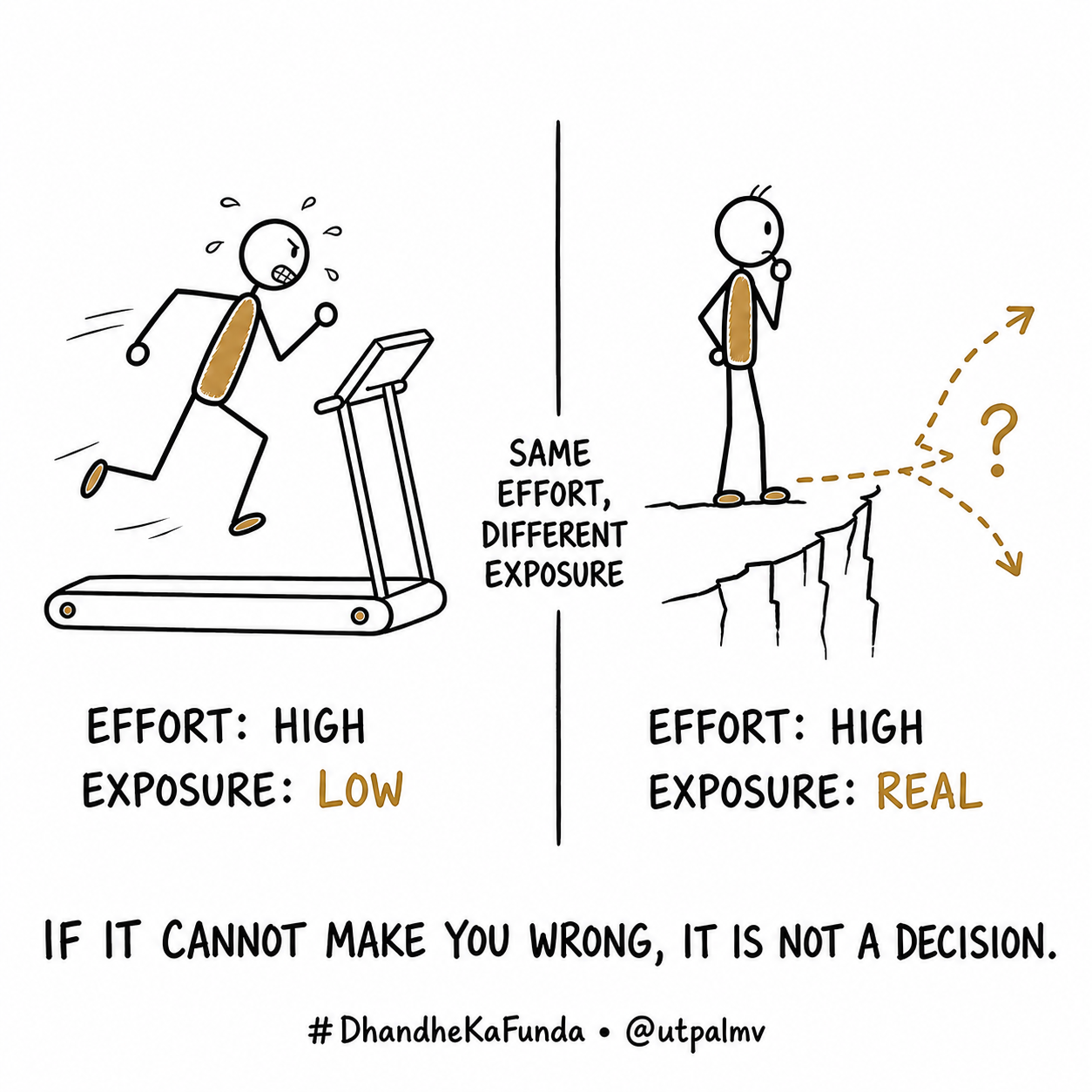
Clarity about priorities does not make the next decision easy. It makes the exposure visible.
That is where motion becomes attractive.
A decision carries two costs: effort and exposure. Motion can spend the same effort while avoiding the exposure.
The calendar remains full. Meetings happen. Documents move. People work hard. By the end of the day, the tiredness is real.
So is the activity.
What may still be missing is a choice someone is willing to own.
This does not require lazy people or weak teams. It only requires a system in which making a choice carries a visible personal cost, while continuing the activity carries a quieter cost spread across the organization.
Given that structure, motion can be the safer option.
A status update can describe the work without deciding what changes. An alignment session can reveal disagreement without resolving it. A framework review can test the logic without committing anyone to the consequence.
All 3 may be useful. None should be mistaken for the decision itself.
The standard is sharper:
A decision is a place where you can be publicly wrong. Any activity that cannot make you wrong is not a decision.
Use that standard carefully.
Research can reduce uncertainty. Discussion can expose a constraint. Review can prevent an avoidable error. Work often has to move before a responsible choice is available.
The test is not whether the activity should exist. The test is whether it is being reported as progress after it has stopped producing information for a decision.
Priority without decision becomes a list.
Distributed authority without exposure becomes permission nobody uses.
Both can look active from a distance.
The harder move is to name the decision, name who owns it, and name what that person is willing to be wrong about.
Everything else may still be useful.
Just stop reporting it as progress.
#DhandheKaFunda: If it cannot make you wrong, it is not a decision.
Use this workExplore with AI
Explore this journal
Take this work into your preferred AI system. Choose a ready-made prompt or add your own context. Nothing you enter here is sent or saved by utpalmv.com.
Use the work as a thinking lens without adding personal context.
Optional. Add details when you want the exploration grounded in your situation. Your context remains in this page and is included only in the prompt you copy.