

Speed is attractive because it is easy to see.
A task takes 2 hours instead of 2 days. A report appears in seconds. A team produces more with the same number of people.
Each improvement may be real.
The harder question is what has become faster.
If the direction is unclear, speed distributes the confusion sooner. If decisions still return to one person, automation delivers them to the bottleneck faster. If nobody owns the standard, better tools produce more work that still has to be reviewed.
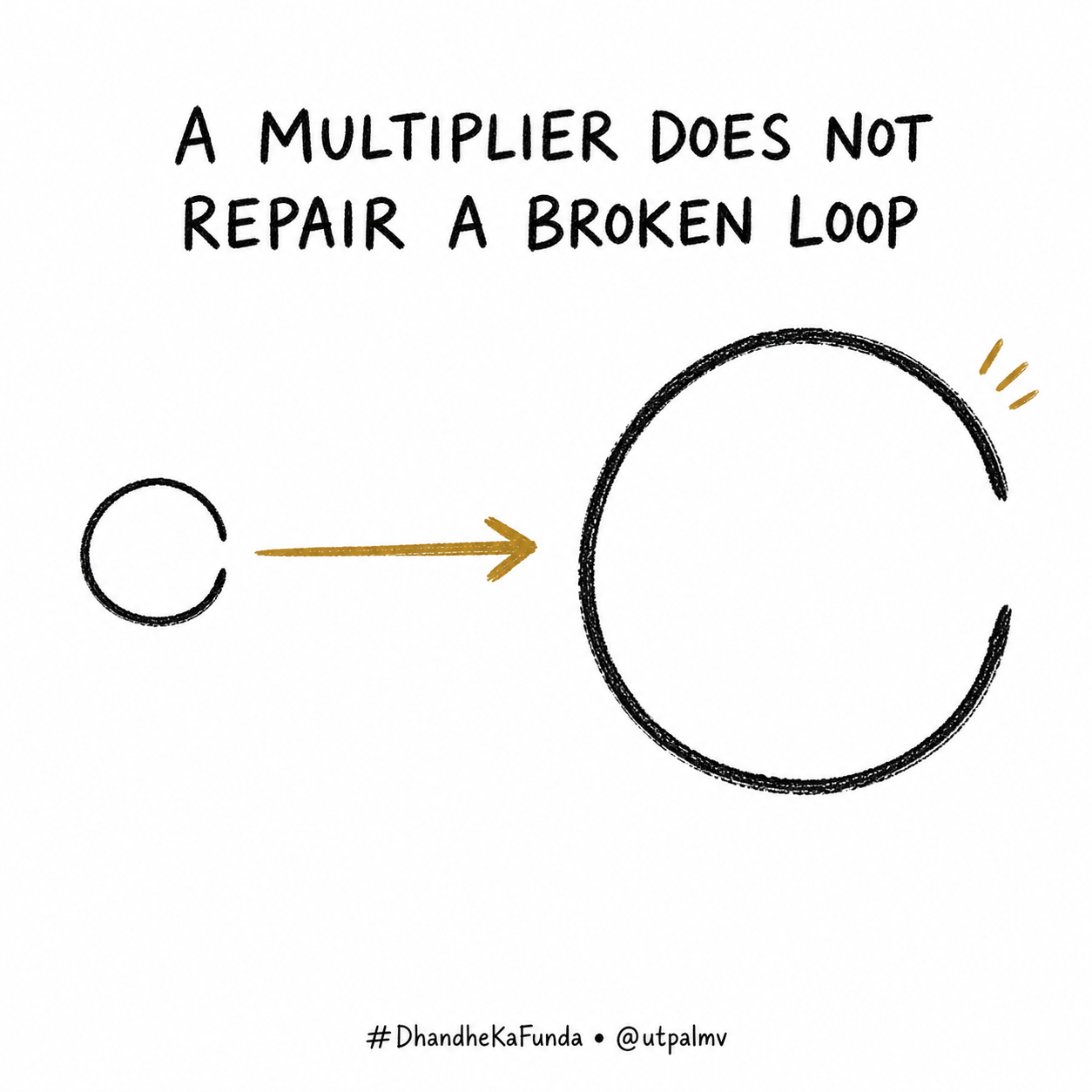
The multiplier worked.
The loop did not.
This is the distinction I keep returning to in DLMx. Doing, leadership clarity, and management discipline form the operating loop. Multipliers sit outside it. They can increase the effect of the loop, but they cannot repair a weakness inside it.
That placement matters.
When a multiplier produces visible gains, it is tempting to treat those gains as proof that the system improved. Sometimes the gain is only local. One step became cheaper while the outcome remained constrained somewhere else.
The demonstration looks good. The work moves faster. The customer, the decision, or the result still waits.
This is especially easy to miss with AI because the output arrives so quickly. Faster drafting can hide slow judgment. Faster analysis can feed an unresolved decision. Faster production can increase the volume entering a weak review system.
None of this makes the multiplier a mistake.
It makes placement the real decision.
Before adding speed, find the weakest part of the loop.
Is the work not being done?
Is the direction too unclear to guide trade-offs?
Is the operating discipline too weak to sustain the standard?
Then ask what the proposed multiplier changes in that specific place.
If it changes nothing there, it may still save time. It may still reduce cost. It may still be worth buying.
Just do not call it a transformation.
You have accelerated the system you already had.
That is valuable when the system works.
When it does not, a multiplier applied to a broken loop returns a bigger broken loop.
#DhandheKaFunda: Repair the loop before you accelerate it.
Use this workExplore with AI
Explore this journal
Take this work into your preferred AI system. Choose a ready-made prompt or add your own context. Nothing you enter here is sent or saved by utpalmv.com.
Use the work as a thinking lens without adding personal context.
Optional. Add details when you want the exploration grounded in your situation. Your context remains in this page and is included only in the prompt you copy.