

The Value Co-Creation Protocol is a lightweight protocol for independent participants to explicitly agree how they will create value together, handle contributions and benefits, and conclude or renew their commitments.
VCC applies to one bounded engagement. Participants may be people, businesses, or institutions. They retain authority over their commitments while accepting responsibility for what they agree to do.
Here, VCC means the Value Co-Creation Protocol for bounded engagements between independent participants, not voluntary carbon credits or a venture-capital firm.
The observation
Across my work, I bring people, businesses, capabilities, relationships, technology, and capital together. My larger purpose is to co-create a shared future with an entrepreneurial spirit worldwide.
Complementary capabilities create a possibility. They do not settle what happens next.
One person sees an opportunity. Another can build. Someone else has access to the people who might benefit. They agree that something is worth doing, but each may carry a different understanding of the work, the risk, and what they will receive.
Those differences become expensive when they remain invisible until work has begun.
While forming an early thesis for House of Starts, I began examining how independent participants could create value together. That inquiry became a foundation for HoSt and developed into the Value Co-Creation Protocol.
The protocol begins with a bounded commitment.
What value co-creation means
Value co-creation happens when participants combine contributions to produce benefits through their interaction.
The broader phenomenon already exists. VCC gives a particular engagement an explicit structure. People can co-create value without using VCC, and an engagement can follow VCC without achieving its intended outcome.
The useful question is whether making commitments visible helps participants act, adapt, and conclude their work with fewer damaging assumptions.
The five stages
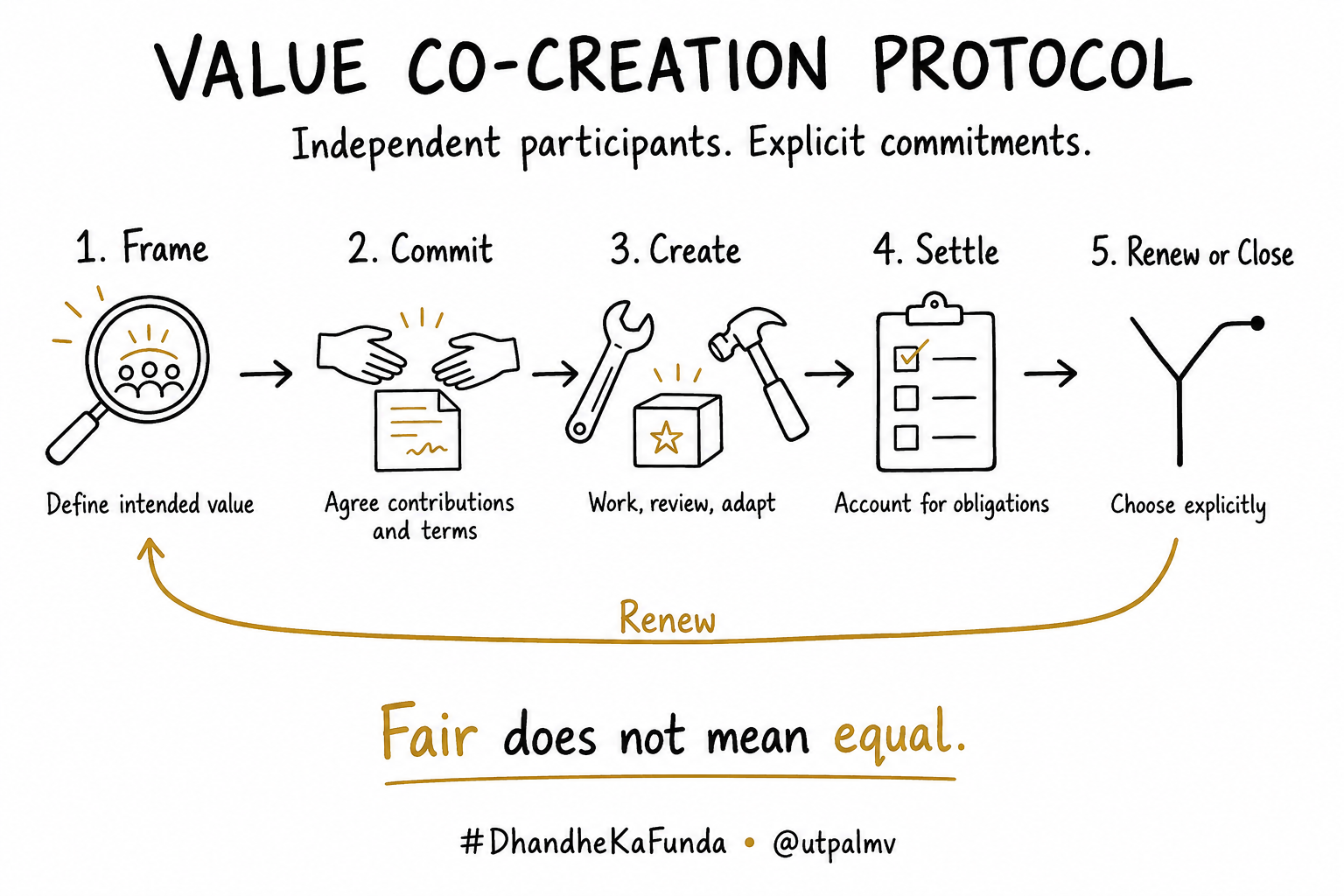
Frame → Commit → Create → Settle → Renew or Close
The sequence can fit in one shared note. Its depth should match the uncertainty and exposure involved. New evidence can send participants back to an earlier stage.
1. Frame
Define the opportunity and who should benefit. Describe the intended outcome, what evidence would count, and what is outside the engagement.
Then examine the fit. What can each participant contribute? Can they actually authorize and supply it? Why does working together make sense?
A finished product is an output. Whether someone can use it to improve their situation is a value question. Frame needs both.
Name material effects on people outside the engagement as well. A benefit to the participants does not justify ignoring costs imposed on others.
Leave Frame with a bounded opportunity, named participants and beneficiaries, an intended outcome, and limits on exposure.
2. Commit
Make the terms explicit before meaningful work, spending, or disclosure begins.
Who contributes what, and by when? Who decides routine matters? Which changes require renewed agreement? How will benefits, costs, risks, ownership, use, and credit be handled?
Include a review date and a way to stop. Participants need to know what happens if the opportunity disappears, a contribution fails to arrive, or their circumstances change.
Trust can make this conversation easier. It cannot answer on another person's behalf.
Leave Commit with terms each participant understands and accepts. An unresolved material term calls for less exposure or a later commitment.
3. Create
Do the work and examine what it produces. Keep material contributions, feedback, and changes visible.
Participants do not need a record of every action. They need enough evidence to distinguish what was promised, what was delivered, and what helped the intended outcome.
If the scope, risk, or expected benefit changes materially, return to the agreement. Do not let a changed engagement continue under assumptions that belonged to the old one.
Leave Create with work that can be assessed, evidence of contributions and outcomes, and a record of agreed changes.
4. Settle
Compare what happened with what was intended. Account for contributions and carry out the agreed treatment of benefits, costs, rights, and handovers.
Settlement matters when a project succeeds, fails, or is canceled. Failure to achieve the outcome does not automatically erase compensation or other obligations. Equally, effort alone does not establish every claim a participant might make.
If something remains unresolved, name it, identify responsibility, and record the next action and review date. Ending active work must not create a false impression that everything has been settled.
Leave Settle with obligations discharged or explicitly accounted for.
5. Renew or Close
Decide whether another bounded engagement is worth undertaking.
Renewal requires fresh agreement from those who will participate. Some people may continue while others leave. Earlier involvement does not create an obligation to join the next project.
Close when the engagement has ended. Preserve any continuing duties and useful learning.
Leave this stage with an explicit conclusion or a new commitment. Silence is not renewal.
Contribution, value, and entitlement
Contribution can include work, judgment, coordination, maintenance, capital, access, distribution, tools, intellectual property, relationships, or defined risk.
What matters is what the participant actually makes available to the engagement. Having a network is different from making a useful introduction. Owning an asset is different from granting permission to use it.
Value can include revenue, profit, knowledge, capability, access, relationships, reputation, social benefit, or future options. Some benefits can be divided. Others are experienced, retained, or made available for use.
Keep three questions separate:
- What did each participant contribute?
- What benefits resulted, and for whom?
- What is each participant entitled to receive under the agreement?
These questions inform one another without producing a universal formula. A transparent allocation rule can be useful without pretending to measure each person's precise causal share of success.
Fair does not mean equal
Explicit before assumed. Fair before equal.
Participants need not contribute equally, carry equal risk, or receive equal rewards. Equal shares can also be a sensible choice when the participants understand and accept the reasons.
Seek a defensible arrangement: clear expectations, relevant information, consistent treatment, and a practical way to challenge a decision. Agreement alone does not establish fairness when someone is misled or cannot meaningfully refuse.
Value capture should follow value contribution. This describes the basis of participation, not a rule that all payment must wait until success. Preparation, committed capacity, and risk may justify compensation or advances before the outcome exists.
Agree the basis before the work. If money will be shared, define the pool, permitted deductions, access to accounts, and payment timing. If no economic participation is intended, make that clear too.
Sometimes the useful contribution is an introduction followed by stepping away. Help does not need to become a permanent claim.
Run a small engagement
Consider two independent professionals planning a workshop. This is a hypothetical example.
One develops and teaches the material. The other recruits participants and manages logistics. During Frame, they identify the audience, the intended learning benefit, and a minimum enrollment threshold.
Before preparation begins, they agree their time limits, cancellation date, expenses, proceeds split, rights to the material, and who verifies receipts. They also decide how participant feedback will inform their assessment.
They create and run the workshop, recording any material changes. Afterward, they assess the result, settle accounts, and decide whether another workshop deserves a fresh commitment.
A noncommercial engagement follows the same logic. A researcher and a community group might create a public guide. Their agreement can cover evidence, review responsibilities, credit, permission to publish, and reuse without promising either party income.
For either engagement, begin with one shared record:
| Record | Make explicit |
|---|---|
| Opportunity | Beneficiary, intended outcome, evidence, and scope |
| Participants | Who joins and who can authorize each commitment |
| Contributions | Who supplies what, by when, with what dependencies and limits |
| Decisions | Routine authority, delivery acceptance, and material-change rules |
| Benefits and burdens | What is paid, shared, retained, or not claimed; costs and risks |
| Rights | Ownership, use, disclosure, and credit |
| Review and exit | Review date, stop conditions, disagreement process, surviving obligations |
| Acceptance | Each participant's explicit agreement to the dated record |
At review, append the actual outcome, settlement status, learning, and the decision to renew or close.
Close or compound
Renew or Close is an operating decision. Close or Compound expresses a wider hope for the relationship.
A cycle may leave participants with better judgment, reusable capabilities, or greater confidence in working together. Those effects can persist even if they never undertake another project.
Compounding is not guaranteed. Repeated collaboration can also accumulate friction or dependency. The next engagement should earn its place rather than inherit it automatically.
Adapting the protocol
Participants can adapt the working record, review rhythm, and supporting tools to their engagement. The adaptation should retain explicit commitments, contribution visibility, decision and rights clarity, settlement, exit, and renewed agreement. Identify the VCC version used and make material departures explicit.
A host's fee or share must follow its disclosed role and accepted terms. Hosting a network does not establish an automatic entitlement to every outcome created within it.
Field use
VCC v0.1 is a candidate for field testing. Its development arose from an operating question, but that does not establish effectiveness. The examples here are hypothetical. The next test is whether independent participants can use the protocol without facilitation and reach clearer commitments than they would through a simpler project agreement.
Limits
VCC cannot supply missing competence, demand, goodwill, or enforcement. It does not establish legal rights by itself or replace the agreements an engagement requires.
Use less process when an existing arrangement already provides sufficient clarity. A networking event, ordinary purchase, or unilateral gift does not need a VCC label merely because it creates value.
The protocol should change if its stages add ceremony without improving understanding, action, or settlement.
Foundations and evolution
Value co-creation has an established intellectual history. Prahalad and Ramaswamy examined co-creation through interaction and customer experience. Vargo and Lusch describe value co-creation among multiple actors, including beneficiaries, and its institutional coordination.
VCC is my practitioner synthesis for conducting a bounded engagement. It does not claim to originate the broader concept or demonstrate the effectiveness of its own sequence through those sources.
The KNOLt Framework offers a related discipline for examining claims and testing their application. VCC must remain open to that same examination.
Revision record
September 6, 2026: First published as v0.1, a living protocol candidate developed around Frame, Commit, Create, Settle, and Renew or Close. Field testing remains outstanding.
September 6, 2026: Disambiguated VCC and separated field use from limits.
FAQs
What is the Value Co-Creation Protocol?
The Value Co-Creation Protocol is a lightweight protocol for independent participants to agree how they will create value together, handle contributions and benefits, and conclude or renew a bounded engagement.
What are the five stages of VCC?
The five stages are Frame, Commit, Create, Settle, and Renew or Close. They establish the opportunity, make terms explicit, guide work and adaptation, account for obligations, and require a decision about what follows.
Does VCC require equal rewards or shared ownership?
No. Participants make benefits, burdens, and rights explicit. Equal rewards or shared ownership are possible choices, but neither is required. Some engagements involve no economic participation.
Can VCC be adapted to different engagements?
Yes. Participants can adapt the working record, review rhythm, and supporting tools while retaining the protocol's core commitments. Identify the version used and make material departures explicit.
Use this workExplore with AI
Explore this canon
Take this work into your preferred AI system. Choose a ready-made prompt or add your own context. Nothing you enter here is sent or saved by utpalmv.com.
Use the work as a thinking lens without adding personal context.
Optional. Add details when you want the exploration grounded in your situation. Your context remains in this page and is included only in the prompt you copy.