

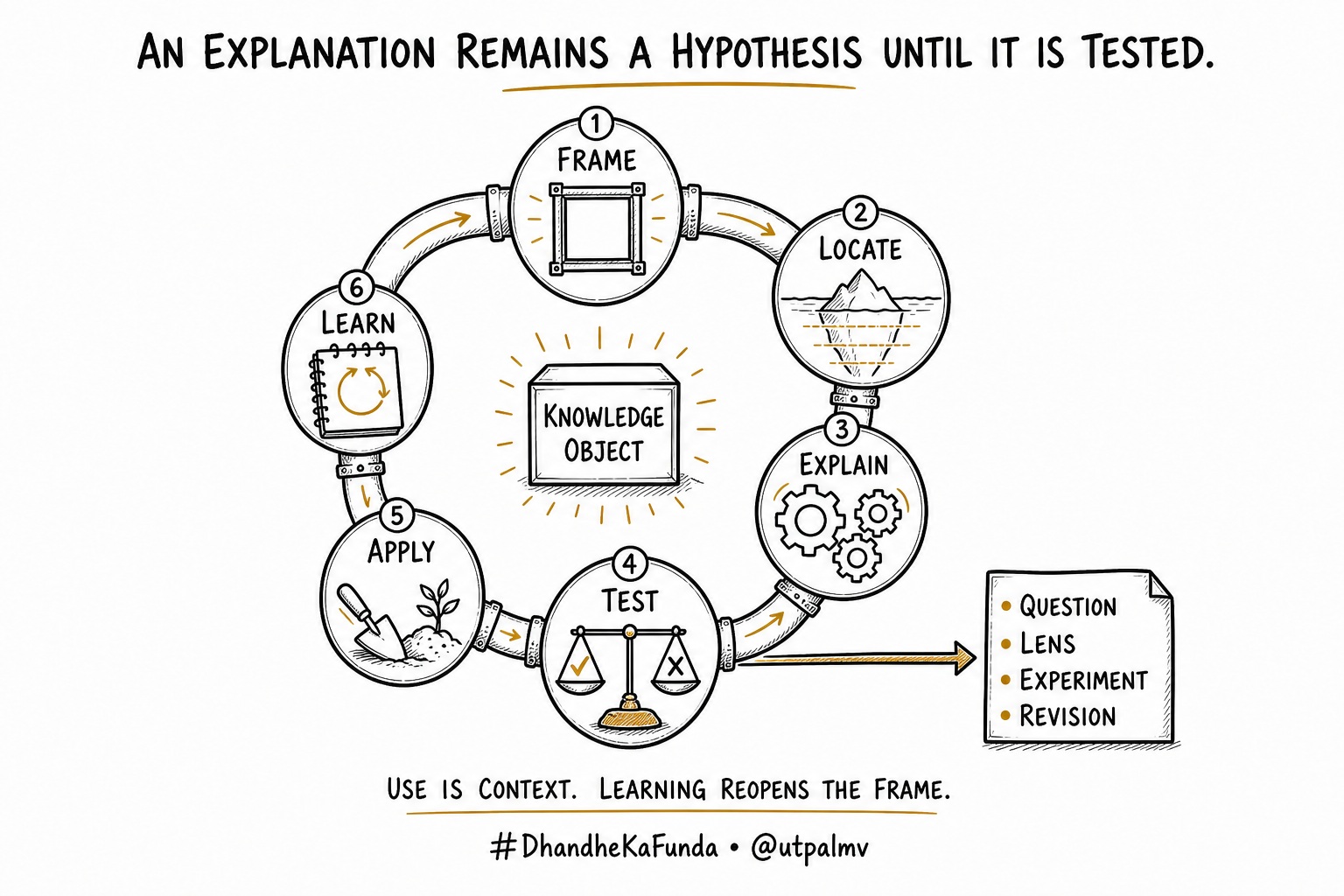
The KNOLt Framework is a living framework for examining one knowledge object before turning it into advice.
Here, KNOLt names this framework, not a typeface or an unrelated acronym.
Ideas travel faster than examination.
A sentence from a book becomes a principle. A chart becomes a diagnosis. A story becomes a rule for a situation it was never meant to explain.
The problem is not access to knowledge. It is the distance between encountering something and knowing what it means, where it holds, what challenges it, and what to do with it.
KNOLt is a framework for working across that distance.
The lowercase t stands for testing. An explanation remains a hypothesis until evidence and contextual application test it.
It begins with one knowledge object and moves through six forms of examination:
Frame. Locate. Explain. Test. Apply. Learn.
The aim is not to make every object look complete. The aim is to expose its boundaries, mechanism, evidence, practical use, and revision path.
KNOLt is a living framework. It is an integration I am developing, not a claim that I invented the theories and practices it draws from. Its components retain their own names, authors, evidence, and limits.
Field use
The KNOLt Framework has been exercised in operating work at Upsquare, EightQor, and House of Starts. Practitioner use does not establish that its six movements outperform a simpler examination. The comparison proposed below remains a test to conduct, and borrowed foundations retain their own attribution, evidence, and limits.
What is a knowledge object?
A knowledge object is a bounded unit selected for examination because it makes or implies a claim, distinction, mechanism, pattern, method, or question that may change understanding or action.
It could be:
- a claim in a paper
- a model in a book
- an argument from a talk
- a pattern observed in an organization
- a scene in a film
- a method used in practice
- a question that keeps returning
The object is not the entire source. It is the particular unit under examination.
This boundary matters. “Remote work” is a subject. “Remote work weakens informal learning for new employees in this type of team” is a knowledge object that can be examined.
Selection does not confer truth or usefulness. It only says: this object deserves a closer look.
Every examination should record the object, its source or observation locator, why it was selected, what is included, what is excluded, and its current evidence status.
The six movements
The movements are ordered, but they are not a one-way pipeline. Evidence found during Test may force a new Frame. An application may reveal that the explanation was too broad. Learning may produce a different object for the next examination.
The operating sequence
Begin with one knowledge object.
- Frame: State the object, boundary, question, terms, and perspectives.
- Locate: Map its context, depth, resolution, incentives, and constraints.
- Explain: Propose the mechanism and state the diagnosis as a hypothesis.
- Test: Record evidence, counterpositions, uncertainty, and possible falsifiers.
- Apply: Design the smallest contextual and reversible experiment.
- Learn: Record the result and decide whether to retain, narrow, expand, correct, retire, or investigate further.
If a movement cannot produce its required output, the examination should stop or return to an earlier movement. Completion is not evidence.
1. Frame
Frame defines what is being examined and from where.
Ask:
- What exactly is the object?
- What question are we asking of it?
- What is inside the boundary, and what is outside it?
- Which terms need operational definitions?
- Whose perspective is present?
- Which relevant perspectives are absent?
A useful frame produces a question narrow enough to investigate and important enough to matter.
This is where distinctions, parts and wholes, relationships, and perspectives can sharpen the inquiry. Those four reasoning patterns come from DSRP Theory by Derek and Laura Cabrera. KNOLt uses DSRP as an optional reasoning layer. It does not rename DSRP, reproduce its full theory, or require it in every inquiry.
The output of Frame is a boundary statement, a primary question, key terms, and a perspective note.
2. Locate
Locate asks where the object sits in depth and context.
A visible event may be part of a pattern. The pattern may be produced by structures. Those structures may persist because of assumptions, incentives, or mental models.
This movement uses the systems-thinking Iceberg model as a depth heuristic when it helps. A traceable source for the events, patterns, systemic structures, and mental-models presentation is Daniel H. Kim's Introduction to Systems Thinking. The heuristic is useful because it interrupts the reflex to explain a recurring outcome as an isolated event. It does not prove that every event has one hidden structure or one decisive mental model.
Ask:
- Is this an event, a recurring pattern, a structure, an assumption, or some combination?
- At what resolution does the object operate?
- What happened before and after it?
- Which incentives or constraints may sustain it?
- What context would make the object behave differently?
The output of Locate is a depth map with supported observations separated from hypotheses.
3. Explain
Explain proposes a mechanism.
It asks how the object could produce the outcome attributed to it. A label is not a mechanism. “Culture,” “mindset,” “leadership,” and “market conditions” often name a territory without explaining what moves inside it.
Ask:
- What acts on what?
- Through which relationship or feedback loop?
- What must be present for the mechanism to work?
- What would interrupt it?
- At what resolution does the proposed mechanism operate?
- What evidence would count against this explanation?
Two Utpal-created living frameworks may be useful here.
MSDx can examine capability architecture through Mindset, Skillset, Drive, and eXecution (x). Accessed leverage can support execution, and execution can create leverage for subsequent cycles. DLMx can examine operating and conversion architecture through Doing, Leadership, Management, and Multipliers.
Neither belongs in every examination. MSDx is useful when capability is genuinely in question. DLMx is useful when the conversion of intent into outcomes is genuinely in question. An ethical claim, historical interpretation, or aesthetic judgment may need neither.
The output of Explain is a mechanism map and a diagnosis stated as a hypothesis.
4. Test
Test asks whether the object and the explanation survive contact with evidence and opposition.
This movement should distinguish:
- a sourced fact
- a theoretical claim attributed to its source
- a heuristic
- an interpretation
- a hypothesis
- a recommendation
- an unknown
Ask:
- What is the strongest evidence for the claim?
- What is the source actually entitled to support?
- What counterposition or alternative explanation deserves attention?
- Is the evidence direct, indirect, anecdotal, or absent?
- What uncertainty changes the recommendation?
- What would falsify or materially weaken the explanation?
A prestigious source can still be irrelevant to the precise claim. Several citations can repeat one unsupported assumption. A vivid example can improve understanding without establishing frequency or causation.
The output of Test is a claim ledger with locators, evidence quality, counterpositions, and open questions.
5. Apply
Apply converts the examination into a contextual experiment.
The word contextual matters. A useful move for a founder may be wrong for a student, a caregiver, or a public institution. The same reader may need different moves under different constraints.
Ask:
- Who is acting, in what situation, and toward what outcome?
- What is the smallest reversible move that tests the explanation?
- What signal will be observed?
- What risk or misuse needs a warning?
- What is the stop condition?
- When will the result be reviewed?
The output is not universal advice. It is an experiment card: context, move, expected signal, risk, stop condition, and review date.
6. Learn
Learn closes the loop without pretending the inquiry is finished.
Ask:
- What happened?
- What did the result support, weaken, or leave unresolved?
- Did the context, execution, or original explanation drive the outcome?
- What changed in the lens?
- What should remain visible from the previous version?
- When does this object need review again?
A failed experiment does not automatically disprove the object. A successful experiment does not prove it generally. Both results update the examination.
The output is a learning note and a revision decision: retain, narrow, expand, correct, retire, or investigate further.
A compact example
Consider the object: Recurring meetings persist because decision ownership is unclear.
This is a hypothetical example, not a finding about a specific organization.
Frame: Examine one recurring project meeting. The question is whether unclear decision ownership, rather than information sharing or coordination complexity, is sustaining it.
Locate: Review the last 8 meetings. Record repeated agenda items, unresolved decisions, attendance, follow-up, and where approval was sought. Treat unclear ownership as a hypothesis.
Explain: Map how an unresolved decision returns to the agenda. If work repeatedly pauses until one senior person responds, an operating-architecture examination may be useful. DLMx can help examine Leadership clarity and Management discipline, but it does not establish the cause.
Test: Compare the ownership hypothesis with alternatives. The meeting may persist because dependencies genuinely change, participants lack information, incentives punish unilateral decisions, or the meeting serves a social function that the formal agenda does not show.
Apply: For 2 cycles, assign one decision owner, a written decision rule, and a deadline for one recurring agenda item. Keep the rest of the meeting unchanged. Observe decision latency, reopened decisions, and downstream confusion. Stop if the change creates a material compliance, safety, or stakeholder risk.
Learn: If the item closes without new confusion, the result supports a narrow ownership explanation for that item in that context. It does not prove that unclear ownership explains all recurring meetings. Record the result and decide whether to test another item.
The example is deliberately modest. The point is not to decorate a diagnosis with frameworks. It is to make the diagnosis testable.
What KNOLt produces
A full examination can produce several artifacts:
- a question lens
- a claim and evidence ledger
- a mechanism or system map
- application prompts
- a contextual experiment card
- counterposition notes
- revision annotations
Not every reader needs the full working record. The public artifact can be concise if the evidence and decisions behind it remain inspectable.
This is where KNOLt and KNOLTOK separate.
KNOLt is the reasoning architecture for examining a knowledge object.
The KNOLTOK Method is the editorial process that turns an accepted examination into an evidence-visible, maintained question lens.
A KNOLTOK lens is the public reader-facing artifact.
KNOLTOK is an independent applied-knowledge library. The UV Almanac is my personal intellectual record. KNOLt may live here as one of my frameworks while KNOLTOK uses it as part of its own editorial method. The two should not be collapsed into one brand.
The review rhythm
Review an examination when new evidence appears, its context changes, an experiment produces a material result, or its scheduled review date arrives.
Ask:
- Is the original object still framed correctly?
- Has the evidence changed?
- Does the explanation still survive the strongest counterposition?
- Did application support the explanation, expose an execution problem, or reveal a context boundary?
- Should the lens be retained, narrowed, expanded, corrected, retired, or investigated further?
Limits
Completing an examination does not establish that its conclusion is sound. A successful contextual experiment does not prove a general claim. KNOLt remains subject to comparison with simpler methods, and it should change if its movements add ceremony without insight. The misuse warnings below are part of that boundary.
Misuse warnings
KNOLt should not be used to make a weak claim look rigorous.
Avoid these failures:
- forcing every named framework into every inquiry
- treating a completed template as evidence of a sound conclusion
- confusing a hypothesis with a diagnosis
- presenting interpretation as sourced fact
- converting one contextual result into general advice
- using a composite scenario as if it were a case study
- hiding contradictory evidence in notes readers cannot inspect
- calling a lens maintained without an owner, review date, and correction path
- erasing earlier versions when the conclusion changes
The framework earns its place only if it produces better questions, clearer evidence boundaries, safer experiments, and more honest revision than a simpler process would.
How the framework should be tested
KNOLt v0.1 needs comparison, not admiration.
A useful pilot would examine the same set of knowledge objects through KNOLt and through a simpler process such as question, evidence, application. Independent reviewers could compare the outputs for:
- clarity
- traceability
- decision value
- time cost
- quality of counterpositions
- safety and specificity of the experiment
- ability to revise without losing history
The framework should change if its six movements add ceremony without insight, force irrelevant layers, obscure evidence, or cost more to maintain than the lenses are worth.
That is also part of the framework.
Learning is not the last box. It is the condition under which KNOLt deserves to continue.
Foundations and provenance
Derek Cabrera and Laura Cabrera describe DSRP as Distinctions, Systems, Relationships, and Perspectives, with paired elements for each pattern. See “DSRP Theory: A Primer,” Systems 10, no. 2 (2022), article 26. KNOLt uses DSRP selectively as an attributed reasoning layer and does not adopt every theoretical or empirical claim made for it.
The Iceberg model has circulated in several systems-thinking and learning-organization forms. A traceable source for the events, patterns, systemic structures, and mental-models presentation is Daniel H. Kim, Introduction to Systems Thinking (Pegasus Communications, 1999), ISBN 9781883823344. KNOLt treats it as a heuristic, not a theory or proof of hidden causes.
MSDx and DLMx are Utpal Vaishnav-created living frameworks. The current MSDx Protocol defines Mindset, Skillset, Drive, and eXecution (x), with leverage treated as a separate concept. The current DLMx Protocol defines Doing, Leadership, Management, and Multipliers. Each remains subject to its own revision record.
Revision record
- 2026-08-15: Originally published.
- 2026-08-16: Last revised.
- 2026-09-26: Corrected two MSDx references to match its August 2026 Working Edition: x means eXecution, with leverage treated separately.
Living means the definitions, application, and limits remain open to correction as evidence and practice change. These dates record the known publication history; they are not a complete account of the framework's development.
FAQs
What is the KNOLt Framework?
The KNOLt Framework is a framework for examining one knowledge object before it becomes advice. Its six movements are Frame, Locate, Explain, Test, Apply, and Learn.
What is a knowledge object in KNOLt?
The KNOLt Framework is a framework for examining one knowledge object before it becomes advice. A knowledge object is a bounded claim, distinction, mechanism, pattern, method, or question selected for examination because it may change understanding or action. It is not the entire source or subject.
What are the six movements of KNOLt?
The KNOLt Framework has six movements: Frame, Locate, Explain, Test, Apply, and Learn. Together they examine what the object is, where it comes from, how it may work, what challenges it, where it can be used, and what should change after use.
Why examine knowledge before turning it into advice?
The KNOLt Framework uses examination to expose a knowledge object's boundaries, mechanism, evidence, context, and revision path. Without that work, a sentence, model, or story can become a rule for a situation it was never meant to explain.
Use this workExplore with AI
Explore this canon
Take this work into your preferred AI system. Choose a ready-made prompt or add your own context. Nothing you enter here is sent or saved by utpalmv.com.
Use the work as a thinking lens without adding personal context.
Optional. Add details when you want the exploration grounded in your situation. Your context remains in this page and is included only in the prompt you copy.