

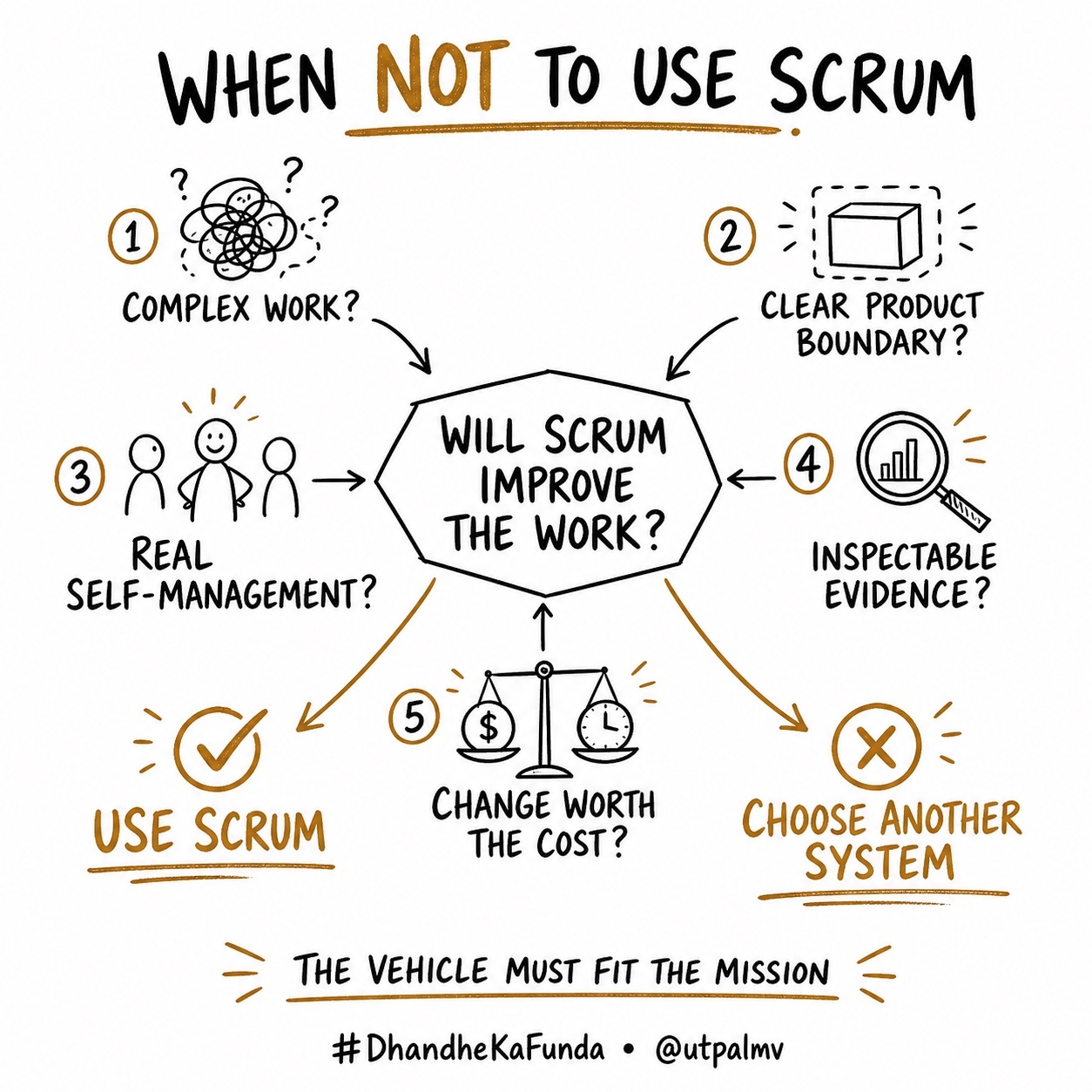
Scrum is useful when the work is uncertain and a capable team can turn short cycles into evidence. Remove those conditions and the framework can become an expensive way to perform certainty.
My old Scrum blog carried an article called When Not To Use Scrum? At the time, Scrum was my preferred vehicle for software development. I still thought a serious practitioner needed to know when another vehicle would serve the organization better.
That position has aged better than some of the reasons I gave for it.
The old list mixed durable concerns with assumptions tied to its time. It mentioned management support, individual performance systems, habitual micromanagement, people spread across projects, extended working hours, status, titles, and organizations that misunderstood Scrum as a daily meeting or a backlog.
I would not republish that list as present-day guidance. I would retain its governing question:
What must be true here for Scrum to improve the work?
Start with the kind of uncertainty
The current Scrum Guide defines Scrum as a lightweight framework for generating value through adaptive solutions to complex problems.
Complex matters. When cause and effect cannot be known sufficiently in advance, short cycles of action, evidence, inspection, and adaptation can reduce the cost of being wrong.
Not all work has that shape.
Some work is repeatable and well understood. Some requires expert analysis before execution. Some is dominated by queues, interrupts, service levels, or dependencies that do not fit a protected Sprint. Some needs an immediate stabilizing response before a team can establish a learning cadence.
Calling every difficult situation complex does not make Scrum appropriate. It merely protects the framework from examination.
Use Scrum when the uncertainty benefits from an empirical cycle. Use something else when the work has a better governing logic.
Scrum needs a real product boundary
A collection of tasks is not necessarily a product.
Scrum becomes difficult to use honestly when a team has no coherent outcome, no meaningful Product Goal, no authority to order the work, and no way to produce an Increment that stakeholders can inspect.
The calendar can still contain Sprints. The board can still contain stories. The meetings can still occur. What is missing is the unit of value around which the system is meant to learn.
If work arrives from unrelated sponsors, competes through escalation, and leaves through different approval chains, the first problem may be organizational design. Scrum cannot create a product boundary merely by naming a Product Owner.
Do not promise self-management while preserving task assignment
The Scrum Guide makes the Scrum Team responsible for deciding who does what, when, and how. That is not a decorative preference. It changes the operating relationship between the team and the organization.
If managers still assign every task, move people between priorities without negotiation, and reverse team decisions without carrying the consequence, the organization has not chosen Scrum's form of self-management.
It may still use planning, reviews, visual work, or short feedback loops. Those practices can be valuable. Calling the arrangement Scrum does not add integrity to it.
Check whether evidence can arrive inside the cadence
A Sprint should produce something useful enough to inspect and learn from.
If the meaningful evidence arrives only after a regulatory cycle, a hardware lead time, a seasonal event, or a dependency controlled elsewhere, a 2-week rhythm may create activity without faster learning.
The right question is not whether the work can be divided into smaller tickets. Almost any work can.
The question is whether a smaller delivery can change what the team knows or what a stakeholder can decide.
When it cannot, the cadence needs a different design.
Count the cost of the framework
Every operating system has a cost.
Scrum asks people to protect goals, maintain transparency, involve stakeholders, produce usable increments, inspect evidence, and change their plan. It challenges functional silos, shared-service queues, individual heroics, and management through assignment.
Those are not meeting costs. They are structural costs.
An organization may decide that the change is worth making. It may also decide that another system fits the present constraint better. That decision should be explicit, not disguised as partial Scrum followed by disappointment that the framework did not transform the organization.
A practical fit test
Before adopting Scrum, I would now ask:
- Is the work genuinely complex enough to benefit from empiricism?
- Is there a coherent product, mission, or outcome around which to organize learning?
- Can a stable, cross-functional group produce something inspectable within a short cycle?
- Can the people doing the work make meaningful decisions about how it is done?
- Can stakeholders provide evidence soon enough to change the next cycle?
- Is leadership willing to change the surrounding system when Scrum exposes a problem?
- Will the expected improvement justify the transition cost?
A weak answer does not always mean no. It identifies the condition that must change or the part of Scrum that should not be promised.
Study the framework without adopting the identity
Scrum can still teach a team to make work visible, reduce commitment size, clarify goals, inspect evidence, and adapt. A team can learn from those disciplines without claiming full Scrum.
That is not failure. It is contextual judgment.
My old blog said Scrum was a vehicle, not the destination. The deeper implication is that choosing the vehicle is part of the work.
Do not ask whether Scrum is good.
Ask whether its operating assumptions are true enough here to help this mission move.
Use this workExplore with AI
Explore this journal
Take this work into your preferred AI system. Choose a ready-made prompt or add your own context. Nothing you enter here is sent or saved by utpalmv.com.
Use the work as a thinking lens without adding personal context.
Optional. Add details when you want the exploration grounded in your situation. Your context remains in this page and is included only in the prompt you copy.