

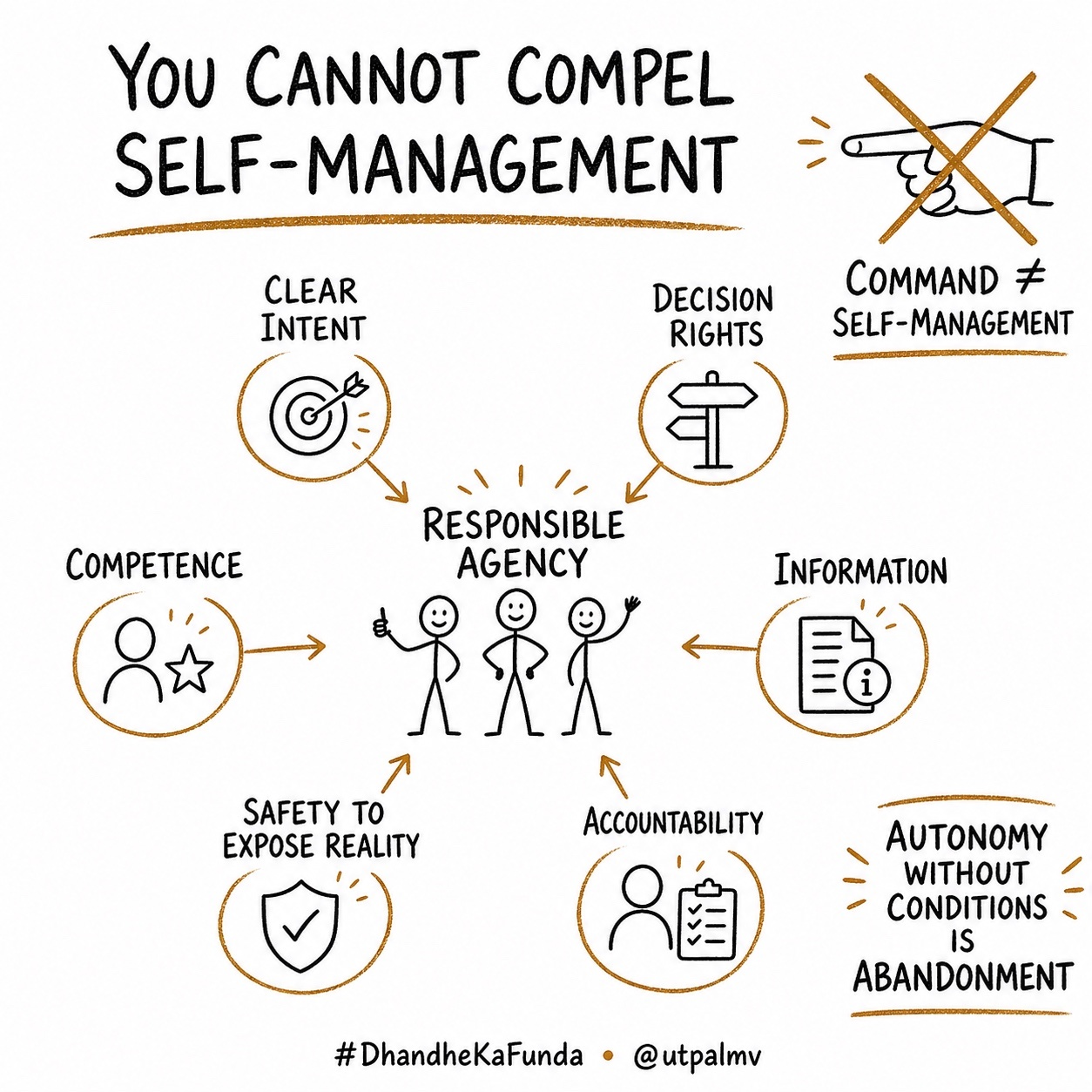
An organization cannot command people to self-manage and continue making every consequential decision for them.
My old Scrum blog approached this through a conversation with a startup CEO. He wanted early working software, clear priorities, and signals that would let him inspect and adapt. Could he compel the team to follow Scrum?
My answer was no. He could inspire people and establish the conditions for Scrum, but compulsion was inconsistent with the agency the framework required.
I would keep that answer. I would make the conditions more explicit.
Freedom is not the absence of structure
Self-management is often described as freedom from a manager assigning tasks. That is only one visible change.
A team cannot manage its work responsibly without knowing the outcome it serves, the boundaries it must respect, the decisions it owns, the evidence it can access, and the consequences it is expected to carry.
Remove those things and autonomy becomes abandonment.
Keep every decision above the team and autonomy becomes theater.
The current Scrum Guide describes Scrum Teams as self-managing. They decide who does what, when, and how. It also says adaptation becomes more difficult when people are not empowered or self-managing.
Empowerment here is not encouragement. It is operating authority.
Six conditions make agency real
Clear intent
The team needs to understand the problem, Product Goal, or mission it is serving.
Without intent, people optimize locally. They complete assigned work, protect their specialty, and make decisions that appear reasonable inside a narrow view.
Intent gives independent action a common direction.
Decision rights
People need to know which decisions they can make, which require consultation, and which belong elsewhere.
If every meaningful choice can be reversed without explanation, people learn to wait. If every choice is pushed downward regardless of consequence, people inherit risk without authority.
Self-management requires an honest boundary between the 2.
Competence
Authority without the ability to use it is not empowerment.
A cross-functional team needs enough technical, product, operational, and collaborative capability to move from intent to a usable result. Gaps can be learned or supported, but they cannot be ignored through motivational language.
Information
People cannot make good decisions with information reserved for management.
They need access to customer evidence, constraints, risks, dependencies, costs, and the reasoning behind material priorities. Transparency is not a board showing team activity while commercial and organizational reality remains hidden.
Safety to expose reality
Scrum depends on people revealing unfinished work, weak assumptions, defects, impediments, and failed experiments.
If bad news is punished, the system will still produce reports. It will stop producing truth.
Psychological safety does not remove standards or consequences. It makes it possible to surface the evidence required for responsible correction.
Accountability
Self-management does not mean that nobody answers for the result.
The team needs to inspect its commitments, explain its decisions, respond to evidence, and change behavior when the same failure repeats. Leaders remain accountable for the conditions, priorities, and constraints they control.
Agency and accountability must travel together.
Why compulsion fails
Compulsion can produce visible compliance quickly.
People attend the events. They move cards. They repeat the vocabulary. They wait for the person with power to reveal what the correct answer was supposed to be.
The organization then concludes that the team lacks initiative.
What the team has learned is more precise: initiative is invited in language and punished in practice.
No ceremony can repair that contradiction.
Leadership changes its work
When a team becomes self-managing, leadership does not disappear. Its work changes.
Leaders establish intent, make boundaries visible, supply context, remove structural impediments, develop capability, and intervene when risk exceeds the team's authority. They protect the team from arbitrary priority changes while keeping it connected to customers and consequences.
They also make decisions the team cannot make.
The test is not whether a leader stayed out of the room. The test is whether authority sits close enough to the relevant knowledge without becoming detached from accountability.
Inspect the conditions before judging the people
When self-management appears weak, ask:
- Was the goal clear enough to guide tradeoffs?
- Did the team possess the required competence?
- Could it see the evidence management could see?
- Were its decision rights explicit and respected?
- Could it expose a problem without being punished for the signal?
- Did it carry consequences proportionate to its authority?
- Did leadership change the system when the problem exceeded the team?
These questions do not excuse poor performance. They identify what kind of failure occurred.
My earlier answer emphasized servant leadership. Service remains important, but the phrase is incomplete if it hides judgment, authority, standards, or consequence.
The mature position is not that leaders should compel less and hope more.
It is that they should design the conditions in which responsible agency can become real.
Use this workExplore with AI
Explore this journal
Take this work into your preferred AI system. Choose a ready-made prompt or add your own context. Nothing you enter here is sent or saved by utpalmv.com.
Use the work as a thinking lens without adding personal context.
Optional. Add details when you want the exploration grounded in your situation. Your context remains in this page and is included only in the prompt you copy.