

A loop you have not named is a loop you are standing inside.
In the book, Manoj Onkar frames the BUSYness cycle this way:
There is a cycle every unled company runs on: unclear goals, frantic activity, thin results, panic, more activity. Naming it out loud is the first act of leadership.
I find that framing useful. I prefer to treat it as a proposition to test: if these conditions form a reinforcing loop, what becomes visible once we name it, and where might we interrupt it?
The obvious response is to treat busyness as a workload problem. Reduce the meetings. Clear the calendar. Add a tool. Ask people to focus.
Any of those moves may help. None necessarily changes the structure producing the activity.
The cycle is not a list
Unclear goals do not sit beside frantic activity. They help produce it.
When the outcome is vague, people still need something observable to do. Activity becomes the available substitute. It creates artifacts, fills reports, and gives effort a visible shape.
Thin results then create pressure. Under pressure, a system often reaches for the response it already knows how to produce: more activity. The response re-enters the cycle without requiring the original goal, assumptions, or decision rights to be examined.
That is what makes this a loop rather than a sequence. Its output becomes its next input.
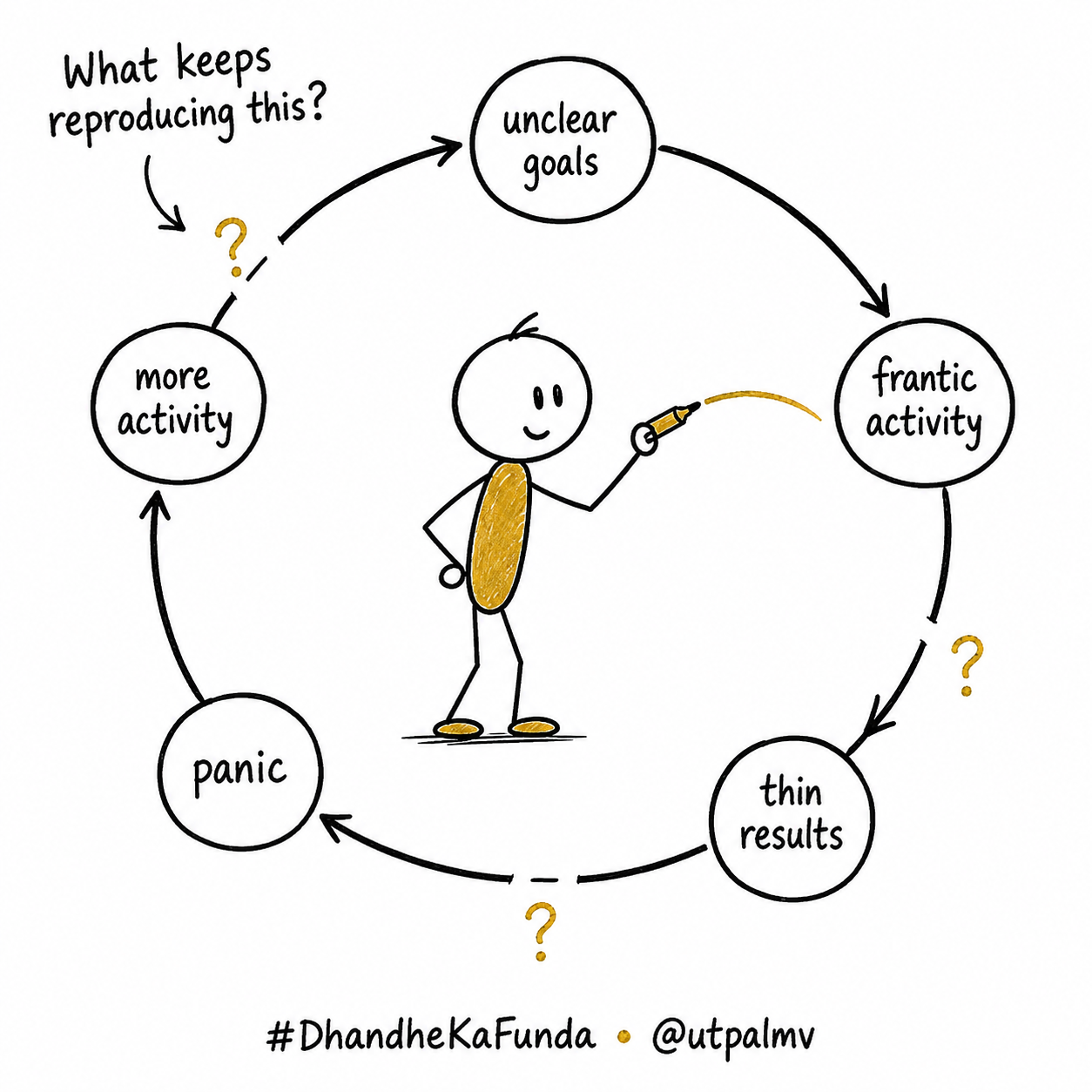
Naming the loop matters because it changes the unit of attention. The question is no longer only, "Why is this person so busy?" It becomes, "What keeps reproducing this pattern?"
The answer may sit in the goal, the governing assumption, the evidence being used, the response to disappointing results, the authority to redirect work, or the feedback that never changes the next cycle.
There may be several places to interrupt it. The useful one depends on what is actually holding the loop in place.
Two diagnostic views
MSDx begins by bounding the diagnosis: the unit, outcome, timeframe, context, responsibility, and evidence. It then examines Mindset, Skillset, Drive, and eXecution. The lowercase x is eXecution. Leverage is separate.
That distinction matters here. Frantic activity is not evidence of eXecution in the MSDx sense. eXecution produces completed action and feedback. If the feedback cannot revise the interpretation, capability, direction, method, or environment, the cycle has produced motion without learning.
DLMx asks a different question: how is intent being converted into outcomes at the individual, system, or federation resolution? Its operating loop is Doing, Leadership clarity, and Management discipline. Multipliers can change scale or speed, but they do not repair a weak operating loop.
For the BUSYness cycle, I would begin at the system resolution. Are goals clear enough to guide trade-offs? Can people make and own the decisions that redirect work? Does the operating discipline turn disappointing results into a change in the system, or merely into another demand for effort?
These frameworks do not prove the cause. They prevent the symptom from becoming the diagnosis.
Name it from inside
A loop named by an observer can still remain somebody else's analysis.
The harder act is for the people whose choices and responses keep the cycle moving to name their part in it. Not as confession. Not as blame. As a condition they can examine and change.
Start with one recurring pattern and draw it plainly:
- What condition begins the cycle?
- What action does that condition make more likely?
- What result follows?
- How do people respond to that result?
- How does the response recreate the earlier condition?
Then ask where a small, safe intervention could produce evidence. Clarify one outcome. Remove one competing priority. Change one decision right. Replace one activity measure with an outcome measure. Pause one automatic response long enough to examine what the result is saying.
The point is not to find a universal exit. It is to find a test that helps distinguish one explanation from another.
Busyness survives when every disappointing result is translated into more effort. Leadership begins when someone makes the loop visible enough to question its terms.
A loop you have not named is a loop you are standing inside.
Use this workExplore with AI
Explore this journal
Take this work into your preferred AI system. Choose a ready-made prompt or add your own context. Nothing you enter here is sent or saved by utpalmv.com.
Use the work as a thinking lens without adding personal context.
Optional. Add details when you want the exploration grounded in your situation. Your context remains in this page and is included only in the prompt you copy.